
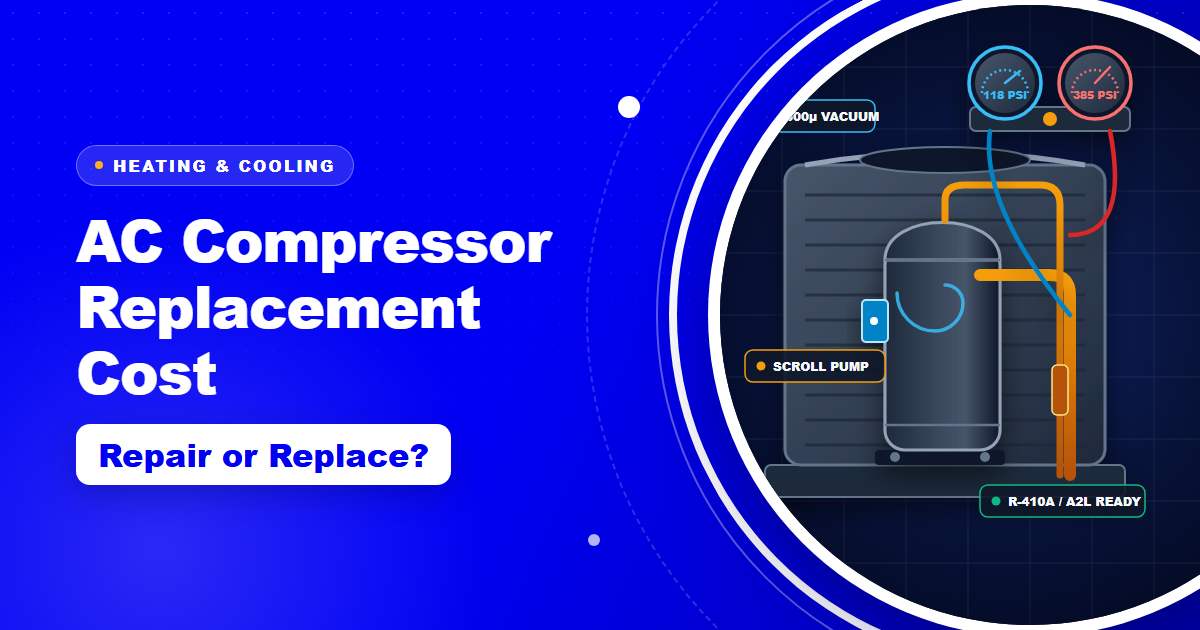
The average ac compressor replacement cost ranges from $1,100 to $4,650 for an out-of-warranty residential system, with most homeowners paying around $1,200 to $1,550 for a standard 3-ton unit. If your air conditioner is still covered under a manufacturer parts warranty, your out-of-pocket price drops to between $600 and $2,650 because the warranty covers the replacement pump itself while you pay for skilled labor and refrigerant. Minor compressor repairs, by comparison, average $931. This guide focuses on residential central air conditioners and split-system heat pumps, not automotive systems that typically cost $800 to $1,500.
Facing a dead AC compressor on a hot summer afternoon creates immediate financial stress. Contractors often present multi-thousand-dollar quotes, warranty coverage terms feel confusing, and aggressive technicians may push you to buy a complete new heating, ventilation, and air conditioning (HVAC) system on the spot. Before authorizing an expensive repair or signing a sales contract, you need to understand what goes into your quote, confirm that your compressor has actually failed, and evaluate whether a part swap or a whole-system replacement makes better financial sense.
| Capacity (tonnage) | Typical home size | Out-of-warranty replacement | Under parts warranty |
|---|---|---|---|
| 1.5 to 2.0 tons | 800 to 1,200 sq ft | $700 – $1,400 | $600 – $1,100 |
| 2.5 to 3.0 tons | 1,300 to 1,800 sq ft | $900 – $2,100 | $650 – $1,600 |
| 3.5 to 4.0 tons | 1,900 to 2,400 sq ft | $1,100 – $2,100 | $750 – $1,800 |
| 4.5 to 5.0 tons | 2,500 to 3,200+ sq ft | $1,300 – $2,800 | $850 – $2,650 |
AC Compressor Replacement Cost Breakdown: Parts, Labor, and Permits
Replacing an AC compressor is the most labor-intensive and technically challenging repair in residential HVAC. The compressor serves as the heart of your cooling system, pumping refrigerant between the indoor evaporator coil and the outdoor condenser. When a contractor gives you an estimate, that total reflects five separate cost factors: hardware, certified labor, refrigerant, piping consumables, and municipal permits.
Bare compressor equipment costs
The replacement compressor hardware itself costs between $700 and $1,400 for a typical 3-ton residential system, with prices across all capacity sizes spanning $500 to $2,000. When your technician orders a replacement from a local distributor, it arrives as a bare metal pump with electrical terminal pins and rubber mounting grommets inside a wooden crate. It contains only a dry nitrogen holding charge to keep moisture out during shipping. It includes no refrigerant, no service valves, and no installation materials.
HVAC technician labor rates and replacement hours
Labor represents a major portion of your invoice. Swapping an AC compressor requires 4 to 8 hours of intensive field work, resulting in $500 to $1,000 in dedicated technician labor charges. In a nationwide survey of 1,000 homeowners who hired HVAC professionals, 78% reported hourly technician labor rates of $100 or higher, with typical billing rates ranging from $100 to $250 per hour.
This job demands specialized expertise. A technician cannot simply unbolt the old motor and slide in a new one. The process requires recovering old refrigerant under federal guidelines, cutting out the failed unit with copper tubing cutters, deburring and cleaning the copper line ends, brazing in the replacement with high-silver alloy rods under a continuous nitrogen sweep, pressurizing the lines to test for leaks, running an electric vacuum pump to pull a deep vacuum below 500 microns, and precisely weighing in virgin refrigerant to manufacturer specifications.
Refrigerant recovery, recharge, and consumables
Refrigerant and trade consumables make up the next major expense. Recharging a standard 3-ton residential system requires 6 to 9 pounds of refrigerant. R-410A refrigerant costs $50 to $100 per pound installed, averaging $50 to $80 per pound, which adds $250 to $800 to your total bill. If you have an older system running on legacy R-22 Freon, prices jump to $90 to $150 or more per pound installed (reaching $250 per pound for emergency weekend service), driving refrigerant costs up to $800 to $1,800 or more.
In addition to refrigerant, a proper installation requires several critical consumables totaling $50 to $200. These include copper couplings, 15% silver brazing alloy, dry nitrogen purge gas, a replacement electrical contactor to protect the new motor windings, and a new liquid-line filter drier to capture residual moisture and debris.
Building permits, mechanical codes, and disposal fees
Local building permits and environmental disposal fees add another $50 to $200 to your invoice. Many municipalities require a mechanical permit for major HVAC component replacements to verify that electrical disconnect switches meet local building codes and that wire gauges match the compressor’s rated load amperage. Licensed contractors also pay disposal fees to transport recovered refrigerants to certified reclamation facilities in accordance with Clean Air Act mandates. Having an official permit protects your property value and ensures your homeowner insurance remains fully valid if an electrical fire occurs.
Itemized compressor replacement cost table
The table below shows an itemized cost breakdown for replacing an out-of-warranty versus a parts-warranty compressor on a standard 3-ton residential central air conditioner.
| Expense category | Description and scope | Out-of-warranty cost | Parts-warranty cost | Percentage of quote |
|---|---|---|---|---|
| Compressor hardware | Bare scroll or reciprocating pump | $700 – $1,400 | $0 (covered) | ~40% |
| Certified HVAC labor | 4 to 8 hours of technician installation time | $500 – $1,000 | $500 – $1,000 | ~30% |
| Refrigerant recharge | 6 to 9 lbs of virgin R-410A ($50 to $100/lb) | $250 – $800 | $250 – $800 | ~20% |
| Consumables and filter drier | Liquid-line filter drier, contactor, nitrogen | $50 – $200 | $50 – $200 | ~5% |
| Permits and EPA recovery disposal | Local mechanical permit and refrigerant disposal | $50 – $200 | $50 – $200 | ~5% |
| Total estimated cost | Complete turnkey compressor replacement | $1,550 – $3,600 | $850 – $2,200 | 100% |
Factors That Drive AC Compressor Replacement Costs
Why does one homeowner pay $1,200 while another receives a $4,000 quote for what seems like the same repair? Equipment sizing, internal mechanical design, motor speeds, and brand tiering directly influence replacement pricing.
Cooling capacity and unit tonnage
Cooling capacity is measured in tons, where one ton equals 12,000 British Thermal Units (BTU) of heat removed per hour. Larger homes require higher cooling capacity, which means bigger compressors with heavier steel casings, thicker copper motor windings, and greater refrigerant requirements.
Typical residential compressor replacement costs by tonnage break down as follows:
- 1.5 to 2.0 tons: $700 to $1,400 out of warranty (average $1,050; typical contractor range $700 to $1,500). Best suited for smaller homes and apartments up to 1,200 square feet.
- 2.5 to 3.0 tons: $900 to $2,100 out of warranty (average $1,500; typical contractor range $1,000 to $1,900). The most common size for mid-sized homes between 1,300 and 1,800 square feet.
- 3.5 to 4.0 tons: $1,100 to $2,100 out of warranty (average $1,600; typical contractor range $1,300 to $2,200). Sized for larger single-family homes between 1,900 and 2,400 square feet.
- 4.5 to 5.0 tons: $1,300 to $2,800 out of warranty (average $2,050; typical contractor range $1,800 to $2,600). Designed for large properties exceeding 2,500 square feet or homes in extreme desert climates.
Compressor design and internal mechanics
The internal mechanical design of the compressor influences part pricing, reliability, and operating noise:
- Scroll compressors: The modern standard in residential HVAC. A scroll compressor uses two interleaved spiral scrolls, one stationary and one orbiting, to compress refrigerant smoothly. With fewer moving parts than piston models, scroll compressors deliver higher efficiency, quiet operation, and strong durability.
- Reciprocating compressors: A traditional piston-and-cylinder mechanism common in older air conditioners. While the initial hardware is slightly less expensive, reciprocating compressors have more moving parts (wrist pins, pistons, valves) that experience mechanical friction and wear over time.
- Rotary compressors: A compact design utilizing a rotating roller inside a cylindrical chamber. Rotary compressors run smoothly and are commonly installed in ductless mini-split condensing units and smaller residential cooling applications.
Compressor staging: single-stage, two-stage, and variable-speed inverter
How your compressor manages its operating speed plays a massive role in both comfort and replacement cost:
- Single-stage compressors: Run at 100% capacity whenever cooling is called for, shutting off once the thermostat is satisfied. They represent the lowest replacement hardware cost ($700 to $1,200), and parts are widely stocked.
- Two-stage compressors: Operate at low capacity (around 65% to 70%) during mild afternoons and switch to full capacity (100%) during peak afternoon heat. Replacement hardware costs $1,200 to $1,800.
- Variable-speed inverter compressors: Use electronic inverter drives to modulate cooling output continuously between 25% and 100% in 1% increments. These offer premium energy savings and humidity control, but replacement hardware costs $1,800 to $3,000 or more because they require matched manufacturer electronic communication boards.
HVAC system type: central air conditioner vs. heat pump vs. mini-split
The type of HVAC system installed in your home also changes replacement economics. Heat pump compressor replacements typically cost 20% to 40% more than cooling-only central air compressors, averaging $1,200 to $3,200. Heat pumps work continuously year-round in both summer cooling and winter heating modes. They operate under higher head pressures during winter heating and must function seamlessly with four-way reversing valves. If you are comparing equipment types or evaluating whether to replace your entire heat pump, reviewing average heat pump installation cost will help you weigh your options.
Equipment brand and manufacturer tiering
Brand tiering affects parts availability, wholesale pricing, and dealer markups:
- Value brands (Goodman, Oxbox): Utilize standardized, off-the-shelf Copeland scroll compressors and generic electrical components, keeping hardware replacement costs at the lower end of the spectrum.
- Mid-tier brands (Rheem, Ruud, York, Coleman): Deliver dependable performance with widely available replacement parts stocked at regional distributor warehouses.
- Premium brands (Trane, Carrier, American Standard, Lennox): Often engineer custom compressor housings, proprietary sound-dampening mounting systems, and electronic communication modules. Complete new systems from these manufacturers range from $6,572 for American Standard to $10,069 for Lennox, and their proprietary replacement parts carry higher price tags.
Seasonality, emergency service, and technician availability
When your compressor breaks down directly impacts what you pay. Having a compressor seize during a 95°F July heatwave means competing with hundreds of other homeowners for service. Contractors during peak summer charge premium emergency dispatch fees of $150 to $300, and supply houses may face temporary parts shortages. Scheduling a replacement during mild shoulder months (March to May or September to October) allows for competitive pricing, faster parts delivery, and more flexible technician scheduling.
State and Regional Cost Variations
HVAC replacement costs vary considerably by state and metropolitan market. A 3-ton compressor replacement that costs $1,600 in Ohio or Georgia can easily run $3,200 in California or New York. Two primary factors drive these regional pricing differences: local skilled labor wage scales and regional cooling demand.
Geographic pricing factors and cooling zone demands
Technician hourly rates vary widely across the country. In rural areas and smaller Midwestern or Southeastern markets, contractor labor rates average $85 to $130 per hour. In high-cost-of-living metropolitan areas like New York, San Francisco, Boston, and Seattle, technician labor rates regularly hit $200 to $350 per hour due to higher business overhead, licensing mandates, and commercial insurance costs.
Regional climate also dictates equipment wear. In the Sun Belt (Texas, Florida, Arizona), cooling systems operate 2,000 to 3,000 hours per year, putting severe strain on compressor bearings and electrical capacitors. In northern states, systems may run for only 500 to 800 hours per season, changing the financial payback calculation for repairs versus replacements.
State-by-state compressor replacement cost table
The table below details typical compressor replacement pricing across 10 representative states, highlighting local climate demands and labor rate brackets.
| State | Climate zone and cooling demand | Typical labor rate range | Out-of-warranty average cost | Parts-warranty average cost |
|---|---|---|---|---|
| Texas | Sun Belt, high cooling load | $100 – $180/hr | $1,600 – $3,200 | $800 – $1,800 |
| Florida | Humid subtropical, continuous operation | $110 – $190/hr | $1,700 – $3,400 | $850 – $1,900 |
| California | High cost of living, Title 24 compliance | $150 – $280/hr | $2,200 – $4,400 | $1,200 – $2,600 |
| New York | High metro labor, older housing stock | $160 – $300/hr | $2,300 – $4,650 | $1,250 – $2,650 |
| Ohio | Midwest moderate climate, standard basements | $95 – $160/hr | $1,400 – $2,800 | $700 – $1,600 |
| North Carolina | Southeast transitional climate | $100 – $170/hr | $1,500 – $3,000 | $750 – $1,700 |
| Arizona | Desert extreme heat, 4 to 5-ton units | $120 – $200/hr | $1,800 – $3,600 | $900 – $2,000 |
| Illinois | Chicagoland metro labor rates | $130 – $230/hr | $1,800 – $3,500 | $950 – $2,100 |
| Pennsylvania | Mid-Atlantic mixed seasonal usage | $105 – $180/hr | $1,500 – $3,100 | $800 – $1,750 |
| Washington | Pacific Northwest moderate, rapid heat pump adoption | $140 – $240/hr | $1,900 – $3,800 | $1,000 – $2,200 |
The Parts Warranty Reality: Why Replacement Still Costs $1,500+
One of the biggest surprises for homeowners is receiving an invoice for $1,500 to $2,500 on an air conditioner that is still covered by a manufacturer parts warranty. Understanding the fine print of HVAC warranties prevents confusion and helps you plan your budget.
How manufacturer parts warranties work
Most residential central air conditioners come with a standard 5-year base manufacturer parts warranty on the compressor. If the original purchasing homeowner registered the equipment with the manufacturer within 60 to 90 days of installation, that coverage typically extends to 10 years. However, if you purchased a home with an existing system and the previous owner never transferred the registration, coverage often reverts to the standard 5-year window.
What is covered vs. what you pay out of pocket
A manufacturer parts warranty covers only the bare metal compressor casting, removing $500 to $2,000 from the contractor’s equipment bill. The manufacturer does not pay for the labor or materials needed to install that part. You remain responsible for:
- Technician labor: 4 to 8 hours of skilled trade work ($500 to $1,000).
- Refrigerant recovery and recharge: 6 to 9 pounds of virgin refrigerant ($250 to $800).
- Consumable parts: New liquid-line filter drier, contactor, and nitrogen purge gas ($50 to $200).
- Warranty processing and freight: Distributor administrative fees to ship the damaged compressor back to the factory for inspection ($75 to $150).
As a result, your final out-of-pocket warranty cost lands between $600 and $2,650, with most homeowners paying around $1,500 to $1,800. While saving $1,000 on the hardware is beneficial, the repair is never completely free.
Warranty vs. out-of-warranty cost comparison table
Here is how an out-of-warranty quote compares directly with a parts-warranty replacement on a standard residential unit.
| Line item | Standard out-of-warranty replacement | Active 10-year parts warranty replacement | Homeowner savings |
|---|---|---|---|
| Compressor hardware component | $700 – $1,400 | $0 (covered by manufacturer) | $700 – $1,400 |
| Installation labor (4 to 8 hours) | $500 – $1,000 | $500 – $1,000 | $0 |
| Refrigerant recovery and recharge | $250 – $800 | $250 – $800 | $0 |
| Filter drier and consumables | $50 – $200 | $50 – $200 | $0 |
| Warranty processing and shipping | $0 | $75 – $150 | -$75 to -$150 |
| Total homeowner out-of-pocket cost | $1,500 – $3,400 | $875 – $2,150 | $550 – $1,250 net savings |
Triage Before You Pay: Avoiding the Capacitor Misdiagnosis Trap
Before agreeing to pay thousands of dollars for a new compressor, you must confirm that the pump is actually dead. Electrical component failures often mimic a seized motor, leading to unnecessary and expensive replacements.
The $20 component that mimics a dead compressor
In 30% to 50% of summer service calls where an outdoor compressor refuses to start, the compressor itself is in perfect working order. The real culprit is almost always a failed dual-run capacitor or a pitted electrical contactor. A replacement capacitor costs just $10 to $50 as a DIY part, or $120 to $400 installed by a licensed technician. A replacement contactor costs $100 to $250 installed. Paying $300 for an electrical repair beats spending $3,000 on an unnecessary compressor swap.
How failed capacitors and contactors fool homeowners
A dual-run capacitor functions like a temporary storage battery that delivers an extra voltage boost to create the phase shift needed to start the compressor motor. When extreme summer heat causes the capacitor to lose its stored electrical charge or vent its dielectric fluid, the compressor tries to start without adequate torque.
The motor draws locked-rotor amperage, hums loudly for 3 to 5 seconds, overheats its internal thermal overload switch, and trips the 240V double-pole circuit breaker. To an inexperienced or commission-driven technician, a humming outdoor unit that trips the breaker looks like a mechanically seized compressor. In reality, replacing the capacitor and installing a hard-start kit restores normal operation within 20 minutes.
Diagnostic verification checklist before condemning a compressor
Ask your technician to walk you through these four diagnostic verification checks before you sign a compressor replacement contract:
- Capacitance test: Did the technician disconnect the dual-run capacitor and test it with a digital multimeter set to microfarads (µF)? The reading must fall within +/- 5% or 10% of the rating printed on the metal can.
- Visual inspection: Is the top of the capacitor domed, bulging, or leaking oily fluid? A bulged top confirms internal capacitor failure.
- Contactor inspection: Are the silver contact points burned, pitted, or covered in carbon buildup? Severely pitted contactors drop voltage and prevent power from reaching the motor.
- Motor winding resistance test: Did the technician use an ohmmeter to measure electrical resistance across the Common (C), Start (S), and Run (R) terminals? The formula (Resistance C to S + Resistance C to R = Resistance S to R) must hold true, and none of the terminals should show continuity to the copper chassis ground.
Compressor Burnout Protocol: Preventing Repeat Failures
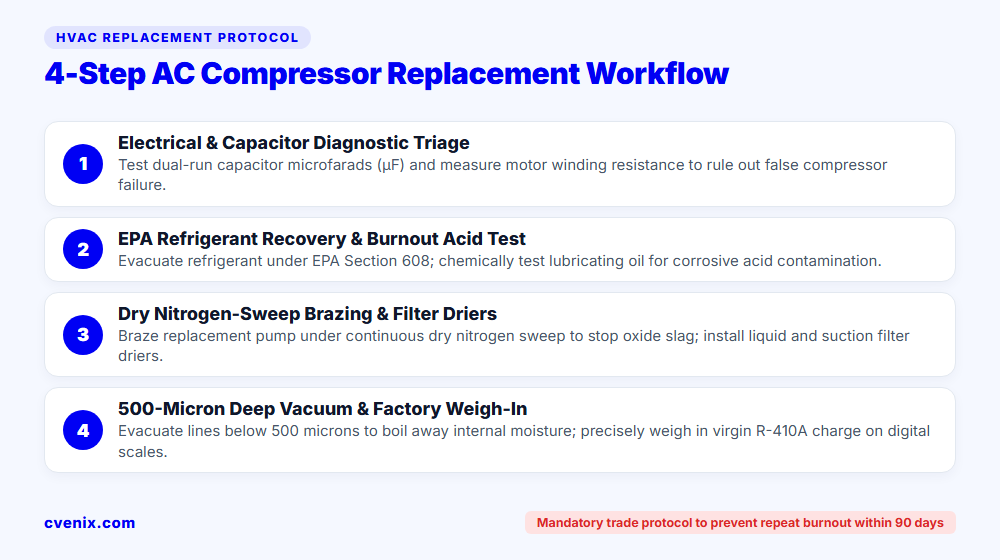
In the HVAC trade, technicians share an established saying: ‘Compressors don’t die, they are murdered.’ A compressor is a sealed mechanical pump that rarely fails on its own. Failure is almost always caused by an external operating problem. If your technician replaces the compressor without finding and fixing that root cause, your new unit will suffer catastrophic failure within months.
Why compressors fail: root causes vs. symptom death
External operating conditions that lead to premature compressor failure include:
- Liquid refrigerant floodback: When airflow across the indoor evaporator coil is choked by a clogged 1-inch air filter, dirty coil fins, or a weak blower motor, liquid refrigerant fails to evaporate into gas. Unevaporated liquid travels down the suction line into the compressor pump, causing liquid slugging that breaks valves and shatters scroll wraps.
- Extreme head pressure and overheating: Heavily soiled outdoor condenser coils coated in dust, grass clippings, or pet hair prevent heat from escaping. The compressor must work twice as hard against elevated discharge pressures, causing internal temperatures to climb past 300°F. Excessive thermal strain in unconditioned spaces can also cause continuous run times; evaluating upgrading attic insulation helps lower household heat gain and reduces operating hours on your cooling equipment.
- Electrical stress: Frequent voltage sags, lightning surges, or running on an out-of-spec capacitor cause high electrical resistance and overheat the motor windings.
Acid contamination and burnout cleanup steps
When a compressor motor burns out electrically, intense heat decomposes the refrigerant and lubricating oil into corrosive hydrofluoric and hydrochloric acids. This acid circulates throughout your copper lineset, indoor evaporator coil, and expansion valve. If a technician simply brazes in a new compressor without flushing the lines, residual acid will eat the insulation off the new motor windings within 60 to 120 days.
A proper compressor burnout remediation protocol includes:
- Chemical acid testing: Performing an on-site test of the compressor oil to measure contamination levels.
- Replacing the liquid-line filter drier: Removing the old drier and installing a high-acid-capacity replacement.
- Installing a temporary suction-line filter drier: Placing an activated alumina and charcoal filter on the suction line immediately before the compressor inlet to catch circulating acid and carbon sludge.
- Solvent lineset flushing: Flushing inaccessible line sets with specialized chemical solvents (such as Nu-Calgon Rx11-Flush) to strip out contaminated oil.
- Follow-up inspection: Returning 2 to 4 weeks later to run a second acid test and remove the temporary suction filter once the system runs clean.
Burnout remediation adds $300 to $800 to the repair bill, but skipping this step guarantees a second compressor failure.
Repair or Replace: The $5,000 Rule and Decision Framework
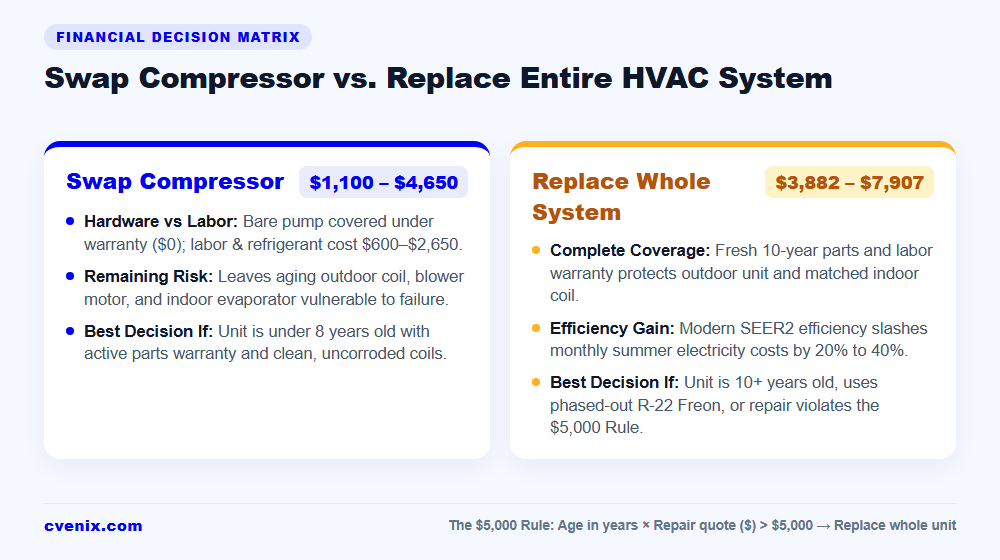
When faced with a repair quote between $1,500 and $3,500, every homeowner asks the same question: Should I replace the compressor or invest in an entirely new air conditioning system? Two industry-standard mathematical rules provide clear guidance.
The $5,000 Rule explained with real examples
The $5,000 Rule is a proven formula used by HVAC professionals. Multiply the age of your air conditioning system in years by the contractor’s repair quote in dollars. If the total exceeds $5,000, replacing the entire system is the financially smarter decision. If the total is under $5,000, repairing the unit makes economic sense.
Consider how this rule applies to three common homeowner scenarios:
- Scenario A (Young system, 3 years old): Your system is 3 years old and the repair quote is $2,200 out of warranty (or $1,500 under a registered parts warranty). Calculation: 3 years multiplied by $2,200 equals $6,600 (or 3 multiplied by $1,500 equals $4,500). Because the unit has 7 or more years of useful operating life remaining and warranty support, repairing the compressor makes sense.
- Scenario B (Mid-life system, 8 years old): Your system is 8 years old and the out-of-warranty repair quote is $2,600. Calculation: 8 years multiplied by $2,600 equals $20,800. This result significantly exceeds the $5,000 threshold. Unless the compressor hardware is completely covered under a registered parts warranty, investing that money into a new system is strongly recommended.
- Scenario C (Aging system, 13 years old): Your system is 13 years old and the repair quote is $3,400. Calculation: 13 years multiplied by $3,400 equals $44,200. Sinking thousands into a unit approaching the end of its lifespan is financial folly; replace the entire system immediately.
The 50% Rule and related component failure risks
The 50% Rule provides a second helpful benchmark: If the cost of repairing your compressor exceeds 50% of the price of a brand-new system, replace rather than repair. Installing a new central air conditioner costs between $3,882 and $7,907 on average, with typical turnkey replacements running $4,000 to $8,000 and overall projects averaging $8,460. If your compressor quote approaches $3,000 to $4,000, you are paying nearly half the price of a new system without getting the benefits of a fresh 10-year warranty or higher operating efficiency. You can review detailed pricing models in our guide to central AC replacement cost.
Remember that replacing only the compressor leaves you with an aging outdoor condenser coil, a worn fan motor, and an older indoor evaporator coil. Related component failures can quickly escalate: replacing a failed blower motor costs $200 to $500, while a leaking evaporator coil costs $400 to $1,500. If your heating equipment is also past its prime, you may save money by reviewing furnace replacement cost and replacing both units together on a combined installation discount.
Repair vs. replace decision matrix table
Use the decision matrix below to evaluate your options based on equipment age, warranty coverage, and repair costs.
| System age | Warranty status | Repair cost range | Whole-system replacement cost | Recommended decision | Financial justification |
|---|---|---|---|---|---|
| 1 to 5 years | Active manufacturer parts warranty | $600 – $1,800 | $4,000 – $8,000 | Repair compressor | Substantial remaining equipment lifespan and active warranty justify the repair. |
| 6 to 9 years | Active registered parts warranty | $1,200 – $2,200 | $4,000 – $8,000 | Repair if coils are sound | Free compressor hardware makes repair practical if coils and line sets are clean. |
| 6 to 9 years | Out of warranty | $1,800 – $3,400 | $4,000 – $8,000 | Borderline / Replace | Spending 40% to 50% of new system cost on aging equipment carries high risk of subsequent coil leaks. |
| 10 to 15+ years | Out of warranty | $2,400 – $4,650 | $4,000 – $8,000 | Replace whole system | System has exceeded its expected design lifespan; a new system provides 10-year warranty protection and energy savings. |
Refrigerant Regulations: How R-410A Phasedown and A2L Impact Your Choice
Environmental regulations play a major role in the repair-versus-replace calculation. The refrigerant circulating through your cooling system affects both current repair bills and future servicing costs.
The EPA AIM Act and the transition to low-GWP A2L refrigerants
Under the EPA American Innovation and Manufacturing (AIM) Act Technology Transitions program, newly manufactured residential central air conditioners and heat pumps produced after January 1, 2025, must use refrigerants with a Global Warming Potential (GWP) of 700 or lower. This mandate phases down high-GWP R-410A (GWP 2,088) in newly manufactured systems, shifting the industry toward mildly flammable A2L refrigerants such as R-454B (GWP 466) and R-32 (GWP 675).
If your home currently has an R-410A system, do not panic. Existing R-410A equipment remains completely legal to operate, maintain, and service. Replacement compressors and virgin or reclaimed R-410A refrigerant will remain available through wholesale supply houses for years to come.
The legacy R-22 Freon trap
The situation is far more urgent for older systems running on R-22 Freon. The EPA banned the production and importation of virgin R-22 on January 1, 2020. Because supplies are strictly limited to reclaimed stock, R-22 prices have surged to $90 to $150 or more per pound installed, with emergency weekend service reaching $250 per pound.
Because a compressor replacement requires recovering and recharging 6 to 9 pounds of refrigerant, filling an older R-22 system adds $800 to $1,800 or more in refrigerant costs alone. Sinking $2,500 to $3,500 into an obsolete R-22 system is throwing money away, especially when the indoor coil could develop a pinhole leak just weeks later.
Servicing existing R-410A units vs. upgrading to a modern system
For R-410A systems under 8 years old, replacing the compressor remains financially reasonable because refrigerant costs remain accessible at $50 to $100 per pound installed. However, as the 85% federal production phasedown advances over the next decade, R-410A supplies will tighten and prices will increase. If your R-410A system is already 10 to 12 years old, upgrading to a modern system running on next-generation A2L refrigerant future-proofs your home and lowers your monthly electric bills through higher seasonal energy efficiency ratio (SEER2) ratings.
DIY vs. Professional AC Compressor Replacement
Can you save money by purchasing an AC compressor online and installing it yourself? While DIY home improvement projects are popular, replacing an air conditioning compressor is strictly a job for licensed, certified professionals.
EPA Section 608 regulations and Clean Air Act penalties
Under Section 608 of the federal Clean Air Act, it is illegal for anyone without EPA Section 608 certification to purchase, handle, or vent regulated refrigerants into the atmosphere. Intentionally venting refrigerant carries severe civil penalties of up to $44,539 per day per violation. All refrigerant must be recovered using specialized recovery cylinders and certified recovery units before any torch touches the copper line sets.
Specialized trade tooling and technical hurdles
Beyond legal restrictions, the technical tooling required to replace a compressor costs thousands of dollars. The job demands an oxy-acetylene or MAP-pro brazing torch, nitrogen pressure regulators, an EPA-certified recovery machine, a two-stage rotary vane vacuum pump, a digital micron gauge capable of measuring sub-500-micron vacuum levels, digital refrigerant manifold gauges, and an electronic charging scale.
Technique matters immensely. If a technician brazes copper joints without flowing dry nitrogen through the pipes, internal oxygen reacts with copper to form thick flakes of copper oxide scale. This scale circulates through the system, clogs the thermal expansion valve (TXV), and starves the replacement compressor of oil, causing complete mechanical seizure within days.
Safe homeowner DIY tasks and diagnostic checks
While you cannot replace the compressor yourself, you can perform several safe maintenance and diagnostic checks before calling a technician:
- Change air filters: Inspect and replace dirty 1-inch or 4-inch pleated filters to ensure maximum airflow over your indoor evaporator coil.
- Rinse the outdoor coil: Turn off electrical power at the outdoor disconnect box and gently rinse dirt, dust, and grass clippings from the condenser fins using a garden hose with a low-pressure nozzle.
- Reset the circuit breaker: Check your home electrical panel for a tripped 240V double-pole breaker. Reset it once. If it trips again immediately, leave it off to prevent electrical fire risks.
- Check the outdoor disconnect: Visually inspect the outdoor pull-out disconnect box to confirm cartridge fuses have not blown.
How to spot private equity ‘go-away’ quotes and questions to ask contractors
In recent years, private equity investment firms have acquired hundreds of local HVAC service companies. Some corporate franchises instruct service technicians on commission to issue inflated ‘go-away’ quotes of $8,000 to $10,000 for a compressor replacement, making an expensive $14,000 to $18,000 full-system installation appear to be your only sensible choice.
Protect yourself by getting at least three written estimates, preferably from established, locally owned independent contractors. Use this 6-question vetting script when evaluating quotes:
- Can you provide an itemized quote separating compressor hardware, technician labor hours, refrigerant poundage, and consumables?
- Does your quote include an acid test, a new liquid-line filter drier, and a temporary suction-line filter drier if burnout contamination is found?
- Will your technicians purge the copper lines with dry nitrogen while brazing the joints?
- Do you guarantee pulling a deep vacuum below 500 microns verified with a digital micron gauge before recharging?
- What specific labor warranty do you provide on this installation beyond the manufacturer parts warranty?
- Did you test the dual-run capacitor and measure motor winding resistance with an ohmmeter to confirm the compressor is actually dead?
How We Researched This Guide (Our Methodology)
Our editorial team built this guide using transparent research standards, trade data, and verifiable industry pricing. To give homeowners accurate, practical guidance, we cross-referenced data from several primary authorities:
- Federal environmental standards: We referenced official EPA AIM Act Technology Transitions program documentation and Clean Air Act Section 608 compliance mandates regarding refrigerant recovery and A2L transitions.
- Trade engineering standards: We examined compressor technical manuals and acid remediation service guidelines from leading manufacturers, including Copeland and Danfoss, alongside matched-system guidelines from the Air Conditioning, Heating, and Refrigeration Institute (AHRI).
- National pricing data: We analyzed residential mechanical labor data, verified contractor billing invoices, RSMeans mechanical cost indices, and homeowner survey data, including This Old House’s survey of 1,000 homeowners on hourly HVAC labor rates.
- Field technician findings: We reviewed hundreds of verified homeowner repair discussions and technician case studies on trade platforms including r/hvacadvice and r/HVAC to identify common capacitor misdiagnoses, warranty billing disputes, and burnout remediation steps.
- Strict data verification: In accordance with our editorial standards, any unverified third-party consumer databases or sources blocked by automated security controls were strictly excluded from our data sets.
Frequently Asked Questions About AC Compressor Replacement
How much does it cost to replace an AC compressor?
An AC compressor replacement typically costs between $1,100 and $4,650 out of warranty, with a national average of $1,200 to $1,550 for a standard 3-ton residential system. If your unit is covered under an active manufacturer parts warranty, your out-of-pocket cost drops to $600 to $2,650 because you only pay for technician labor, refrigerant, and consumables.
Should I replace the AC compressor or buy a new system?
Use the $5,000 Rule: multiply your AC unit’s age in years by the contractor’s repair quote in dollars. If the total exceeds $5,000, replace the entire system. If your unit is under 8 years old and covered by a parts warranty, repairing the compressor makes sense. If the system is 10 to 15 years old, uses phased-out R-22 Freon, or the repair costs exceed 50% of a new system ($3,882 to $7,907), replace the whole unit.
Why is AC compressor replacement so expensive?
Replacing a compressor is the most labor-intensive repair in HVAC. Beyond the compressor hardware ($700 to $1,400), the job requires 4 to 8 hours of EPA-certified labor ($100 to $250 per hour), recovering old refrigerant, brazing copper tubing under a nitrogen sweep, installing new filter driers, pulling a deep 500-micron vacuum, and recharging 6 to 9 pounds of virgin refrigerant ($250 to $800).
How much does an AC compressor cost under warranty?
Under an active manufacturer parts warranty, the replacement compressor hardware is free, saving you $500 to $2,000. However, you still pay out of pocket for skilled technician labor ($500 to $1,000), refrigerant recharge ($250 to $800), filter driers, and distributor warranty processing fees, bringing total out-of-pocket expenses to $600 to $2,650.
Can a bad capacitor mimic a bad compressor?
Yes. In 30% to 50% of summer diagnostic calls where a compressor fails to start, the actual culprit is a failed dual-run capacitor or pitted contactor. A weak capacitor cannot supply starting torque, causing the compressor to hum loudly, overheat, and trip circuit breakers. A capacitor replacement costs $120 to $400 professionally ($10 to $50 DIY) compared to thousands for a new compressor.
What is an AC compressor burnout, and why does cleanup cost extra?
An electrical burnout occurs when the compressor motor windings overheat and melt, contaminating the refrigerant circuit with corrosive hydrofluoric and hydrochloric acids. Technicians must perform an oil acid test, install a temporary suction-line filter drier, and flush the lines with specialized solvent (such as Rx11-Flush), adding $300 to $800. If this acid is not removed, it will destroy the replacement compressor within months.
Is it worth replacing a compressor on a 10-year-old AC?
Rarely. At 10 years old, manufacturer parts warranties have expired, and the system is nearing the end of its typical 12- to 15-year operational lifespan. Sinking $2,000 to $3,500 into an aging condenser leaves older coils and fan motors prone to subsequent failure, while missing out on modern high-efficiency SEER2 standards.
Can you replace just the compressor on an air conditioner?
Yes, technicians can cut out the failed compressor and braze in a compatible new pump. However, the new compressor must match the system’s exact tonnage, electrical specifications, and refrigerant type. If the unit uses obsolete R-22 or has severe coil corrosion, replacing just the compressor is usually unwise.
How long does it take an HVAC technician to replace a compressor?
A professional compressor replacement typically takes 4 to 8 hours. The process cannot be rushed because recovering the old refrigerant, nitrogen-purge brazing, and pulling a deep vacuum below 500 microns to boil off moisture requires several hours of dedicated pump time.
Does homeowners insurance cover AC compressor replacement?
Standard homeowners insurance policies exclude normal mechanical wear and tear, age, and maintenance neglect. However, if the compressor died as a direct result of a covered sudden peril, such as a lightning strike, severe power surge, or falling tree branch, insurance may cover the replacement minus your deductible.

