
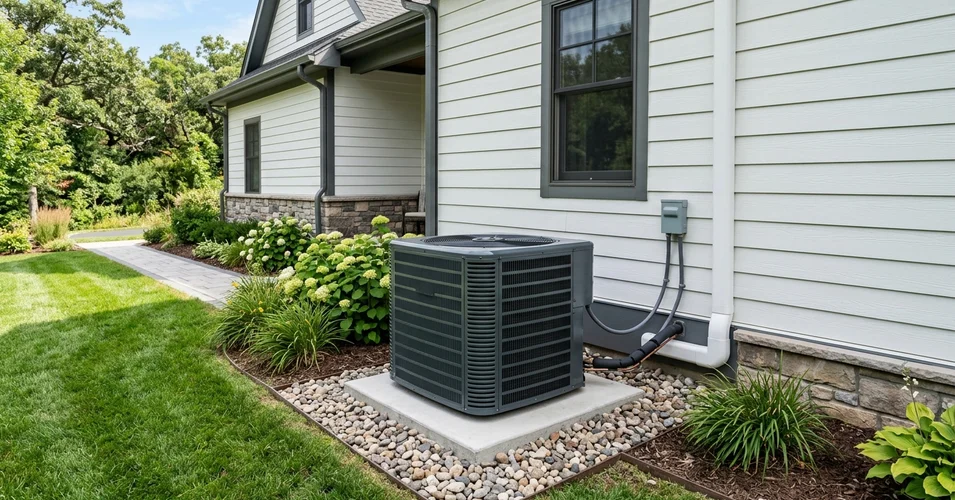
Most homeowners pay between $5,800 and $8,200 to replace a central air conditioning system, with an average project cost of $6,850 for a standard 3-ton, 15.2 SEER2 split system installed by a licensed crew. Replacing only the outdoor condenser unit and evaporator coil on intact ductwork runs as low as $3,800 to $5,400. Upgrading to a premium 18 to 22 SEER2 variable-speed system or combining installation with a matching high-efficiency gas furnace will push total HVAC replacement costs past $12,500 to $18,000.
Central AC Replacement Cost by System Tonnage and Home Size
Air conditioner cooling capacity is measured in tons, where one nominal ton equals 12,000 British Thermal Units (BTUs) of heat removal per hour. Residential systems range from 1.5 tons up to 5.0 tons. Professional contractors calculate tonnage using Manual J load calculations, evaluating climate zone, ceiling height, insulation quality, and window orientation rather than relying on rough square footage estimates alone:
| System Capacity (Tonnage) | Cooling Output (BTUs) | Typical Home Square Footage | Equipment Only Price | Total Installed Cost Range |
|---|---|---|---|---|
| 1.5 Ton | 18,000 BTU/hr | 700 to 1,000 sq ft | $1,550 to $2,300 | $3,800 to $5,400 |
| 2.0 Ton | 24,000 BTU/hr | 1,001 to 1,400 sq ft | $1,850 to $2,700 | $4,400 to $6,200 |
| 2.5 Ton | 30,000 BTU/hr | 1,401 to 1,800 sq ft | $2,150 to $3,200 | $5,100 to $7,100 |
| 3.0 Ton | 36,000 BTU/hr | 1,801 to 2,200 sq ft | $2,500 to $3,700 | $5,800 to $8,200 |
| 3.5 Ton | 42,000 BTU/hr | 2,201 to 2,600 sq ft | $2,900 to $4,200 | $6,500 to $9,100 |
| 4.0 Ton | 48,000 BTU/hr | 2,601 to 3,200 sq ft | $3,300 to $4,800 | $7,400 to $10,500 |
| 5.0 Ton | 60,000 BTU/hr | 3,201 to 4,000+ sq ft | $3,900 to $5,900 | $8,600 to $12,800 |
SEER2 Efficiency Ratings: Upfront Investment vs Long-Term Electric Savings
Department of Energy regulations mandate SEER2 (Seasonal Energy Efficiency Ratio 2) testing protocols, which evaluate cooling performance against realistic external static duct pressures. Modern baseline standards require at least 13.4 SEER2 in northern states and 14.3 SEER2 across southern regions. Upgrading through efficiency tiers alters equipment cost and lifecycle electrical consumption:
- Single-Stage Standard Efficiency (14.3 to 15.2 SEER2): $3,800 to $6,500 installed. The compressor cycles on at 100 percent capacity or shuts off entirely. Provides reliable cooling for mild climates but struggles with consistent indoor humidity control during moderate days.
- Two-Stage High Efficiency (16.0 to 17.5 SEER2): $6,200 to $9,400 installed. Operates at a low 65 percent stage roughly 80 percent of the time, switching to full capacity during intense afternoon heat. Reduces temperature swings, removes significantly more humidity, and drops electricity bills by 12 to 18 percent.
- Variable-Speed Inverter Premium (18.0 to 22.0+ SEER2): $9,500 to $14,500 installed. Inverter-driven scroll compressors modulate between 25 and 100 percent in 1 percent increments. Maintains indoor temperatures within half a degree, operates at whisper-quiet 55 decibels, and cuts monthly summer cooling power draw by up to 35 percent compared to older 10 SEER units.
Top Central AC Brand Comparison: Equipment Costs and Warranties
Major HVAC manufacturers build equipment across three distinct pricing and reliability tiers. Equipment represents roughly 50 percent of the total contractor invoice:
| Manufacturer Tier | Popular Brands | Equipment Only Cost (3-Ton) | Standard Factory Warranty |
|---|---|---|---|
| Budget / Value | Goodman, RunTru, Comfortmaker | $1,700 to $2,500 | 10-year parts (when registered within 60 days) |
| Mid-Range / Reliable | Rheem, Ruud, Amana, York | $2,300 to $3,400 | 10-year parts; lifetime compressor on select Amana lines |
| Premium / Flagship | Trane, Carrier, Lennox, American Standard | $3,200 to $5,800 | 10-year parts, 10-year compressor, advanced communicating controls |
Line-Item Labor, Permits, and Unseen Installation Expenses
Contractor quotes bundle critical labor and code compliance steps that homeowners rarely see itemized on final invoices. Understanding these line items helps you negotiate transparent bids:
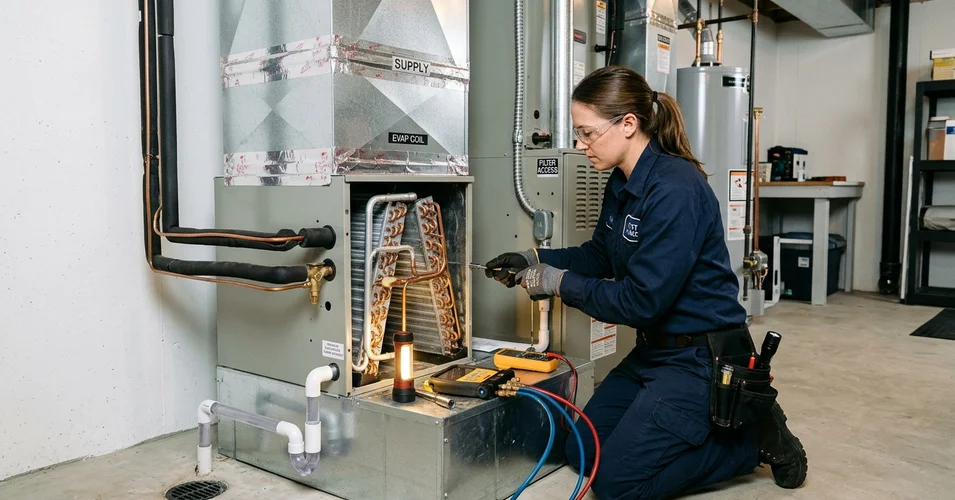
- Skilled Mechanical Labor: $1,400 to $3,200. Licensed HVAC technicians invest 6 to 10 hours recovering old refrigerant under EPA Section 608 certification, leveling the outdoor concrete pad, brazing copper line sets with nitrogen purge, pulling a 500-micron deep vacuum, and balancing airflow.
- Municipal Building & Electrical Permits: $150 to $450. Required by local code departments to verify proper disconnect boxes, ground rods, and adequate ampacity on your breaker panel.
- Refrigerant Copper Line Set Flush or Replacement: $250 to $850. Upgrading older R-22 Freon systems to modern R-410A or A2L synthetic refrigerants requires thorough chemical line flushing to remove residual mineral oil that ruins new compressors.
- Sheet Metal Plenum Transitions & Duct Sealing: $400 to $1,800. Modifying supply and return air drops to fit new evaporator coil dimensions. If entire duct trunks leak conditioned air into attics, consult our guides on thermal envelopes and attic insulation cost for complete efficiency optimization.
- Electrical Circuit Upgrades: $300 to $1,200. Older homes may require a dedicated 30 to 50-amp 240V breaker circuit or new outdoor weather-resistant disconnect boxes.
The 5,000 Rule: Should You Repair or Replace Your Air Conditioner?
Professional HVAC contractors evaluate repair vs replacement using the industry standard 5,000 Rule: multiply the age of your air conditioning system in years by the exact written repair quote. If the resulting number exceeds 5,000, replacement delivers superior financial value. For example, spending $1,100 to replace a seized blower motor on a 6-year-old unit equals 6,600, indicating that replacement prevents throwing good money after bad. In addition, systems older than 12 years still running on phased-out R-22 refrigerant should be replaced immediately due to exorbitant chemical recharge prices exceeding $150 to $200 per pound.
Frequently Asked Questions (Google People Also Ask)
How much does it cost to replace a central AC unit?
Replacing a central air conditioning unit costs between $3,800 and $8,200 on average for standard equipment and professional installation. Total costs depend on system tonnage (1.5 to 5 tons), efficiency rating (14.3 to 18+ SEER2), and whether you replace only the outdoor condenser or install a full matched system.
How long does a central air conditioner last?
Most central air conditioners last 12 to 17 years in moderate climates. Systems installed in hot, humid southern zones with prolonged daily run times often require replacement at 10 to 14 years, while units receiving annual coil cleanings and regular filter swaps can reach 20 years.
Do I need to replace my furnace when I replace my AC?
You do not have to replace a furnace when replacing an AC, but contractors strongly advise doing so if your furnace is over 12 to 15 years old. Bundling both installations saves $1,000 to $2,000 in labor fees and guarantees your new evaporator coil matches the blower motor for full SEER2 efficiency.
How long does it take an HVAC crew to install a new AC?
A standard residential central AC replacement takes 4 to 8 hours for a two-person licensed HVAC crew. Complete system swaps including a new furnace or minor sheet metal plenum re-ducting can extend installation time to 1.5 to 2 days.
Does homeowners insurance cover central AC replacement?
Standard homeowners insurance policies cover central AC replacement only when caused by sudden, accidental covered perils such as lightning strikes, residential fires, or fallen tree branches. Mechanical failure, old age, and gradual wear and tear are strictly excluded.

