The average water softener installation cost ranges between $1,200 and $3,800 for most single-family homes in the United States, with a national median of approximately $1,500. Equipment alone costs between $400 for an entry-level retail cabinet unit and $2,500 or more for a commercial-grade twin-tank configuration. Labor charges typically run from $300 to $700 if your garage or utility room already has a pre-plumbed loop, but can increase to $700 to $1,800 or more if a plumber needs to cut into your main trunk line and run dedicated drain lines. Once up and running, standard monthly operating expenses total $12 to $19 for salt pellets, backwash water, and electricity.
How much you spend depends largely on the equipment tier you select and your home’s existing plumbing setup. Homeowners generally choose between three distinct routes: purchasing an all-in-one cabinet unit from a retail home center, buying a modular commercial valve build online and hiring an independent local plumber, or purchasing a proprietary turnkey package through a franchise water treatment dealer. Understanding these options helps you avoid overpriced sales pitches and select the right capacity for your household water usage.
| Project tier | Bare equipment | Professional labor | Total installed cost | Typical configuration |
|---|---|---|---|---|
| Basic DIY or entry level | $400 – $700 | $0 – $400 | $400 – $1,100 | 32,000-grain retail cabinet unit installed on an existing loop |
| Standard professional install | $800 – $1,200 | $400 – $700 | $1,200 – $1,900 | 48,000-grain commercial Fleck or Clack valve on an existing loop |
| Complex new loop addition | $800 – $1,400 | $800 – $1,800 | $1,600 – $3,200 | Commercial metered system with new main cut-in and drain routing |
| Franchise turnkey package | $2,500 – $6,500+ | Included in quote | $2,500 – $6,500+ | Branded proprietary system with dealer installation and service contract |
Water Softener Cost by System Type and Technology
Water softeners rely on specific treatment methods to handle mineral hardness in tap water. While traditional ion exchange remains the industry standard for removing dissolved calcium and magnesium, alternative technologies and dual-tank configurations serve different household demands and water chemistry profiles.
Traditional salt-based ion exchange systems (single tank)
Single-tank salt-based ion exchange systems are the most common softening systems in American homes. Raw water enters a mineral tank filled with millions of microscopic, negatively charged polystyrene resin beads coated in sodium or potassium ions. As hard water flows down through the resin bed, positively charged calcium and magnesium ions displace the sodium ions, locking the mineral hardness onto the resin beads while delivering softened water throughout your home.
Hardware for single-tank systems costs between $400 and $1,500, with total professional installation running from $1,000 to $2,500. A single-tank unit must regenerate periodically, typically at 2:00 AM once every few days. During this two-hour backwash and brine cycle, the control valve automatically shifts into bypass mode, meaning any water used in the middle of the night bypasses the unit as untreated hard water.
Dual-tank water softeners (continuous 24/7 softening)
Dual-tank water softeners feature two separate resin mineral tanks connected to a single alternating control valve. While tank A actively treats incoming water, tank B remains on standby. The instant tank A exhausts its softening capacity, the digital valve automatically switches service to tank B and begins regenerating tank A using treated soft water. This alternating setup guarantees 24/7 uninterrupted soft water with zero hard-water bypass.
Dual-tank systems cost between $1,200 and $2,500 for equipment and $1,800 to $4,000 installed, with an average installed cost of about $2,500. They are particularly beneficial for larger families of five or more people, homes with shift workers, or areas with extreme water hardness exceeding 15 grains per gallon where daily regeneration would otherwise cause frequent nighttime hard-water bleed-through.
Salt-free water conditioners (template-assisted crystallization)
Salt-free water conditioners, commonly utilizing template-assisted crystallization (TAC), do not soften water in the traditional chemical sense. Instead of removing calcium and magnesium ions through ion exchange, the specialized media inside the tank attracts dissolved minerals and binds them into microscopic, inert crystals. These microscopic crystals remain suspended in the water stream rather than sticking to the inside of copper pipes and water heater heating elements.
Salt-free equipment costs $600 to $1,800, with total installation ranging from $1,200 to $2,800. While TAC systems require zero salt, produce zero wastewater, and need no electrical outlet, they do not reduce measured grains per gallon. They will not produce the silky lather associated with soft water, will not relieve dry skin, and still leave wipeable white mineral spots on glassware and shower doors.
Magnetic and electronic descalers (physical conditioning)
Magnetic and electronic descalers are entry-level physical conditioning devices that clamp onto your main water pipe. These units cost between $150 and $500 for hardware and $250 to $600 to install. They wrap wire coils around copper or PEX tubing, sending electromagnetic frequencies through the pipe wall to alter the crystalline structure of calcium carbonate before it reaches household fixtures.
While inexpensive and easy to attach without cutting plumbing lines, independent laboratory evaluations by the Water Quality Research Foundation (WQRF) show minimal to zero measurable scale reduction under normal household water flow rates. If your home has moderate to severe water hardness, magnetic devices rarely deliver noticeable protection for appliances or plumbing fixtures.
Whole-house reverse osmosis vs. point-of-use systems
Homeowners often confuse water softeners with reverse osmosis (RO) systems. While an ion-exchange softener removes calcium and magnesium to prevent limescale, reverse osmosis forces water through a dense semipermeable membrane to eliminate up to 98% of all dissolved solids, including heavy metals, nitrates, chlorine, and microplastics.
Whole-house reverse osmosis systems are rarely practical for residential applications due to high equipment expenses ($4,500 to $12,000 or more), substantial space requirements for atmospheric storage tanks and booster pumps, and high water waste ratios (2 to 4 gallons sent down the drain for every single gallon produced). Instead, the standard recommendation is to install a whole-house ion-exchange softener paired with an under-sink reverse osmosis drinking water unit ($250 to $600 hardware) dedicated to your kitchen sink and refrigerator ice maker.
System technology and equipment cost comparison
The table below summarizes equipment pricing, total installed costs, and functional performance across residential water treatment technologies.
| System type | Equipment cost range | Total installed cost | Hardness removal method | Best suited for |
|---|---|---|---|---|
| Single-tank ion exchange | $400 – $1,500 | $1,000 – $2,500 | Chemical cation exchange (replaces Ca/Mg with Na) | Most single-family homes with 2 to 4 occupants |
| Dual-tank alternating ion exchange | $1,200 – $2,500 | $1,800 – $4,000 | Continuous chemical exchange with alternating resin tanks | Large families, shift workers, and very hard water |
| Salt-free TAC conditioner | $600 – $1,800 | $1,200 – $2,800 | Template-assisted crystallization (suspends crystals) | Homes in areas with municipal brine discharge restrictions |
| Magnetic or electronic descaler | $150 – $500 | $250 – $600 | Electromagnetic physical frequency conditioning | Budget scale reduction on very mild hardness |
| Whole-house reverse osmosis | $4,500 – $12,000+ | $6,000 – $15,000+ | Semipermeable membrane filtration | Severe total dissolved solids or specialized well contamination |
| Under-sink RO drinking add-on | $250 – $600 | $450 – $900 | Point-of-use membrane filtration | Dedicated kitchen drinking water and ice maker supply |
Equipment Tiers and Brand Pricing Breakdown
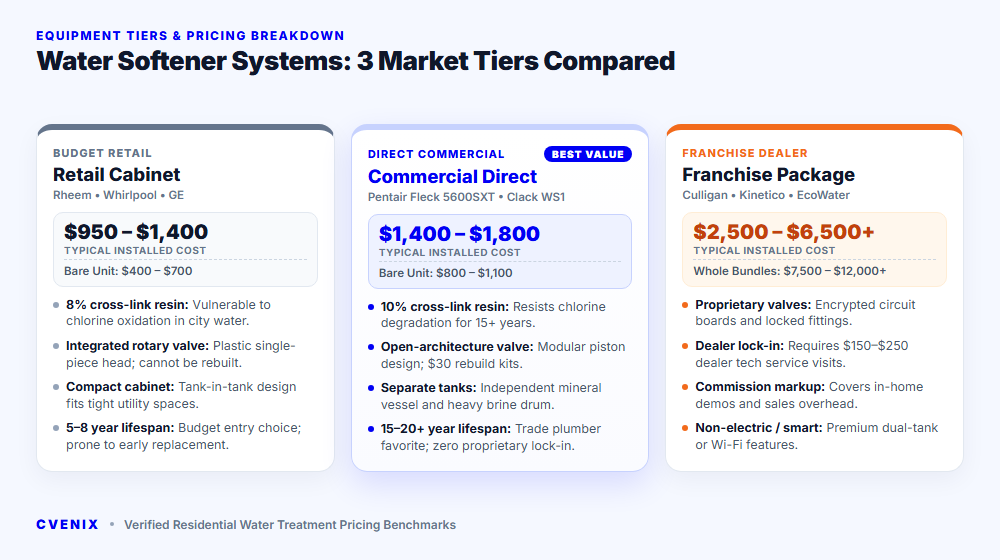
When shopping for a water softener, prices range from under $500 on the shelf at a home improvement store to upwards of $6,000 or more from a national door-to-door sales franchise. Understanding component construction, valve engineering, and resin quality makes it easy to separate durable hardware from marketing markup.
Budget retail cabinet units (Rheem, Whirlpool, GE)
Big-box home improvement stores like The Home Depot and Lowe’s carry all-in-one cabinet softeners manufactured by brands like Rheem, Whirlpool, and GE. In these systems, the resin mineral tank sits directly inside the salt brine container to create a single compact footprint. Retail pricing is approachable: a Rheem 32,000-grain Preferred unit retails for $489, the 42,000-grain Preferred Plus retails for $549, and the 42,000-grain Smart Wi-Fi model sells for $689.
While these units work well in tight utility closets, their compact construction involves engineering compromises. They generally contain lower-density 8% cross-linked polystyrene resin, which breaks down quickly when exposed to chlorinated municipal water. In addition, their control valves use integrated plastic rotary discs that cannot be rebuilt with individual parts. When a seal fails after 3 to 6 years, homeowners often have to replace the entire electronic valve head or discard the appliance altogether.
Direct-to-consumer commercial valve builds (Fleck 5600SXT and Clack WS1)
For most homeowners, purchasing a modular system built with an open-architecture commercial control valve hits the sweet spot between long-term durability and price. These units feature separate heavy-duty mineral and brine tanks topped by proven digital metered valves, primarily the Pentair Fleck 5600SXT or Clack WS1. Complete 32,000 to 48,000-grain systems packed with premium 10% cross-linked resin retail direct-to-consumer for $800 to $1,100.
These commercial valve platforms have dominated the professional plumbing industry for decades. Their modular internal components can be rebuilt in under 30 minutes using inexpensive $30 seal-and-spacer kits. Packed with chlorine-resistant 10% cross-linked resin beads, these independent builds routinely deliver a 15 to 20-year service life without locking you into proprietary service contracts.
Franchise dealer proprietary systems (Culligan, Kinetico, EcoWater)
National franchise treatment companies like Culligan, Kinetico, and EcoWater operate through dedicated local dealer networks. Their single-tank systems generally start at $2,500 to $4,500 installed, while high-efficiency non-electric or dual-tank packages often reach $5,000 to $6,500. When bundled with whole-house carbon pre-filters and under-sink reverse osmosis units, dealer contract quotes routinely land between $7,500 and $12,000 or more.
These dealers frequently attract customers through door-to-door pitches or mailed flyers offering a “free in-home water test.” During these visits, sales representatives often conduct chemical precipitation demonstrations, adding chemical reagents that turn clear tap water dark and murky to highlight harmless mineral content and create urgency. While brands like Kinetico manufacture quality non-electric dual-tank hardware, their computerized valve assemblies and quick-connect fittings are completely proprietary. Independent plumbers cannot buy parts for them, leaving you reliant on $150 to $250 dealer service calls whenever maintenance is required.
Retailer installation programs (Home Depot, Lowe’s, and Costco)
Big-box retail home centers offer equipment and installation bundles by contracting jobs to licensed local plumbing companies. Basic installation packages through Home Depot or Lowe’s typically range from $400 to $800 in labor, provided your home already features a functional pre-plumbed loop and nearby electrical hookup. However, if your home lacks a loop or needs pipe modifications, store subcontractors charge premium supplemental fees that can push labor above $1,200.
Costco partners directly with authorized franchise dealers, often EcoWater. While members receive 10% to 15% back on Costco Shop Cards, the baseline pricing reflects standard franchise dealer margins ($4,000 to $7,000 installed). This makes the net package significantly more expensive than purchasing an open-architecture commercial unit through an independent contractor.
Renting vs. buying a water softener ($25 to $50 monthly rentals)
Franchise dealers also market monthly rental programs ranging from $25 to $50 per month, often requiring an upfront delivery and connection fee of $150 to $300. Rentals generally cover basic repairs and annual service checks, which can appeal to short-term tenants or homeowners planning to relocate within a year.
For permanent homeowners, renting is an expensive long-term proposition. Over three years, a $40 monthly rental costs $1,440 in payments while building zero equity. In contrast, purchasing an open-architecture Fleck 5600SXT unit outright for $900 and paying $500 for professional installation totals $1,400. The purchased system breaks even within 30 to 36 months, after which it operates for another 10 to 15 years with minimal annual upkeep.
Equipment brand and distribution channel cost table
Review the table below to compare equipment tiers, valve designs, and price ranges across popular brands and distribution paths.
| Brand and model | Distribution channel | Bare equipment price | Typical installed cost | Valve architecture | Resin cross-link grade |
|---|---|---|---|---|---|
| Rheem Preferred 42k (RHS42) | Big-box retail (Home Depot) | $549 | $950 – $1,400 | Proprietary plastic rotary | 8% cross-linked resin |
| Whirlpool 40,000-Grain (WHES40) | Big-box retail (Lowe’s) | $529 | $950 – $1,350 | Proprietary integrated rotary | 8% cross-linked resin |
| Pentair Fleck 5600SXT 48k | Direct-to-consumer online | $850 – $1,050 | $1,350 – $1,850 | Open-architecture piston valve | 10% cross-linked resin |
| Clack WS1 48,000-Grain | Independent plumbing supply | $900 – $1,150 | $1,400 – $1,950 | Open-architecture stack valve | 10% cross-linked resin |
| Culligan High Efficiency (HE) | Proprietary franchise dealer | $2,500 – $4,200 | $3,200 – $5,500+ | Proprietary digital valve | Proprietary resin blend |
| Kinetico Premier Series (Dual-Tank) | Proprietary franchise dealer | $3,200 – $5,000 | $4,000 – $6,500+ | Proprietary non-electric valve | Fine mesh commercial resin |
Installation Labor and Plumbing Infrastructure Costs
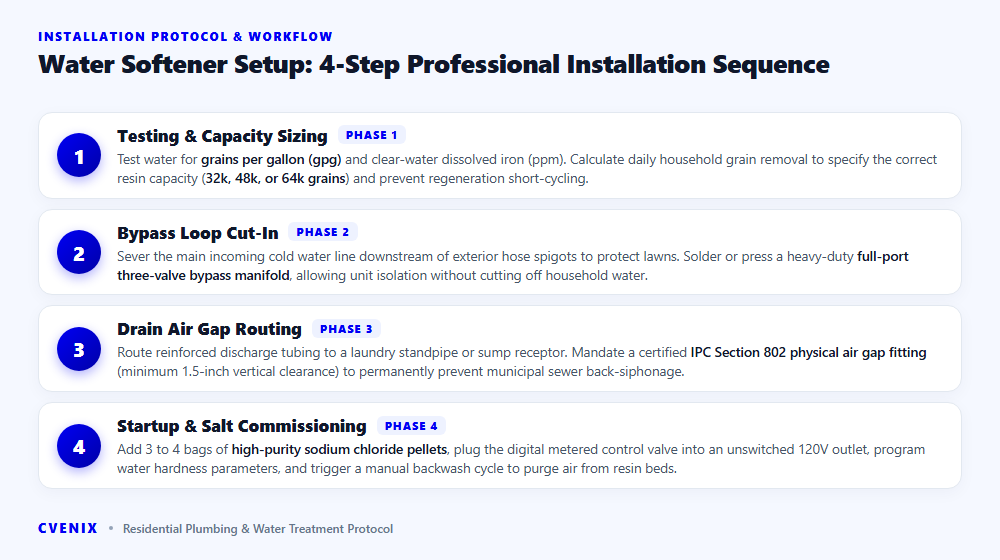
Installation labor accounts for a significant portion of your total project invoice. The physical layout of your home’s plumbing infrastructure, particularly the presence or absence of a dedicated water softener loop, dictates how many hours a licensed plumber must spend on the job.
Existing pre-plumbed loop installation ($300 to $700 labor)
A pre-plumbed loop is an architectural feature common in newer homes built in hard-water states. During construction, the plumber installs a dedicated U-shaped cold water pipe in the garage, basement, or utility room that intercepts the home’s incoming water supply before it branches off to indoor fixtures. A pre-plumbed location almost always includes an unswitched electrical outlet and a drain standpipe within 3 to 5 feet.
Connecting a water softener to an existing pre-plumbed loop takes between 2 and 4 hours of professional labor, costing $300 to $700. The plumber cuts the pre-formed loop, attaches bypass shutoff valves, runs corrugated stainless steel flex lines or crimps PEX tubing to the softener inlet and outlet, and secures the brine discharge line into the standpipe.
Adding a new water softener loop ($700 to $1,800+ labor)
If your home lacks a dedicated loop, installation complexity increases considerably. The plumber must find the exact point where the municipal water main enters your foundation, cut into the main 3/4-inch or 1-inch copper or PEX supply trunk, and re-route cold water lines to the chosen installation location. Crucially, the technician must tap into the main downstream of outdoor spigots so exterior irrigation remains on untreated water.
Installing a new loop requires 4 to 8 or more labor hours, costing between $700 and $1,800 or more in labor and specialized fittings. Plumbers often need to drill through floor joists, core concrete basement walls, route 20 or more feet of drain discharge line, and coordinate electrical access.
Plumbing modifications, bypass valves, and drain routing
A proper professional installation includes several supplemental plumbing components. A heavy-duty full-port brass three-valve bypass manifold ($60 to $120 in parts) allows you to isolate the softener for servicing while maintaining water pressure to the rest of the house. Adding a 5-micron sediment spin-down pre-filter ($75 to $200) ahead of the mineral tank protects delicate valve seals and resin beads from silt, sand, and pipe scale.
Discharge drain routing also affects labor fees. Tying the regeneration drain line into an adjacent washing machine standpipe or utility sink drain is simple and economical. However, if the softener sits across a finished basement or in a subterranean mechanical room below the main sewer line, your plumber may need to install a dedicated condensate or effluent pump ($300 to $600) to pump backwash discharge up into overhead waste lines.
Electrical outlet requirements and dedicated circuits
Standard electronic metered softeners require continuous 120V AC power to operate their digital circuit boards, turbine flow meters, and drive motors. The manufacturer transformer cord is typically only 5 to 6 feet long. If there is no open outlet near the install site, hiring a licensed electrician to run a dedicated circuit and install a code-compliant GFCI outlet adds $150 to $350 to your total budget.
Municipal plumbing permits and inspection fees
Most municipalities require a residential plumbing permit whenever a contractor modifies a primary potable water service line or connects an appliance to a sanitary drain. Plumbing permit fees range from $50 to $200 depending on local municipal building codes. While simple like-for-like appliance replacements often bypass inspection requirements, cutting into main water lines to add a new loop requires an inspection to confirm backflow prevention compliance.
Itemized installation cost breakdown table (equipment, labor, permits)
The table below provides a comprehensive itemized cost breakdown comparing an existing loop hookup against a brand-new infrastructure rough-in.
| Cost component | Existing loop scenario | New loop rough-in scenario | Description and specifications |
|---|---|---|---|
| Water softener hardware | $850 – $1,100 | $850 – $1,100 | Complete 48,000-grain metered Fleck or Clack commercial system |
| Bypass valve and pipe fittings | $75 – $125 | $150 – $300 | Brass three-valve bypass manifold, PEX/copper adapters, flex lines |
| Sediment spin-down pre-filter | $75 – $150 | $75 – $150 | 5-micron clear-housing pre-filter to catch rust and silt |
| Licensed plumbing labor | $300 – $700 | $700 – $1,800 | 2 to 4 hours on loop vs. 4 to 8+ hours cutting main and routing pipes |
| Electrical outlet installation | $0 (existing) | $150 – $350 | Dedicated 120V GFCI outlet added by a licensed electrician |
| Municipal plumbing permit | $0 – $75 | $75 – $200 | Local municipal building department fee and rough inspection |
| Initial salt pellet supply | $30 – $45 | $30 – $45 | Three 40-lb bags of high-purity sodium chloride pellets |
| Total project investment | $1,330 – $2,195 | $2,030 – $3,945 | Complete turnkey installation ready for daily household service |
Regional and State Water Softener Installation Cost
Installation pricing fluctuates across geographic regions based on local trade wages and underlying water chemistry. Knowing where your state ranks on mineral hardness and labor costs helps you judge whether local contractor quotes are in line with market averages.
Geographic labor variances and water hardness zones
According to the U.S. Bureau of Labor Statistics (SOC 47-2152), licensed plumbers, pipefitters, and steamfitters earn a national mean wage of $34.70 per hour. When overhead, insurance, vehicle fueling, and worker benefits are factored in, established plumbing companies bill retail rates of $75 to $150 or more per hour.
In states with exceptionally hard water, such as Arizona, Texas, Indiana, and Florida, water softeners are considered essential household equipment. Builders in these regions routinely include pre-plumbed loops as standard construction features, and high contractor competition keeps installation rates competitive. In contrast, coastal metropolitan markets across California and New York experience higher wage overhead, driving labor quotes toward the upper end of the scale.
Municipal brine discharge bans and environmental regulations
Before installing a salt-based softener, check with your local water utility regarding discharge regulations. In arid Western agricultural basins and parts of Central and Southern California, municipal sanitation districts restrict or prohibit automatic salt-based water softeners from discharging salty brine backwash into public sewer systems. High chloride levels pass through wastewater treatment plants untouched, making recycled effluent unsuitable for agricultural irrigation and groundwater recharge.
If you reside in a restricted district, compliant solutions include using potassium chloride pellets, installing ultra-high-efficiency metered valves programmed to consume less than 3.5 pounds of salt per regeneration cycle, or selecting an approved template-assisted crystallization physical conditioner.
State-by-state water softener cost table
The table below provides regional pricing benchmarks and typical water hardness profiles across ten representative states.
| State | USGS hardness level | Average equipment cost | Average labor cost (standard loop) | Typical total installed cost range |
|---|---|---|---|---|
| Arizona | Very Hard (15 – 25+ gpg) | $850 – $1,300 | $350 – $650 | $1,200 – $2,100 |
| California | Hard to Very Hard (10 – 20 gpg) | $950 – $1,500 | $550 – $1,100 | $1,500 – $2,900 |
| Texas | Hard to Very Hard (12 – 22 gpg) | $850 – $1,350 | $350 – $700 | $1,200 – $2,250 |
| Florida | Hard (10 – 18 gpg) | $800 – $1,300 | $350 – $650 | $1,150 – $2,150 |
| Ohio | Very Hard (12 – 20 gpg) | $800 – $1,250 | $300 – $600 | $1,100 – $2,000 |
| Illinois | Hard (10 – 18 gpg) | $850 – $1,350 | $400 – $800 | $1,250 – $2,350 |
| Pennsylvania | Moderately Hard (6 – 12 gpg) | $800 – $1,250 | $350 – $700 | $1,150 – $2,100 |
| Colorado | Hard (8 – 15 gpg) | $850 – $1,350 | $400 – $750 | $1,250 – $2,300 |
| New York | Moderate to Hard (5 – 12 gpg) | $900 – $1,450 | $500 – $950 | $1,400 – $2,600 |
| Washington | Soft to Moderate (2 – 6 gpg) | $850 – $1,300 | $450 – $850 | $1,300 – $2,400 |
How to Size a Water Softener for Your Home
Selecting the proper grain capacity is essential for system efficiency. An undersized unit regenerates every night, wasting hundreds of gallons of water and bags of salt. Conversely, an oversized system leaves stagnant brine sitting in the tank, increasing the risk of resin channeling and premature valve fouling.
Understanding water hardness grains per gallon (USGS classification)
Water hardness measures the concentration of dissolved calcium carbonate minerals in your supply. According to the U.S. Geological Survey (USGS), water hardness is categorized into four standard tiers:
- Soft water: 0 to 3.5 grains per gallon (0 to 60 mg/L or ppm)
- Moderately hard water: 3.5 to 7.0 grains per gallon (61 to 120 mg/L or ppm)
- Hard water: 7.0 to 10.5 grains per gallon (121 to 180 mg/L or ppm)
- Very hard water: Greater than 10.5 grains per gallon (greater than 180 mg/L or ppm)
If your municipal water quality report lists hardness in parts per million (ppm) or milligrams per liter (mg/L), divide that number by 17.1 to find your hardness in grains per gallon (gpg). For instance, a test reading of 256 ppm equals 15 gpg.
The standard capacity sizing formula
Professional water treatment specialists use a standardized engineering formula developed by the Water Quality Association to determine exact grain capacity:
Step 1: Calculate daily household water consumption. Multiply the number of permanent residents by 75 gallons per day. A four-person household consumes approximately 300 gallons daily (4 people x 75 GPD = 300 gallons).
Step 2: Calculate daily grain removal requirements. Multiply daily household water consumption by your compensated water hardness in gpg. If your water hardness is 10 gpg, a four-person home requires 3,000 grains of removal capacity per day (300 gallons x 10 gpg = 3,000 daily grains).
Step 3: Establish weekly capacity with an operational safety reserve. Water softeners operate at peak salt efficiency when regenerating once every six to seven days. Multiplying 3,000 daily grains by 7 days gives 21,000 grains. Dividing by 0.80 provides a 20% operational reserve margin: 21,000 divided by 0.80 equals 26,250 grains. A standard 32,000-grain system matches this household perfectly.
Factoring iron, manganese, and well water minerals
If your home relies on private well water, you must calculate compensated hardness rather than relying solely on calcium test strips. Dissolved clear-water ferrous iron and manganese place extra chemical demand on cation resin beads:
Compensated Hardness = Measured Hardness (gpg) + [Dissolved Iron (ppm) x 4] + [Manganese (ppm) x 4]
For example, if your well tests at 12 gpg hardness and contains 2.0 ppm of clear-water iron, your compensated hardness is 20 gpg (12 + [2 x 4] = 20 gpg). If dissolved iron levels exceed 3.0 to 5.0 ppm, an air-injection oxidizing iron filter should be installed upstream to prevent iron fouling of the softener resin bed.
Grain capacity recommendations by household size and hardness level
Use the matrix below to match your household size and mineral hardness level to the proper equipment grain rating.
| Household size | Moderate hardness (7 to 10 gpg) | Hard water (11 to 15 gpg) | Very hard water (16 to 20+ gpg) | Recommended system grain rating |
|---|---|---|---|---|
| 1 to 2 people | 24,000 grains | 24,000 grains | 32,000 grains | 24,000 – 32,000 grain capacity |
| 3 to 4 people | 32,000 grains | 40,000 grains | 48,000 grains | 32,000 – 48,000 grain capacity |
| 5 to 6 people | 48,000 grains | 48,000 grains | 64,000 grains | 48,000 – 64,000 grain capacity |
| 7 or more people | 64,000 grains | 64,000 grains | 80,000+ grains (twin-tank) | 64,000+ grain alternating dual-tank |
Monthly Operating and Ongoing Maintenance Costs
Beyond initial installation fees, operating a water softener requires ongoing salt replenishment, modest utility water usage for backwashing, and minimal electricity to run the digital control valve.
Salt consumption and pellet retail prices
Salt pellets represent your main recurring operating expense. At home improvement stores and supermarkets, a standard 40-pound bag of sodium chloride pellets (such as Morton Clean and Protect) retails for $9.88 to $11.28 ($0.25 to $0.28 per pound). Naturally evaporated coarse solar salt crystals cost slightly less, running $8.98 to $9.98 per bag.
A typical four-person home dealing with 10 to 15 gpg hardness consumes 40 to 50 pounds of salt per month (roughly one to one and a quarter bags). This equals an ongoing expenditure of $10 to $15 per month ($120 to $180 annually) for standard sodium chloride. If you choose potassium chloride pellets to minimize dietary sodium or comply with municipal discharge limits, 40-pound bags cost $28 to $35 each, elevating monthly salt spending to $30 to $45 ($360 to $540 per year).
Regeneration backwash water and sewer utility expenses
During a regeneration cycle, the control valve directs water through the mineral tank to lift, expand, and rinse the resin beads before discharging the spent brine solution down the drain. A standard 32,000 to 48,000-grain residential system consumes between 35 and 65 gallons of water per cycle.
Modern demand-metered digital valves track actual water consumption and regenerate only when capacity is exhausted, typically cycling once every four to seven days (4 to 7 cycles per month). This equates to 140 to 350 gallons of backwash water monthly. At national municipal combined water and sewer utility rates of $0.008 to $0.012 per gallon, regeneration adds $1.50 to $3.50 per month to your utility bill.
Electrical power consumption
Modern digital metered control valves like the Fleck 5600SXT and Clack WS1 use compact 120V AC transformers that draw 2 to 4 Watts when idle. During active regeneration, when the internal motor turns the drive gears and piston, power draw briefly peaks at 10 Watts. Over an entire month, total electrical consumption is less than 3 to 5 kilowatt-hours (kWh). Based on average US residential electric rates of roughly 17 cents per kWh, electricity costs less than $0.50 to $0.85 per month.
Resin bead lifespan, degradation, and replacement costs
Ion-exchange resin beads slowly lose softening capacity over time. Chlorine and chloramines added to city water oxidize the divinylbenzene (DVB) polymer bonds inside the beads, causing them to swell, lose rigidity, and fracture into tiny particles. Standard 8% cross-linked resin typically lasts 6 to 10 years in city water, whereas commercial 10% cross-linked resin resists chemical breakdown for 15 to 20 years.
When resin reaches the end of its life, replacing the beads does not require purchasing a new system. Homeowners can re-bed an existing mineral tank with fresh 10% cross-linked resin for $120 to $180 in materials, or hire a local plumber to re-bed the system for $300 to $500 in combined parts and labor.
Monthly and annual operating cost breakdown table
Review the comprehensive schedule below for a summary of routine operating costs associated with running a residential water softener.
| Expense category | Monthly cost (sodium chloride) | Monthly cost (potassium chloride) | Annual total | Maintenance interval |
|---|---|---|---|---|
| Softener salt pellets | $10 – $15 | $30 – $45 | $120 – $180 (sodium) | Add 1 to 2 bags every 4 to 6 weeks |
| Regeneration backwash water | $1.50 – $3.50 | $1.50 – $3.50 | $18 – $42 | Automated via demand-metered valve |
| Electricity draw (120V valve) | $0.50 – $0.85 | $0.50 – $0.85 | $6 – $10 | Continuous plug-in operation |
| Pre-filter cartridge replacements | $2.00 – $4.00 | $2.00 – $4.00 | $24 – $48 | Replace sediment filter every 6 to 9 months |
| Resin bed amortization | $1.00 – $2.00 | $1.00 – $2.00 | $12 – $24 | Amortized over 10 to 15 year resin life |
| Total monthly operating cost | $15 – $25.35 | $35 – $55.35 | $180 – $304 (sodium) | Comprehensive monthly running budget |
Is a Water Softener Worth It? Return on Investment and Savings
While installing a water softener requires an upfront investment, empirical engineering studies demonstrate that eliminating hard water mineral scale produces substantial household savings by protecting water heating equipment, extending plumbing fixture lifespans, and cutting cleaning supply purchases in half.
Water heater protection and Battelle efficiency research
The financial return of a water softener was documented in a landmark multi-year scientific study conducted by the Battelle Memorial Institute for the Water Quality Research Foundation (WQRF). Battelle researchers evaluated conventional storage gas water heaters, tankless water heaters, and electric water heaters under controlled laboratory conditions over simulated multi-year residential cycles.
The findings showed that gas storage water heaters operated on hard water lost 24% to 48% of their operational energy efficiency over their lifespan, shedding approximately 4% efficiency for every 5 grains per gallon of mineral hardness. On tankless water heaters, the effects were even more severe: units operating on 26 gpg hard water failed completely from scale blockage within just 1.6 years. In stark contrast, water heaters running on softened water retained 100% of their original factory efficiency throughout the entire 15-year testing cycle.
Review our comprehensive guide on water heater replacement cost to see how scale buildup accelerates premature tank failure, and learn how soft water protects heating elements to lower long-term ownership costs. If you own or are considering high-efficiency on-demand water heating, the extreme sensitivity of copper and stainless steel heat exchangers makes soft water critical for managing tankless water heater installation cost over the life of the appliance.
Extending the lifespan of plumbing fixtures and appliances
Hard water mineral deposits take a steady toll on dishwashers, washing machines, thermostatic shower mixing valves, and faucet aerators. Limescale coats internal heating coils, hardens rubber cartridge seals, and clogs tiny spray nozzles, frequently cutting appliance service lives in half.
When budgeting a major bathroom remodel cost, protecting luxury shower valves, matte black faucets, and frameless glass enclosures from permanent mineral etching makes a water softener an essential safeguard. Softened water eliminates the abrasive calcium buildup that scratches glass and tarnishes specialty designer finishes.
Detergent, soap, and cleaning supply savings
Dissolved calcium and magnesium ions bond with the fatty acids in soaps and detergents, neutralizing their cleaning action and creating an insoluble curd known as soap scum. In hard-water homes, families routinely use two to three times more laundry detergent, liquid dish soap, and shampoo just to generate an effective lather.
According to consumer research published by the Water Quality Association, homes operating with softened water can reduce laundry detergent and dish soap usage by 50% to 75% while achieving superior stain removal. For a family of four, this reduction cuts household cleaning expenditures by $100 to $200 each year.
Long-term financial payback breakdown
The table below models the 10-year financial impact of installing an open-architecture water softener, showing how equipment costs compare with utility and maintenance savings.
| Financial category | 10-year estimated amount | Economic impact | Financial calculation basis |
|---|---|---|---|
| Upfront equipment and installation | -$1,600 | Initial capital cost | 48k Fleck commercial system installed on loop |
| 10-year salt and water operating fees | -$1,800 | Recurring operating expense | $15/month for salt pellets, water, and electricity |
| Water heater energy efficiency savings | +$1,200 to $2,000 | Direct utility reduction | Preventing 24% to 48% Battelle efficiency loss |
| Detergent and cleaning soap savings | +$1,000 to $1,800 | Household budget reduction | 50% to 75% decrease in laundry and dish soap use |
| Appliance and fixture life extension | +$1,500 to $3,000 | Avoided replacement cost | Preventing premature water heater and dishwasher failure |
| Net 10-year financial return | +$300 to $3,400 | Net positive return | Overall financial payback across 10-year service life |
DIY vs. Professional Installation
Deciding between a DIY installation and hiring a licensed professional comes down to your home’s existing plumbing infrastructure and your familiarity with local plumbing codes.
When a DIY installation makes sense (existing loop)
Tackling a water softener installation as a DIY project is practical if your home already features a pre-plumbed loop with an adjacent drain standpipe and an active 120V outlet. If these three connections are present, connecting the unit requires no structural demolition or main trunk line cutting.
A capable homeowner can complete the connection in 2 to 4 hours using corrugated stainless steel water heater flex connectors or push-to-connect fittings, braided drain tubing, and hose clamps, spending between $50 and $120 on materials. However, if your home requires soldering copper lines or cutting into main building supply trunks, hiring a professional plumber is the safer path.
Critical plumbing code and safety risks (IPC air gaps and cross-connections)
Professional plumbers understand critical sanitary code requirements that unpermitted installations frequently miss. One vital requirement is Section 802 of the International Plumbing Code (IPC), which mandates a physical air gap between the water softener backwash discharge line and the waste receptor.
Connecting a brine discharge hose directly into a sewer stack, sump basin, or standpipe without an air gap creates an illegal cross-connection. If the municipal sewer or home drain line backs up, contaminated wastewater can siphon directly back through the discharge tubing, enter the mineral tank, and contaminate your home’s drinking water. Just as improper drainage can drive up unexpected sewer line replacement cost, code-mandated air gaps protect your domestic water lines from dangerous contamination.
Outdoor hose spigot isolation (preventing salt waste and plant damage)
Another common mistake in unpermitted installations is failing to isolate exterior water lines. Outdoor hose bibbs, lawn sprinkler zones, and swimming pool auto-fill lines must remain on hard water upstream of the softener loop.
Running softened water to your garden or lawn wastes dozens of pounds of salt each month and triggers unnecessary regeneration cycles. More importantly, softening swaps calcium ions for sodium ions; repeatedly irrigating with softened water accumulates sodium in topsoil, damaging turfgrass, stunting ornamental shrubs, and killing sensitive garden plants.
Questions to ask when hiring a water treatment contractor
Before signing an installation agreement, ask prospective plumbing contractors these six questions to verify their licensing, component quality, and code compliance:
- Are you a state-licensed and insured plumbing contractor, or an independent sales dealer?
- Does your quote include a full-port brass three-valve bypass and an IPC-compliant physical air gap on the discharge line?
- Are all outdoor hose bibbs and landscape irrigation lines isolated on hard water upstream of the softener?
- Is the control valve an open-architecture, non-proprietary brand (such as Pentair Fleck or Clack) with readily available replacement parts?
- What grade of cross-linked resin (standard 8% or commercial-grade 10%) is loaded into the mineral tank?
- Does your final estimate include pulling a municipal plumbing permit and hauling away existing equipment?
Signs It Is Time to Replace Your Water Softener
While quality water softeners provide many years of service, internal components eventually wear out. Recognizing early symptoms of equipment failure helps you fix minor issues before they lead to plumbing emergencies.
Return of hard water spots and limescale buildup
The clearest indicator of an aging water softener is the return of hard water symptoms: crusty white mineral rings around faucets, cloudy spots on glassware, stiff laundry, and soap that refuses to lather. If your salt tank remains full while your water turns hard, either the resin bed has reached chemical exhaustion or the control valve injector has clogged, preventing the system from drawing concentrated brine during regeneration.
Resin bead blowout into household plumbing fixtures
One of the most disruptive plumbing failures occurs when degraded resin beads break through the mineral tank’s lower distributor screen and surge into household supply pipes. Homeowners discover tiny yellow or orange plastic beads clogging faucet aerators, jamming toilet fill valves, and blocking shower cartridges throughout the house. This issue requires immediate bypass of the softener, whole-house pipe flushing, and replacing the exhausted mineral tank.
Brine tank overflow and mechanical valve failure
If you open your salt storage tank and find water standing near the top, the system is failing to evacuate brine during the regeneration sequence. This condition is often caused by a stuck brine float safety shutoff valve, a cracked drain line, or worn piston seals within the main control valve. If replacing the brine valve does not resolve the issue, the valve head likely requires a complete rebuild or replacement.
Equipment age and declining salt efficiency
Most big-box retail cabinet softeners last 5 to 8 years, while commercial valve systems (such as Fleck or Clack builds) provide 15 to 20 or more years of dependable service. If your home has an older timer-based unit that regenerates on a fixed schedule regardless of actual water use, upgrading to a modern demand-initiated metered system can reduce salt and backwash water consumption by up to 40%.
Research Methodology and Data Sources
Our pricing models and technical recommendations are developed through rigorous industry analysis, combining trade labor wage statistics, published engineering research, and verified homeowner project contracts.
Data collection standards and cost estimation parameters
Cvenix analyzes residential water treatment pricing across ten distinct geographic zones in the United States. Labor rates are benchmarked against official data from the U.S. Bureau of Labor Statistics for plumbers and pipefitters (SOC 47-2152), combined with contractor surveys and municipal permit schedules. Bare equipment pricing is audited directly from national home improvement retailers (The Home Depot and Lowe’s), direct-to-consumer filtration distributors, and verified homeowner invoices shared across community plumbing forums including Reddit’s r/HomeImprovement, r/WaterTreatment, and r/Plumbing.
Government, laboratory, and trade benchmark citations
Factual data, engineering sizing calculations, and efficiency claims throughout this guide are cited from authoritative scientific and government bodies:
- U.S. Geological Survey (USGS): National water hardness classifications and grains per gallon conversion scales.
- Battelle Memorial Institute and Water Quality Research Foundation (WQRF): Multi-year laboratory research on water heater efficiency loss, detergent reduction, and appliance longevity under hard-water conditions.
- U.S. Bureau of Labor Statistics (BLS): National Occupational Employment and Wage Statistics for licensed plumbers and pipefitters.
- Water Quality Association (WQA): Technical equipment sizing formulas, salt consumption benchmarks, and cation resin capacity guidelines.
- International Code Council (ICC): International Plumbing Code Section 802 air-gap backflow prevention standards for residential water treatment appliances.
Frequently Asked Questions About Water Softener Costs
How much does a water softener cost with installation?
Most homeowners pay between $1,200 and $3,800 for a professionally installed water softener, with a national median of approximately $1,500. A basic retail cabinet unit installed as a DIY project on an existing loop costs as little as $500 to $700, while commercial-grade metered systems installed by a licensed plumber typically cost $1,300 to $1,900. Turnkey proprietary franchise dealer packages frequently cost $2,500 to $6,500 or more.
How much does it cost to add a water softener loop?
Installing a new water softener loop where none exists costs between $700 and $1,800 or more in plumbing labor and materials. The plumber must locate your incoming main service trunk, cut into the pipe downstream of outdoor hose bibbs, install a three-valve bypass, run supply and return lines to the utility area, and route a dedicated drain line with an approved physical air gap.
How much does a water softener cost per month to run?
Operating a standard residential water softener costs between $12 and $19 per month for a family of four using sodium chloride pellets. This budget includes $10 to $15 for 40 to 50 pounds of salt pellets, $1.50 to $3.50 for regeneration backwash water, and less than $1 in electricity. Using potassium chloride pellets instead of sodium chloride increases monthly running costs to $30 to $45.
How much is a Culligan water softener installed?
Turnkey Culligan systems typically cost between $2,500 and $6,500 or more installed for standard residential single-tank units. When bundled with whole-house carbon filtration, customized dual tanks, and under-sink reverse osmosis drinking systems, total dealer contract packages frequently land between $7,500 and $12,000 or more.
Do salt-free water softeners really work?
Salt-free water conditioners using template-assisted crystallization (TAC) reduce limescale buildup inside pipes and water heaters, but they do not soften water. They do not remove calcium or magnesium ions, do not produce rich soap lather, will not relieve dry skin, and still leave wipeable white mineral spots on glassware and shower doors.
How long does a water softener last?
A quality water softener lasts between 10 and 20 years depending on component construction and maintenance. Budget all-in-one cabinet units from retail stores generally last 5 to 8 years, while modular commercial valve systems (such as Pentair Fleck or Clack builds) packed with 10% cross-linked resin routinely last 15 to 20 or more years.
Should outdoor spigots be connected to a water softener?
No. Exterior hose bibbs and landscape sprinkler systems should always remain connected to raw, unsoftened hard water. Running softened water to your lawn or garden wastes expensive salt pellets, triggers premature regeneration cycles, and deposits sodium into garden soil that can damage grass and kill ornamental plants.
Why do plumbers require an air gap on the drain line?
Plumbing codes, including International Plumbing Code Section 802, mandate a physical air gap between the softener discharge tubing and the sewer drain receptor. A physical air gap prevents back-siphonage: if the municipal sewer line or home drain backs up, contaminated wastewater cannot siphon back through the brine line and contaminate your household drinking water.