
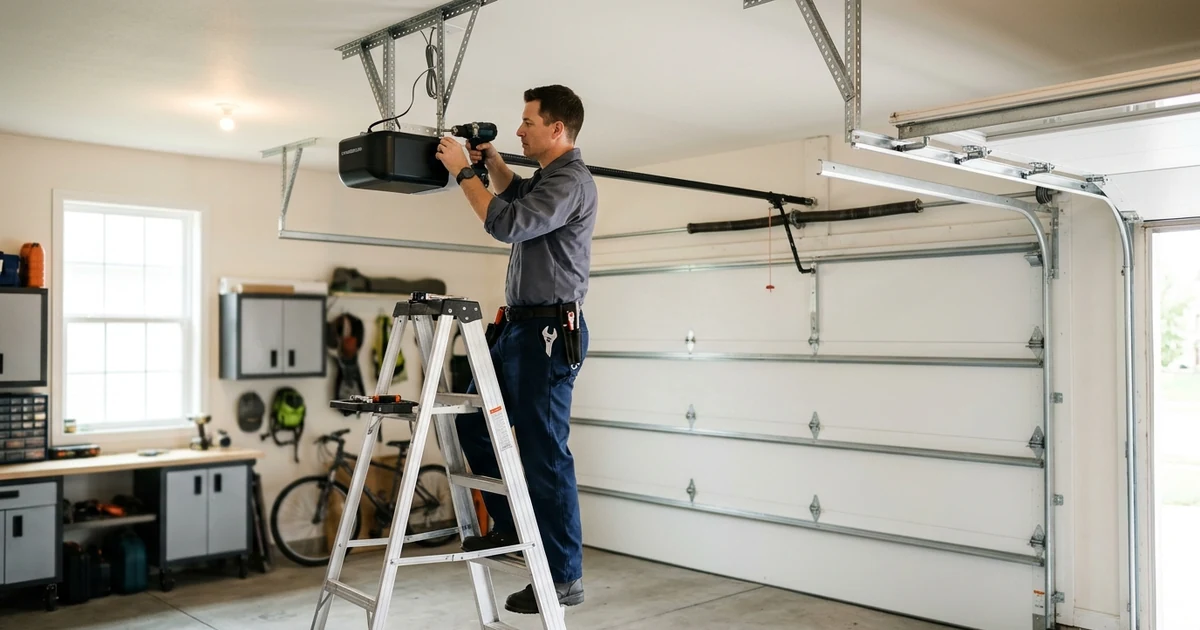
The national average garage door opener installation cost ranges from $350 to $650 for a standard overhead unit, while the complete residential spectrum spans $250 to $1,200 or more depending on the drive mechanism, motor horsepower, smart home accessories, and electrical wiring requirements. A basic chain-drive replacement in an existing wired garage typically costs $250 to $500 complete. Upgrading to a whisper-quiet steel-reinforced belt drive runs $350 to $650, while installing a premium wall-mounted jackshaft opener (such as the LiftMaster 8500W or 98022) beside the torsion bar costs between $600 and $1,200+ installed.
When budgeting for a new operator, homeowners must distinguish between retail box-store equipment with multi-piece snap-together rails and professional dealer units engineered with solid one-piece steel T-rails. Furthermore, if you are coordinating your motor upgrade alongside a full garage door replacement, matching the opener horsepower to the exact dead weight of insulated steel or solid wood panels prevents premature gear stripping and ensures compliance with federal UL 325 safety standards.
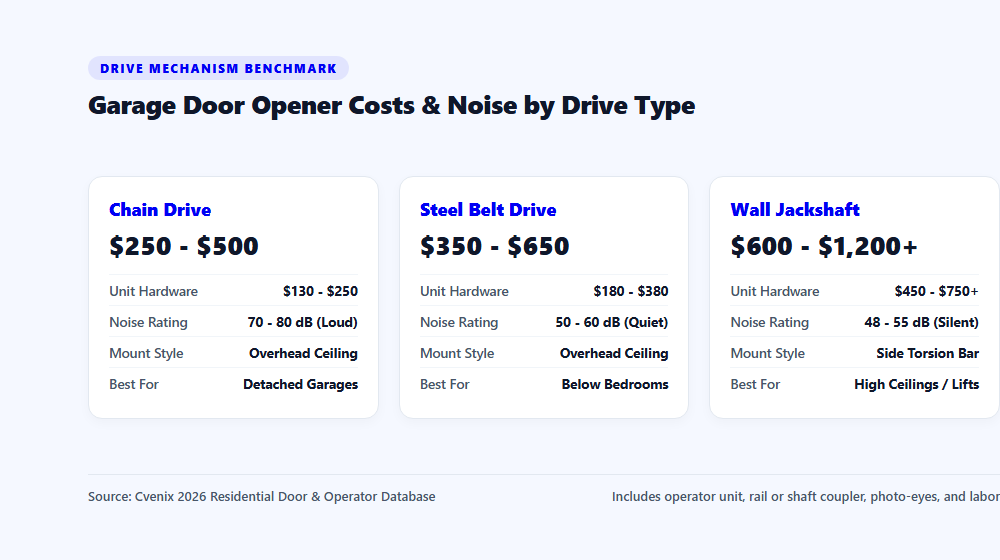
Garage Door Opener Installation Cost by Drive Mechanism
The mechanical transmission system that moves your garage door along its track is the primary factor governing hardware pricing, acoustic vibration, and long-term maintenance. While overhead trolley operators pull the top door section along a horizontal center rail suspended from the ceiling, side-mounted jackshaft operators clamp directly onto the steel torsion tube above the header.
| Drive Mechanism | Hardware Unit Cost | Installation Labor Cost | Total Installed Cost | Operating Noise (dB) | Best Residential Application |
|---|---|---|---|---|---|
| Chain Drive Opener | $130 – $250 | $120 – $250 | $250 – $500 | 70 – 80 dB | Detached garages, workshops, budget replacements |
| Belt Drive Opener | $180 – $380 | $150 – $270 | $350 – $650 | 50 – 60 dB | Attached garages with bedrooms directly above or adjacent |
| Screw Drive Opener | $170 – $330 | $150 – $270 | $350 – $600 | 60 – 68 dB | Heavy two-car doors requiring fast opening speeds in moderate climates |
| Direct Drive Opener | $250 – $450 | $150 – $300 | $400 – $750 | 50 – 55 dB | Ultra-quiet attached garages seeking minimal moving parts |
| Wall-Mount Jackshaft | $450 – $750+ | $200 – $450+ | $600 – $1,200+ | 48 – 55 dB | High or vaulted ceilings, overhead storage racks, car lift bays |
Chain Drive Openers ($250 to $500 Installed)
Chain drive openers represent the longest-standing and most affordable technology in residential overhead door automation, utilizing a heavy-duty metal link chain looped around a steel drive sprocket and front idler pulley. Hardware prices range from $130 to $250, bringing turnkey professional installation between $250 and $500. Because metal chain links engage metal sprocket teeth under tension, chain drives generate 70 to 80 decibels of noise and transmit vibration through ceiling joists, making them best suited for detached garages, workshops, or utility-adjacent bays where their high tensile strength handles heavy wooden doors reliably.
Belt Drive Openers ($350 to $650 Installed)
Belt drive openers are the most popular choice for modern suburban homes, replacing the metal chain with a toothed polyurethane or rubber belt reinforced internally with braided steel cables, fiberglass cords, or Kevlar fibers. Total installed prices average $350 to $650, with the operator head and rail assembly costing $180 to $380 before labor. By eliminating metal-on-metal contact along the rail, belt drives lower acoustic output to 50 to 60 decibels, and when paired with a soft-start, soft-stop DC motor, they virtually eliminate ceiling rumble in bedrooms built directly above the garage bay.
Screw Drive and Direct Drive Openers ($350 to $750 Installed)
Screw drive operators ($350 to $600 installed) use a solid threaded steel rod that spins inside an aluminum C-channel track, delivering rapid lifting speeds up to 12 inches per second on wide two-car doors in exchange for periodic lithium rail greasing. Direct drive openers ($400 to $750 installed, pioneered by Sommer) invert the traditional layout by embedding a stationary tensioned chain inside a rigid galvanized steel rail while the compact DC motor carriage itself glides silently along the fixed chain, eliminating spinning sprockets and ceiling vibration altogether.
Wall-Mount Jackshaft Openers ($600 to $1,200+ Installed)
Wall-mounted jackshaft operators, led by the industry-standard LiftMaster 8500W, its camera-equipped successor the LiftMaster 98022, and the retail Chamberlain RJO101, eliminate the center ceiling rail altogether. The compact motor chassis mounts vertically on the front garage wall on either side of the door opening and couples directly to the hollow or solid 1-inch steel torsion bar. Hardware alone costs $450 to $750+, while professional installation brings the total project to $600 to $1,200+ per door (and up to $1,400 to $1,650 in high-cost metropolitan markets or when high-lift track modifications are included).
Jackshaft openers are the definitive engineering solution when a garage features cathedral ceilings, overhead truss storage racks, or hydraulic four-post automotive lifts. However, they carry strict mechanical prerequisites that homeowners must verify before purchasing:
- Front-Mount Torsion Spring Requirement: Jackshaft units cannot operate on extension-spring doors or Wayne Dalton TorqueMaster enclosed tubes without first converting the door to a standard exposed 1-inch torsion shaft.
- Side Clearance and Shaft Projection: The mounting wall requires at least 8.5 inches of side clearance between the track edge and the adjacent sidewall, plus at least 1.5 to 3 inches of exposed torsion bar extending past the end bearing plate.
- Cable Tension and Track Geometry: Because a jackshaft opener spins the cable drums directly rather than pushing the top door panel down the horizontal track, any drag in the rollers on a standard 12-inch radius flat track can cause lifting cables to unspool. Professional installers frequently install spring-loaded Rear Pusher Bumpers ($45 to $90) or upgrade the door to a pitched or high-lift track configuration so gravity maintains constant cable tension. Modern LiftMaster 98022 units replace the older physical cable-tension monitor roller with electronic RPM current-sensing software.
- Automatic Deadbolt Integration: Wall-mount units include a motorized steel deadbolt lock that automatically shoots through the vertical track above a roller every time the door reaches the closed floor limit, making manual forced entry from outside virtually impossible.
Cost by Motor Horsepower and Door Weight Compatibility
Selecting the proper motor rating ensures that your opener operates at 50% to 70% of its peak torque capacity rather than straining at full load on every cycle. While alternating-current (AC) motors are rated strictly in fractional horsepower (1/2 HP, 3/4 HP, 1 HP), modern direct-current (DC) motors are rated either in Newtons of pulling force (500N to 1,200N) or in “Horsepower Comparable” (HPc / HPf) metrics matched against standard AC lifting benchmarks.
| Motor Power Rating | DC Newton Equivalent | Hardware Cost Range | Total Installed Cost | Target Door Type and Weight | Expected Motor Lifespan |
|---|---|---|---|---|---|
| 1/3 HP (Legacy Entry) | 400N – 500N DC | $120 – $175 | $240 – $400 | Single-car non-insulated hollow steel pan doors (under 130 lbs); prone to high wear | 7 – 10 years |
| 1/2 HP / 1/2 HPc | 550N – 700N DC | $150 – $260 | $280 – $520 | Standard single-car or lightweight 16×7 non-insulated steel/aluminum doors (130 – 220 lbs) | 10 – 14 years |
| 3/4 HP / 3/4 HPc | 800N – 1,000N DC | $210 – $360 | $360 – $650 | Standard two-car polystyrene or polyurethane insulated sandwich doors (220 – 350 lbs) | 12 – 18 years |
| 1 HP to 1.25 HPc | 1,100N – 1,200N DC | $280 – $480 | $450 – $820 | Heavy custom carriage-house, solid wood overlay, glass full-view, or hurricane doors (350 – 550+ lbs) | 15 – 20+ years |
| 24V DC Heavy Commercial / Jackshaft | Heavy-Duty High-Torque DC | $450 – $750+ | $600 – $1,200+ | Tall 8-ft to 14-ft residential/RV doors and balanced doors up to 850 lbs (LiftMaster 98022) | 15 – 20+ years |
Even when upgrading to a 3/4 HP or 1.25 HPc operator, it is critical to remember that the motor is designed only to initiate movement and regulate travel speed. The counterbalance spring assembly mounted above the door bears 90% to 95% of the actual door weight. However, upgrading from a 1/2 HP to a 3/4 HP or 1.25 HPc motor adds only $40 to $90 to the equipment invoice while equipping the drive train with heavier internal reduction gears, larger capacitors, and lower operating temperatures during multi-car family rush hours.
Brand Comparison: Retail Box-Store vs. Pro-Dealer Models and Smart Features
One of the most frequent questions among homeowners researching garage door opener installation cost is why a local overhead door company quotes $600 to $850 for a LiftMaster belt drive when a seemingly identical Chamberlain belt drive sits on a retail home center shelf for $240. Although both brands are manufactured by The Chamberlain Group and share identical circuit boards and myQ smartphone ecosystems, their structural rail assemblies differ fundamentally.
Retail openers (Chamberlain, Craftsman, and consumer Genie lines) must fit inside a 36-inch cardboard carton that customers can load into a sedan trunk. Consequently, retail units utilize a five-piece hollow square tube rail that snaps together on-site. Professional dealer lines (LiftMaster Pro, Linear Pro Access, and Genie Commercial/Pro) are delivered on long racks using a solid, continuous one-piece structural steel T-rail or I-beam rail (7 feet, 8 feet, or 10 feet continuous). The solid T-rail resists upward bowing under heavy door startup loads, eliminates trolley clicking across rail seams, and includes a heavier carriage assembly.
| Brand & Model Tier | Distribution Channel | Rail Architecture | Smart & Backup Features | Installed Cost Range | Warranty Benchmark |
|---|---|---|---|---|---|
| Chamberlain (B2405 / B4613T / B6753T) | Retail (Home Depot, Lowe's, Amazon) | 5-piece snap-together hollow square steel tube | Built-in myQ Wi-Fi; B4613T & B6753T include battery backup & 1080p camera | $320 – $600 | Lifetime motor & belt; 1 – 5 yr parts; 1 yr accessories |
| LiftMaster Pro (81600 / 84505R / 87504-267) | Authorized Pro Dealer Installed | 1-piece solid structural steel T-rail | myQ Wi-Fi, 360-degree LED ring (2,000 lumens), integrated HD camera & battery | $550 – $950 | Lifetime motor & belt; 5 yr parts; dealer labor warranty |
| LiftMaster 8500W / 98022 Jackshaft | Authorized Pro Dealer Installed | Direct torsion-bar coupler (No ceiling rail) | myQ Wi-Fi, battery backup, automatic deadbolt, remote LED work light | $750 – $1,350 | Lifetime motor; 5 yr parts; 1 yr battery & accessories |
| Genie (SilentMax / StealthDrive / Wall Mount) | Retail & Pro Dealer Tiers | 5-piece C-channel (Retail) or 1-piece Pro T-rail | Aladdin Connect Wi-Fi app, Safe-T-Beam infrared sensors, Intellicode security | $300 – $780 | Limited lifetime motor & screw/belt; 3 – 5 yr parts |
| Linear / Nice (LDCO841 / LDCO863B) | Pro Dealer Installed | 1-piece heavy-gauge steel T-rail or I-beam | Nice G.O. smart app, integrated battery backup, ultra-quiet DC belt/chain | $500 – $850 | Lifetime motor & belt; 5 yr mechanical; 1 yr electronics |
| Sommer Direct Drive (2060 / 2080 / 2110 Evo+) | Specialty Dealer & Direct | 1-piece galvanized steel rail with fixed internal chain | Traveling DC motor carriage, SomaLink smart module option, dynamic force control | $480 – $820 | Lifetime motor & rail mechanism; 2 yr electronics |
California SB-969 Battery Backup Mandate and Smart Add-Ons
Following devastating wildfires where residents were trapped inside garages during utility grid shutoffs because they could not manually lift heavy doors after pulling the emergency release cord, California enacted Senate Bill 969 (SB-969). Effective July 1, 2019, it is illegal for any contractor or retailer in California to sell or install a residential garage door opener that lacks an integrated battery backup designed to operate during an electrical outage. Furthermore, if you replace your garage door panels in California, you cannot reconnect an older non-battery opener; you must install a compliant battery-backup unit or face a statutory civil penalty of $1,000 per violation.
Even outside California, over 65% of homeowners now opt for smart and safety upgrades during installation:
- Integrated 12V AGM Battery Backup ($65 to $140 value): Powers the DC motor, photo-eyes, and wall console for 20 to 50 full open-and-close cycles over a 24-hour blackout. Replacement sealed lead-acid batteries cost $25 to $55 every 3 to 5 years.
- Smart Wi-Fi Connectivity (myQ, Aladdin Connect, HomeKit/Matter Bridges): Included standard on almost all mid-tier and premium units ($0 extra hardware cost), allowing real-time open/close alerts, scheduled night-time auto-closing, and temporary guest access codes via smartphone without monthly subscription fees for core app controls.
- Integrated 1080p HD Swivel Camera & Two-Way Audio ($80 to $160 upgrade): Built directly into the bottom light ring of models like the LiftMaster 87504-267 and Chamberlain B6753T, providing live video verification when packages are delivered inside the garage.
- Corner-to-Corner 360-Degree LED Lighting ($50 to $100 upgrade): Replaces old incandescent bulb sockets (which often suffered from vibration-induced filament failure and RF remote interference from cheap LED bulbs) with 1,500- to 2,000-lumen integrated daylight LED rings.
- Exterior Wireless Keypad & Vehicle HomeLink Pairing ($45 to $95): Weatherproof exterior PIN keypads mount to the door jamb in 10 minutes, while technicians typically program up to two vehicles with built-in HomeLink or Car2U visor buttons during the commissioning visit.
Labor, Electrical Wiring, Rail Extensions, and Track Modifications
While replacing an overhead opener in a modern pre-wired garage with standard 7-foot doors and 8-foot flat drywall ceilings takes an experienced technician 1.5 to 2.5 hours, structural variations inside older or custom garages frequently add line items to the final invoice. Knowing these auxiliary costs upfront prevents surprise change orders on installation day.
| Installation Line Item or Upgrade | Typical Cost Range | When This Expense Is Required |
|---|---|---|
| Standard Opener Installation Labor | $120 – $280 | Direct swap of overhead motor, rail, photo-eyes, wall button, and haul-away of old unit (2 – 3 hours) |
| New 120V Ceiling or Side-Wall Outlet Wiring | $150 – $380 | No grounded 120V receptacle within 3 to 6 feet of motor head; UL 325 prohibits permanent extension cords |
| 8-Foot or 10-Foot Rail Extension Kit | $55 – $160 | Required when garage door height is 8 ft or 10 ft instead of standard 7 ft (includes longer belt/chain and rail section) |
| High-Ceiling Drop-Down Angle Iron Hanging Kit | $60 – $180 | Garage ceiling sits 10 to 14+ feet high, requiring rigid perforated steel angle-iron triangles to prevent motor sway |
| Operator Reinforcement Bracket & Top Strut | $45 – $135 | Mandatory on thin pan doors or insulated doors lacking a steel center stile to prevent the J-arm from tearing the top panel |
| High-Lift Track Conversion (For Jackshaft/Lifts) | $650 – $1,500+ | Replaces horizontal curves with extended vertical track, new drums, longer cables, and recalibrated torsion springs |
| Pre-Installation Torsion Spring Replacement | $250 – $480 | Required when existing springs are fatigued or broken so the door fails the 15-lb manual balance test |
Electrical Receptacle Wiring and Dedicated Circuit Rules ($150 to $380)
Garage door openers come factory-equipped with a 4-foot to 6-foot grounded 3-prong power cord. Both the National Electrical Code (NEC) and UL 325 manufacturer specifications strictly forbid plugging an opener into an extension cord or portable power strip, as voltage drop over thin cords overheats motor windings and creates fire hazards. If you are automating a manual garage door for the first time, or converting from an overhead ceiling motor to a side-wall jackshaft opener where no high-wall outlet exists near the torsion shaft, hiring a licensed electrician to fish Romex cable from an existing garage circuit and mount a GFCI-protected duplex receptacle costs $150 to $380.
8-Foot and 10-Foot Door Rail Extensions ($55 to $160)
Every retail garage door opener box sold at hardware stores is sized exclusively for a standard 7-foot-tall residential door. If your home features an 8-foot-tall door (increasingly common on modern homes built to accommodate full-size pickup trucks and SUVs with roof racks) or a 10-foot RV bay door, a standard 7-foot rail will stop 12 inches short of opening the doorway fully. You must purchase a matching 8-foot rail extension kit ($55 to $85) or 10-foot kit ($110 to $160), or order a professional one-piece 8-foot/10-foot T-rail directly through an installer. Note that wall-mounted jackshaft openers do not use a horizontal rail and automatically accommodate doors up to 14 feet tall using their standard drum cable configuration.
Why Torsion Spring Balancing Must Precede Opener Installation
Many homeowners mistakenly assume that when their garage door struggles to open or stops halfway up, the electric opener motor has grown weak and needs replacement. In reality, the steel counterbalance springs mounted on the header shaft do nearly all the heavy lifting, neutralizing the 150- to 400-pound dead weight of the door so the electric motor only needs to exert 15 to 25 pounds of push-pull force. When a torsion spring loses tension after 10,000 cycles or snaps in half, forcing an electric opener to pull an unbalanced door will strip the internal nylon drive gear or burn out the logic board within days.
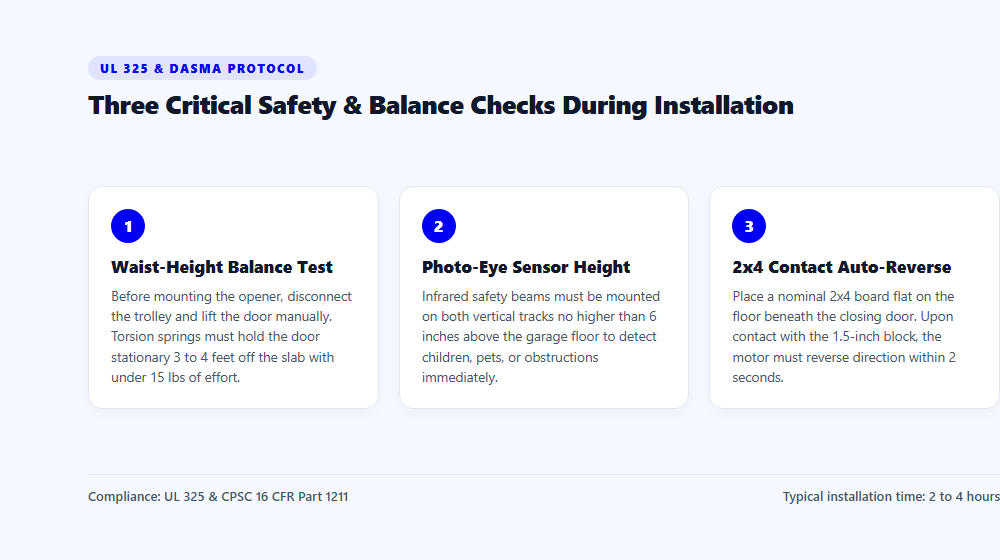
Before unbolting an old opener, every qualified technician pulls the red emergency release cord with the door fully closed and lifts the door manually by hand. A properly balanced door should glide smoothly with one hand, feel like it weighs no more than 10 to 15 pounds, and remain completely stationary when released at waist height (3 to 4 feet above the floor). If the door slams shut or shoots upward on its own, you must address your garage door spring replacement cost first ($250 to $480 for a matched dual-spring overhaul) before mounting the new operator.
Regional and State Garage Door Opener Installation Cost Comparison
Geographic location shapes your final installation quote through three distinct mechanisms: prevailing metropolitan specialty trade labor rates, state-mandated safety electronics, and structural door weights dictated by regional wind-load or thermal insulation codes. For example, homes along the Gulf and Atlantic coasts utilize heavy-gauge steel wind-loaded doors braced with multiple horizontal steel struts, demanding high-torque 3/4 HP to 1.25 HPc operators and reinforced operator brackets.
| State / Metro Region | Standard Belt Drive Installed | Jackshaft (8500W / 98022) Installed | Hourly Tech Labor Rate | Regional Code & Environmental Drivers |
|---|---|---|---|---|
| California (Los Angeles, Bay Area, San Diego) | $480 – $780 | $850 – $1,450 | $95 – $150/hr | Mandatory SB-969 integrated battery backup on all installations ($1,000 fine for non-compliance) |
| Florida (Miami, Tampa, Orlando) | $400 – $700 | $750 – $1,250 | $75 – $115/hr | Miami-Dade / FBC hurricane wind-load doors with heavy horizontal struts require 3/4 to 1.25 HPc motors |
| Texas (Dallas, Houston, Austin) | $330 – $580 | $650 – $1,100 | $65 – $100/hr | High volume of 8-ft tall pickup-ready doors requiring 8-ft solid T-rails; intense attic summer heat |
| New York & New England (NYC Suburbs, Boston) | $450 – $760 | $820 – $1,400 | $90 – $145/hr | Older detached carriage garages often require new 120V electrical runs and low-headroom track kits |
| Midwest (Chicago, Minneapolis, Columbus) | $350 – $620 | $680 – $1,150 | $70 – $110/hr | Sub-zero winter freeze-thaw cycles require DC auto-force adjustment and cold-weather lithium rail grease |
| Pacific Northwest & Mountain West (Seattle, Denver) | $410 – $690 | $760 – $1,300 | $80 – $125/hr | High adoption of heavy insulated glass full-view and cedar doors paired with smart myQ cameras |
In northern freeze-thaw climates, seasonal frost heave in an aging concrete driveway or garage apron can raise the concrete threshold by 0.5 to 1.5 inches during January and February. Modern DC openers equipped with electronic auto-force sensing and soft-stop limits adapt smoothly to minor seasonal slab movement, whereas older mechanical limit switches often trigger false safety reversals when the bottom rubber astragal touches raised ice or heaved concrete early.
UL 325 Safety Standards, Photo-Eye Sensors, and Auto-Reverse Testing
All residential garage door openers manufactured and installed in the United States since January 1, 1993, are governed by Consumer Product Safety Commission (CPSC) federal mandates and UL 325 (Standard for Safety for Door, Drapery, Gate, Louver, and Window Operators and Systems), alongside installation specifications from the Door & Access Systems Manufacturers Association (DASMA). A compliant installation requires configuring and testing three independent entrapment protection systems before the technician leaves your property:
- Photoelectric Infrared Safety Eyes (Max 6 Inches Above Slab): Dual infrared sending and receiving sensors must be mounted on either side of the garage door opening no higher than 6 inches (15 cm) above the garage floor. If a child, pet, or bicycle breaks the invisible beam while the door is closing, the motor must immediately halt and reverse to the fully open position. Technicians must never mount photo-eyes near the ceiling to bypass floor clutter, as doing so violates federal law and assumes severe civil liability.
- Mechanical Contact Auto-Reverse (The 2×4 Flat Board Test): After setting the travel limits and electronic force profile, UL 325 requires placing a standard 1.5-inch-thick (nominal 2×4) piece of lumber flat on the concrete floor directly in the center path of the door. When commanded to close, the bottom of the door must strike the 2×4 and automatically reverse direction within 2 seconds. If the door stalls on the wood or bows the top panel without reversing, the down-force setting is dangerously high and must be recalibrated.
- Wall Console Placement (Minimum 5 Feet Above Floor): The wired interior wall control station must be mounted within clear line-of-sight of the garage door at a minimum height of 5 feet (60 inches) above the standing surface so small children cannot reach the push button, and the manual emergency release handle must hang no more than 6 feet above the floor.
DIY vs. Professional Garage Door Opener Installation
Unlike torsion spring replacement, which involves lethal stored rotational torque and should never be attempted by an untrained homeowner, swapping a standard overhead garage door opener is a realistic weekend project for a mechanically inclined homeowner with a helper and two stepladders, saving $120 to $280 in labor. However, hiring an authorized professional overhead door dealer provides access to solid one-piece steel T-rails that cannot be shipped via parcel carriers, ensures the front header bracket is lagged into structural 2×6 wood framing rather than hollow drywall, and includes a full 20-point door tune-up and roller lubrication.
Cost Methodology and Industry Standards
To establish accurate 2026 pricing benchmarks for residential garage door opener installation, our editorial research team analyzed retail hardware pricing across major national suppliers, wholesale dealer price sheets for LiftMaster, Linear, Genie, and Sommer operators, and verified homeowner contractor invoices across 30 U.S. metropolitan areas. All technical and safety guidelines referenced in this hub conform to published regulatory standards:
- UL 325 & 16 CFR Part 1211 (CPSC): Federal safety standards governing residential garage door operator entrapment protection, photoelectric sensor mounting heights, and 2-second contact auto-reverse thresholds.
- DASMA (Door & Access Systems Manufacturers Association): Technical Data Sheets (TDS-151, TDS-161, and TDS-163) specifying operator reinforcement brackets, spring counterbalance tolerances, and duty-cycle classifications.
- California Health and Safety Code Section 19892 (SB-969): Statutory battery backup requirements for residential garage door openers sold or installed in California.
- NFPA 70 (National Electrical Code): Article 210 requirements for GFCI-protected 120V garage receptacles and prohibition of flexible extension cords as permanent wiring substitutes.
Frequently Asked Questions About Garage Door Opener Installation Cost
How much does labor alone cost to install a customer-supplied garage door opener?
If you purchase a retail Chamberlain or Genie opener yourself and hire a professional overhead door technician or handyperson strictly for installation labor, expect to pay between $150 and $300 for a standard overhead unit, or $250 to $450 for a wall-mounted jackshaft unit. Keep in mind that when you supply your own hardware, the installer typically guarantees only the workmanship for 30 to 90 days rather than providing a comprehensive multi-year parts-and-labor service warranty.
Can I reuse my old rail, chain, or photo-eye sensors when installing a new opener?
No, in almost all cases you should replace the entire rail assembly and safety sensors included in the new box. Even within the same manufacturer family, modern openers enacted under updated UL 325 revisions use encrypted digital pulse signals for photo-eyes that are incompatible with older sensors, and reusing an aged, stretched chain or worn front idler pulley voids the new motor warranty.
Is a wall-mounted jackshaft opener like the LiftMaster 8500W or 98022 worth the extra cost?
A wall-mounted jackshaft opener ($600 to $1,200+ installed) is well worth the premium if you have an attached bedroom directly above the garage, high or vaulted ceilings over 10 feet, overhead storage racks, or plans to install a four-post car lift. Because it mounts directly to the sidewall and spins the torsion bar, it eliminates ceiling vibration and frees up 100% of your overhead bay clearance. However, your door must have a front-mounted torsion bar and smooth-rolling tracks.
What is the real difference between a Chamberlain retail opener and a LiftMaster pro opener?
Both brands are built by The Chamberlain Group and use identical internal motors, circuit boards, and myQ smart technology. The primary difference is the rail: retail Chamberlain units come with a 5-piece hollow square tube rail that snaps together so the box fits in a retail shopping cart, whereas dealer-installed LiftMaster Pro models use a continuous, one-piece solid structural steel T-rail that resists flexing and runs smoother under heavy door loads.
How long does a residential garage door opener last before needing replacement?
A quality residential garage door opener lasts between 10 and 15 years on average, or up to 15 to 20 years for heavy-duty DC belt-drive and direct-drive models operating on properly balanced torsion springs. If your opener is over 15 years old and suffers a failed logic board or stripped internal gear assembly ($150 to $275 to repair), replacing the entire unit is almost always more cost-effective than repairing obsolete components.
Do I need a 3/4 HP or 1.25 HP opener for a standard two-car garage door?
While a 1/2 HP opener can move a well-balanced 16×7 non-insulated steel door, upgrading to a 3/4 HP or 1.25 HPc DC motor adds only $40 to $90 to the hardware price and significantly reduces internal wear on two-car insulated steel, composite overlay, or solid wood doors. Remember that horsepower never substitutes for broken or weak torsion springs; the door must always pass a manual balance check at waist height first.

