A typical residential metal roof cost ranges from $5.00 to $16.00 per square foot installed for common materials, with most homeowners spending between $7,500 and $40,000 for a complete installation on a standard 1,500 to 2,500 square foot home. Premium architectural standing seam systems typically run between $11.50 and $20.50 per square foot, which brings full project totals to $17,000 to $45,000 or more. While a metal roof requires two to three times more upfront capital than traditional shingles, it provides a 40 to 70-year service life, superior wind and fire resistance, and lower lifetime life-cycle expenses.
Investing in a metal roof represents a fundamental shift from temporary roofing materials to a permanent architectural barrier. Standard three-tab and architectural asphalt shingles remain popular due to lower upfront pricing, but they typically require tear-off and replacement every 15 to 25 years. As outlined in our overall roof replacement cost guide, repeated tear-offs, rising disposal fees, and escalating roofing labor can easily double or triple your long-term shelter expenses. Selecting the right metal panel style, alloy, gauge thickness, and fastener system allows you to match your project budget with your home’s structural requirements.
| Roofing system | Fastener type | Material cost per sq ft | Labor cost per sq ft | Total installed cost per sq ft | Expected lifespan |
|---|---|---|---|---|---|
| Corrugated steel / 5V-crimp | Exposed screws | $1.00 – $5.00 | $4.00 – $7.00 | $5.00 – $12.00 | 20 – 30 years |
| Standing seam steel (snap-lock) | Concealed clips | $4.00 – $7.00 | $5.00 – $9.00 | $9.00 – $16.00 | 50 – 70+ years |
| Standing seam steel (mechanically seamed) | Concealed clips | $5.00 – $8.50 | $6.50 – $12.00 | $11.50 – $20.50 | 50 – 70+ years |
| Stone-coated steel shingles or shakes | Concealed and interlocking | $3.50 – $6.00 | $3.50 – $7.00 | $7.00 – $13.00 | 40 – 70 years |
| Architectural copper standing seam | Concealed clips | $8.50 – $18.00 | $9.50 – $22.00 | $18.00 – $40.00+ | 100+ years |
| House footprint (sq ft) | Roof surface area (sq ft) | Corrugated installed cost | Standing seam installed cost | Stone-coated steel installed cost |
|---|---|---|---|---|
| 1,000 sq ft | 1,150 sq ft | $5,750 – $13,800 | $10,350 – $18,400 | $8,050 – $14,950 |
| 1,500 sq ft | 1,725 sq ft | $8,625 – $20,700 | $15,525 – $27,600 | $12,075 – $22,425 |
| 2,000 sq ft | 2,300 sq ft | $11,500 – $27,600 | $20,700 – $36,800 | $16,100 – $29,900 |
| 2,500 sq ft | 2,875 sq ft | $14,375 – $34,500 | $25,875 – $46,000 | $20,125 – $37,375 |
| 3,000 sq ft | 3,450 sq ft | $17,250 – $41,400 | $31,050 – $55,200 | $24,150 – $44,850 |
| 3,500 sq ft | 4,025 sq ft | $20,125 – $48,300 | $36,225 – $64,400 | $28,175 – $52,325 |
The 3 Core Metal Roof Systems: Styles, Mechanics, and Costs
Residential metal roofing divides into three distinct categories based on panel fabrication, fastener mechanics, and architectural profile. Understanding how these systems differ in mechanical attachment and water shedding helps you evaluate quotes and select the right roof for your property.
Corrugated and exposed-fastener metal roofing
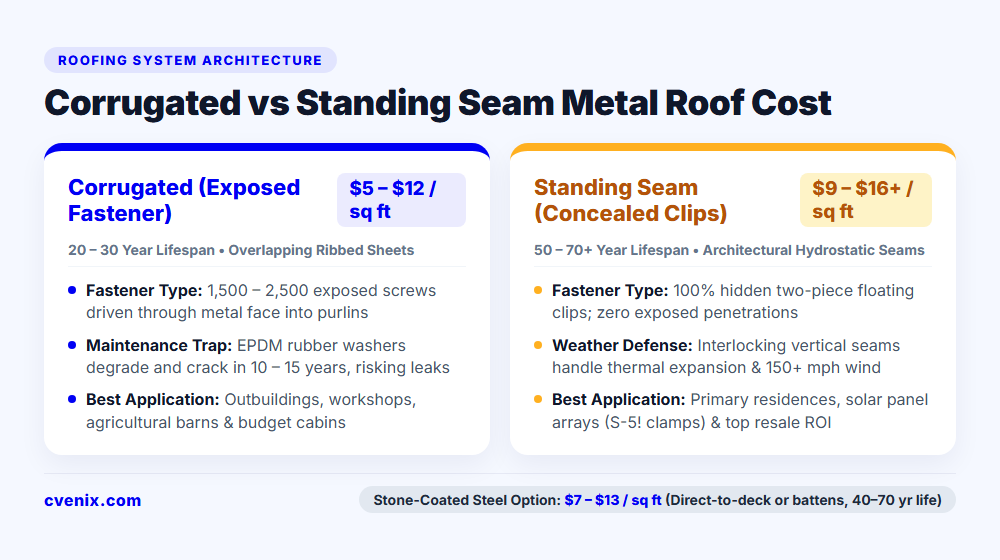
Corrugated metal panels represent the most budget-friendly entry point into metal roofing. The raw materials cost between $1.00 and $5.00 per square foot, and total installation runs from $5.00 to $12.00 per square foot, or $500 to $1,200 per roofing square. These systems feature roll-formed steel or aluminum sheets with repeated parallel wave, U-panel, or 5V-crimp ribs that overlap at adjacent edges.
Contractors secure corrugated panels by driving hex-head screws directly through the face of the metal into wood purlins or solid roof sheathing. While this exposed fastening method speeds up installation and keeps initial labor costs low, it creates an ongoing maintenance commitment. On a standard 2,000 square foot roof, an exposed-fastener system requires between 1,500 and 2,500 screw penetrations. Each screw relies on an EPDM synthetic rubber washer to seal out rain.
Over time, intense ultraviolet radiation, summer heat, and thermal movement cause these rubber washers to dry rot, crack, or pull loose within 10 to 15 years. Because of this maintenance cycle, corrugated panels are best suited for single-story utility sheds, detached garages, workshops, rural agricultural barns, and budget cabins where periodic inspection is simple and occasional minor leaks will not ruin finished living space.
Standing seam concealed-fastener metal roofing
Standing seam metal roofing is the gold standard for residential architecture. Raw materials cost between $4.00 and $8.00 per square foot, while total professional installation ranges from $9.00 to $16.00 per square foot, or $900 to $1,600 per square. Premium installations featuring heavy-gauge metal or complex multi-pitch rooflines often reach $11.50 to $20.50 per square foot, bringing complete projects to $17,000 to $45,000 or more.
The defining feature of standing seam is its concealed fastener design. Adjacent metal panels interlock along raised vertical seams that rise 1 inch to 2 inches above the flat panel surface. All mounting clips and screws remain completely hidden beneath the interlocking seams, shielding them from sunlight, wind-driven rain, and freeze-thaw cycles. Because zero screw heads pierce the weather-exposed panel surface, standing seam systems virtually eliminate fastener leak risks and deliver a reliable service life of 50 to 70 years or more.
Standing seam profiles divide into two main assembly styles:
- Snap-lock panels: Adjacent panel edges snap together over hidden clips without specialized mechanical equipment. Snap-lock systems install quickly and perform well on roof slopes of 3:12 and steeper.
- Mechanically seamed panels: Installers roll adjacent panel edges together using an electric or hand-operated seaming machine. Single-lock folds bend the metal 90 degrees, while double-lock folds bend the seams a full 180 degrees. Mechanically seamed profiles form a hydrostatic, watertight barrier required on low-pitch roofs down to a 1:12 slope.
Stone-coated steel shingles, shakes, and tiles
Stone-coated steel roofing combines the structural strength of metal with the traditional aesthetic of architectural asphalt shingles, hand-split cedar shakes, or Mediterranean barrel tiles. Raw materials cost between $3.50 and $6.00 per square foot, and full professional installation ranges from $7.00 to $13.00 per square foot, or $700 to $1,300 per square. Most complete residential installations fall between $10,500 and $32,500.
These panels are stamped from 26-gauge Galvalume steel sheet coated with an acrylic resin basecoat, natural ceramic-fired stone granules, and an acrylic overglaze. The ceramic stone coating deadens impact noise from rain, shields the underlying steel from ultraviolet rays, and produces deep architectural shadow lines. Homeowners associations that prohibit industrial standing seam panels frequently approve stone-coated steel because it blends seamlessly with neighboring asphalt or tile roofs.
Installers mount stone-coated panels using two different methods:
- Direct-to-deck installation: Stamped panels are fastened directly through the roof underlayment into solid plywood or OSB roof decking. This method requires less labor and keeps upfront installation costs near the lower end of the pricing scale.
- Counter-batten grid installation: Contractors anchor 2×2 wood or steel battens across the roof deck before securing the metal panels. This batten grid adds $1.00 to $2.50 per square foot in carpentry labor and framing materials, but creates a continuous air pocket beneath the panels. Known as above-sheathing ventilation, this air buffer reduces heat transfer into your attic and helps prevent winter ice dams.
Detailed Metal Roof Cost Breakdown: Materials, Labor, and Permits
Understanding where your money goes helps you compare contractor estimates and evaluate project scope. Unlike asphalt shingle projects where raw materials make up half the expense, metal roofing requires extensive custom sheet metal fabrication that shifts most of the budget into skilled labor.
Cost component allocation
On a typical residential metal roofing project, total expenses divide across five distinct categories: metal panels and trim packages, installation craftsmanship, existing roof tear-off, specialized underlayment, and local building permits. The following breakdown illustrates typical allocations for a standard 2,000 square foot home requiring 23 roof squares of material.
| Cost component | Percentage of budget | Cost per square (100 sq ft) | Cost for typical 2,000 sq ft home (23 squares) | Details |
|---|---|---|---|---|
| Metal panels, clips, and trim | 35% – 45% | $300 – $700 | $6,900 – $16,100 | Galvalume steel panels, ridge caps, rakes, valleys, and starter strips |
| Installation and fabrication labor | 50% – 65% | $400 – $800 | $9,200 – $18,400 | Precision measuring, on-site hemming, cutting, and seaming |
| Old roof tear-off and disposal | 8% – 15% | $100 – $300 | $2,300 – $6,900 | Asphalt shingle stripping, haul-away, and dumpster landfill fees |
| High-temp synthetic underlayment | 3% – 6% | $30 – $90 | $690 – $2,070 | 240°F-rated synthetic barrier and self-adhering ice membrane |
| Municipal permits and inspections | 1% – 3% | $15 – $40 | $350 – $920 | Building department filings, plan reviews, and final sign-offs |
Why professional metal roofing labor costs 50% to 65% of the invoice
Labor to install a residential metal roof runs between $400 and $800 per square, or $4.00 to $8.00 per square foot. By comparison, general roofing crews install standard asphalt shingles for $150 to $300 per square. That wide gap often surprises homeowners, but it reflects a completely different level of trade specialization.
Asphalt shingles are manufactured as flexible, uniform mats that general laborers can rapidly nail down with pneumatic nail guns in one or two days. Standing seam metal roofing, by contrast, is custom architectural sheet metal work. Installers must carefully measure roof geometry, square each panel, align concealed clips, and hand-hem sheet metal edges at eaves, rakes, hips, valleys, and sidewalls. Rushing an installation or bending a panel incorrectly can crease the metal, ruin the factory paint coating, or cause water intrusion.
Jobsite safety protocols also increase labor overhead. Unpainted and painted metal panels have slick surfaces that become extremely hazardous when damp or dusty. Crews must set up dedicated roof scaffolding, safety harness anchor lines, and specialized hoisting equipment to lift long panels onto upper roofs without kinking or scratching the metal.
Metal Types, Steel Gauges, and Architectural Finishes
The metal alloy, sheet thickness, and protective paint finish you select dictate how your roof withstands coastal salt air, violent windstorms, winter snow loads, and summer heat. Matching these specifications to your regional climate protects your investment.
Comparing roofing metal alloys: steel, aluminum, copper, and zinc
Different metals offer unique combinations of structural rigidity, weight, corrosion defense, and visual character. The four most common residential options include Galvalume steel, galvanized steel, aluminum, and luxury architectural metals like copper and zinc.
- Galvalume steel: Carbon steel coated with a hot-dipped alloy of 55% aluminum, 43.4% zinc, and 1.6% silicon. Galvalume is the residential roofing industry benchmark, offering two to four times better rust protection than standard galvanized steel at a moderate material price of $1.50 to $5.00 per square foot.
- Galvanized steel (G-90): Carbon steel protected by a hot-dipped layer of pure zinc. G-90 galvanized panels cost between $1.50 and $4.50 per square foot for materials. While durable in dry inland environments, cut edges can develop surface rust in humid or coastal climates if not properly sealed.
- Aluminum: A lightweight metal that will never rust, making it mandatory for homes located within 1,500 feet of ocean saltwater coastlines. Aluminum costs $3.00 to $7.00 per square foot for materials and $8.00 to $16.00 per square foot installed. Because aluminum is softer than steel, specifying heavier panels prevents hail denting.
- Copper: The premier architectural metal. Copper develops an unmistakable green verdigris patina over decades and lasts 100 to 200 years or more. Raw copper costs $8.50 to $18.00 per square foot for materials, leading to total installed quotes of $18.00 to $40.00 or more per square foot.
- Zinc: An architectural metal that forms a protective zinc carbonate patina when exposed to carbon dioxide and moisture. This patina self-heals minor scratches over time and provides a service life of 80 to 100 years. Raw zinc panels cost $6.00 to $12.00 per square foot, with installed costs ranging from $14.00 to $28.00 per square foot.
| Metal type | Material cost per sq ft | Installed cost per sq ft | Lifespan | Best climate application |
|---|---|---|---|---|
| Galvalume steel (24-ga) | $3.00 – $7.00 | $9.00 – $16.00 | 50 – 60 years | General residential, heavy snow, and hail zones |
| Galvanized steel G-90 (26-ga) | $1.50 – $4.50 | $7.00 – $13.00 | 30 – 50 years | Moderate inland climates and budget projects |
| Aluminum (0.032-in) | $3.00 – $7.00 | $8.00 – $16.00 | 50+ years | Coastal environments within 1,500 ft of saltwater |
| Copper (16 oz / 20 oz) | $8.50 – $18.00 | $18.00 – $40.00+ | 100+ years | Historic restorations and luxury architectural estates |
| Zinc (0.8 mm) | $6.00 – $12.00 | $14.00 – $28.00 | 80 – 100 years | Modern custom homes and self-healing applications |
Steel gauge thickness: 29, 26, 24, and 22-gauge explained
In sheet metal manufacturing, gauge follows an inverted measurement scale: a lower gauge number indicates a thicker, heavier, and more durable piece of steel. Selecting the wrong gauge is one of the most common mistakes budget-minded homeowners make.
Here is how the four standard steel roofing gauges compare in cost and structural performance:
- 29-gauge steel (0.014-inch thickness): Raw material costs run $1.00 to $3.00 per square foot. This thin sheet metal dents easily under small hail or standard foot traffic and flexes in strong winds. It is suitable for agricultural barns, sheds, and detached carports, but should never be installed on a primary residential home.
- 26-gauge steel (0.018-inch thickness): Raw material costs range from $1.50 to $5.00 per square foot. This is the common entry-level residential grade used for corrugated panels and basic snap-lock standing seam in mild climates with light winds and minimal hail.
- 24-gauge steel (0.024-inch thickness): Raw material costs run $3.00 to $7.00 per square foot. This is the recommended residential standard for high-wind coastal areas, heavy snow regions, and hail alleys. The thicker steel provides superior structural stiffness and significantly resists unsightly oil canning ripples.
- 22-gauge steel (0.030-inch thickness): Raw material costs range from $4.00 to $8.00 per square foot. This heavy commercial and industrial grade provides extreme wind uplift resistance on coastal high-rises and public municipal buildings.
Paint coatings and solar reflectance index (SRI)
Bare steel and aluminum require high-performance factory coatings to shield the base metal from sun oxidation, chalking, and paint peel. The chemical composition of the coating determines how long the roof keeps its rich, original color.
- Kynar 500 / PVDF (Polyvinylidene Fluoride): The gold standard for architectural standing seam roofs. Made of 70% fluoropolymer resin, PVDF coatings withstand intense ultraviolet sunlight, resisting fading and chalking for 30 to 40 years or more.
- SMP (Siliconized Modified Polyester): A quality mid-tier finish frequently applied to 26-gauge corrugated and residential ribbed panels. SMP finishes provide 20 to 30 years of reliable service at a 15% to 25% lower coating cost than PVDF, though darker shades may begin slight chalking after 15 years.
- Standard polyester: An economy coating applied to entry-level 29-gauge utility panels. Standard polyester coatings often begin micro-cracking and fading within 5 to 10 years of sun exposure.
| Coating system | Chemical base | Chalk and fade warranty | UV resistance | Relative cost |
|---|---|---|---|---|
| Kynar 500 / Hylar 5000 | 70% Polyvinylidene fluoride (PVDF) | 30 – 40 years | Exceptional (minimal chalking or color shift) | Premium ($$$) |
| Super SMP | Siliconized modified polyester | 20 – 30 years | High (slight chalking after 15 years) | Moderate ($$) |
| Standard polyester | Basic polyester resin | 5 – 10 years | Fair (rapid color fading and surface chalk) | Economy ($) |
Quality metal finishes also feature cool roof chemistry with high Solar Reflectance Index (SRI) ratings. These specialized pigments reflect up to 70% of solar infrared rays away from the roof deck rather than absorbing them into the structure. In sunny summer climates, a high-SRI metal roof reduces attic air temperatures by 20°F to 35°F, trimming 10% to 25% off your summer cooling electricity costs.
Key Factors That Drive Installation Costs
Roof size is only the baseline starting point when estimating total project investment. Roof pitch, architectural geometry, existing shingle tear-off, and underlayment upgrades all influence the final contractor estimate.
Roof size, pitch, and slope complexity
Contractors calculate roof materials based on actual surface area rather than a home’s ground footprint. A two-story home with a 2,000 square foot ground footprint easily requires 2,200 to 2,800 square feet of actual roofing surface once slope angles, eaves, and gable overhangs are factored into the calculation.
Roof pitch directly impacts crew safety and installation speed:
- Low pitch (under 4:12): Installers can walk comfortably across the roof surface without special rigging, keeping baseline labor costs low.
- Moderate pitch (4:12 to 7:12): Manageable slopes that allow standard rope-and-harness anchoring.
- Steep pitch (8:12 to 12:12 and above): Steep slopes prevent crews from walking directly on the metal. Installers must set up specialized staging ladders, roof brackets, and dual-line safety harnesses, which increases labor costs by 20% to 45%.
Roof geometry adds another layer of fabrication expense. A simple gable roof with two flat rectangular planes requires minimal trimming, producing just 5% to 10% scrap metal waste. Conversely, complex hip roofs featuring multiple intersecting valleys, dormers, turrets, and skylights require continuous custom measuring and hand-hemming, increasing material scrap rates to 15% to 25% and doubling on-site fabrication hours.
Roof tear-off versus overlay code compliance
Stripping off your existing asphalt shingle roof costs between $1.00 and $3.00 per square foot, or $100 to $300 per roofing square. On a typical 2,000 square foot home, complete tear-off and dumpster disposal adds $1,500 to $4,500 to your total invoice.
Some contractors suggest installing metal panels directly over your old asphalt shingles to save money on tear-off labor. However, you must verify local building codes first. Under International Residential Code (IRC) Section R908.3.1.1, a new roof covering cannot be installed over an existing roof that already has two or more layers of any roofing material. If your home already has two shingle layers, full tear-off is legally mandatory.
Even if your roof has only a single shingle layer, professional sheet metal fabricators strongly advise against overlays for four critical reasons:
- Deck rot concealment: Overlays prevent contractors from inspecting the underlying plywood or OSB decking for dry rot, moisture delamination, and sagging rafters.
- Moisture entrapment: Trapped condensation between old asphalt shingles and hot metal panels creates a humid microclimate that can degrade roof rafters.
- Surface telegraphing: Uneven shingle tabs and curled edges push against the underside of flat metal panels, creating visible buckling and oil canning.
- Flashing compromises: Installing metal over old shingles makes it difficult to seat custom metal valley liners and sidewall step flashings tightly against exterior walls, increasing future leak risks. If your home has worn siding, coordinating roof replacement with your siding replacement cost ensures wall flashings tie seamlessly into your moisture barrier.
Underlayment and flashing requirements
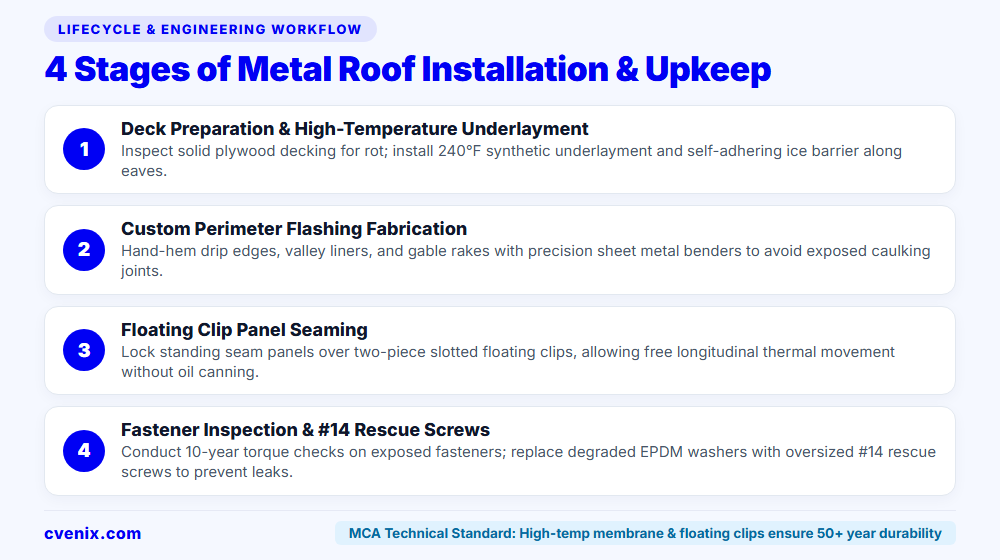
Standard 15-pound or 30-pound asphalt organic felt underlayment should never be used beneath a metal roof. Metal panels conduct extreme heat during summer months, causing traditional asphalt felt to bake, become brittle, and adhere to the metal underside. Metal roofs require high-temperature synthetic underlayments rated to at least 240°F.
In freeze-thaw climates, building codes mandate self-adhering ice and water shield membranes along all eaves, extending at least 24 inches inside the interior heated wall line. This rubberized membrane is also required along valleys, roof hips, and chimney sidewalls to protect against wind-driven rain. Complete trim packages including ridge vents, drip edges, rake trims, and custom transition flashings typically add $1,200 to $3,500 to a residential installation. If your eaves require updated drainage, planning your gutter installation cost alongside your new drip edge ensures water discharges cleanly away from your foundation.
Metal Roof Cost by State and Region
Metal roof replacement expenses vary substantially across the United States. Regional labor rates, municipal permit regulations, and climatic engineering codes create significant differences in total project quotes.
Regional labor markets and climatic building code impacts
In high-cost metropolitan markets like the Northeast and West Coast, skilled union sheet metal wages and high business overhead push installed prices 40% to 75% higher than rural markets in the Midwest and South. Local building codes also dictate panel specifications. In coastal Florida, for example, the Florida Building Code mandates certified high-velocity hurricane assemblies (including Miami-Dade and Broward county approvals) with tight clip spacing and heavy-gauge panels engineered to resist 150 to 175 mph winds.
| State or region | Average installed cost per sq ft | Typical total cost (2,000 sq ft home) | Primary climate and code drivers |
|---|---|---|---|
| Northeast (NY, MA, PA) | $12.00 – $20.00 | $27,600 – $46,000 | High union labor rates, heavy snow loads, and mandatory ice dam membranes |
| Southeast (FL, GA, NC) | $10.50 – $17.50 | $24,150 – $40,250 | High-velocity hurricane zones (150-175 mph wind clips, Florida Building Code) |
| Midwest (OH, IL, MN) | $9.00 – $16.00 | $20,700 – $36,800 | Severe freeze-thaw cycling, thermal movement management, and snow retention |
| South / Southwest (TX, AZ, OK) | $8.50 – $15.50 | $19,550 – $35,650 | Intense solar UV radiation, severe hail resistance, and cool roof SRI coatings |
| West Coast / Mountain (CA, WA, CO) | $12.50 – $21.00 | $28,750 – $48,300 | Wildfire WUI Class A fire codes, seismic detailing, and high installer wage rates |
Critical Engineering Considerations and Maintenance Traps
To ensure your metal roof reaches its full operational lifespan, your installation must address thermal movement physics, fastener aging, winter snow loads, and rooftop equipment integration.
Exposed screw maintenance and rescue screw retrofitting
Homeowners who purchase corrugated metal roofing expecting 50 years of zero maintenance are often caught off guard by fastener degradation. While the steel panels can endure for decades, the 1,500 to 2,500 exposed screws holding them down begin failing after 10 to 15 years.
Because corrugated panels are fastened rigidly through their faces, daily thermal expansion and contraction causes the metal sheets to slide slightly against the wood purlins. This continuous cycling loosens screws, wallows out the pilot holes in the wood framing, and crushes the EPDM rubber sealing washers. Ultraviolet radiation accelerates this breakdown by hardening the rubber, causing it to split and weep rainwater into your attic framing.
When maintaining or re-screwing an aged corrugated roof, driving new factory-size #10 or #12 screws into stripped, enlarged holes will not hold torque. Contractors use oversized #14 diameter rescue screws fitted with 5/8-inch or 3/4-inch vulcanized EPDM bonded washers. These heavy rescue screws grip fresh wood fibers and create an airtight, watertight seal over wallowed-out screw penetrations.
Preventing oil canning on standing seam panels
Oil canning describes visible waviness, dimpling, or rippling across the flat pans of standing seam metal roofs. While oil canning does not reduce structural weather resistance, it creates an uneven, buckled appearance that frustrates homeowners who paid tens of thousands for clean architectural lines.
The root cause of oil canning is thermal expansion stress. A 30-foot continuous steel roofing panel expands and contracts roughly 1/4 inch across an 80°F temperature swing. If panels are pinned tightly at both ends, fastened over uneven roof decking, or held by overtightened clips, the expanding metal has nowhere to go and buckles outward.
You can prevent oil canning before installation by specifying the following engineering triad:
- Heavy 24-gauge steel: Specify 24-gauge (0.024-inch) steel rather than thin 26-gauge or 29-gauge metal. Thicker metal has greater natural beam strength that resists surface deflection.
- Surface striations or pencil ribs: Order standing seam panels with longitudinal striations, pencil ribs, or fluted pans. These subtle factory-formed ribs break up flat sheet metal spans, reducing visible oil canning distortion by over 70% compared to completely smooth, flat pans.
- Slotted floating expansion clips: Require two-piece slotted floating expansion clips on all panels longer than 20 feet. These clips allow the metal panels to expand and contract smoothly along the seam without binding.
Snow guard engineering and ice slide prevention
In northern and high-altitude freeze-thaw zones, smooth metal roofs present a sudden winter hazard known as a roof avalanche. Unlike rough asphalt shingles that grip snow, slick metal panels warm up rapidly under winter sunshine. Meltwater forms a frictionless film between the metal and accumulated snowpacks, causing hundreds of pounds of compacted snow and ice to slide off eaves in sudden sheets.
These snow slides can rip perimeter gutters off eaves, crush ground-level air conditioning condensers, damage deck railings, and endanger pets or pedestrians below. Installing engineered snow retention systems protects your property. Homeowners can install cast aluminum color-matched snow guards or continuous dual-pipe snow rails along eaves and over entryways. On standing seam roofs, these retention systems clamp directly to the vertical seams using non-penetrating clamps, preserving watertight integrity for $10 to $25 per linear foot.
Solar panel array integration and detach fees
If your home already has a rooftop solar photovoltaic system, replacing your roof requires removing the panels before tearing off the old covering. Certified solar electricians charge between $2,000 and $3,000 to de-energize, detach, safely store, and reinstall a standard residential solar array. If you are exploring future solar additions, checking your solar panel installation cost before selecting your roof material helps you coordinate mounting hardware.
Standing seam metal roofing is the ideal platform for rooftop solar. Installers can attach solar panel mounting rails directly to the standing seam ribs using aluminum S-5! clamps. These mechanical clamps grip the seam without drilling a single screw hole through the roof deck, eliminating leak points and keeping your roof warranty intact.
Long-Term Financial Return, Insurance Discounts, and Lifespan
While metal roofing demands two to three times more upfront capital than asphalt shingles, calculating lifecycle performance over a 50-year horizon reveals a compelling financial return.
Metal versus asphalt shingle life-cycle economics
A standard architectural asphalt shingle roof costs between $5,700 and $12,000 upfront, but typically requires complete replacement every 20 to 25 years. Over a 50-year period, an asphalt shingle roof will need two full replacements. When factoring in inflation, escalating labor wages, and rising landfill disposal fees, paying for three shingle installations totals $34,000 to $42,000.
By contrast, a quality standing seam metal roof installed for $23,000 lasts 50 to 70 years or more with minimal maintenance. On a long-term cost basis, standing seam provides lower annualized shelter expenses. Furthermore, homeowners who install metal roofs recoup an average of 85% or more of their investment in increased home resale value, compared to 60% to 65% for asphalt shingles.
| Feature or expense | Architectural asphalt shingles | Standing seam metal roof | Stone-coated steel roof |
|---|---|---|---|
| Initial installation cost | $8,500 | $23,000 | $18,500 |
| Expected service life | 20 – 25 years | 50 – 70+ years | 40 – 70 years |
| Number of replacements over 50 years | 2 replacements | 0 replacements | 0 replacements |
| Cost of replacements (factoring inflation) | $24,000 – $32,000 | $0 | $0 |
| Routine maintenance over 50 years | $1,500 (shingle blow-offs, caulking) | $500 (sealant touch-ups) | $800 (granule inspection) |
| Estimated 50-year total investment | $34,000 – $42,000 | $23,500 | $19,300 |
| Resale value recoup | 60% – 65% | 85%+ | 80%+ |
Insurance premium discounts and the cosmetic hail exclusion trap
Most residential metal roofs carry a UL 2218 Class 4 impact resistance rating, which certifies that the metal can withstand a 2-inch steel ball dropped from 20 feet without cracking or puncturing. In hail-prone states across the Midwest and Southern Plains, insurance carriers reward homeowners who install Class 4 roofs with annual premium discounts ranging from 5% to 35% on their dwelling insurance coverage.
However, you must be aware of a critical policy trap. In high-risk hail regions, insurance carriers frequently require homeowners to sign an ISO HO 04 21 endorsement, known as a Cosmetic Damage Exclusion. Under this endorsement, the insurer will not pay to replace metal panels if hail leaves visible surface dents or dimples, provided the metal is not punctured and water does not penetrate your home. Homeowners who file claims for dented panels under this endorsement receive $0 from their carrier while having a claim recorded on their Comprehensive Loss Underwriting Exchange (CLUE) property report.
Acoustic performance and rain noise science
One of the most persistent myths surrounding metal roofs is that heavy rain will sound deafeningly loud inside living spaces. Homeowners often conflate residential metal roofs with uninsulated metal barns or commercial storage sheds.
In a standard residential home, the roofing assembly features 5/8-inch solid wood roof decking, continuous synthetic underlayment, and an insulated attic floor. Under acoustic laboratory testing conducted by the Metal Construction Association, heavy rainfall on a metal roof installed over solid decking and R-38 attic insulation registers an interior sound level of 52 decibels (dB). Standard architectural asphalt shingles under identical rainfall conditions register 49 dB. That 3 dB difference is virtually undetectable to human ears, sounding like a gentle ambient hum. If you are upgrading attic insulation during your roofing project, blown-in cellulose or fiberglass further dampens acoustic vibrations.
Professional Installation vs. DIY and Contractor Vetting
Installing a metal roof requires specialized trade equipment, engineering knowledge, and fall protection gear, making it poorly suited for do-it-yourself homeowners.
Why metal roofing is rarely a DIY project
Standing seam metal roofing requires sheet metal tools that most homeowners do not own, including electric shears, panel benders, locking hand seamers, and precision torque drivers. Handling 20 to 30-foot metal panels on a sloped roof requires experienced multi-person crews who know how to maneuver flexible metal sheets in gusty winds without kinking them.
Furthermore, major coil manufacturers (such as Sheffield Metals, McElroy Metal, and Drexel Metals) require certified installation practices to honor their 30 to 40-year paint and watertight performance warranties. The only practical DIY metal roofing application is installing basic 29-gauge corrugated panels on a single-story detached utility shed, wood storage shelter, or ground-level carport where complex flashing is not required.
How to vet metal roofing contractors and spot bid red flags
When collecting estimates for a standing seam roof, watch out for astronomical quotes ranging from $80,000 to $115,000 on standard homes. In the roofing trade, these are known as “go-away” quotes. Large roofing companies that specialize in one-day asphalt shingle tear-offs often submit inflated metal bids because they lack specialized sheet metal fabricators and prefer to scare homeowners back into buying shingles.
Ask each contractor whether they roll custom panels on-site using a portable roll-forming machine or order factory-cut panels. On-site roll-forming allows the installer to roll continuous full-length panels customized to your exact eave-to-ridge dimensions, eliminating weak horizontal lap joints across your roof planes.
Use these six essential vetting questions when interviewing metal roofing contractors:
- What exact steel gauge thickness (24-gauge or 26-gauge) and paint coating (Kynar 500 / PVDF or SMP) will be installed?
- Do you install two-piece slotted floating expansion clips on all standing seam panels longer than 20 feet?
- Will all valleys, drip edges, and sidewalls be custom hand-folded on-site, or do you rely on pre-fabricated, caulked trim components?
- Are your installation crews dedicated in-house sheet metal craftsmen, or do you subcontract to general roofing crews?
- What specific high-temperature synthetic underlayment rated to 240°F will you place beneath the metal panels?
- Can you provide written manufacturer warranty documentation and contact information for three local metal roof installations completed more than five years ago?
Cost Estimation Methodology and Data Sources
The pricing benchmarks, material specifications, and engineering data in this guide reflect independent research and rigorous cost modeling across the residential building trades.
Data collection protocol and validation
Our cost models draw from national construction cost estimation databases (including RSMeans, HomeGuide, and RoofingCalc), architectural technical guidelines published by the Metal Construction Association (MCA), and model building codes established by the International Code Council (ICC IRC 2021 and 2024 editions).
Labor rate calculations reflect prevailing wage determinations and contractor productivity benchmarks across more than 40 metropolitan markets in the United States. Material prices reflect wholesale coil and roll-formed panel commodity pricing adjusted for current 2026 market conditions. We independently cross-reference all fastener dimensions, steel gauges, and underlayment specifications with official installation manuals from leading manufacturers, including McElroy Metal, Sheffield Metals, and DECRA Roofing Systems.
Frequently Asked Questions About Metal Roof Costs
Is a metal roof cheaper than asphalt shingles?
No. A metal roof costs two to three times more upfront than asphalt shingles. A new asphalt shingle roof typically costs between $5,700 and $12,000, while a metal roof ranges from $7,500 to $40,000 or more. However, because a quality standing seam metal roof lasts 50 to 70 years compared to 20 to 25 years for shingles, it is often more cost-effective on a per-year lifecycle basis.
What is the cheapest metal roof option?
Corrugated or exposed-fastener steel roofing is the cheapest metal option. Materials cost between $1.00 and $5.00 per square foot, and professional installation ranges from $5.00 to $12.00 per square foot. The tradeoff is that exposed screws require routine inspection and washer replacement every 10 to 15 years to prevent leaks.
How much does a standing seam metal roof cost for a 2,000 sq ft house?
A standing seam metal roof for a typical 2,000 square foot home (which requires roughly 2,300 square feet of actual sloped roof area) costs between $20,700 and $36,800 installed for standard 26-gauge or 24-gauge steel. Complex steep pitches, multiple valleys, or premium copper panels can push total project costs over $45,000.
How long does a stone-coated steel roof last?
A stone-coated steel roof lasts between 40 and 70 years. Most manufacturers provide 50-year limited warranties, Class 4 impact resistance against hail, and 120 mph wind uplift ratings, making them far more durable than traditional asphalt shingles.
Does a metal roof make a house hotter in summer?
No. Metal roofs with cool roof coatings reflect up to 70% of solar radiation away from your home. This high solar reflectance reduces attic air temperatures by 20°F to 35°F compared to dark asphalt shingles, lowering summer air conditioning electricity bills by 10% to 25%.
Can you walk on a metal roof without damaging it?
Yes, provided you follow proper walking protocols. On standing seam roofs, walk on the flat pans wearing soft rubber-soled shoes and avoid stepping directly on the vertical seams. On corrugated panels, step directly over purlins or roof deck supports where screws anchor the metal. On stone-coated steel roofs, step on the balls of your feet on the lower third of each panel where the structural step rests against decking or battens.
Will a metal roof attract lightning?
No. Metal conducts electricity, but it does not attract lightning. Lightning strikes the highest point in an area regardless of roof material. Because metal panels are non-combustible with a Class A fire rating, a metal roof safely dissipates electrical current into the ground without catching fire if struck.
Can I put a new metal roof over an existing layer of shingles?
Under building codes (IRC Section R908.3.1.1), you can install a metal roof over a single layer of asphalt shingles if the roof deck is dry and sound. However, doing so is discouraged by experienced installers because it traps moisture, hides deck rot, and telegraphs uneven shingle tabs through thin metal panels, worsening visible oil canning.