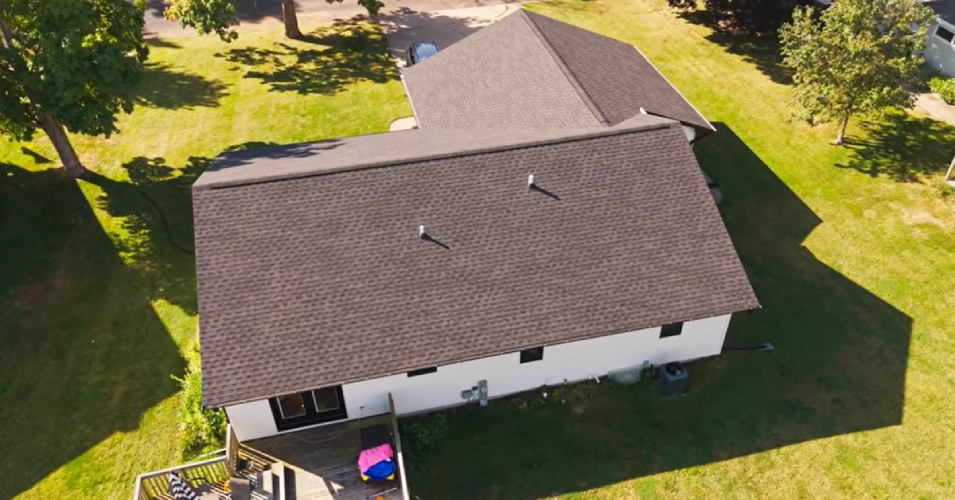
A new asphalt shingle roof costs about $10,300 for a 2,000-square-foot roof, according to Guide A, a national home-improvement guide. Guide B, a cost-data site, puts the national average at $12,000 to $14,500, with a full range of $8,000 to $36,000. Metal runs about $38,600 and clay tile about $44,400 for the same size. Roof size, material, and labor explain most of the gap.
Updated November 5, 2026. We read each source page on that date and copied the figures as published. Rows marked Derived are our own arithmetic.
What is the average roof replacement cost?
It depends on who you ask, and the reasons are worth knowing. Guide A averages $29,909 for a 2,000-square-foot roof, but that number blends in metal, wood shake, and clay tile. Asphalt shingles alone come to $10,319 in the same guide. Guide B lists $12,000 with a range of $8,000 to $16,000 on one page, and $14,500 with a range of $8,000 to $36,000 on another.
If you plan to use asphalt shingles, the most common choice, start with $10,000 to $14,500 for an average-size roof and adjust from there.
| Item | Figure | Source | Label |
|---|---|---|---|
| Asphalt shingles, 2,000 sq ft roof | $10,319 ($5.16 per sq ft) | Guide A, updated 10/07/2026 | Sourced |
| All four materials averaged, 2,000 sq ft roof | $29,909 | Guide A | Sourced |
| National average, asphalt shingles | $12,000 ($8,000 to $16,000) | Guide B, updated Jan 21, 2026 | Sourced |
| National average, 2,000 sq ft roof | $14,500 ($8,000 to $36,000) | Guide B, updated Jan 30, 2026 | Sourced |
| Labor share of the total | 50% to 65% | Guide B, Guide A | Sourced |
Roof replacement cost by size
Price scales with roof area, not floor area. A roof is larger than the house under it because of overhangs and pitch. Guide B’s tables assume a roof about 1.2 times the size of the home.
Cost by roof size and material
| Roof size | Asphalt shingles | Wood shake | Metal | Clay tile |
|---|---|---|---|---|
| 1,000 sq ft | $5,160 | $13,150 | $19,300 | $22,210 |
| 1,500 sq ft | $7,740 | $19,725 | $28,950 | $33,315 |
| 2,000 sq ft | $10,320 | $26,300 | $38,600 | $44,420 |
| 2,500 sq ft | $12,900 | $32,875 | $48,250 | $55,525 |
| 3,000 sq ft | $15,480 | $39,450 | $57,900 | $66,630 |
Source: Guide A, updated 10/07/2026. Its cost data come from a cost-estimating database and assume builder-grade materials, medium labor rates, and low-slope roofs. Label: Sourced.
Cost by house size, asphalt shingles
| House size | Roof size | Price range |
|---|---|---|
| 1,000 sq ft | 1,200 sq ft | $4,800 to $21,600 |
| 1,500 sq ft | 1,800 sq ft | $7,200 to $32,400 |
| 1,700 sq ft | 2,000 sq ft | $8,000 to $36,000 |
| 2,000 sq ft | 2,400 sq ft | $9,600 to $43,200 |
| 2,500 sq ft | 3,000 sq ft | $12,000 to $54,000 |
| 3,000 sq ft | 3,600 sq ft | $14,400 to $64,800 |
Source: Guide B, updated Jan 30, 2026. Label: Sourced. The wide ranges cover every shingle grade, from the cheapest to the most expensive.
Cost by roofing material
Material is the biggest price lever after size. It also sets how long the roof lasts.
| Material | Average for 2,000 sq ft | Per sq ft | Lifespan |
|---|---|---|---|
| Asphalt shingles | $10,319 | $5.16 | 30 to 35 years |
| Wood shake | $26,302 | $13.15 | 30 to 50 years |
| Metal | $38,593 | $19.30 | 40 to 70 years |
| Clay tile | $44,423 | $22.21 | 50 to 100 years |
Source: Guide A. Label: Sourced. Guide B lists wider per-square-foot ranges: asphalt $3 to $16, rubber $4 to $15, wood $6 to $15, metal $6 to $22, composite $7 to $14, slate $10 to $30, and solar $21 to $25 (Guide B, updated Jan 30, 2026).
Asphalt is also the most popular choice. In Guide A’s 2026 survey of 1,000 homeowners, 47% chose it. Its resale value holds up too: the guide cites a 68% return for asphalt and 50% for metal.
Asphalt shingle replacement cost: 3-tab, architectural, and luxury
Not all asphalt shingles cost the same. Guide B breaks them into three grades.
| Grade | Per sq ft installed | Per square (100 sq ft) | Lifespan | Label |
|---|---|---|---|---|
| 3-tab | $3 to $5 | $300 to $500 | 15 to 20 years | Sourced; per square is Derived |
| Architectural | $4 to $8 | $400 to $800 | 25 to 30 years | Sourced; per square is Derived |
| Luxury | $6.50 to $16 | $650 to $1,600 | 30+ years | Sourced; per square is Derived |
Source: Guide B, updated Jan 21, 2026. One caution: Guide B’s other page says 3-tab shingles may last only 10 to 15 years. Architectural shingles usually cost a few dollars more per square foot and last longer, which often makes them the better value.
Roofing cost per square foot and per square
Roofers quote by the square, which is 100 square feet. Multiply any per-square-foot price by 100 to compare. Guide A’s asphalt price of $5.16 per square foot is $516 per square. Guide B’s asphalt range of $3 to $16 per square foot is $300 to $1,600 per square. To price your own roof, measure each roof plane, add them up, and divide by 100.
How much of the price is labor?
More than half. Guide A puts labor at 65% of total project cost, with roofing labor at about $75 an hour. Guide B puts it at 50% to 60%, or $1.50 to $9.60 per square foot. Applying Guide A’s 65% to its $10,319 asphalt price gives about $6,700 for labor and $3,600 for materials (Derived, our arithmetic).
Hidden costs and add-ons
The base price rarely covers everything. These items show up on many invoices.
| Item | Cost | Source | Label |
|---|---|---|---|
| Decking repair (rotted or damaged boards) | $150 to $1,000 or more | Guide B | Sourced |
| Old roof removal and disposal, if billed separately | $50 to $150 per square | Guide B | Sourced |
| Ice and water shield | About $1,000 | Guide B | Sourced |
| Rigid foam insulation (hot climates) | $1,000 to $2,000 | Guide B | Sourced |
| Permits | $100 to $600 | Guide B | Sourced |
Guide A also lists drip edge, flashing, pipe boots, vents, underlayment, and gutter work as extras but gives no prices. Hidden damage matters: about 23% of homeowners who found it paid more than their estimate, compared with 13% of those who did not.
Repair or replace?
A roof older than 15 years usually points to replacement. A younger roof with minor damage usually points to repair. Guide A’s guide sorts it this way.
| Situation | Repair | Replace |
|---|---|---|
| Minor surface damage | Yes | |
| Roof less than 15 years old | Yes | |
| Sound underlying structure | Yes | |
| Extensive surface damage | Yes | |
| Leaks or moisture issues | Yes | |
| Roof older than 15 years | Yes | |
| Structural issues | Yes |
Repairs are much cheaper. Guide B lists $400 to $2,000, with an average of $1,150, against about $14,500 for a full replacement. Ask any roofer who recommends replacement to price both options in writing.
How long does a roof replacement take?
Most jobs take a few days. In Guide A’s survey, 46% of homeowners said the work took 3 to 7 days from start to finish. Plan for more time before the crew arrives. Inspections, insurance paperwork, and scheduling can add a month or more.
Can you replace a roof yourself?
Technically yes, but it is rarely a good idea. Guide B notes that shingle labor averages just under $9,000, which is the most you would save. Falls are the main risk, and mistakes can void the shingle warranty. Check permit rules with your building department, and hire a licensed, insured roofer for anything beyond a small repair.
How to save on a new roof
- Get three quotes. Compare line items, not just totals.
- Schedule off-season. Guide B suggests fall, while Guide A points to spring and winter. Roofers are less busy outside peak season either way.
- Bundle projects. Doing gutters or other exterior work at the same time can cut mobilization costs.
- Check your insurance. Storm damage may be covered. Check your policy or your agent before you sign.
- Match the material to your plans. If you will sell in five years, asphalt returns more of its cost than metal.
What homeowners report
Guide A surveyed 1,000 homeowners who replaced a roof within the past five years. About 79% said the final cost matched what they expected, and 73% said the contractor finished on time. Weather or disaster damage drove 40% of replacements and active leaks drove 25%. Just over half (52%) paid between $5,001 and $20,000.
Frequently asked questions
How much does a new roof cost for a 1,500-square-foot house?
A 1,500-square-foot house has a roof of about 1,800 square feet. Guide B lists $7,200 to $32,400 for that size. Guide A prices a 1,500-square-foot asphalt roof at $7,740. Measure your actual roof, since pitch and overhangs add area.
How much does it cost to replace a 2,000-square-foot roof?
Guide A lists $10,320 for asphalt shingles, $38,600 for metal, and $44,420 for clay tile. Guide B lists $8,000 to $36,000 across all shingle grades.
What is the cheapest roofing material?
Asphalt shingles. At $5.16 per square foot, they cost about half as much as wood shake and a quarter as much as metal, according to Guide A.
How long does a roof last?
Asphalt lasts 30 to 35 years in Guide A’s guide, while Guide B lists 15 to 30. Metal lasts 40 to 70 years, wood shake 30 to 50, and clay tile 50 to 100.
Is it cheaper to repair or replace a roof?
Repair is cheaper up front. Guide B lists $400 to $2,000 for repairs. Replacement makes more sense if the roof is over 15 years old, leaks repeatedly, or has structural damage.
When is the best time to replace a roof?
Sources disagree on the season. Guide B suggests fall and Guide A points to spring and winter. Choose a stretch of dry weather and ask roofers when their schedule is lightest.
Does a new roof add value to your home?
Guide A cites a 68% return on cost for asphalt shingles and 50% for metal.
Related cost guides
- All roofing and gutter guides
- Window replacement cost
- Bathroom remodel cost
- Water heater replacement cost
How we got these numbers
We read three pages from two published sources on November 5, 2026. Guide A is a national home-improvement guide (updated 10/07/2026). It combines a cost-estimating database, built on builder-grade materials, medium labor rates, and low-slope roofs, with a 2026 survey of 1,000 homeowners. Guide B is a cost-data site, and we used two of its pages (updated Jan 21 and Jan 30, 2026). It bases its figures on pricing databases, licensed contractors, and industry experts, and states no sample size. These are published averages, not contractor bids, so get at least three written quotes.