
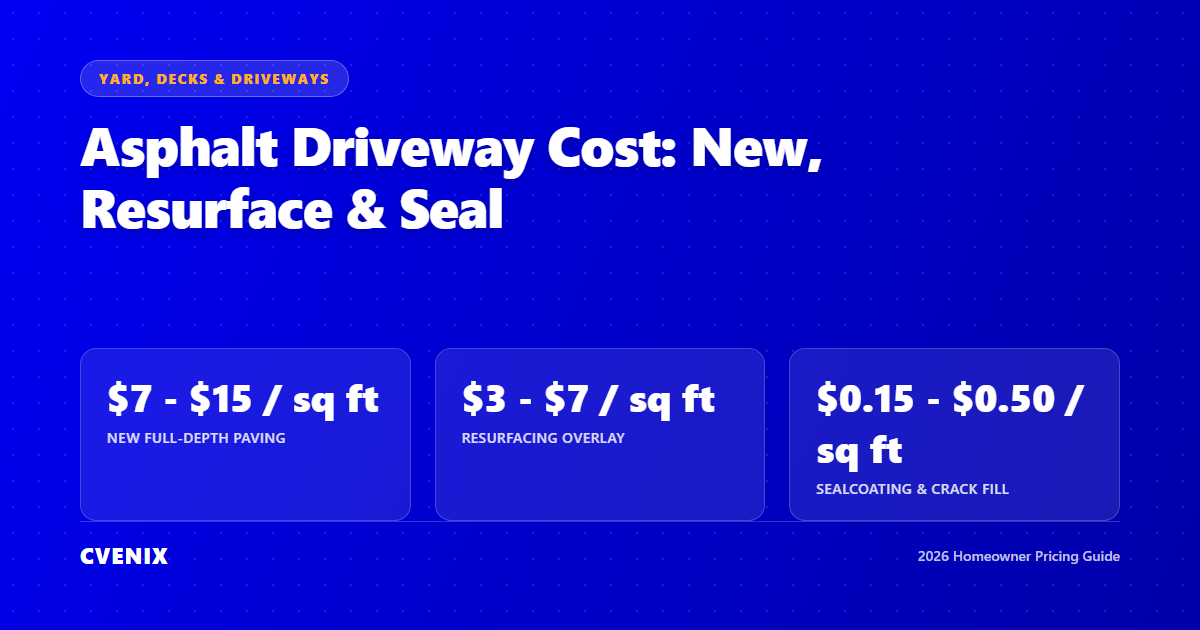
The national average asphalt driveway cost ranges from $7.00 to $15.00 per square foot for a full-depth new installation, bringing a standard 600-square-foot, two-car driveway to $4,200 to $9,000 including topsoil excavation and a compacted crushed-stone subbase. If your existing pavement foundation remains structurally stable without deep base rutting, an asphalt resurfacing overlay costs $3.00 to $7.00 per square foot ($1,800 to $4,200 total), while routine protective sealcoating and hot-pour crack filling run $0.15 to $0.50 per square foot ($150 to $500 per service visit).
Choosing the right scope of work requires inspecting the hidden aggregate layers beneath the blacktop surface. A well-engineered hot-mix asphalt (HMA) pavement installed to National Asphalt Pavement Association (NAPA) specifications delivers 20 to 30 years of service life under daily passenger vehicle loads. Conversely, laying a thin cosmetic overlay over a waterlogged, failing subbase often leads to reflective cracking within 18 months. Below is a complete breakdown of residential paving prices across project scopes, driveway dimensions, asphalt mixes, structural layers, and regional markets.
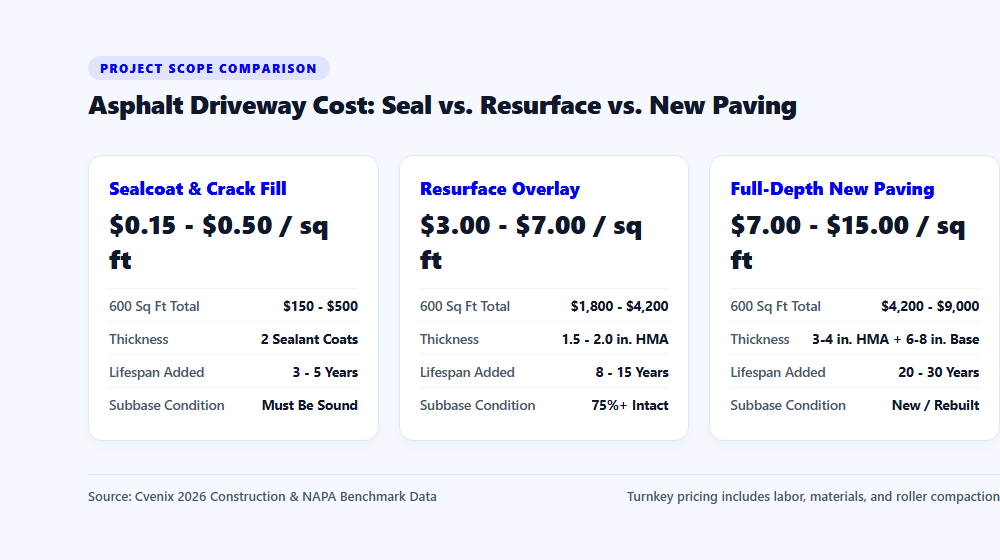
| Project Scope | Cost per Sq Ft | 2-Car Driveway (600 Sq Ft) | Lifespan Added | Best Structural Application |
|---|---|---|---|---|
| Sealcoating and Crack Filling | $0.15 – $0.50 | $150 – $500 (minimum fee) | 3 – 5 years | Sound asphalt with minor oxidation and isolated cracks under 0.5 inches wide |
| Resurfacing (Mill and Overlay) | $3.00 – $7.00 | $1,800 – $4,200 | 8 – 15 years | Intact aggregate base with surface raveling, minor pitting, and under 25% cracking |
| New Full-Depth Installation (Raw Land) | $7.00 – $13.00 | $4,200 – $7,800 | 20 – 25 years | First-time paving requiring topsoil excavation, geotextile fabric, and 6-8 inch gravel base |
| Full Tear-Out and Replacement | $8.00 – $15.00 | $4,800 – $9,000 | 20 – 30 years | Severe alligator cracking, sunken wheel ruts, frost heaving, or subbase clay contamination |
| Hot-Mix Paving Only (Existing Base) | $4.00 – $8.00 | $2,400 – $4,800 | 15 – 22 years | Upgrading an established, properly graded, and compacted gravel driveway to blacktop |
Asphalt Driveway Cost by Project Scope: New, Resurface, or Seal
Homeowners researching blacktop pricing often encounter quotes that vary by thousands of dollars for the exact same square footage. That price spread almost always reflects differences in subbase preparation, asphalt thickness after roller compaction, and transition milling rather than contractor markup alone. Understanding what is included in each tier protects your budget against premature pavement failure.
1. Full-Depth New Installation and Replacement ($7.00 to $15.00 per Sq Ft)
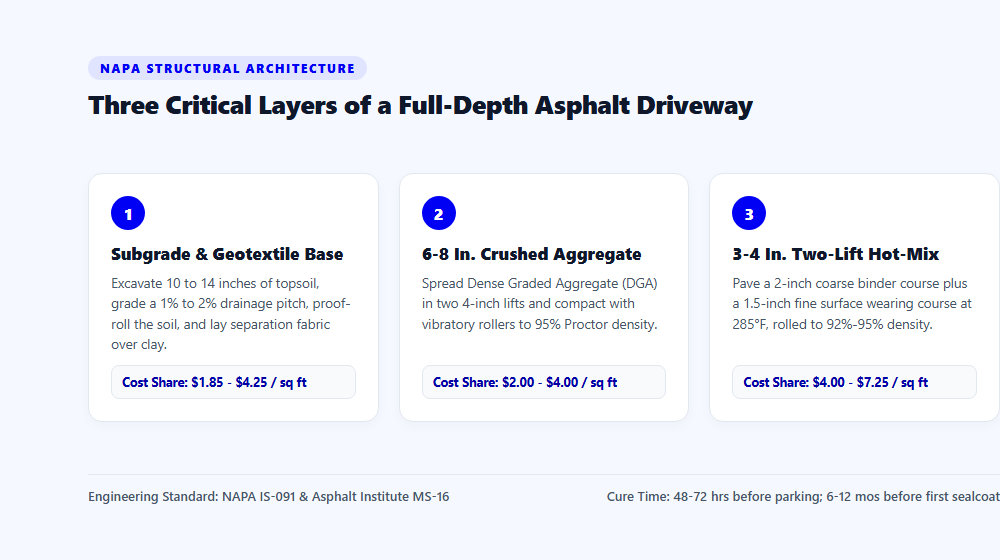
A true full-depth asphalt driveway installation builds a load-bearing roadway from the native soil upward. Because flexible asphalt pavement transfers vehicle weight directly downward into the underlying earth, the blacktop mat itself is only as strong as its gravel foundation. When paving over raw lawn or replacing a collapsed driveway, crews excavate 10 to 14 inches of organic topsoil or broken pavement, haul the debris to a recycling facility, and grade the soil subgrade to a 1% to 2% drainage pitch.
Over soft clay or silty subgrades, contractors install a woven geotextile separation membrane before dumping 6 to 8 inches of Dense Graded Aggregate (DGA) or crushed limestone. The stone base is moistened and compacted in lifts using heavy vibratory drum rollers until it achieves 95% Modified Proctor density. Finally, the paving machine lays 3 to 4 inches of hot-mix asphalt, typically split into a 2-inch coarse binder course for structural strength and a 1.5-inch to 2-inch fine-aggregate surface wearing course for a smooth, water-shedding finish.
2. Asphalt Resurfacing and Mill-and-Overlay ($3.00 to $7.00 per Sq Ft)
Resurfacing, known in the paving industry as a mill-and-overlay, preserves your existing crushed-stone base and lower asphalt binder while installing a fresh 1.5-inch to 2-inch top wearing layer. Before the paving screed arrives, contractors use a cold-planing milling machine to grind down 1.5 to 2 inches of old asphalt along the street apron, sidewalk edges, and garage threshold. This butt-joint milling ensures the new overlay sits completely flush with adjacent concrete slabs so water does not pool against your garage door seal. If you are simultaneously modernizing your entryway, reviewing garage door replacement cost benchmarks helps you coordinate threshold weatherstripping and slab elevation changes before the paving crew sets the final grade.
After milling the transitions, crews route and fill isolated structural cracks, patch any localized potholes with hot binder mix, sweep the surface mechanically, and spray a sticky liquid asphalt emulsion called a tack coat ($0.25 to $0.60 per square foot). The tack coat chemically bonds the old pavement to the new 1.5-inch to 2-inch compacted surface mat, preventing horizontal slippage when vehicles brake or turn sharp corners.
3. Sealcoating and Crack Filling ($0.15 to $0.50 per Sq Ft)
Sealcoating is a preventative maintenance treatment rather than a structural repair. Over time, ultraviolet (UV) solar radiation oxidizes the liquid petroleum bitumen binder that holds asphalt aggregate together, turning the surface from deep charcoal black to brittle gray and causing fine stones to ravel loose. Applying a refined asphalt emulsion or polymer-modified sealer every 3 to 5 years blocks UV oxidation, resists motor oil drips, and seals microscopic surface pores against winter freeze-thaw water intrusion.
Because residential sealcoating crews face fixed equipment mobilization costs, most reputable contractors charge a minimum flat fee of $150 to $350 for a single-car or small two-car driveway, scaling to $0.15 to $0.50 per square foot on larger properties. Linear crack routing and hot-pour rubberized asphalt filler (conforming to ASTM D6690 standards) typically adds $1.00 to $3.00 per linear foot of cracking, or $75 to $250 on a standard residential job.
Turnkey Asphalt Driveway Cost by Size and Car Capacity
Asphalt paving exhibits strong economies of scale. Mobilizing a dump truck fleet, tracked skid-steer loader, self-propelled asphalt paver, and dual-drum vibratory roller costs a contractor nearly the same in transport labor and fuel for a 300-square-foot pad as it does for a 1,200-square-foot driveway. Consequently, small single-car driveways often carry a higher price per square foot ($10.00 to $16.00/sq ft for new construction) than expansive three-car parking courts or long rural lanes ($6.50 to $11.50/sq ft).
| Driveway Configuration | Typical Dimensions | Total Area (Sq Ft) | Sealcoating Cost | Resurfacing Overlay Cost | New Full-Depth Installation |
|---|---|---|---|---|---|
| Single-Car Straight Driveway | 12 ft x 20 ft | 240 sq ft | $150 – $250 (min fee) | $950 – $1,800 | $2,400 – $3,800 |
| Extended Single-Car Stall | 12 ft x 40 ft | 480 sq ft | $175 – $320 | $1,450 – $3,350 | $3,600 – $6,900 |
| Standard Two-Car Driveway | 20 ft x 24 ft to 24 ft x 25 ft | 480 – 600 sq ft | $200 – $400 | $1,800 – $4,200 | $4,200 – $9,000 |
| Two-Car with Turnaround Pad | 20 ft x 35 ft + 10 ft x 15 ft | 850 sq ft | $275 – $525 | $2,550 – $5,950 | $5,950 – $12,750 |
| Three-Car Suburban Driveway | 30 ft x 30 ft to 24 ft x 40 ft | 900 – 1,000 sq ft | $300 – $600 | $2,700 – $7,000 | $6,300 – $14,500 |
| Long Rural Lane (100-Foot Run) | 12 ft x 100 ft | 1,200 sq ft | $320 – $650 | $3,400 – $8,100 | $8,100 – $16,800 |
| Estate or Semi-Circular Driveway | 12 ft x 200 ft | 2,400 sq ft | $480 – $1,100 | $6,500 – $15,600 | $15,600 – $32,400 |
When sizing a new residential driveway, civil engineers recommend a minimum width of 10 to 12 feet for a single-lane run and 20 to 24 feet for side-by-side two-car parking. If your driveway borders a steep drop-off, retaining wall, or drainage ditch, widening the compacted aggregate subbase by 6 to 12 inches beyond the paved asphalt edge prevents the outer wheel track from shearing off under heavy SUV or pickup truck tires.
Asphalt Driveway Cost by Mix Type and Architectural Finish
Not all asphalt pavement is mixed to the same formula at the batch plant. Depending on your local stormwater management regulations, aesthetic preferences, and budget, paving contractors can supply five distinct asphalt formulations. Each mix carries its own material cost per ton (typically $100 to $165 per ton at the plant for standard hot-mix) and specialized installation labor requirements.
| Asphalt Mix / Finish Type | Installed Cost per Sq Ft | 600 Sq Ft Driveway Cost | Expected Lifespan | Key Performance Characteristics |
|---|---|---|---|---|
| Standard Hot-Mix Asphalt (HMA) | $7.00 – $13.00 | $4,200 – $7,800 | 20 – 30 years | Dense-graded virgin aggregate and liquid bitumen heated to 300°F; smooth, durable all-climate standard |
| Recycled Asphalt Pavement (RAP / Millings) | $3.50 – $7.50 | $2,100 – $4,500 | 10 – 20 years | Crushed reclaimed highway millings compacted with roller and optional emulsion seal; budget-friendly for long lanes |
| Chip-and-Seal (Tar-and-Chip) | $4.00 – $8.50 | $2,400 – $5,100 | 10 – 15 years | Hot liquid asphalt sprayed over gravel base and topped with rolled stone chips; high traction, rustic texture, no sealcoating needed |
| Porous / Permeable Asphalt | $9.00 – $18.00 | $5,400 – $10,800 | 20 – 25 years | Open-graded mix without fine sand over an 8-18 inch open stone recharge bed; drains stormwater directly into soil |
| Stamped or Colored Asphalt | $12.00 – $22.00 | $7,200 – $13,200 | 15 – 25 years | Standard HMA embossed with brick or cobblestone templates using infrared heaters and coated with pigmented acrylic-epoxy polymer |
- Standard Dense-Graded Hot-Mix Asphalt (HMA): Comprises 95% crushed stone, gravel, and sand bound together by 5% petroleum asphalt cement heated to 275°F to 300°F. Standard HMA mixes frequently incorporate 15% to 25% factory-processed recycled content at the plant to enhance stiffness while keeping material prices competitive.
- Compacted Recycled Asphalt Millings (RAP): Rather than running reclaimed pavement through a hot drum plant, contractors spread cold or warm crushed highway millings 4 to 6 inches thick over a graded base and compact them with a heavy vibratory roller. Over the first summer, residual bitumen in the millings binds under solar heat to create a semi-rigid, dust-free surface at nearly half the cost of virgin hot-mix.
- Porous (Permeable) Asphalt: Increasingly favored in municipalities with strict impervious-surface stormwater fees, porous asphalt omits fine sand particles so rainwater drains straight through 15% to 20% interconnected void spaces into a deep Underground Choker and Recharge Stone Bed (#2 or #57 washed angular stone). While excavation and stone storage bed costs add $3.00 to $5.00 per square foot, permeable driveways eliminate surface ice puddles and often qualify for municipal stormwater tax credits.
- Tar-and-Chip (Chip Seal): Popular on rural estates, chip-and-seal installation involves spraying hot liquid asphalt binder onto a compacted gravel base, immediately spreading washed pea gravel, bluestone, or granite chips across the sticky tar, and embedding the stone with a rubber-tired roller. Beware that snowplow blades can catch the textured stone if the plow shoes are not raised 0.5 inches.
Structural Layer Breakdown and Site Prep Costs (NAPA Standards)
According to engineering guidelines published by the National Asphalt Pavement Association (NAPA) and the Asphalt Institute, residential driveway longevity depends on three engineering fundamentals: positive water drainage, unyielding subbase support, and proper hot-mix compaction density. When comparing contractor bids, always verify that each structural layer below is itemized with exact compacted thicknesses.
| Structural Layer / Site Phase | NAPA / Industry Specification | Cost per Sq Ft (or Flat Fee) | Share of Total Cost | Why Cutting Corners Causes Failure |
|---|---|---|---|---|
| Demolition, Excavation, and Subgrade Proof-Rolling | Remove 10-14 in. topsoil/old pavement; compact native subgrade | $1.50 – $3.50 / sq ft | 15% – 22% | Paving over organic topsoil or soft clay pockets causes immediate wheel-track sinking |
| Non-Woven / Woven Geotextile Separation Fabric | 4 oz – 6 oz polypropylene fabric over clay or silt subgrades | $0.35 – $0.75 / sq ft | 3% – 5% | Without fabric, wet clay pumps upward into the crushed stone base and destroys load capacity |
| Compacted Crushed Aggregate Subbase | 6 to 8 inches of Dense Graded Aggregate (DGA / 3/4-in. minus) compacted in two lifts | $2.00 – $4.00 / sq ft | 22% – 28% | Using only 2-3 inches of loose gravel leads to frost heaving and alligator fatigue cracking |
| HMA Binder Course (Lower Structural Lift) | 1.5 to 2.5 inches compacted coarse aggregate hot-mix (19mm nominal) | $2.00 – $3.50 / sq ft | 20% – 25% | Omitting the binder lift reduces flexural strength under heavy delivery trucks and SUVs |
| HMA Surface Wearing Course (Top Lift) | 1.5 to 2.0 inches compacted fine aggregate mix (9.5mm or 12.5mm) | $2.00 – $3.75 / sq ft | 22% – 28% | Insufficient roller compaction leaves over 8% air voids, allowing water and salt to rot the mat |
| Drainage Pitch, Swales, and Trench Drains | Minimum 1% to 2% cross-slope (1/8 to 1/4 in. drop per foot) | $500 – $2,800 flat | 5% – 10% | Standing water saturates the subbase and accelerates freeze-thaw pothole formation |
| Edge Curbing, Apron Permits, and Mobilization | 45-degree tamped safety edge or Belgian block curb; municipal right-of-way permit | $250 – $1,500 flat | 3% – 8% | Vertical, uncompacted edges crumble rapidly when tires roll off the side of the driveway |
Two-Lift Paving vs. Single-Lift Full-Depth Placement
A critical technical question to ask any paving estimator is whether they install a two-lift pavement structure (a 2-inch coarse binder course followed by a 1.5-inch fine top wearing course, totaling 3.5 inches compacted) or a single 3-inch lift of all-purpose surface mix. Two-lift construction costs roughly $1.00 to $2.00 more per square foot because the crew must make two separate passes with the paving machine and rollers. However, the coarse stones in the binder course provide superior rutting resistance against heavy garbage trucks, moving vans, and boat trailers, while the second pass eliminates minor grade undulations for a glass-smooth surface.
Subsurface Drainage and Edge Restraint Considerations
Water is the primary enemy of flexible asphalt pavements. If groundwater seeps beneath your driveway from an uphill slope or roof downspouts discharge onto the pavement edge, the saturated aggregate base loses its shear strength. On sloped lots or properties with heavy clay soil, installing a perimeter perforated pipe or trench drain alongside the driveway prevents water from undermining the gravel base. You can explore detailed trenching and gravel envelope pricing in our guide to French drain installation cost before finalizing your paving excavation plan.
How to Decide: Sealcoat, Resurface Overlay, or Tear Out and Replace?
Evaluating your current driveway before calling contractors prevents you from overpaying for an unnecessary tear-out or wasting thousands on an overlay that fails prematurely. Use the diagnostic criteria below to match your pavement symptoms to the right intervention.
- Choose Sealcoating and Crack Filling ($0.15 to $0.50/sq ft) When: The pavement is structurally flat and firm underfoot, with no sunken wheel tracks, birdbaths (standing puddles deeper than 0.25 inches), or interconnected web cracks. Linear shrinkage cracks are narrower than 0.5 inches and cover less than 10% of the surface area. Wait at least 6 to 12 months after a brand-new installation before applying your first sealcoat so light hydrocarbon oils can evaporate and the mat can fully harden.
- Choose Resurfacing / Mill-and-Overlay ($3.00 to $7.00/sq ft) When: The driveway is 12 to 18 years old with surface oxidation, shallow pitting, or minor raveling of top aggregate stones, but at least 75% to 80% of the pavement remains structurally intact. Any localized soft spots must be saw-cut out to the gravel base and patched with hot-mix binder (“dig-out patching” at $8.00 to $15.00/sq ft of patch area) prior to laying the 1.5-inch to 2-inch overlay.
- Choose Full Tear-Out and Replacement ($8.00 to $15.00/sq ft) When: More than 25% to 30% of the driveway displays alligator cracking (interconnected polygonal scales resembling reptile skin), deep tire rutting exceeding 1 inch, frost heaving, or severe tree root uplift. Alligator cracking is a definitive symptom of subbase failure. Laying a fresh 2-inch overlay over alligator cracks without rebuilding the stone base causes the exact same crack pattern to telegraph through the new asphalt via reflective cracking within one to two winters.
Asphalt vs. Concrete Driveway Cost and Lifespan Comparison
Homeowners planning a full tear-out or new construction frequently weigh hot-mix asphalt against poured Portland cement concrete. Asphalt offers a 30% to 45% lower upfront installation price, cures fast enough to accept passenger vehicles within 48 to 72 hours, and flexes naturally during northern freeze-thaw ground movement without cracking from road salt. Concrete commands a higher initial investment but lasts 30 to 40+ years with minimal ongoing sealing. For a comprehensive look at slab reinforcement,psi ratings, and decorative stamped finishes, compare these figures with our concrete driveway cost guide.
| Comparison Metric | Hot-Mix Asphalt Driveway | Poured Concrete Driveway | Gravel / Crushed Stone Driveway |
|---|---|---|---|
| Upfront Cost per Sq Ft | $7.00 – $15.00 (full-depth new) | $8.00 – $18.00 (plain broom finish) | $1.50 – $4.00 (graded and compacted) |
| 600 Sq Ft Two-Car Turnkey Cost | $4,200 – $9,000 | $4,800 – $10,800 | $900 – $2,400 |
| Expected Structural Lifespan | 20 – 30 years | 30 – 40+ years | Indefinite with stone top-dressing |
| Routine Maintenance Schedule | Sealcoat and crack-fill every 3-5 years ($150-$500) | Degrease and clear-seal every 3-5 years ($200-$450) | Regrade ruts and add 1-2 inches of stone every 2-3 years |
| Resurfacing Feasibility | Easy and economical ($3.00 – $7.00/sq ft overlay) | Difficult; thin overlays delaminate easily ($6-$12/sq ft) | Simple tail-gate spread and box-blade grading |
| Best Climate Performance | Northern freeze-thaw zones; dark color melts snow fast; resists de-icing salt spalling | Southern and temperate heat zones; stays cooler underfoot; will not soften at 100°F+ | Rural properties, long lanes, and areas with strict impervious runoff caps |
| Cure Time Before Driving | 24 hours foot traffic; 48 – 72 hours passenger cars | 24 – 48 hours foot traffic; 7 days cars; 28 days full cure | Immediate use upon roller compaction |
Regional and State Asphalt Driveway Cost Comparison
Geographic location impacts asphalt driveway pricing through three primary economic and environmental channels:
- Proximity to Hot-Mix Batch Plants and Quarries: Hot-mix asphalt leaves the drum plant at roughly 300°F and must be laid and compacted before cooling below 185°F to 175°F. If your rural property sits more than 35 to 45 miles from the nearest asphalt plant, contractors must deploy insulated tarp dump trucks and add $1.00 to $2.50 per square foot in haul-time surcharges.
- Liquid Asphalt Binder Index and Crude Oil Markets: State Departments of Transportation track monthly liquid asphalt binder price indices (typically ranging from $550 to $700+ per ton of liquid AC binder). Because liquid asphalt is refined directly from petroleum crude, regional refinery proximity and summer highway paving demand cause seasonal price swings of 10% to 18%.
- Frost-Line Subbase Depth vs. High-Temperature Binder Grades: Northern states (Minnesota, Michigan, New York, New England) require 8 to 12 inches of frost-free crushed aggregate base and softer Performance Grade (PG 58-28) binders that flex at -28°C without thermal cracking. Southern states (Texas, Florida, Arizona) use thinner aggregate bases over stable sand or caliche but specify stiffer polymer-modified binders (PG 70-22 or PG 76-22) so parked vehicle tires do not sink into the pavement during 105°F summer afternoons.
| U.S. Region / Representative States | Resurfacing Cost (Per Sq Ft) | New Full-Depth Cost (Per Sq Ft) | 600 Sq Ft New Driveway Average | Regional Engineering & Market Drivers |
|---|---|---|---|---|
| Northeast (NY, PA, NJ, MA, CT) | $3.75 – $7.50 | $8.50 – $15.00 | $5,100 – $9,000 | Deep 36-48 in. frost lines requiring 8-10 in. DGA subbase; high union/prevailing wage labor rates; dense plant availability |
| Midwest (OH, MI, IL, MN, WI, IN) | $3.00 – $6.25 | $7.00 – $12.50 | $4,200 – $7,500 | Abundant limestone quarries keep aggregate affordable; short May-to-October paving season creates summer scheduling peaks |
| Mid-Atlantic & Southeast (VA, NC, GA, TN, FL) | $3.00 – $6.00 | $6.75 – $12.00 | $4,050 – $7,200 | Year-round paving season lowers overhead; Piedmont red clay requires geotextile separation fabric and French drains |
| South Central & Southwest (TX, OK, AZ, NM) | $3.25 – $6.50 | $7.25 – $13.00 | $4,350 – $7,800 | Close to Gulf Coast petroleum refineries; expansive clay soils and extreme summer heat require stiff PG 76-22 binders |
| Mountain West (CO, UT, ID, MT) | $3.50 – $7.25 | $8.00 – $14.50 | $4,800 – $8,700 | Long haul distances from mountain plants; steep driveway grades (over 8%-10%) require specialized paver traction and drainage |
| West Coast (CA, WA, OR) | $4.25 – $8.00 | $9.50 – $16.00 | $5,700 – $9,600 | Strict environmental emissions rules on hot-mix plants, high fuel taxes, and municipal permeable stormwater mandates |
How to Vet Asphalt Paving Bids and Avoid Common Scams
Residential asphalt paving is notorious for high-pressure door-to-door solicitation scams during spring and summer. Transient crews frequently knock on doors claiming they have leftover hot-mix asphalt from a nearby municipal road project and offer a steep discount if you let them pave immediately without a written contract. In reality, legitimate highway pavers calculate tonnage within 2% accuracy and never peddle cooling plant mix door to door.
Before signing any residential paving proposal, verify that your written contract explicitly specifies these five technical checkpoints:
- Compacted vs. Uncompacted Thickness: Uncompacted loose hot-mix asphalt compresses by roughly 20% to 25% under a heavy vibratory roller (for example, 4 inches of loose mix rolls down to about 3 inches compacted). Ensure your contract specifies “3 inches minimum compacted depth” rather than “3 inches laid.”
- Exact Aggregate Base Depth and Waiting Period: Confirm that new installations include 6 to 8 inches of compacted crushed stone (such as DOT-spec Dense Graded Aggregate or Crusher Run). On soft clay lots, allowing the compacted gravel base to settle through 1 to 3 weeks of rain and vehicle traffic before laying the final asphalt mat eliminates hidden compaction voids.
- State DOT Mix Designation: Ask for the specific plant mix code (such as 19mm Superpave binder and 9.5mm surface wearing course) and request copies of the certified batch plant weight tickets upon delivery so you can verify total tonnage placed on your property.
- Herbicide Soil Sterilization: Aggressive perennial weeds like nutsedge, horsetail, and bindweed can push straight through 2 inches of warm asphalt. Reputable contractors apply a commercial pre-emergent soil sterilant to the compacted gravel base prior to paving.
- Minimum 1-to-2-Year Structural Workmanship Warranty: Ensure the contractor carries active general liability and workers compensation insurance, operates from a verifiable local yard address, and guarantees the pavement against drainage puddling, edge crumbling, and subbase settlement through at least one full winter freeze-thaw cycle.
Pricing Methodology and Engineering Sources
To establish accurate 2026 residential asphalt driveway cost ranges, our editorial team synthesized material and equipment unit rates with residential contractor line-item bids across all four U.S. Census regions. Structural thickness, aggregate subbase, and compaction specifications adhere to technical standards from the National Asphalt Pavement Association (NAPA IS-091: Design and Construction of Quality Asphalt Driveways) and the Asphalt Institute (MS-2 Mix Design and MS-16 Asphalt in Pavement Maintenance).
Material tonnage calculations assume a standard compacted hot-mix asphalt unit weight of 145 to 148 pounds per cubic foot (approximately 110 pounds per square yard per inch of compacted depth). Under this formula, a 600-square-foot driveway paved to a 3-inch compacted thickness requires roughly 11.2 to 12.0 tons of hot-mix asphalt, including a 5% allowance for edge tamping and grade irregularities, paired with 18 to 24 tons of compacted Dense Graded Aggregate for a 6-inch to 8-inch structural subbase.
Frequently Asked Questions About Asphalt Driveway Costs
How much does a 2-car asphalt driveway cost in 2026?
A standard 2-car asphalt driveway measuring 20 by 24 feet to 24 by 25 feet (480 to 600 square feet) costs between $4,200 and $9,000 for a full-depth new installation or complete tear-out and replacement. If the existing crushed-stone base and lower asphalt layer are structurally sound, resurfacing that same 2-car driveway with a 1.5-inch to 2-inch hot-mix overlay costs $1,800 to $4,200, while routine sealcoating and crack filling cost $150 to $500.
Is it cheaper to resurface or replace an asphalt driveway?
Resurfacing is roughly 40% to 55% cheaper upfront than a full tear-out and replacement, averaging $3.00 to $7.00 per square foot compared to $8.00 to $15.00 per square foot for full replacement. However, resurfacing is only cost-effective when at least 75% of the existing pavement is free of structural fatigue. If your driveway has widespread alligator cracking, deep wheel ruts, or frost heaving, an overlay will crack within 1 to 2 years, making a full replacement the smarter long-term investment.
How thick should a residential asphalt driveway be?
According to the National Asphalt Pavement Association (NAPA), a residential asphalt driveway should have a minimum compacted hot-mix asphalt thickness of 3 inches (or 3.5 to 4 inches if heavy delivery trucks, RVs, or garbage trucks use the lane) over 6 to 8 inches of compacted Dense Graded Aggregate (crushed stone). Because loose hot-mix compresses by 20% to 25% under heavy rollers, contractors must lay roughly 3.75 to 4 inches of loose asphalt to achieve a true 3-inch compacted thickness.
How long should I wait to sealcoat a brand-new asphalt driveway?
You should wait 6 to 12 months (including at least one full summer season) before applying sealcoat to a brand-new asphalt driveway or fresh resurfacing overlay. Fresh hot-mix asphalt contains light petroleum oils that need solar heat and air exposure to oxidize, evaporate, and harden the pavement mat. Applying sealer too early traps those volatile solvents inside the asphalt, leaving the driveway permanently soft and prone to power-steering tears and tire imprints.
What time of year is best for paving an asphalt driveway?
Late spring through early autumn (May through October in northern climates, and April through November in temperate zones) is the ideal window for asphalt paving. Hot-mix asphalt must be laid when ambient air and ground temperatures are consistently above 50°F and rising. Cold ground rapidly chills the hot asphalt mat below the critical 175°F roller compaction threshold, preventing proper density and leaving porous air voids that absorb winter water.
Does an asphalt driveway increase home value and curb appeal?
Yes, replacing a cracked gravel or deteriorated blacktop lane with a smooth, properly edged full-depth asphalt driveway typically recovers 60% to 85% of its installation cost at resale while accelerating buyer interest. Beyond aesthetics, home inspectors and appraisers value a crowned or properly pitched driveway that channels stormwater away from the home foundation and garage slab.

