
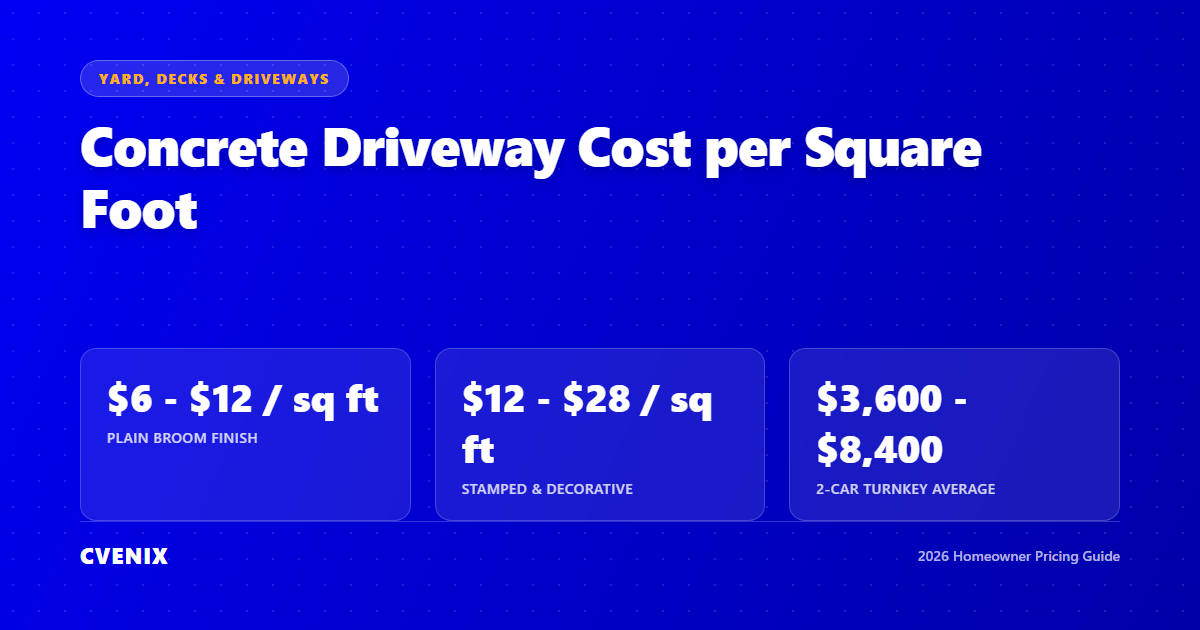
The national average concrete driveway cost ranges from $6 to $15 per square foot for standard broom-finished flatwork, with most homeowners spending between $3,600 and $8,400 (averaging $6,400) for a turnkey 400-to-600-square-foot two-car installation. Upgrading to architectural decorative finishes such as stamped patterns, acid or water-based staining, exposed aggregate, or structural 6-inch heavy-duty slabs increases unit pricing to $12 to $28 per square foot, bringing full replacement projects with old driveway demolition and steel rebar reinforcement between $7,200 and $16,800+.
Evaluating flatwork quotes on a price-per-square-foot basis requires looking beyond the surface texture. Ready-mix concrete delivery represents only 25% to 35% of your final invoice, while site excavation, old asphalt or concrete tear-out, crushed stone subbase compaction, steel reinforcement tying, and skilled finishing labor account for 65% to 75% of total project expenses. Understanding how slab thickness, compressive strength (PSI), and soil engineering interact allows you to specify a driveway that resists freeze-thaw scaling and structural cracking for 30 to 40+ years.
Concrete Driveway Cost per Square Foot by Finish Type
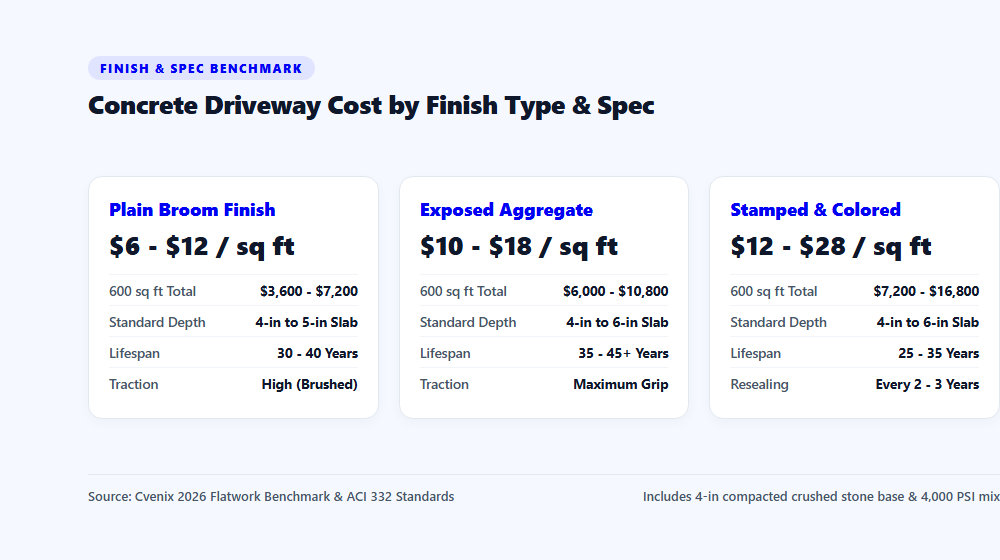
Surface finish selection dictates both the hourly labor rate of the flatwork finishing crew and the specialty chemical additives required during the pour. A standard gray broom finish relies on straightforward screeding, bull floating, and broom texturing, whereas multi-color stamped concrete requires integral pigments, release agents, urethane stamping mats, and acrylic surface sealers applied under strict curing windows.
| Driveway finish type | Installed cost per sq. ft. | Material & mix cost/sq. ft. | Labor & finishing cost/sq. ft. | Typical 600 sq. ft. driveway cost | Expected lifespan & maintenance |
|---|---|---|---|---|---|
| Plain gray broom finish | $6.00 – $12.00 | $2.25 – $4.00 | $3.75 – $8.00 | $3,600 – $7,200 | 30 – 40 years; reseal every 3 – 5 years |
| Stained or integrally colored | $8.00 – $18.00 | $3.50 – $6.50 | $4.50 – $11.50 | $4,800 – $10,800 | 30 – 40 years; UV-stable sealer every 2 – 3 years |
| Exposed aggregate finish | $10.00 – $18.00 | $4.00 – $7.00 | $6.00 – $11.00 | $6,000 – $10,800 | 35 – 45+ years; superior slip resistance |
| Stamped & textured concrete | $12.00 – $28.00 | $4.50 – $9.00 | $7.50 – $19.00 | $7,200 – $16,800 | 25 – 35 years; reseal every 2 years for gloss |
| Pervious (permeable) concrete | $12.00 – $25.00 | $5.00 – $10.00 | $7.00 – $15.00 | $7,200 – $15,000 | 20 – 30 years; annual vacuum sweeping required |
| Concrete resurfacing (overlay) | $3.50 – $9.00 | $1.25 – $3.00 | $2.25 – $6.00 | $2,100 – $5,400 | 8 – 15 years; requires structurally sound base slab |
Plain Broom-Finished Concrete ($6 to $12 per Square Foot)
Broom-finished gray concrete accounts for more than 70% of residential driveway installations across the United States. After pouring, consolidating, screeding, and bull floating the fresh concrete, finishers wait until the bleed water evaporates from the surface and pull a specialized horsehair or nylon flatwork broom perpendicular to the direction of vehicle travel. This creates uniform microscopic ridges that provide reliable tire and pedestrian traction during rain, sleet, and snow without inflating labor costs. Many homeowners pair a standard broom-finished center field with a smooth hand-troweled picture-frame border along the perimeter and control joints, which adds $1.00 to $2.00 per square foot for a crisp, architectural look.
Stamped and Patterned Concrete ($12 to $28 per Square Foot)
Stamped concrete replicates the visual texture of natural bluestone, herringbone brick, cobblestone, or Ashlar slate while preserving the monolithic strength of a continuous reinforced slab. Achieving a realistic stamped finish requires adding integral iron-oxide pigment to the ready-mix truck ($100 to $180 per cubic yard surcharge), broadcasting a secondary color hardener or antiquing release agent across the wet slab, and pressing heavy polyurethane stamping mats into the surface before initial set occurs. Because the concrete sets rapidly in warm weather, stamped pours demand a larger crew of 4 to 6 experienced finishers working simultaneously, doubling the labor cost compared to a standard broom finish.
Exposed Aggregate Concrete ($10 to $18 per Square Foot)
Exposed aggregate driveways offer exceptional durability and high-traction performance on steep slopes. Contractors either batch smooth, colorful river pebbles (such as pea gravel, granite chips, or basalt) directly into the concrete mix or seed the decorative stones onto the freshly floated surface. Once the slab reaches initial hardness, crews spray a chemical surface retarder over the top 1/8 inch of cement paste and pressure-wash it away the following morning, revealing the natural stone mosaic underneath. Because the exposed river rock bears the direct brunt of tire friction and snowplow blades, exposed aggregate surfaces resist surface wear better than any other decorative concrete option.
Stained, Dyed, and Pervious Concrete ($8 to $25 per Square Foot)
Acid stains and penetrating water-based acrylic dyes ($8 to $18 per square foot installed) react chemically with calcium hydroxide in the cured concrete or penetrate open surface pores to create mottled earth tones, charcoal grays, or warm terracotta hues without altering surface traction. Meanwhile, pervious or permeable concrete ($12 to $25 per square foot) is engineered with zero fine sand aggregate, creating an interconnected network of 15% to 25% void space that allows stormwater to drain directly through the slab into a deep 8-to-12-inch washed stone recharge bed. While pervious concrete carries higher excavation and aggregate costs, it often qualifies homeowners for municipal impervious-surface fee exemptions and eliminates runoff pooling.
Total Concrete Driveway Cost by Size and Vehicle Capacity
While contractors quote flatwork by the square foot, total project pricing follows strong economies of scale. Small single-car pads and short aprons carry higher unit costs ($10 to $16+ per square foot even for plain finishes) because ready-mix suppliers enforce “short-load fees” of $150 to $350 for deliveries under 8 to 10 cubic yards, and contractor mobilization minimums apply regardless of square footage. Conversely, wide three-car turnarounds and long suburban driveways spread excavator transport, form lumber, and crew setup across a larger footprint.
| Driveway configuration | Standard dimensions | Total area (sq. ft.) | Concrete volume (4-in / 6-in slab) | Plain broom finish total | Decorative / stamped total |
|---|---|---|---|---|---|
| Single-car straight pad | 12 ft x 24 ft | 288 sq. ft. | 3.6 / 5.4 cu. yds. | $2,300 – $3,800 | $3,700 – $7,800 |
| Long single-car driveway | 12 ft x 40 ft | 480 sq. ft. | 6.0 / 8.9 cu. yds. | $3,400 – $5,800 | $5,800 – $12,500 |
| Standard two-car driveway | 20 ft x 20 ft | 400 sq. ft. | 5.0 / 7.5 cu. yds. | $2,800 – $4,800 | $4,800 – $10,800 |
| Comfortable two-car driveway | 24 ft x 24 ft | 576 sq. ft. | 7.2 / 10.7 cu. yds. | $3,800 – $6,900 | $6,900 – $15,500 |
| Two-car with turnaround pad | 24 ft x 32 ft | 768 sq. ft. | 9.5 / 14.3 cu. yds. | $4,800 – $8,900 | $9,200 – $20,500 |
| Three-car wide driveway | 24 ft x 36 ft | 864 sq. ft. | 10.7 / 16.0 cu. yds. | $5,400 – $10,200 | $10,400 – $23,000 |
| Heavy-duty RV / boat pad (6-in) | 14 ft x 40 ft | 560 sq. ft. | N/A / 10.4 cu. yds. | $5,100 – $8,400 | $7,800 – $15,600 |
| Long rural estate driveway | 12 ft x 100 ft | 1,200 sq. ft. | 14.9 / 22.3 cu. yds. | $7,200 – $13,800 | $14,400 – $31,000 |
Why Width and Turnaround Geometry Matter
Many older suburban homes feature 10-foot-wide single-car lanes or 16-foot-wide two-car driveways. With modern full-size pickup trucks and three-row SUVs measuring 6.5 to 7 feet wide mirror-to-mirror, a 16-foot two-car slab forces occupants to step onto wet grass or mud every time they exit the vehicle, which concentrates wheel loads right along the vulnerable outer edge of the concrete. Expanding a two-car driveway from 18 feet wide to 24 feet wide adds roughly 120 to 150 square feet ($900 to $1,800 at the time of the initial pour), preventing edge spalling and eliminating the steep mobilization cost of pouring narrow side extensions later. If your driveway borders a newly installed boundary enclosure, coordinating your slab edges with your fence installation cost per linear foot prevents post-hole augers from undermining the compacted gravel subbase along the driveway edge.
Structural Engineering Specs: Slab Thickness, PSI Mix Design, and Steel Reinforcement
Two concrete driveways that look identical on the day the forms are stripped can have vastly different lifespans depending on what lies inside and underneath the concrete. Low-bid contractors routinely cut corners by pouring a thin 3.5-inch slab using low-strength 2,500-to-3,000 PSI commercial mix directly over uncompacted topsoil. To build a structurally permanent residential pavement, specifications should align with American Concrete Institute (ACI 332) residential concrete guidelines and Portland Cement Association (PCA) exterior flatwork standards.
| Structural specification | Unit cost impact | Cost for 600 sq. ft. | Load & engineering performance | Recommended residential application |
|---|---|---|---|---|
| 4-inch slab thickness | Baseline ($0.00/sq. ft.) | Baseline included | Supports passenger cars & light SUVs up to 6,000 lbs GVW | Standard suburban passenger car driveways on stable soil |
| 5-inch slab thickness | +$1.25 – $2.00/sq. ft. | +$750 – $1,200 | 35% to 50% higher flexural load capacity than 4-inch slab | Full-size pickup trucks, heavy EVs, and delivery van access |
| 6-inch slab thickness | +$2.50 – $4.00/sq. ft. | +$1,500 – $2,400 | Supports 10,000 – 20,000+ lb axle loads without shear cracking | RV pads, boat trailers, dumpsters, and municipal street aprons |
| 3,000 PSI standard mix | Baseline ($145-$175/yd) | Baseline included | Adequate compressive strength for mild, frost-free climates | Southern states with zero freeze-thaw cycles or deicers |
| 4,000 – 4,500 PSI air-entrained | +$0.45 – $0.90/sq. ft. | +$270 – $540 | 5% – 7.5% microscopic air voids prevent freeze-thaw scaling | Mandatory per ACI 332 in all northern freeze-thaw states |
| Synthetic fiber mesh additive | +$0.25 – $0.50/sq. ft. | +$150 – $300 | Reduces early plastic shrinkage cracking during first 48 hours | Secondary supplement; does not replace structural steel |
| 6×6 W1.4xW1.4 welded wire mesh | +$0.65 – $1.25/sq. ft. | +$390 – $750 | Holds hairline cracks tight if supported on chairs at mid-depth | Light-duty 4-inch passenger car slabs on uniform gravel base |
| #3 or #4 steel rebar grid (18-in OC) | +$1.50 – $3.00/sq. ft. | +$900 – $1,800 | High tensile strength; prevents vertical slab faulting/heaving | Expansive clay soils, tree root zones, and 5-to-6-inch slabs |
Slab Thickness: 4-Inch vs. 5-Inch vs. 6-Inch Pours
Flexural strength in a concrete slab increases exponentially with thickness. According to PCA pavement thickness design principles, increasing a residential driveway from 4 inches to 5 inches requires 25% more ready-mix concrete volume (rising from 7.4 cubic yards to 9.3 cubic yards on a 600-square-foot driveway) but increases the slab load-carrying capacity by nearly 50%. Moving to a full 6-inch slab doubles the flexural load capacity of a 4-inch slab while adding only 15% to 22% to the overall turnkey contractor invoice, because excavation setup, form placement, and surface finishing labor remain virtually identical.
- When a 4-inch slab is sufficient: Light passenger sedans and compact crossovers under 5,000 pounds gross vehicle weight (GVW) parked on well-drained sandy or gravelly native subgrades with a compacted 4-inch crushed stone base.
- When to upgrade to a 5-inch slab (+$1.25 to $2.00 per sq. ft.): Modern heavy electric vehicles (which frequently weigh 6,000 to 9,000 pounds due to battery packs), half-ton and three-quarter-ton pickup trucks, and homes receiving frequent parcel delivery box trucks.
- When a 6-inch slab is mandatory (+$2.50 to $4.00 per sq. ft.): Class A, B, or C motorhomes, fifth-wheel trailers, garbage truck turnarounds, and the municipal right-of-way apron between the street curb and public sidewalk, where city building codes almost universally mandate 6-inch minimum thickness.
PSI Mix Design and Air Entrainment (ACI 332 Compliance)
Compressive strength, measured in pounds per square inch (PSI) at 28 days of curing, determines how well the surface resists crushing, abrasion, and moisture absorption. Under ACI 332 (Code Requirements for Residential Concrete), exterior flatwork exposed to freezing and thawing in a moist condition must use a minimum 4,000 to 4,500 PSI mix design with a maximum water-to-cementitious-materials ratio of 0.45 and 5% to 7.5% entrained air. Air entrainment introduces billions of microscopic bubbles into the cement paste, giving freezing water room to expand inside the slab without popping off the top layer of mortar (a failure known as surface scaling or spalling). Homeowners should also forbid crews from adding excessive water to the chute on-site to make the concrete easier to rake; raising the slump with extra water dilutes the cement paste, drops compressive strength by up to 1,000 PSI, and triggers severe surface dusting.
Rebar Grid vs. Wire Mesh vs. Fiber Mesh
Concrete possesses immense compressive strength but relatively low tensile strength. When underlying soil expands, contracts, or settles unevenly, reinforcement keeps the slab locked together horizontally and vertically:
- Deformed Steel Rebar (#3 or #4 bars at $1.50 to $3.00 per sq. ft.): Tied in an 18-inch or 24-inch grid and elevated on plastic or concrete chairs so the bars sit at the exact vertical center of the slab, steel rebar is the undisputed structural benchmark. Even if a shrinkage crack develops, the ribbed steel bars prevent one side of the slab from sinking or heaving above the other.
- Welded Wire Reinforcement (6×6 W1.4xW1.4 mesh at $0.65 to $1.25 per sq. ft.): Wire mesh effectively holds tight hairline cracks together only if placed on support chairs. In practice, many crews lay sheets of wire mesh flat on the gravel and promise to “pull it up with a hook” during the pour, which frequently results in the mesh getting trampled back down to the bottom of the slab where it provides near-zero structural benefit.
- Synthetic Micro-Fiber and Macro-Fiber Mesh ($0.25 to $0.50 per sq. ft.): Polypropylene or nylon fibers mixed directly into the ready-mix drum disperse throughout the slab to control plastic shrinkage cracking during the first 24 to 48 hours of curing. However, micro-fibers do not provide structural load-bearing tensile strength and should be paired with steel rebar rather than used as a standalone substitute on unstable soils.
Line-Item Breakdown: Labor, Demolition, Subbase Compaction, Drainage, and Permits
When comparing contractor estimates, the biggest pricing discrepancies almost always hide in the site preparation and demolition lines. A driveway is only as stable as the ground beneath it. Pouring high-strength concrete over organic black topsoil, uncompacted clay, or poorly drained subgrade guarantees structural cracking within two to three winters.
| Project line item | Unit cost range | Typical 600 sq. ft. cost | Share of budget | Scope & engineering specification |
|---|---|---|---|---|
| Old driveway demolition & haul-off | $2.00 – $6.00 / sq. ft. | $1,200 – $3,600 | 15% – 25% | Skid-steer hydraulic breaker, dump truck hauling, concrete recycling fee |
| Subgrade excavation & grading | $1.00 – $2.50 / sq. ft. | $600 – $1,500 | 8% – 12% | Stripping topsoil to 8-10 inches depth; establishing 1%-2% drainage pitch |
| Compacted crushed stone subbase | $1.25 – $2.75 / sq. ft. | $750 – $1,650 | 10% – 15% | 4 to 6 inches of 3/4-inch dense-grade crushed aggregate compacted in lifts |
| Formwork, rebar & expansion joints | $1.50 – $3.25 / sq. ft. | $900 – $1,950 | 12% – 18% | 2×4/2×6 perimeter forms, #3/#4 rebar on chairs, asphalt isolation strips |
| Ready-mix concrete delivery | $2.25 – $4.25 / sq. ft. | $1,350 – $2,550 | 22% – 30% | 4,000+ PSI air-entrained concrete ($160-$240/cubic yard delivered) |
| Pouring, finishing & control joints | $3.00 – $7.00 / sq. ft. | $1,800 – $4,200 | 25% – 35% | Placing, screeding, bull floating, edging, brooming, early-entry saw cutting |
| Curing compound & penetrating sealer | $0.85 – $2.25 / sq. ft. | $510 – $1,350 | 5% – 8% | ASTM C309 curing membrane day of pour; silane/siloxane sealer at 28 days |
| Municipal curb-cut & right-of-way permit | $50 – $450 flat fee | $50 – $450 | 1% – 3% | City engineering inspection of apron thickness, sidewalk ADA cross-slope |
Old Driveway Demolition and Disposal ($2 to $6 per Square Foot)
If you are replacing an existing deteriorated driveway, tearing out and hauling away the old pavement adds $2.00 to $6.00 per square foot ($1,200 to $3,600 for a 600-square-foot two-car slab). Breaking up an unreinforced 3-inch asphalt driveway sits at the low end of that range ($1.50 to $3.00 per square foot) because a skid steer or mini-excavator bucket can peel up asphalt sheets in a few hours. Conversely, demolishing an existing 6-inch concrete slab reinforced with heavy wire mesh or rebar requires hydraulic jackhammer attachments, reciprocating saws or bolt cutters to sever embedded steel, and multiple 15-ton dump truck trips to a concrete crushing facility.
Subbase Excavation, Compaction, and Drainage Grading
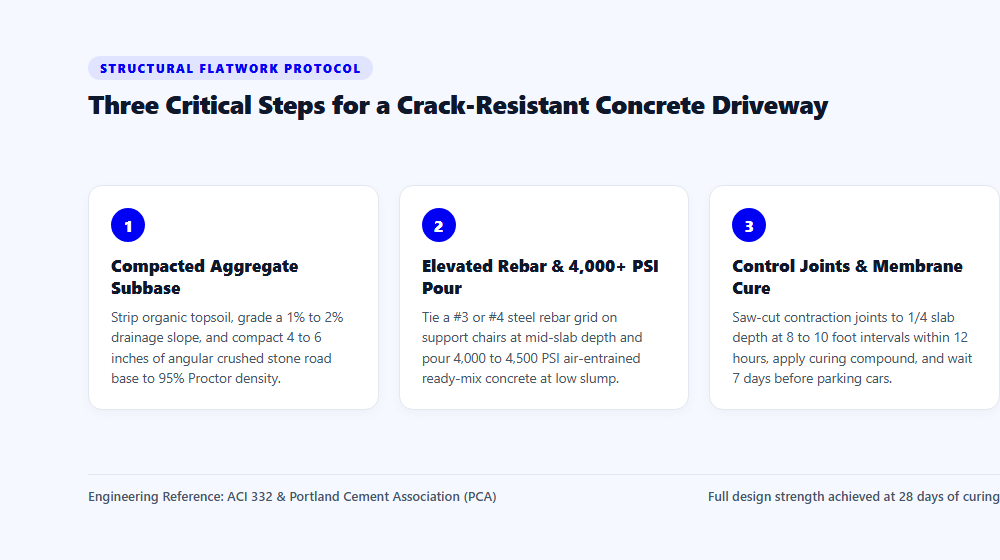
After stripping away all organic sod, tree roots, and soft topsoil, contractors must install a 4-to-6-inch subbase of compactable crushed stone aggregate (often called Crusher Run, Dense Grade Aggregate, or Class 5 road base, consisting of angular 3/4-inch crushed limestone or granite mixed with stone dust fines). Unlike round pea gravel, which rolls under load like marbles, angular crushed stone with fines locks together into a rigid structural mat when compacted with a vibratory plate compactor or smooth-drum roller to 95% Standard Proctor density.
Proper grading is equally critical. Every driveway must be pitched with a minimum 1% to 2% slope (1/8 inch to 1/4 inch of vertical drop per linear foot) away from your garage apron and house perimeter. If your lot slopes downward toward the house or collects sheet runoff from higher ground, channeling water away with a trench drain or sub-surface perforated pipe is essential; reviewing French drain installation cost benchmarks ($25 to $65 per linear foot) and installing a channel drain across the garage threshold ($800 to $2,200) prevents stormwater from saturating the subbase or pooling against your basement wall, which can otherwise trigger costly structural movement covered in our foundation repair cost guide.
Control Joints, Isolation Joints, and Municipal Permits
All Portland cement concrete shrinks slightly (approximately 1/16 inch per 10 linear feet) as excess mix water evaporates during hydration. Rather than trying to prevent shrinkage altogether, skilled finishers force the slab to crack in neat, straight, hidden lines beneath engineered joints:
- Contraction (Control) Joints: Hand-tooled during finishing or cut with an early-entry diamond concrete saw within 6 to 18 hours of the pour. Under ACI 332 and PCA standards, control joints must be cut to a minimum depth of one-fourth (25%) of the slab thickness (1 inch deep on a 4-inch slab; 1.5 inches deep on a 6-inch slab). Panels should be kept as square as possible (length-to-width ratio not exceeding 1.5-to-1), with maximum joint spacing of 8 to 10 feet for 4-inch slabs and 12 to 15 feet for 6-inch slabs.
- Isolation (Expansion) Joints: Compressible 1/2-inch asphalt-impregnated fiberboard or closed-cell foam strips installed full-depth wherever the new driveway abuts fixed structures, including the garage foundation slab, concrete porch steps, municipal sidewalks, and utility manholes. Isolation joints allow the driveway to expand and contract seasonally without crushing adjacent masonry.
- Municipal Curb-Cut and Apron Permits ($50 to $450): Whenever a driveway replacement disturbs the city sidewalk or street curb apron inside the public right-of-way, municipalities require a right-of-way permit and a pre-pour formwork inspection to verify ADA sidewalk cross-slope compliance (maximum 2% cross-slope) and 6-inch apron depth.
Regional and State-by-State Concrete Driveway Cost Comparison
Geographic location drives a 35% to 60% variance in concrete driveway pricing across the United States. Three local variables explain the spread: ready-mix plant aggregate haul distances ($150 per cubic yard in the Midwest vs. $230+ per cubic yard on the West Coast), seasonal construction windows in northern frost belts, and soil engineering requirements in expansive clay or seismic regions.
| Region / Key States | Plain broom finish (/sq. ft.) | Stamped / decorative (/sq. ft.) | Average 600 sq. ft. turnkey | Regional soil, climate & code requirements |
|---|---|---|---|---|
| Midwest (OH, MI, IN, IL, WI, MN) | $7.00 – $13.00 | $13.00 – $24.00 | $4,200 – $7,800 | Severe freeze-thaw; 4,500 PSI air-entrained mix & 6-in compacted gravel base required |
| Northeast (NY, NJ, PA, MA, CT) | $8.50 – $15.00 | $15.00 – $28.00 | $5,100 – $9,000 | High union/prevailing labor rates, strict curb-cut permits, deep frost heave protection |
| South Central (TX, OK, LA) | $6.00 – $11.00 | $11.00 – $21.00 | $3,600 – $6,600 | Highly expansive plastic clay soils; #3/#4 steel rebar on 18-in centers essential |
| Southeast (FL, GA, NC, SC, TN) | $6.00 – $11.50 | $11.50 – $22.00 | $3,600 – $6,900 | High seasonal water tables in FL coastal zones; red clay grading in Piedmont region |
| Mountain West (CO, UT, ID, AZ) | $7.50 – $13.50 | $13.50 – $25.00 | $4,500 – $8,100 | Bentonite expansive soils on Front Range; rapid arid evaporation requires curing compound |
| West Coast (CA, WA, OR) | $9.50 – $16.50 | $16.00 – $30.00 | $5,700 – $9,900 | Highest ready-mix ($210-$260/yd) and dump fees; stormwater permeability mandates |
In northern states such as Michigan, Minnesota, New York, and Massachusetts, contractors can only pour exterior flatwork between mid-April and early November without incurring cold-weather concreting surcharges. Pouring in late autumn when overnight temperatures drop below 40 degrees Fahrenheit requires non-chloride chemical accelerators (calcium nitrite; never calcium chloride if steel rebar is present, as chloride corrodes steel) and insulated curing blankets, adding $0.75 to $1.50 per square foot. Conversely, in Texas, Oklahoma, and Colorado, expansive montmorillonite and bentonite clay soils swell dramatically when wet and shrink during summer droughts, making #3 or #4 deformed steel rebar grids mandatory even in frost-free zones.
Concrete vs. Asphalt, Interlocking Pavers, and Gravel Driveways
Homeowners weighing a new concrete driveway often compare upfront installation numbers against hot-mix asphalt, interlocking concrete pavers, or crushed gravel. While concrete carries a higher initial price tag than gravel or asphalt, its 30-to-40-year service life and minimal maintenance schedule frequently deliver a lower 30-year total cost of ownership.
- Concrete Driveway ($6 to $15 per sq. ft. installed | 30 to 40+ year lifespan): Provides a rigid, clean, high-albedo surface that does not soften in 100-degree summer heat or track black tar indoors. Maintenance is limited to applying a breathable penetrating silane-siloxane sealer every 3 to 5 years ($0.85 to $2.00 per sq. ft. hired out, or $150 in materials DIY).
- Hot-Mix Asphalt Driveway ($3 to $7 per sq. ft. installed | 15 to 20 year lifespan): Costs roughly 40% to 50% less upfront than concrete, making it popular for long rural lanes over 1,000 square feet. However, asphalt requires coal-tar or asphalt-emulsion sealcoating every 2 to 3 years ($0.35 to $0.75 per sq. ft.) and hot-rubber crack filling, bringing its 30-year cumulative cost close to or above concrete.
- Interlocking Concrete or Brick Pavers ($15 to $35 per sq. ft. installed | 40 to 50+ year lifespan): Offers unmatched curb appeal and frost-heave flexibility, plus individual pavers can be lifted and reset if an underground sewer or water line requires repair. The trade-off is high installation labor and periodic polymeric joint sand replenishment every 4 to 6 years.
- Crushed Stone Gravel Driveway ($1.50 to $4.00 per sq. ft. installed | Indefinite with regrading): The most economical choice for long rural properties, utilizing 3 layers of washed #3 base stone, #57 middle stone, and crusher-run top dressing. However, gravel ruts during spring thaw, complicates snow plowing, and requires fresh top-dressing every 2 to 3 years.
How to Prevent Premature Driveway Cracking and Surface Scaling
Even a well-engineered concrete driveway can suffer cosmetic scaling or structural cracks if abused during its critical first year of curing. Following five field-tested construction and maintenance rules protects your investment:
- Enforce strict curing wait times before driving on the slab: Keep foot traffic and pets off the fresh concrete for at least 24 to 48 hours. Wait a full 7 days before parking standard passenger cars, and wait 28 days (when concrete reaches 99% of its rated design PSI) before allowing heavy pickup trucks, moving vans, RVs, or boat trailers onto the driveway.
- Never use chemical deicing salts during the first winter: Rock salt (sodium chloride), calcium chloride, magnesium chloride, and ammonium nitrate/sulfate fertilizers aggressively attack new concrete during its first 12 months. Even if you avoid salting your driveway directly, salty slush dripping off your car underbody from treated municipal highways can cause scaling if the slab is not sealed. Use plain traction sand or kitty litter for winter grip during year one.
- Apply a breathable penetrating silane-siloxane sealer after 28 days: For broom-finished driveways, avoid thick topical acrylic film-forming sealers, which can trap rising ground moisture, turn milky white (blushing), and make the surface slippery when wet. Instead, apply a penetrating hydrophobic silane-siloxane water repellent that chemically bonds inside the capillary pores without altering surface traction.
- Seal control joints with self-leveling polyurethane caulk: Leaving saw-cut control joints open allows rainwater to funnel directly down into the crushed stone subbase, where it freezes, expands, and heaves the slab panels unevenly. Filling control joints with backer rod and elastomeric polyurethane sealant ($1.50 to $3.00 per linear foot) keeps the subbase bone-dry.
- Verify pump truck vs. chute access before signing the contract: Fully loaded ready-mix barrel trucks weigh up to 66,000 pounds. If your driveway sits behind a narrow gate, steep slope, or soft septic yard where a ready-mix truck cannot back up directly to the forms, the crew must hire a concrete line pump or buggy service, adding $450 to $1,100 to the project day cost.
How We Compiled These Concrete Driveway Cost Benchmarks
To provide residential homeowners with accurate, verifiable pricing data, our construction research team analyzed 2026 national and regional ready-mix concrete plant price sheets, residential flatwork contractor line-item bids across 50 US metropolitan areas, and municipal right-of-way permit schedules. Structural thickness, mix design, and jointing specifications are cross-referenced against the American Concrete Institute (ACI 332-20: Residential Code Requirements for Structural Concrete), the Portland Cement Association (PCA) Guide to Concrete Driveways, and ASTM C94 (Standard Specification for Ready-Mixed Concrete). All square-foot unit averages reflect turnkey installation including 4 inches of compacted crushed stone subbase, perimeter formwork, standard finishing, and contractor overhead and profit, with optional upgrades itemized separately.
Frequently Asked Questions About Concrete Driveway Costs
How much does a 20×20 two-car concrete driveway cost?
A standard 20×20-foot (400-square-foot) two-car concrete driveway costs between $2,800 and $4,800 for a plain gray broom finish ($7 to $12 per square foot), including a 4-inch compacted gravel base and basic reinforcement. If the project requires demolishing and hauling away an old concrete or asphalt driveway ($2 to $6 per square foot) or upgrading to a 5-inch slab with a #4 steel rebar grid and stamped decorative finish, total turnkey costs range from $5,200 to $10,800.
Is it cheaper to pour concrete Over an existing driveway or tear it out?
Pouring a 2-to-3-inch unbonded concrete topping directly over an old, cracked, or settling concrete or asphalt driveway is strongly discouraged by the Portland Cement Association because existing structural cracks will rapidly telegraph straight through the new slab (a failure called reflective cracking). Full demolition and subbase recompaction ($2 to $6 per square foot extra) is required for any structurally compromised slab. Thin polymer-modified resurfacing overlays ($3.50 to $9.00 per square foot) only work when the existing slab is structurally sound with solely minor surface cosmetic wear.
Should I use rebar or wire mesh in my residential concrete driveway?
For long-term structural stability, a #3 or #4 deformed steel rebar grid tied on 18-to-24-inch centers and elevated on support chairs ($1.50 to $3.00 per square foot) outperforms welded wire mesh ($0.65 to $1.25 per square foot). While wire mesh can control minor hairline crack width if properly elevated, workers frequently step on wire mesh during the pour, pushing it flat against the bottom gravel where it offers minimal tensile reinforcement. Steel rebar stays rigid on chairs at mid-slab depth and prevents vertical slab faulting across expansive clay or tree-root zones.
How thick should a residential concrete driveway be for heavy trucks or RVs?
While a 4-inch concrete slab is the minimum residential baseline for lightweight passenger sedans, any driveway supporting full-size pickup trucks, heavy electric SUVs, delivery vans, boat trailers, or recreational vehicles should be poured 5 to 6 inches thick. Increasing thickness from 4 inches to 6 inches adds $2.50 to $4.00 per square foot in extra ready-mix concrete volume and Deeper formwork, but doubles the slab flexural load-bearing capacity and prevents corner shear breaks.
Does a new concrete driveway increase home resale value?
Yes. Replacing a cracked, sunken, or potholed driveway with a clean, properly graded concrete driveway typically recoups 75% to 90% of its installation cost at resale while dramatically improving front-elevation curb appeal. In suburban markets where buyer home inspectors flag negative driveway drainage pitching toward the garage foundation, a newly poured slab with proper 2% slope and clean control joints eliminates buyer repair credits during closing negotiations.
What is the best time of year to pour a concrete driveway?
Late spring through early autumn, when daytime ambient temperatures remain steadily between 50 and 80 degrees Fahrenheit with moderate humidity, offers ideal hydration and curing conditions. Pouring during peak mid-summer heat waves above 90 degrees requires chemical set retarders and immediate evaporation-retarding curing sprays to prevent plastic shrinkage cracking, while late-fall pours when overnight temperatures dip below 40 degrees require heated enclosures or insulated curing blankets so ice crystals do not destroy the fresh cement paste.

