
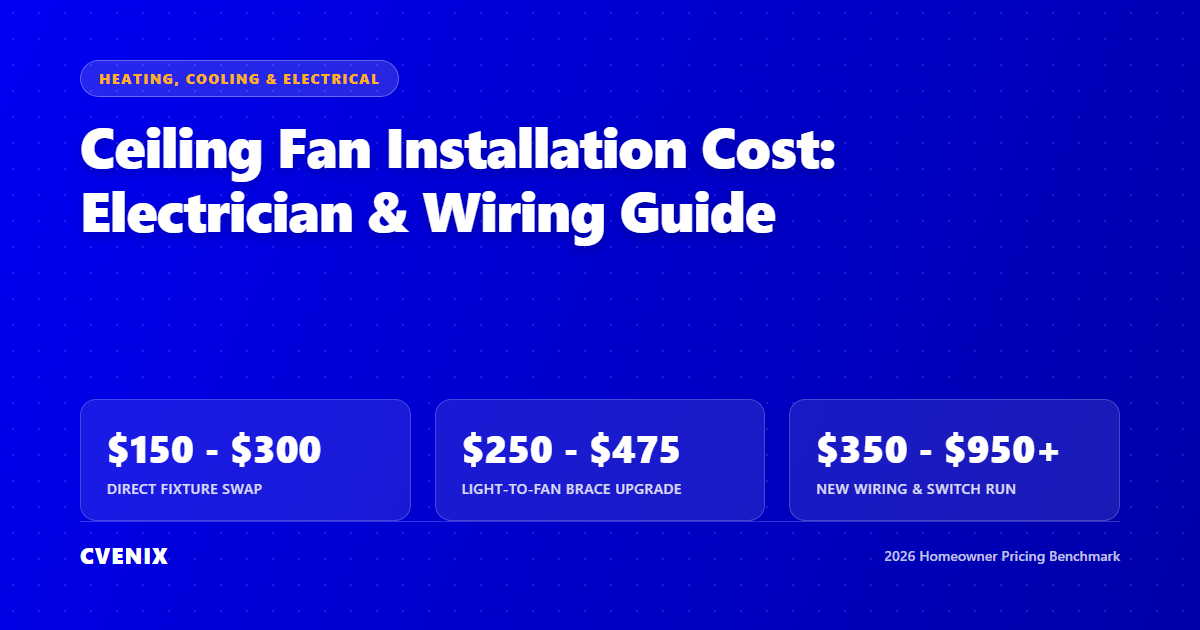
The national average ceiling fan installation cost ranges from $150 to $650, with most homeowners paying a median price of $285 for professional electrical labor and mounting hardware when replacing an existing overhead fixture. When your room already features a dedicated wall switch, grounded copper branch wiring, and a fan-rated ceiling junction box, a licensed electrician can complete a direct swap for $150 to $300 in under 90 minutes. However, installing a ceiling fan in a room where no overhead fixture or wiring currently exists increases total project costs to $350 to $850+, depending on attic accessibility, drywall fishing complexity, and whether you require separate wall switches for the fan motor and light kit.
Beyond simple fixture assembly, residential ceiling fan installation is governed by strict structural and electrical safety provisions under the National Electrical Code (NEC). Unlike a static chandelier or flush-mount LED dome light, a ceiling fan exerts continuous rotational torque, gyroscopic oscillation, and dynamic deadweight ranging from 20 to over 55 pounds. Evaluating your existing junction box rating, ceiling height, and branch circuit wiring before scheduling an electrician ensures accurate budgeting and prevents dangerous structural failures or irritating blade wobble.
Ceiling Fan Installation Cost by Electrical Scenario
The single largest cost driver in any ceiling fan project is the state of the electrical infrastructure hidden above your ceiling drywall. Electricians categorize residential installations into five distinct scenarios based on whether an NEC-compliant fan box and switched hot conductor are already present at the mounting point.
| Installation Scenario | Electrician Labor & Hardware | Total Cost With Mid-Range Fan ($150 – $300 Unit) | Typical On-Site Duration | Primary Scope of Electrical Work |
|---|---|---|---|---|
| Direct Fan-to-Fan Swap (Existing Fan-Rated Box) | $150 – $300 | $300 – $600 | 1.0 – 1.5 hours | Remove old fan, inspect existing UL fan-rated box, wire receiver/canopy, balance blades |
| Replace Standard Light Fixture + Upgrade to Fan Brace Box | $250 – $475 | $400 – $775 | 1.5 – 2.5 hours | Remove non-rated plastic/metal light box, install NEC 314.27(C) 70-lb expandable bar brace, mount fan |
| New Installation With Open Attic Access Above | $350 – $650 | $500 – $950 | 2.5 – 4.0 hours | Cut ceiling hole, mount joist brace in attic, fish 14/3 AWG Romex down wall to new switch box |
| New Installation Between Floors (No Attic Access) | $500 – $950+ | $650 – $1,250+ | 3.5 – 6.0 hours | Cut drywall access holes across floor joists, install old-work tension brace, fish wire to wall switch |
| High/Vaulted Ceiling (14 – 20+ ft) + New Wiring Run | $650 – $1,350+ | $850 – $1,750+ | 4.0 – 7.0 hours | Two-electrician crew, A-frame scaffolding setup, angled canopy ball adapter, extended downrod wiring |
Homeowners frequently assume that any existing ceiling light fixture can be swapped directly for a ceiling fan at the base labor rate. In practice, roughly 60% of homes built prior to 2010 utilize standard plastic nail-on boxes or lightweight 4-inch octagonal metal boxes in bedrooms and dining areas where builders only installed flush light domes. When an electrician removes your old light fixture and discovers an unrated plastic box, upgrading to an old-work expandable steel fan brace adds $100 to $175 to the invoice but is legally mandatory under NEC Section 314.27(C).
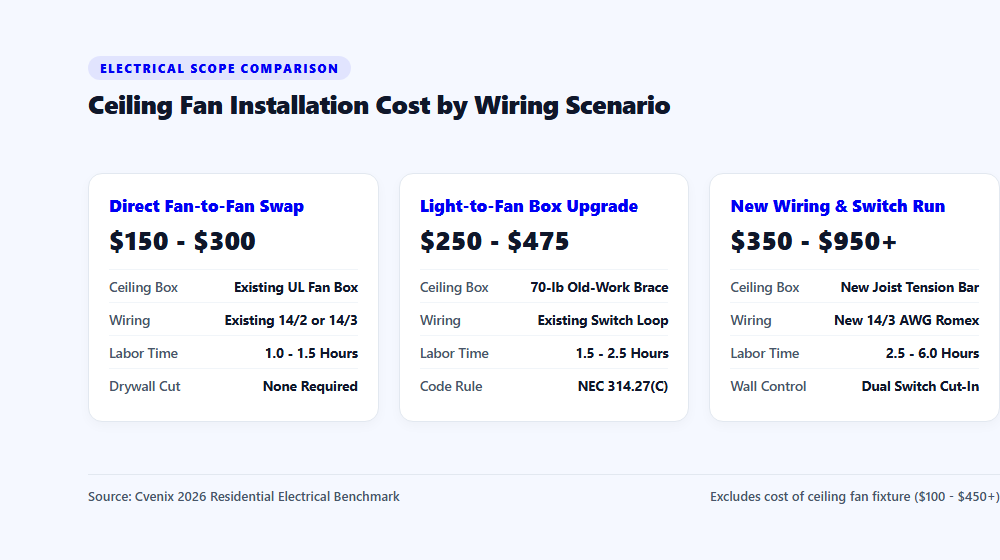
Replacing an Existing Ceiling Fan ($150 to $300)
When you are replacing an aging, noisy ceiling fan with a modern fixture on an standard 8-foot to 10-foot flat ceiling, labor stays at the lowest tier. Because the previous installer already anchored a heavy-duty fan box and pulled switched power to the ceiling cavity, the electrician only needs to verify box tightness, assemble the new motor housing and blades, wire the canopy or solid-state remote receiver module, and test rotational balance. Many electrical contractors offer a flat-rate service call of $175 to $250 for the first fan swap, with discounted add-on labor of $100 to $150 per additional fan if you replace multiple bedroom fans during the same appointment.
Converting a Ceiling Light Fixture to a Ceiling Fan ($250 to $475)
Converting a static ceiling light into a ceiling fan requires both structural reinforcement and switch verification. First, the electrician extracts the existing nail-on lighting box without tearing the surrounding drywall edge. Next, they insert a twist-and-lock steel retrofit fan brace through the 4-inch ceiling opening; as the technician turns the hex shaft with a wrench, sharpened steel teeth bite deep into the opposing wood ceiling joists (spaced 16 or 24 inches on center), creating a rigid bridge rated for 70 pounds of dynamic load. If the existing wall switch is a rotary or slide incandescent dimmer, the electrician must also swap it for a standard single-pole toggle or fan-rated speed control ($35 to $85), as firing a fan motor through a lighting dimmer can burn out the motor windings and create an electrical fire hazard.
Installing a Ceiling Fan With No Existing Wiring ($350 to $950+)
Many mid-century homes, brick ranches, and modern townhomes rely on switched wall receptacles for floor lamps and have zero overhead junction boxes in bedrooms or living rooms. Installing a brand-new ceiling fan in a blank drywall ceiling requires tapping into a nearby 15-amp or 20-amp general lighting circuit, fishing non-metallic sheathed cable (NM-B Romex) up the wall cavity to a new switch cutout, and routing the cable across the ceiling to the center of the room.
- Top-Floor Rooms With Attic Access ($350 to $650): When an unfinished attic sits directly above the room, the electrician can climb into the attic, nail a heavy-duty new-work steel bar box directly between the wood trusses, drill through the top wall plate, and drop a fish tape down into the wall switch box without cutting extra access holes in your finished plaster or drywall.
- First-Floor Rooms Below a Second Story ($500 to $950+): When a finished bedroom or bathroom sits directly above the installation site, there is no top access. If the floor joists run parallel to the path between the desired wall switch and the center of the ceiling, the electrician only needs to cut a single 4-inch access hole at the wall-to-ceiling corner coving. However, if the solid wood joists run perpendicular to the wire path, the electrician must bore 5/8-inch holes through multiple joists via small drywall access cutouts every 32 to 48 inches, which later require patching and touch-up work detailed in our interior painting cost guide.
Cost by Ceiling Fan Mount Type, Size, and Motor Technology
While electrical labor forms the core of installation pricing, the mechanical design, physical diameter, and motor technology of the fixture you select significantly impact both unit purchase price and mounting complexity. Oversized great-room fans and smart brushless DC fixtures require specialized mounting brackets, extra assembly time, and careful canopy wiring.
| Ceiling Fan Type & Configuration | Fixture Purchase Price | Professional Installation Labor | Total Installed Cost Range | Ideal Room & Ceiling Application |
|---|---|---|---|---|
| Flush-Mount / Low-Profile Hugger (42″ – 52″) | $80 – $250 | $150 – $325 | $230 – $575 | 8-ft ceilings, basements, compact bedrooms (keeps blades 7+ ft above floor) |
| Standard Downrod Fan (48″ – 56″ AC Motor) | $110 – $320 | $150 – $350 | $260 – $670 | 9-ft to 11-ft flat ceilings in primary bedrooms, family rooms, dining rooms |
| Sloped / Vaulted Angled Mount Fan (52″ – 64″) | $160 – $450 | $275 – $650 | $435 – $1,100 | Cathedral ceilings (15° to 45° pitch) requiring sloped ball adapter and 24″-60″ downrod |
| Damp / Wet-Rated Outdoor Patio Fan (52″ – 60″) | $150 – $480 | $225 – $550 | $375 – $1,030 | Covered porches, screened sunrooms, pergolas, and coastal decks with GFCI protection |
| Smart Brushless DC Motor Fan (ENERGY STAR) | $220 – $650 | $175 – $400 | $395 – $1,050 | Ultra-quiet bedrooms, automated smart homes, high-efficiency HVAC zones (up to 70% less power) |
| Large Industrial / Great Room Fan (66″ – 84″+) | $380 – $1,200+ | $300 – $750 | $680 – $1,950+ | Two-story living rooms, open-concept lofts, and workshops requiring heavy-duty 70-lb framing |
Flush-Mount Hugger vs. Standard Downrod Installations
Building codes and UL safety guidelines mandate that ceiling fan blades must hang at least 7 feet (84 inches) above the finished floor to prevent accidental contact with raised hands, and at least 18 to 24 inches away from any vertical wall or cabinet door. On a standard 8-foot ceiling, using a hanging downrod would drop the light kit below the 7-foot clearance threshold. Consequently, 8-foot ceilings require a flush-mount (hugger) ceiling fan where the motor housing bolts directly against the ceiling collar plate, keeping the blades 7.2 to 7.5 feet off the floor.
Ironically, flush-mount hugger fans often take an electrician 15 to 20 minutes longer to wire and assemble than a standard downrod fan. With a downrod fan, the installer hangs the motor ball inside the mounting bracket first, freeing both hands to splice the copper wires and tuck the remote receiver neatly into the canopy. With many hugger fans, the installer must support the weight of the motor housing on a temporary J-hook while making wire-nut connections and attaching individual fan blades in tight quarters just inches below the drywall.
Oversized Multi-Blade Fans (66-Inch to 84-Inch Span)
Modern open-concept floor plans frequently call for 66-inch, 72-inch, or 84-inch architectural fans with six to nine extruded aluminum or carved wood airfoil blades. While these fixtures move massive volumes of air (8,000 to 14,000+ CFM) at low RPMs, their wider wingspan amplifies any minor structural flex in the ceiling box. Furthermore, under NEC Section 422.18, any ceiling-suspended paddle fan weighing more than 35 pounds (16 kg) with its accessories cannot rely solely on the outlet box for support unless the box is specifically listed and marked for the maximum weight (up to 70 lbs), or the fan is supported independently by a structural framing timber or safety cable anchored directly into the ceiling joist.
NEC Electrical Code Requirements, Brace Boxes, and Switch Wiring
Understanding why licensed electricians price ceiling fan installations differently from handymen comes down to two technical areas: structural load engineering at the ceiling box and conductor routing at the wall switch. Cutting corners on either element results in persistent fan wobble, humming motors, or code violations during a home sale inspection.
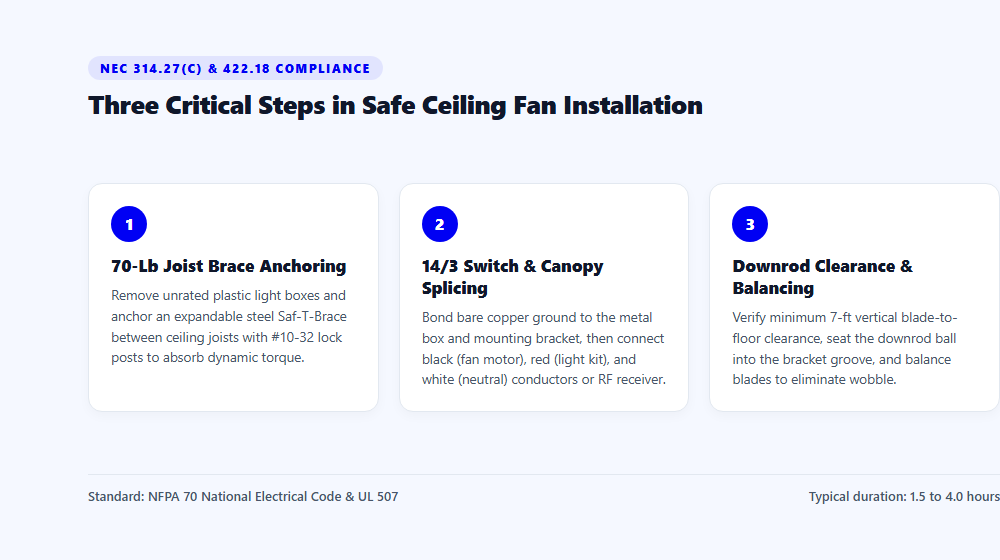
NEC Section 314.27(C): Why Standard Light Boxes Are Illegal for Ceiling Fans
Under NEC Section 314.27(C), every outlet box used as the sole support of a ceiling-suspended (paddle) fan must be listed, labeled on the interior of the box as “Acceptable for Fan Support,” and engineered with high-tensile #10-32 machine screw posts rather than the thin #8-32 bent metal ears found on standard lighting boxes. Recent editions of the NEC went even further: in residential new construction and remodels, any ceiling outlet box mounted in a location acceptable for a ceiling fan where a spare switched conductor is run must be a fan-rated box right from the start, even if the homeowner initially hangs a simple light fixture.
- Old-Work Expandable Saf-T-Brace ($22 to $38 part + $85 to $150 labor): Used when upgrading through a 4-inch drywall hole with no attic access. A heavy square steel tube expands outward via reverse threads until spiked end plates embed into adjacent joists, supporting up to 70 lbs of fan weight.
- Saddle / Pancake Joist Box ($12 to $25 part + $65 to $120 labor): Used when the desired fan location falls directly centered over an existing wood ceiling joist or structural ridge beam. The saddle box straddles the timber and anchors directly into the solid wood with heavy structural lag screws.
- Vaulted / Cathedral Ceiling Angled Framing Box ($28 to $55 part + $120 to $250 labor): Engineered specifically to mount flush against a peaked roof rafter or angled collar tie while presenting a level, reinforced mounting face for a sloped-ceiling ball canopy.
Dual Wall Switch Wiring (14/2 vs. 14/3 AWG Romex) vs. Remote Receivers
When replacing an existing ceiling light or installing a new fan, you must decide how you will control the fan motor speeds and the light kit independently. This choice directly determines whether your electrician needs to fish new wire inside your walls:
- Existing 14/2 AWG Wire + Wireless Canopy Receiver ($0 to $50 extra wiring cost): Most bedrooms with a single wall switch only have a 2-conductor cable (one black hot wire, one white neutral wire, one bare copper ground) running to the ceiling. With only one hot wire, flipping the wall switch turns both the fan and the light on or off together. To avoid tearing into drywall, 80% of modern ceiling fans include a compact RF or Wi-Fi receiver module that tucks inside the ceiling canopy, allowing independent speed and dimming control via a handheld remote or wall-mounted wireless keypad.
- Upgrading to 14/3 AWG Wire + Dual Hardwired Wall Switches ($150 to $325 extra): If you prefer dedicated, hardwired wall switches so you never have to hunt for a lost remote or replace dead batteries, the electrician must pull a 3-conductor cable (14/3 AWG or 12/3 AWG NM-B containing black, red, white, and ground wires). The black conductor powers the fan motor via a multi-speed fan control switch, while the red conductor powers the light kit via an LED dimmer switch. The electrician will either install a single-gang stacked dual switch or widen the wall opening to install a 2-gang wall box with two side-by-side Decora switches.
- Converting a Switched Wall Outlet to an Overhead Fan ($250 to $500 extra): In rooms where the wall switch currently controls the top half of a duplex wall outlet for a floor lamp, the electrician reconfigures the outlet to remain “always hot,” then fishes a new Romex cable from the existing switch box up the stud bay and across the ceiling to the new fan brace.
Ceiling Height, Vaulted Slopes, and Downrod Sizing Multipliers
Ceiling height and roof pitch affect both labor pricing and aerodynamic performance. When a ceiling fan is mounted too close to a high ceiling, air gets trapped in the upper pocket and fails to create a cooling breeze at floor level; conversely, working 16 to 22 feet above a hardwood or tile floor requires specialized staging equipment and a two-person electrical crew.
| Ceiling Height | Recommended Downrod Length | Target Blade Height Above Floor | Additional Labor & Equipment Surcharge | Equipment & Wiring Adjustments Required |
|---|---|---|---|---|
| 8 ft Flat Ceiling | Flush-Mount / Hugger (No Rod) | 7.2 – 7.5 ft | +$0 (Baseline Rate) | Standard 6-ft step ladder, single electrician |
| 9 ft Ceiling | 3″ to 6″ Standard Downrod | 7.8 – 8.2 ft | +$0 (Baseline Rate) | Included in box with almost all standard ceiling fans |
| 10 to 12 ft Ceiling | 12″ to 24″ Extension Downrod | 8.0 – 9.0 ft | +$50 – $125 | 8-ft to 10-ft A-frame ladder, $25-$45 extension downrod |
| 13 to 15 ft Vaulted Ceiling | 36″ to 48″ Extension Downrod | 8.5 – 9.5 ft | +$150 – $275 | 12-ft podium ladder, sloped ceiling adapter (up to 42° pitch), extended lead wires |
| 16 to 20+ ft Two-Story Great Room | 48″ to 72″ Extension Downrod | 9.0 – 10.0 ft | +$250 – $500+ | Two-person crew, interior rolling scaffolding or 16-ft A-frame ladder, lead wire splicing |
When installing a fan on a 16-foot to 20-foot vaulted or cathedral ceiling, verify three critical hardware details before the electrician arrives:
- Sloped Ceiling Canopy Adapter ($30 to $75): Standard canopies only handle roof pitches up to 18 degrees (4/12 pitch). Steeper cathedral ceilings between 20 and 45 degrees require a steep-slope ball adapter kit so the downrod hangs plumb without binding.
- Extended Motor Lead Wires: Factory fan harnesses typically measure 54 to 80 inches. For 60-inch or 72-inch downrods, the electrician must splice and heat-shrink insulated 18 AWG extension leads before threading the pipe.
- Matching Downrod Diameter: Manufacturers use either 3/4-inch or 1-inch outer diameter rods with brand-specific threading and cross-pin holes. Always purchase the finish-matched extension rod made by your fan brand.
Line-Item Electrical Labor, Hardware, and Permit Cost Breakdown
When reviewing itemized estimates from licensed electrical contractors, separating hourly labor rates from specialty electrical materials helps you spot padded quotes and understand exactly what is included in a turnkey installation package.
| Expense Category / Line Item | Typical Cost Range | Billing Structure | When This Line Item Applies |
|---|---|---|---|
| Licensed Journeyman Electrician Labor | $75 – $150 / hour | Hourly + $75-$125 service call minimum | All professional installations; master electricians in major metros bill up to $185/hr |
| UL-Listed Old-Work Fan Brace Box (70-lb Rating) | $22 – $42 (Material) | Per fixture ($100-$175 installed) | Whenever replacing a non-rated light box or cutting into finished drywall |
| 14/2 or 14/3 AWG NM-B Copper Romex Cable | $1.20 – $2.50 / linear ft | $6 – $9 / ft installed with fishing labor | New ceiling fan locations or upgrading a single switch to dual fan/light controls |
| Dual Wall Switch / Smart Fan-Light Controller | $25 – $85 (Material) | $90 – $225 installed | Adding independent wall speed and dimmer sliders or Lutron Caseta smart fan switches |
| Extension Downrod (24″ to 72″) & Sloped Kit | $35 – $130 (Material) | Per high-ceiling fixture | Ceilings 10 ft or taller, or vaulted rafters exceeding an 18-degree pitch |
| Drywall Access Patching & Texture Repair | $125 – $350 | Subcontracted or separate handyman visit | First-floor ceiling runs with perpendicular joists and no attic access above |
| Municipal Electrical Permit (New Circuit/Wiring) | $50 – $175 | Flat municipal filing fee | Required in most cities when running new branch wiring or adding a breaker; rarely needed for direct swaps |
Licensed Electrician vs. Handyman: Which Should You Hire?
For a straightforward, like-for-like ceiling fan swap on an 8-foot or 9-foot ceiling where an NEC-approved fan box and working wall switch are already installed, an experienced, insured handyman typically charges $100 to $200, saving $50 to $100 compared to a licensed electrical company. However, if your project involves running new Romex cable inside walls, cutting in a new wall switch, upgrading an ungrounded knob-and-tube or cloth-sheathed circuit, or retrofitting a structural brace box into a vaulted ceiling, hiring a licensed, bonded electrician is strongly recommended and legally required in most states. Licensed electricians carry commercial liability coverage that protects your homeowners insurance policy against electrical faults and structural ceiling damage.
Outdoor Patio, Covered Porch, and Pergola Ceiling Fan Costs
Installing an outdoor ceiling fan on a covered back patio, screened lanai, or backyard pergola typically costs $375 to $1,030 including the fixture, or $225 to $550 for electrical labor alone. Beyond moving air to keep outdoor living areas comfortable in summer heat, high-velocity patio airflow disrupts the flight pattern of mosquitoes and biting gnats, which struggle to fly against wind speeds above 2 to 3 miles per hour.
Outdoor ceiling fan installations must adhere to UL moisture ratings and exterior NEC wiring standards:
- UL Damp-Rated Ceiling Fans ($150 to $350 unit): Designed for fully covered porches, screened sunrooms, and enclosed patios where high humidity and condensation occur, but rain, snow, or garden hose spray can never directly contact the motor housing or ABS composite blades.
- UL Wet-Rated Ceiling Fans ($200 to $500+ unit): Built with sealed waterproof motor enclosures, stainless steel hardware, all-weather marine-grade finishes, and UV-stabilized ABS blades. Wet-rated fans are mandatory for open pergolas, gazebos, exposed coastal decks, and porch perimeters exposed to wind-driven rain.
- Weatherproof Conduit & GFCI Protection ($150 to $350 extra): When wiring an open-beam pergola or exposed timber porch ceiling where wires cannot be concealed behind soffit panels, electricians must run Underground Feeder (UF-B) cable or THWN conductors inside painted Schedule 40 PVC or EMT metal conduit into a weatherproof bell box, protected upstream by a Ground Fault Circuit Interrupter (GFCI) breaker or receptacle.
AC vs. Brushless DC Motors and HVAC Energy Efficiency
When selecting a ceiling fan, choosing between a traditional Alternating Current (AC) induction motor and a modern Brushless Direct Current (DC) motor impacts both upfront purchase price, acoustic comfort, and year-round utility bills. While a ceiling fan does not lower the actual air temperature in an unoccupied room, the wind-chill evaporative effect on human skin makes a room feel 4°F (2.2°C) cooler. According to the U.S. Department of Energy and ENERGY STAR guidelines, raising your central thermostat by 4°F while running a ceiling fan in occupied rooms reduces air conditioning energy consumption by 12% to 16%, helping extend compressor life and deferring expensive central AC replacement cost or full HVAC replacement cost outlays.
- Traditional AC Motor Fans ($80 to $250 unit): Powered directly by 120V household alternating current, AC fans typically offer 3 speeds controlled by a capacitor chain or standard wall switch, drawing 55 to 90 watts at high speed. They are economical and easy to wire with third-party wall switches, though some budget models emit a faint 60-Hz electromagnetic hum at low speeds.
- Brushless DC Motor Fans ($200 to $650 unit): Utilize an internal transformer and permanent magnets to convert AC power into direct current, consuming up to 65% to 70% less electricity (often drawing just 3 to 5 watts on low speed and 22 to 32 watts at maximum airflow). DC fans operate virtually silently, offer 6 to 10 granular speed settings, weigh 30% less than comparable AC motors, and allow one-touch summer/winter direction reversal straight from the remote or smartphone app.
Regional and State-by-State Ceiling Fan Installation Costs
Licensed electrician hourly rates, municipal permit enforcement, and common residential framing styles vary considerably across U.S. regions. In Sun Belt states such as Texas, Florida, and Arizona, nearly all homes built since the late 1990s come pre-wired with fan-rated brace boxes in every bedroom and covered patio, keeping installation costs near the direct-swap baseline. Conversely, older pre-war housing stock in the Northeast and Upper Midwest frequently lacks overhead bedroom boxes and requires complex fishing through plaster-and-lath ceilings.
| State / Metro Region | Direct Swap Labor Cost | New Wiring & Brace Box Install | Electrician Hourly Rate | Regional Housing & Electrical Code Factors |
|---|---|---|---|---|
| Texas (Dallas, Houston, Austin) | $140 – $260 | $325 – $625 | $75 – $125 / hr | High rate of pre-wired fan boxes in bedrooms & patios; deep attic truss access |
| Florida (Miami, Orlando, Tampa) | $150 – $275 | $350 – $675 | $80 – $130 / hr | Concrete block walls & damp/wet-rated lanai fan mandates; truss attic access |
| California (Los Angeles, Bay Area, San Diego) | $210 – $380 | $475 – $950+ | $115 – $175 / hr | Title 24 energy compliance, high licensed C-10 electrician rates, seismic bracing |
| New York & New England (NYC, Boston) | $220 – $400 | $500 – $1,050+ | $120 – $185 / hr | Older plaster-and-lath ceilings, BX armored cable runs, strict municipal permits |
| Illinois & Upper Midwest (Chicago, Minneapolis) | $175 – $325 | $425 – $850 | $95 – $155 / hr | EMT metal conduit requirements in Cook County/Chicago increase new-run labor |
| Georgia & Carolinas (Atlanta, Charlotte, Raleigh) | $150 – $270 | $340 – $650 | $75 – $130 / hr | Two-story vaulted great rooms common; competitive residential service rates |
| Arizona & Mountain West (Phoenix, Denver) | $155 – $285 | $360 – $690 | $80 – $135 / hr | Flat foam roofs or shallow attics in desert homes require careful wire fishing |
Practical Ways to Lower Your Ceiling Fan Installation Cost
Because licensed electrical contractors incur fixed dispatch overhead for every visit, strategic scheduling can reduce your per-fan installation cost by 25% to 40%:
- Bundle Multiple Fans in One Appointment: Most electrical contractors charge a $150 to $250 minimum trip fee for the first fixture, then drop add-on labor to $95 to $145 per additional fan during the same visit.
- Pre-Inspect Fixture Hardware: Unbox your fans ahead of time to verify that mounting brackets, canopy screws, downrods, and remote modules are complete, avoiding hourly electrician delays for missing parts.
- Use Wireless RF Wall Controls on 14/2 Wiring: On first-floor ceilings with no attic access, pairing a canopy RF receiver with a wireless wall keypad saves $200 to $450 in 14/3 wire fishing and drywall patching.
- Book Off-Peak Spring or Fall Service Windows: Scheduling installations in March, April, October, or November avoids peak summer heatwave surcharges and unlocks multi-fixture flat rates.
Pricing Methodology and Electrical Code Sources
To establish verifiable 2026 cost benchmarks for residential ceiling fan installations, our research team analyzed flat-rate price books from licensed electrical contractors across 35 U.S. metro areas, cross-referenced with RSMeans electrical labor unit data and retail material pricing. Structural and wiring specifications follow these national standards:
- NFPA 70 / National Electrical Code (NEC) Section 314.27(C): Mandates UL-listed fan support outlet boxes (rated up to 70 lbs dynamic load) and #10-32 machine screw lock posts for all ceiling-suspended paddle fans.
- NFPA 70 / National Electrical Code (NEC) Section 422.18: Defines structural framing support requirements for paddle fans up to 35 lbs (16 kg) versus heavy-duty fans exceeding 35 lbs.
- U.S. EPA & DOE ENERGY STAR Ceiling Fan Specification (v4.0): Sets minimum airflow efficiency (CFM/watt) across operating speeds and LED light kit efficacy requirements.
- UL 507 Standard for Electric Fans: Governs minimum 7-foot blade-to-floor vertical clearance and environmental testing for Dry, Damp, and Wet-rated outdoor patio fans.
Frequently Asked Questions About Ceiling Fan Installation Costs
How much does an electrician charge to install a ceiling fan where a light fixture already exists?
A licensed electrician typically charges $150 to $300 if your existing light fixture is already mounted to an NEC-compliant, fan-rated metal brace box. However, if the existing light is attached to a standard plastic or lightweight metal lighting box, the electrician must replace the box with an expandable 70-pound fan brace, bringing the total labor and hardware cost to $250 to $475.
How much does it cost to install a ceiling fan in a room with no existing ceiling wiring?
Installing a ceiling fan where no overhead box or wiring currently exists costs $350 to $650 if there is an unfinished attic directly above the room for easy wire routing. If the room sits on the first floor beneath a finished second story with no attic access, fishing 14/3 AWG Romex cable across ceiling joists and down to a wall switch increases the cost to $500 to $950+.
Can I hang a ceiling fan on a standard plastic ceiling junction box?
No. Standard blue or white plastic nail-on ceiling boxes are only rated for static lighting fixtures and will crack, strip, or pull out of the drywall under the continuous rotational torque and vibration of a ceiling fan. Under NEC Section 314.27(C), every ceiling fan must be mounted to a UL-listed box explicitly stamped ‘Acceptable for Fan Support’ and anchored directly to ceiling joists.
How much extra does it cost to install a ceiling fan on a 16-foot or 20-foot vaulted ceiling?
Installing a ceiling fan on a high or vaulted ceiling between 14 and 20+ feet adds $150 to $500+ to standard labor rates. High-reach jobs require a two-electrician crew to safely transport and set up a 14-foot to 16-foot A-frame ladder or interior rolling scaffold, plus $60 to $150 in specialty parts for an angled sloped-ceiling adapter and a 36-inch to 72-inch extension downrod.
Do I need a new wire pulled to control the ceiling fan and light from separate wall switches?
If you want two separate hardwired wall switches (one for fan speeds and one for dimming the light) and your wall currently has only a 2-wire (14/2 AWG) cable, an electrician must pull a new 3-conductor (14/3 AWG) cable for $150 to $325. Alternatively, you can avoid running new wire by installing a ceiling fan with a canopy RF receiver and mounting its wireless remote keypad next to your existing wall switch.
Do I need an electrical permit to install or replace a ceiling fan?
In most U.S. municipalities, you do not need an electrical permit for a direct like-for-like swap of an existing ceiling fan or light fixture using existing branch wiring. However, if the project involves running new Romex wiring inside walls, cutting in a new switch box, or adding a new circuit breaker at the main electrical panel, local building departments typically require a $50 to $175 electrical permit.

