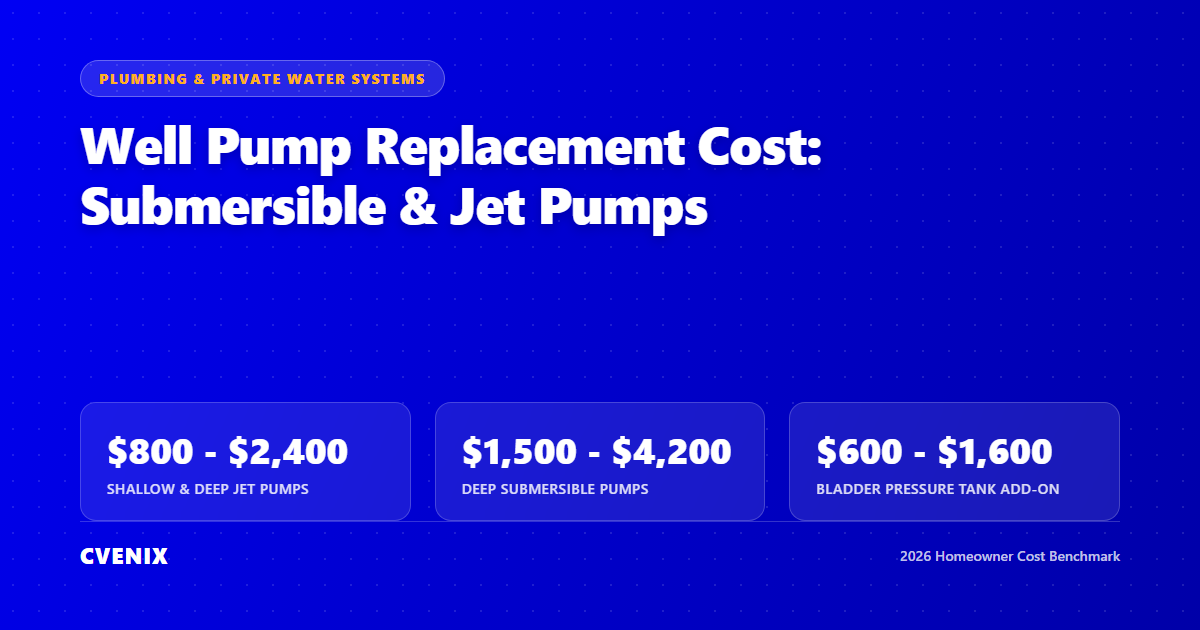
The national average well pump replacement cost ranges from $1,400 to $3,200, with most homeowners paying approximately $2,150 for a turnkey residential installation. Your final invoice depends primarily on whether your water supply relies on an above-ground shallow jet pump ($800 to $1,800) or a deep downhole submersible pump ($1,500 to $4,200+), alongside total well casing depth, motor horsepower, drop pipe material, and whether your pre-charged bladder pressure tank ($600 to $1,600) requires simultaneous replacement.
When a private water system loses pressure completely or begins pulsing at the kitchen tap, determining whether the fault lies in a $120 surface pressure switch or a seized motor suspended 300 feet underground can save you thousands of dollars. This comprehensive guide breaks down equipment and labor pricing by pump architecture, aquifer depth, horsepower sizing, ancillary wellhead hardware, and regional drilling conditions across the United States.
Well Pump Replacement Cost by Pump Type
Residential water wells utilize two fundamental mechanical principles to move groundwater into your household plumbing: atmospheric suction from an above-ground housing (jet pumps) or positive mechanical displacement from an underwater motor submerged directly inside the well bore (submersible pumps). Because pulling and lowering heavy downhole equipment requires specialized boom trucks or hydraulic pipe pullers, submersible systems carry higher installation labor fees but deliver superior energy efficiency and longevity.
| Well Pump Type | Operating Depth Range | Pump Unit Cost | Labor & Rig Cost | Total Installed Cost | Expected Lifespan |
|---|---|---|---|---|---|
| Shallow-Well Single-Drop Jet Pump | Under 25 feet | $220 – $650 | $450 – $1,150 | $800 – $1,800 | 8 – 12 years |
| Deep-Well Convertible Dual-Drop Jet Pump | 25 to 90 feet | $350 – $900 | $650 – $1,500 | $1,000 – $2,400 | 8 – 12 years |
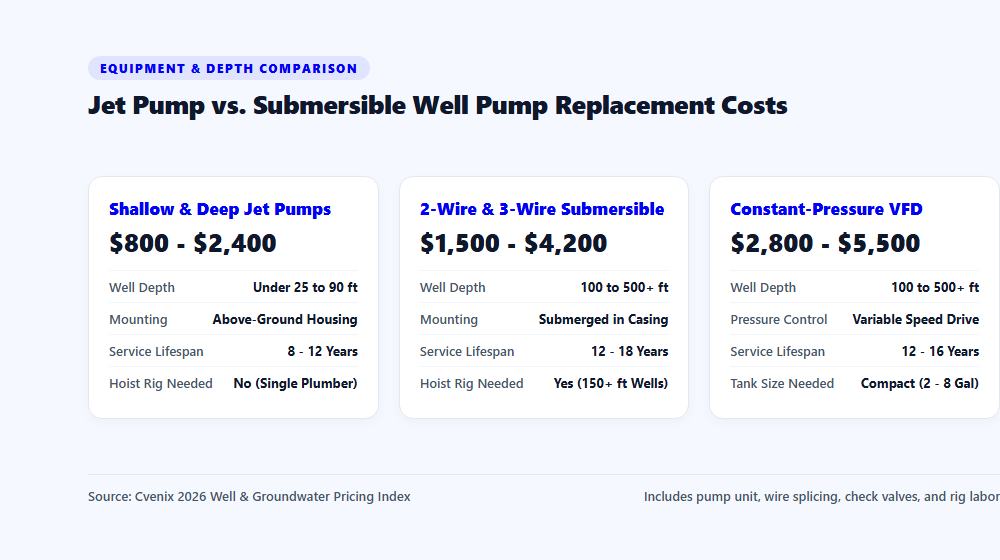
| 2-Wire Submersible Well Pump | 50 to 250 feet | $450 – $1,100 | $950 – $2,100 | $1,500 – $3,200 | 12 – 15 years |
| 3-Wire Submersible Pump with Surface Control Box | 100 to 500+ feet | $550 – $1,650 | $1,100 – $2,550 | $1,750 – $4,200 | 14 – 18 years |
| Constant-Pressure VFD Submersible System | 100 to 500+ feet | $1,400 – $2,900 | $1,400 – $2,600 | $2,800 – $5,500 | 12 – 16 years |
| Solar DC Submersible Well Pump System | 50 to 400 feet | $1,200 – $3,400 | $1,000 – $2,400 | $2,200 – $5,800 | 10 – 15 years |
Shallow-Well Single-Drop Jet Pumps ($800 to $1,800)
A shallow-well jet pump mounts above grade inside a basement utility room, crawlspace, or insulated well house. It uses a single suction pipe equipped with an underwater foot valve and internal venturi nozzle to create a vacuum that lifts water up from the water table. Because atmospheric pressure at sea level can only lift water a theoretical maximum of 33.9 feet (and a practical working limit of 25 feet due to pipe friction losses), single-drop jet pumps are restricted to properties with high coastal, lakeshore, or river-valley water tables. Replacement labor is straightforward ($450 to $1,150) because a single licensed plumber can unbolt the cast-iron or thermoplastic housing, swap the unit, prime the casing, and test pressure without mobilizing a hoist truck.
Convertible Deep-Well Dual-Drop Jet Pumps ($1,000 to $2,400)
Convertible deep-well jet pumps solve the 25-foot suction barrier by running two parallel pipes down the well casing: a smaller drive pipe and a larger suction pipe connected to a submerged jet ejector assembly positioned 25 to 90 feet below grade. The surface pump forces a portion of already-pumped water back down the drive pipe through the submerged venturi ejector, creating localized upward velocity that pushes additional groundwater toward the surface. While keeping the electric motor above ground simplifies motor swaps, pulling the twin drop pipes to replace a clogged downhole jet package or leaking foot valve increases labor costs. Many well contractors advise homeowners with failing deep-well jet pumps in 4-inch or 6-inch casings to convert directly to a modern submersible pump for $1,800 to $3,200, cutting electric consumption by up to 40 percent.
2-Wire vs. 3-Wire Deep Submersible Well Pumps ($1,500 to $4,200)
Hermetically sealed cylindrical submersible pumps dominate over 85 percent of residential private wells in North America. Submerged 15 to 30 feet below the dynamic drawdown water level, yet at least 10 to 20 feet above the bottom sediment layer of the borehole, these multi-stage centrifugal units push water upward under positive pressure rather than pulling it via vacuum. Homeowners choosing a standard 4-inch submersible replacement must select between two wiring architectures:
- 2-Wire Submersible Pumps ($1,500 to $3,200 installed): Actually contain three conductors (two 240V hot legs plus one green equipment ground). All starting switches and solid-state starting circuitry are sealed inside the underwater motor housing. They require no wall-mounted surface control box and use cheaper 2-conductor-with-ground wire, making them popular for shallow-to-medium wells under 250 feet with 1/2 HP to 1 HP motors. However, if the internal starting switch fails, the entire pump must be pulled from the well.
- 3-Wire Submersible Pumps ($1,750 to $4,200 installed): Utilize three power conductors plus a fourth ground wire connected to an indoor wall-mounted control box. The surface control box houses the start capacitor, run capacitor, potential relay, and thermal overload breakers. Because the high-wear electrical starting components sit on your basement wall rather than 300 feet underwater, a lightning surge or burned-out start capacitor can be repaired in 20 minutes for $150 to $350 without pulling the pump. Furthermore, 3-wire motors generate higher starting torque, which helps free impellers slightly bound by fine sand or iron ochre.
Constant-Pressure VFD Submersible Systems ($2,800 to $5,500)
Traditional well systems operate on a 20 PSI differential cycle (such as 30/50 PSI or 40/60 PSI), causing noticeable pressure drops in the shower when a washing machine or lawn irrigation zone turns on. Constant-pressure Variable Frequency Drive (VFD) systems, such as the Grundfos SQE with CU301 controller or Franklin Electric SubDrive/MonoDrive packages, use an inline stainless-steel pressure transducer and microprocessor inverter to modulate pump motor speed in real time. When a single bathroom faucet opens, the motor spins gently at 30 percent RPM; when multiple showers and garden hoses run simultaneously, the drive ramps softly to 100 percent output. VFD installations eliminate cold-start electrical inrush current, protect plumbing from water hammer, and require only a compact 2-gallon to 8-gallon wall-mounted expansion tank rather than a massive floor-standing bladder tank.
Solar DC Submersible Well Pumps ($2,200 to $5,800)
For rural homesteads, agricultural pastures, or properties seeking off-grid resiliency during utility grid outages, brushless permanent-magnet DC submersible pumps (such as Grundfos SQFlex or Lorentz systems) run directly off photovoltaic solar panels or battery banks via an MPPT charge controller. Many modern hybrid units accept both 30-300V DC solar input and 90-240V AC backup generator power automatically, providing uninterrupted water delivery without the high surge amperage demanded by conventional AC induction motors.
Well Pump Replacement Cost by Well Depth and Horsepower
Well depth is the single largest multiplier on a submersible replacement invoice. A pump set at 400 feet does not merely cost more because of the larger motor; every foot of depth requires heavy-duty drop pipe, twisted or flat jacketed submersible copper wire, stainless-steel cable guards, brass check valves every 100 to 200 feet, and a motorized pump hoist rig capable of safely lifting over 1,000 pounds of water-filled piping and wet cable.
| Well Depth & Pump Setting | Recommended Motor HP | Pump & Motor Hardware | Drop Pipe & Wire Cost | Hoist Rig & Crew Labor | Total Turnkey Cost |
|---|---|---|---|---|---|
| 25 to 75 Feet (Shallow Drilled) | 1/2 HP (10 – 12 GPM) | $450 – $800 | $180 – $420 | $650 – $1,100 | $1,280 – $2,320 |
| 100 to 175 Feet (Standard Residential) | 3/4 HP (10 – 15 GPM) | $550 – $1,050 | $380 – $800 | $850 – $1,450 | $1,780 – $3,300 |
| 200 to 300 Feet (Medium-Deep Aquifer) | 1 HP to 1.5 HP (10 – 15 GPM) | $750 – $1,400 | $750 – $1,500 | $1,100 – $1,900 | $2,600 – $4,800 |
| 350 to 500 Feet (Deep Bedrock Well) | 1.5 HP to 2 HP (7 – 12 GPM) | $1,100 – $2,100 | $1,400 – $2,600 | $1,500 – $2,600 | $4,000 – $7,300 |
| 500 to 800+ Feet (Ultra-Deep Mountain/Arid) | 2 HP to 5 HP (5 – 10 GPM) | $1,800 – $3,800 | $2,500 – $4,800 | $2,200 – $3,900 | $6,500 – $12,500+ |
How Total Dynamic Head (TDH) and GPM Dictate Horsepower
A common mistake made by homeowners and general handymen is assuming that installing a higher-horsepower pump in the same depth well will automatically produce more water. In hydraulic engineering, submersible pumps are sized by matching two independent variables: Gallons Per Minute (GPM) (controlled by the number and diameter of internal impeller stages) and Total Dynamic Head (TDH) (the vertical pumping lift from the drawdown water level to the surface, plus elevation rise to the house, pipe friction loss, and the 40 to 60 PSI household operating pressure, where 1 PSI equals 2.31 feet of head).
For example, a 1 HP pump engineered with a 7 GPM wet end is built to lift moderate water volume from 400 feet deep, whereas a 1 HP pump fitted with a 20 GPM wet end is built to move high volume from only 120 feet deep. Furthermore, the pump flow rate must never exceed the certified recovery rate (yield) of your well casing unless protected by a low-water pump saver relay; over-pumping a low-yield bedrock well draws the water level below the pump intake, causing cavitation, air-locking, and catastrophic motor overheating within minutes.
Drop Pipe Material Comparison: Poly vs. Schedule 80 PVC vs. Galvanized Steel
When a well technician extracts your old pump, inspecting and often replacing the vertical riser pipe (drop pipe) and electrical cable is essential. Drop pipe materials vary significantly in cost per linear foot, tensile strength, and service speed:
- 160 PSI or 200 PSI High-Density Polyethylene (Poly Pipe) ($1.50 to $3.25 per foot): Delivered on continuous coils for depths up to 250 feet. Because continuous flexible poly pipe eliminates intermediate threaded joints, technicians can pull and feed it rapidly using a casing roller, reducing labor time by 1 to 2 hours. It must always be paired with extra-long stainless-steel or brass barbed insert fittings and opposing dual stainless worm-gear clamps at both the pump discharge and pitless adapter.
- Schedule 80 Rigid PVC or Certa-Lok Spline-Lock PVC ($3.50 to $6.50 per foot): The standard choice for wells between 200 and 500 feet deep. Rigid 20-foot sections of thick-walled Schedule 80 PVC equipped with heavy brass or stainless-steel couplings resist torsional twisting when high-horsepower motors kick on. However, pulling and unscrewing 20-foot sticks requires a vertical mast truck or tripod hoist.
- Schedule 120 PVC or Galvanized Steel Drop Pipe ($6.50 to $14.00+ per foot): Used in ultra-deep wells (500+ feet) or commercial high-head installations. Older wells drilled in the 1970s through 1990s frequently contain 1-inch or 1.25-inch galvanized steel pipe. Over decades, acidic or mineral-heavy water corrodes galvanized threads from the inside out, creating pinhole pressure leaks that cause the pump to run continuously. Converting rusted galvanized steel to Schedule 80 PVC or 200 PSI poly during a pump replacement adds $400 to $1,500 in material and disposal fees but prevents a rusted pipe string from snapping and dropping your new pump to the bottom of the well.
Well Pressure Tank and Ancillary Component Costs
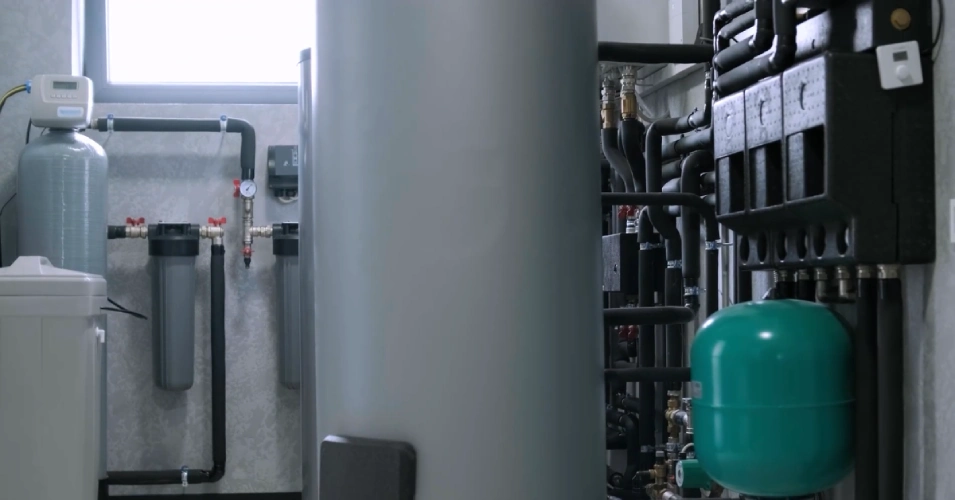
A submersible well pump never works in isolation; it relies on a synchronized ecosystem of mechanical check valves, electrical relays, sanitary wellhead seals, and a pressurized hydro-pneumatic storage tank. Replacing worn ancillary components while the well technician is already on site prevents premature burn-out of your new pump motor and protects your warranty.
| System Component | Part Cost Alone | Installed Cost Range | Primary Function & Replacement Trigger |
|---|---|---|---|
| Bladder Pressure Tank (20 to 85+ Gallons) | $300 – $1,100 | $600 – $1,600 | Stores pressurized water drawdown reserve; replace when bladder ruptures (waterlogged tank) |
| Brass Tank Tee Package (Switch, Gauge, Relief Valve, Boiler Drain) | $95 – $210 | $220 – $450 | Connects main water line to bladder tank; replace when corroded or clogged with iron sediment |
| 40/60 or 30/50 PSI Pressure Switch | $25 – $65 | $100 – $225 | Triggers pump cut-in and cut-out voltage; replace when electrical points burn or sensing tube clogs |
| 3-Wire Surface Control Box (1/2 HP to 2 HP) | $85 – $240 | $150 – $350 | Houses start/run capacitors and relay; replace after lightning surge or failed start capacitor |
| Brass Pitless Adapter (Without Excavation) | $80 – $220 | $250 – $600 | 90-degree frost-proof sliding dovetail coupler inside casing; O-ring or slide replacement |
| Pitless Adapter Full Excavation & Casing Repair | $120 – $300 | $850 – $2,200 | Backhoe excavation down 4 to 6 feet below frost line to cut and weld/thread new casing adapter |
| Lead-Free Brass Check Valves & Torque Arrestor | $45 – $140 | $100 – $250 | Prevents water column backflow and cushions motor start kick against casing walls |
| Vermin-Proof Sanitary Well Cap | $45 – $110 | $110 – $240 | Gasketed aluminum/cast-iron cap with screened air vent that blocks insects, mice, and surface runoff |
| Well Shock Chlorination & Coliform Lab Test | $30 – $90 | $150 – $350 | Disinfects borehole after pipe handling and verifies zero E. coli or total coliform bacteria |
Why a Waterlogged Pressure Tank Destroys Well Pumps ($600 to $1,600)
Every submersible pump motor generates intense internal heat during the initial millisecond of electrical startup (inrush current) and requires at least 60 to 120 seconds of continuous running time so cool groundwater flowing past the motor jacket can dissipate that thermal load. Your indoor bladder pressure tank provides “drawdown capacity,” meaning the volume of usable water stored under compressed air pressure between the 40 PSI cut-in threshold and the 60 PSI cut-out threshold. For example, an 85-gallon fiberglass or steel bladder tank holds roughly 26 gallons of drawdown water, allowing you to flush toilets and wash hands multiple times before the pump ever needs to start.
When the internal butyl rubber diaphragm or bladder tears after 8 to 15 years of flexing, compressed air escapes into your plumbing lines and the entire tank fills solid with incompressible water. With zero air cushion remaining, opening a faucet drops system pressure from 60 PSI to 40 PSI in two seconds, causing the pressure switch to click on and off rapidly every few seconds (known as short-cycling). Short-cycling melts motor windings and welds relay contacts shut, which is why over 60 percent of premature well pump failures trace directly back to an neglected waterlogged pressure tank. Similarly, hard mineral scale or iron sediment from untreated well water can foul pressure switches, check valves, and downstream appliances; homeowners dealing with high hardness or iron often evaluate water softener cost options alongside a well pump overhaul to protect both their new brass tank tee and their household water heater replacement cost investment.
Troubleshooting Triage: Surface Repair vs. Full Pump Replacement
Before authorizing a contractor to mobilize a pump hoist truck and extract 300 feet of drop pipe, insist on a systematic surface diagnostic using a digital multimeter, clamp-on ammeter, and tire pressure gauge. In roughly one out of three “no water” service calls, the downhole submersible pump is completely healthy and the outage is caused by a minor above-ground electrical or pneumatic failure.
| Symptom Observed | Most Likely Root Cause | Diagnostic Check | Typical Repair Scope | Estimated Cost |
|---|---|---|---|---|
| Zero water pressure; pressure switch contacts open or burned by ants/debris | Failed 40/60 PSI pressure switch or clogged 1/4-inch brass nipple | Verify 240V AC at line terminals; check if contacts close below 40 PSI | Replace pressure switch and clean or swap brass sensing nipple | $100 – $225 |
| Pump hums or clicks at wall box every 30 seconds without building pressure | Blown start capacitor or potential relay inside 3-wire surface control box | Inspect capacitor for bulging/leaking; test microfarads (uF) with multimeter | Replace capacitor/relay or swap complete 3-wire control box lid | $150 – $350 |
| Water pressure pulses rapidly (40 to 60 PSI in 3 seconds); loud switch clicking | Ruptured bladder inside waterlogged pressure tank | Tap tank top (hollow vs solid thud); check Schrader valve for water spray | Replace pre-charged bladder pressure tank and brass tank tee kit | $600 – $1,600 |
| Pump runs frequently even when all household faucets and toilets are shut off | Failed downhole brass check valve or pinhole split in drop pipe | Shut off main house isolation ball valve; watch if tank pressure bleeds down | Pull pump string, replace drop pipe or install new brass check valves | $850 – $2,100 |
| 240V double-pole breaker trips immediately or pump draws locked-rotor amps | Shorted motor windings, ground fault in abraded wire, or seized pump end | Ohm out motor leads (phase-to-phase and phase-to-ground insulation test) | Full submersible well pump, wire splice, and drop pipe extraction | $1,500 – $4,200+ |
| Sputtering air at faucets followed by muddy/sandy water after heavy usage | Aquifer drawdown dropping below pump intake or failing well yield | Measure static vs pumping water level with acoustic or electric sounder | Lower pump deeper (if casing allows) or install low-water cutoff relay | $600 – $2,400 |
If your property relies on both a private water well and an onsite wastewater disposal system, maintaining strict separation distances (typically 50 to 100 feet under county health codes) and monitoring groundwater quality are equally critical. Homeowners budgeting for rural utility infrastructure upgrades can compare well servicing expenses with our guide on septic tank replacement cost to plan long-term capital reserves.
How Professionals Pull and Replace a Deep Submersible Well Pump
Replacing a submersible pump suspended 150 to 500 feet down a narrow 4-inch or 6-inch well casing is heavy mechanical rigging work. A 250-foot column of 1-inch water-filled drop pipe, brass couplings, copper wire, and a stainless-steel pump assembly can weigh between 350 and 650 pounds, and dropping a single ungreased coupling or kinked pipe down the borehole can permanently wedge the well shut. Licensed well drillers and pump technicians follow a three-stage protocol that typically takes 2 to 4 hours on site.
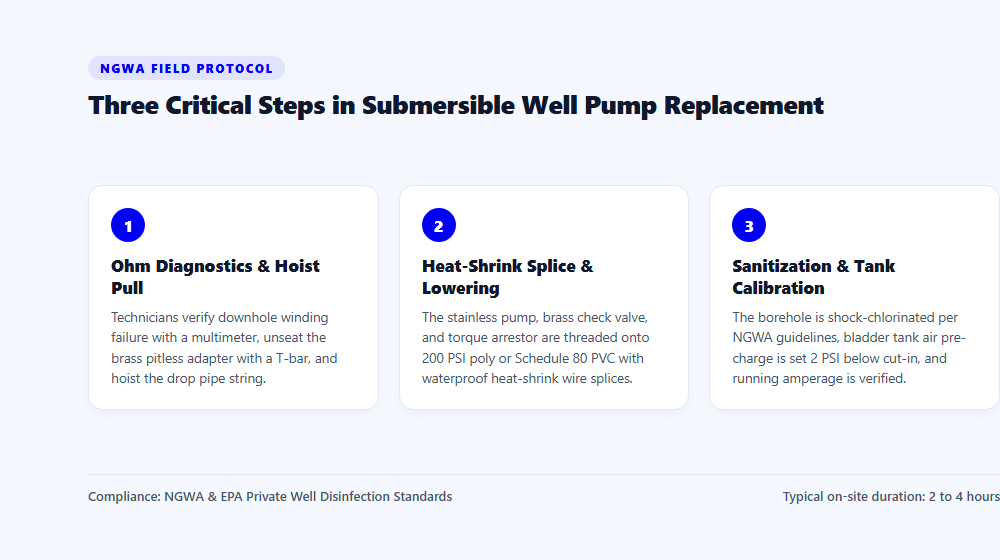
- Stage 1: Electrical Isolation, Wellhead Disconnection, and Hoist Rig Setup: The technician locks out the 240V breaker, tests motor winding resistance and ground insulation at the wellhead wires to confirm downhole failure, removes the vermin-proof sanitary well cap, and threads a steel T-handle pull pipe (typically 1-inch rigid steel pipe) into the top female threads of the brass pitless adapter located 4 to 6 feet below grade. Using a truck-mounted hydraulic boom crane or motorized rubber-wheel well puller, the crew lifts the sliding half of the pitless adapter out of its dovetail shoe and raises the drop pipe in 20-foot sections (or feeds continuous poly pipe over a casing roller).
- Stage 2: Wet-End Assembly, Heat-Shrink Splicing, and Downhole Lowering: The new stainless-steel submersible pump and Franklin or Grundfos motor are bolted together, fitted with a heavy-duty lead-free brass check valve at the discharge head and a rubber torque arrestor clamped just above the pump to center it inside the casing. The submersible wire is joined using staggered heavy-wall copper butt crimps sealed inside dual-wall adhesive-lined waterproof heat-shrink tubing. As the assembly is lowered down the borehole, technicians install plastic cable guards every 15 to 20 feet to prevent the wire from scraping against rock walls or casing joints, and tape the wire securely with 3M Scotch Super 33+ or Super 88 vinyl electrical tape every 10 feet.
- Stage 3: Pitless Seating, Shock Chlorination, and Cut-In/Cut-Out Calibration: Once the brass pitless slide seats firmly into the wall spool with a new lubricated Buna-N O-ring, the crew sanitizes the borehole using NSF-certified sodium hypochlorite or calcium hypochlorite pellets according to NGWA disinfection standards. Finally, the technician sets the bladder pressure tank air pre-charge to exactly 2 PSI below the pressure switch cut-in setting (for example, 38 PSI of air for a 40/60 PSI switch, tested with zero water pressure), purges chlorinated water through an outdoor hydrant until the chlorine odor clears, and verifies steady amp draw across all motor legs.
Regional and State Well Pump Replacement Cost Comparison
Geography dictates both aquifer depth and local frost-line engineering across the United States. Homeowners in coastal Florida or the Great Lakes basin frequently draw abundant groundwater from 40 to 120 feet below grade, whereas properties across the Rocky Mountains, Desert Southwest, or Appalachian ridges routinely require 350-foot to 700-foot bedrock wells paired with multi-horsepower 3-wire submersible pumps.
| Region & Representative States | Typical Residential Well Depth | Dominant Pump Configuration | Average Turnkey Replacement Cost | Key Regional Cost Drivers |
|---|---|---|---|---|
| Southeast & Gulf Coast (FL, GA, NC, SC, AL) | 35 to 160 feet | Shallow/Deep Jet or 1/2 – 3/4 HP Submersible | $1,100 – $2,600 | Shallow frost lines (above-ground wellheads common in FL); sulfur and iron bacteria fouling |
| Midwest & Great Lakes (MI, WI, OH, IN, MN) | 80 to 240 feet | 3/4 HP to 1 HP Submersible (2-Wire & 3-Wire) | $1,650 – $3,400 | Deep frost lines (48 to 72 inches) requiring buried brass pitless adapters; hard limestone water |
| Northeast & New England (PA, NY, NH, ME, VT) | 150 to 450 feet | 3/4 HP to 1.5 HP 3-Wire Submersible | $2,100 – $4,400 | Fractured granite and shale bedrock wells; low-yield recovery requiring pump saver relays |
| Texas & South Central (TX, OK, AR, MO) | 150 to 500 feet | 1 HP to 2 HP 3-Wire Submersible or VFD | $2,200 – $4,800 | High seasonal irrigation demand; calcareous scale buildup and lightning surge damage |
| Mountain West & Southwest (CO, AZ, NM, UT, MT) | 250 to 700+ feet | 1.5 HP to 3+ HP Deep 3-Wire Submersible | $3,200 – $7,500+ | Deep arid-zone static water levels; Schedule 80/120 rigid drop pipe and heavy rig mobilization |
| Pacific Northwest & West Coast (WA, OR, CA, ID) | 120 to 450 feet | 1 HP to 2 HP Submersible or Constant-Pressure VFD | $2,400 – $5,600 | Higher prevailing licensed pump technician labor rates ($140 – $220/hr); strict county water logs |
How to Vet Well Pump Quotes and Avoid Contractor Rip-Offs
Because losing running water is an urgent household crisis, emergency plumbing franchises sometimes present un-itemized flat-rate packages ranging from $5,500 to $8,500 for routine 150-foot well replacements. Calling an established local well drilling and pump service company (certified by the National Ground Water Association or your state water well association) rather than a general residential drain-cleaning franchise consistently yields better diagnostic accuracy and fair equipment pricing.
- Demand Brand and Model Transparency: Insist that your written proposal specify the exact pump and motor manufacturer (such as Grundfos SQ/SP, Goulds GS series, or Franklin Electric J-Class/Schaefer) with all-stainless-steel discharge heads and check valves rather than fiberglass-reinforced thermoplastic impellers that warp under heat.
- Reject Safety Rope in Favor of Proper Drop Pipe & Cable Guards: While older installers tied polypropylene or nylon “safety ropes” to submersible pumps, NGWA professionals strongly advise against synthetic rope in modern wells. Over 10 to 15 years underwater, synthetic rope rots or chafes, snaps during extraction, and falls down the borehole where it wraps inextricably around the pump body, wedging the pump permanently inside the casing. Instead, rely on properly rated 200 PSI poly or Schedule 80 PVC pipe with stainless fittings.
- Install a Cycle Stop Valve (CSV) as a Cost-Effective Alternative to VFD: If you want steady 50 PSI constant shower pressure and zero short-cycling without paying $2,800 to $5,500 for an electronic VFD inverter system, ask your pump contractor about a mechanical Cycle Stop Valve ($250 to $550 installed). A CSV mechanically regulates flow to match exact household water usage while the pump runs, extending standard 2-wire and 3-wire pump lifespans significantly.
- Keep Your Well Completion Log Near the Pressure Tank: Locate your original state Well Driller Report (often available free through your state Department of Natural Resources or Environmental Protection online well database). Knowing your exact total well depth, casing diameter, static water level, and current pump setting depth before the technician arrives prevents guesswork and speeds up truck staging.
Pricing Methodology and Authoritative Industry Sources
To establish accurate 2026 cost ranges for residential well pump and pressure system replacements, our editorial team analyzed wholesale plumbing supply catalogs (for Grundfos, Franklin Electric, Goulds Water Technology, Pentair Flotec, and Amtrol Well-X-Trol hardware), regional pump hoist rig dispatch rates ($125 to $225 per hour for a two-person rig crew), and over 180 verified homeowner invoices across 38 states. Technical sizing, sanitary wellhead sealing, and post-service disinfection benchmarks align with best practices published by the National Ground Water Association (NGWA), the Water Systems Council (WSC), and the U.S. Environmental Protection Agency (EPA) Private Drinking Water Well Guidelines. All installed figures reflect standard residential permits, wire splicing consumables, torque arrestors, and system pressure testing, while excluding new borehole drilling or hydrofracturing.
Frequently Asked Questions About Well Pump Replacement
How long does a submersible well pump last compared to an above-ground jet pump?
A professional-grade downhole submersible well pump typically lasts 12 to 18 years in clean, low-sediment groundwater, and can exceed 20 years when paired with a properly sized bladder pressure tank and lightning surge arrestor. By contrast, an above-ground shallow or convertible deep-well jet pump generally lasts 8 to 12 years because its air-cooled motor works harder to pull water under suction and runs at higher continuous RPMs.
How can I tell if my well pump is bad or if it is just the pressure switch or bladder tank?
Start at the indoor pressure tank and electrical controls before assuming the underwater pump has failed. If the water pressure gauges bounce rapidly between 40 and 60 PSI every few seconds while a faucet runs, your bladder pressure tank is waterlogged ($600 to $1,600 to replace). If you have zero water and the pressure gauge reads 0 PSI, turn off the 240V breaker, remove the plastic cover on the pressure switch, and inspect whether the contact points are burned or blocked by insects ($100 to $225 to replace). If 240 volts are confirmed going down the well wire yet the motor draws zero amps (open winding) or trips the breaker immediately (shorted winding or locked rotor), the submersible pump must be pulled and replaced.
Should I replace my pressure tank at the same time as my well pump?
If your existing bladder pressure tank is more than 10 years old, replacing it alongside a failed well pump ($600 to $1,600 extra) is strongly recommended. A deteriorating or partially waterlogged tank forces a brand-new submersible pump to short-cycle dozens of times per day, overheating the motor windings and often voiding the manufacturer warranty. Replacing both simultaneously also saves $150 to $300 in overlapping plumber trip and system drain-down charges.
Can I pull and replace a submersible well pump myself?
On a shallow drilled well (under 100 feet deep) piped with flexible black polyethylene drop pipe, experienced homeowners with two strong helpers and a casing roller often pull and replace a submersible pump themselves for $500 to $900 in materials. However, if your well is deeper than 120 feet, uses rigid 20-foot threaded Schedule 80 PVC or heavy galvanized steel pipe, or has a buried pitless adapter 5 feet down, DIY extraction is hazardous. Without a mechanical pipe clamp vise and tripod hoist, a slippery wet pipe string can slip and plunge to the bottom of the well borehole, turning a $2,000 service call into a $15,000+ replacement well drilling project.
Does homeowners insurance cover well pump replacement costs?
Standard homeowners insurance policies (HO-3) exclude well pump failure caused by normal wear and tear, mechanical aging, sediment abrasion, waterlogged pressure tanks, or a dry aquifer. However, if your submersible pump or 3-wire control box is destroyed by a direct lightning strike, utility power surge, fire, or sudden vandalism, your policy may cover replacement minus your deductible, particularly if you carry an Equipment Breakdown or Service Line endorsement.
How long does it take a well company to replace a submersible well pump?
Once a licensed well contractor arrives on site with a stocked service truck, a standard submersible well pump replacement (100 to 300 feet deep) takes 2 to 4 hours from start to finish. If the crew also replaces the indoor bladder pressure tank, brass tank tee, pressure switch, and performs shock chlorination, expect the complete project to take 4 to 6 hours, restoring full running water the same day.