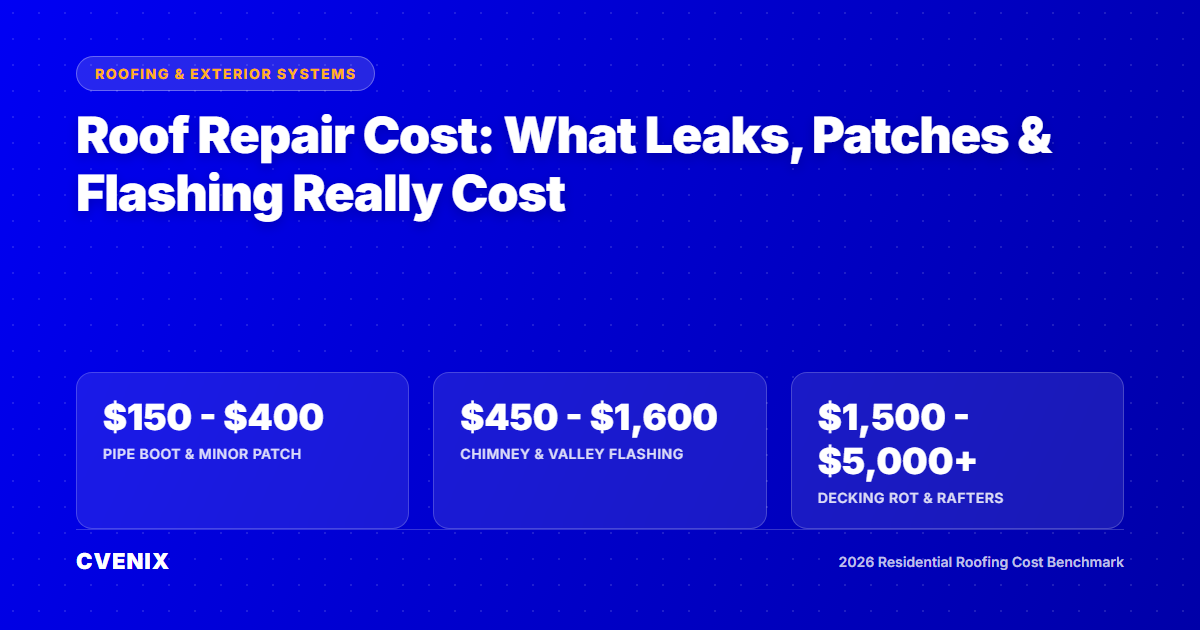
The national average roof repair cost ranges from $380 to $1,900, with most homeowners paying approximately $985 for moderate leak detection, flashing replacement, and localized shingle patching. Simple service calls such as replacing a cracked rubber plumbing vent boot or resealing exposed nail heads start between $150 and $400, reflecting a licensed roofing contractor minimum dispatch fee. Conversely, extensive structural remediation involving rotted plywood roof decking, rebuilt metal valleys, or sagging rafter stabilization typically ranges from $1,800 to $6,000 or more.
Unlike full reroofing projects that scale linearly by total square footage, roof repair pricing is governed by point-of-failure complexity, roof pitch accessibility, and how far moisture has migrated beneath the primary weather barrier. When water breaches deteriorated step flashing or an aging valley liner, it rarely drips straight down; instead, capillary action and gravity carry moisture along wooden rafters and underlayment seams before staining interior drywall ceilings. Understanding how contractors price individual roof components, material systems, and structural deck repairs allows you to evaluate contractor proposals accurately and determine when localized patching makes financial sense over a complete roof replacement.
Roof Repair Cost by Repair Type and Component
Over 85% of residential roof leaks originate at roof penetrations and plane transitions rather than through the uninterrupted field of shingles or panels. Every plumbing stack, skylight curb, masonry chimney, and dormer cheek requires a multi-layered mechanical transition between the roof covering and the vertical structure. When ultraviolet radiation, thermal expansion, or wind uplift compromises these joints, contractors price the repair according to the labor hours required to disassemble the surrounding courses, install self-adhering ice and water membrane, and weave new courses back into place.
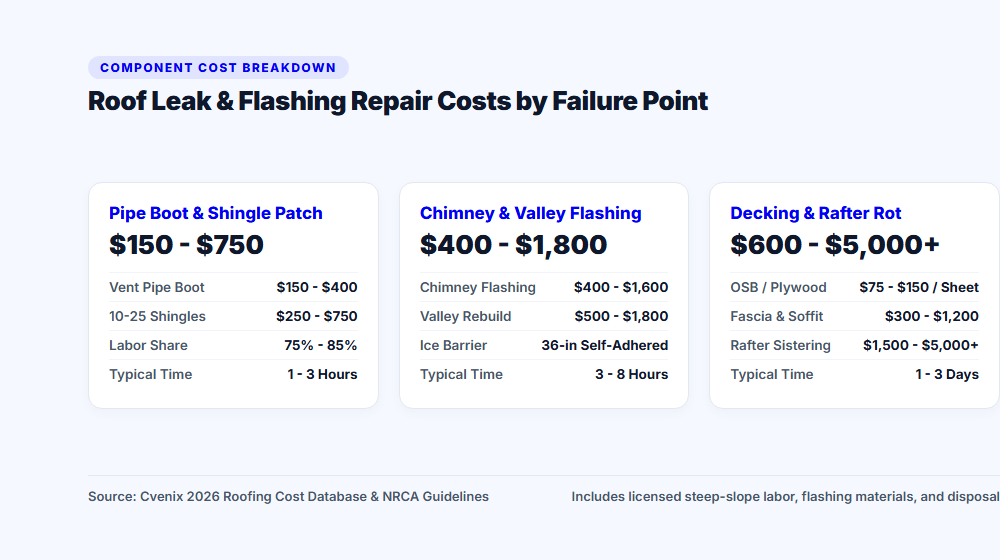
| Roof Repair Type / Component | Average Cost Range | Labor Share | Typical Timeline | Primary Failure Mechanism |
|---|---|---|---|---|
| Plumbing vent pipe boot replacement | $150 – $400 | 75% – 85% | 1 – 2 hours | UV dry rot and cracking of neoprene or EPDM rubber collar around PVC stack |
| Missing or wind-damaged shingle patch (10-25 tabs) | $250 – $750 | 70% – 80% | 1.5 – 3 hours | High-wind sealant bond failure, nail pull-through, or tree limb impact |
| Skylight flashing kit and perimeter reseal | $350 – $1,200 | 65% – 75% | 2 – 5 hours | Improper step-flashing overlap, debris damming at head wall, weep hole blockage |
| Chimney step and counter-flashing rebuild | $400 – $1,600 | 70% – 80% | 3 – 6 hours | Mortar joint shrinkage pulling metal counter-flashing out of masonry reglet |
| Roof valley leak rebuild (open or closed-cut) | $500 – $1,800 | 65% – 75% | 4 – 8 hours | High-volume water channeling eroding granules, thermal cracking, or nail placement too close to valley centerline |
| Fascia board and soffit overhang replacement | $300 – $1,200 | 60% – 70% | 3 – 6 hours | Clogged gutters overflowing backward behind drip edge into wooden sub-fascia |
| Rotted OSB or plywood roof decking replacement | $600 – $2,500 ($75-$150/sheet) | 60% – 70% | 4 – 10 hours | Chronic undetected leak delaminating wood sheathing layers and rusting fasteners |
| Ice dam eave repair and membrane retrofit | $800 – $2,800 | 65% – 75% | 1 – 2 days | Freeze-thaw meltwater backing up under first two shingle courses at uninsulated eaves |
| Sagging rafter, collar tie, or truss sistering | $1,500 – $5,000+ | 70% – 80% | 1 – 3 days | Long-term structural moisture decay, snow load overstress, or split framing members |
| Emergency storm tarping and board-up | $250 – $800 | 80% – 90% | 1 – 3 hours | Immediate temporary weatherproofing after severe hail, tornado, or fallen tree branch |
Plumbing Vent Boots and Roof Penetrations ($150 to $400)
The single most common source of a residential roof leak is a deteriorated plumbing vent pipe boot. Every bathroom and kitchen drain line vents sewer gases through a 1.5-inch to 4-inch PVC or cast-iron pipe extending through the roof deck. Standard builder-grade pipe flashings utilize an aluminum or plastic base plate fitted with a flexible neoprene or EPDM rubber collar that hugs the pipe. Within 8 to 12 years, intense solar heat and ozone exposure cause that rubber gasket to harden, shrink, and split open, allowing rainwater to run directly down the outside of the PVC pipe into the attic.
While the replacement flashing collar itself costs $20 to $65 at a roofing supply house, professional installation ranges from $150 to $400. A technician must carefully break the asphalt sealant bond on the three shingle courses overlapping the top and sides of the flange, extract the corroded roofing nails without tearing the fiberglass shingle mat, slide the new boot over the pipe, secure it with gasketed fasteners, and reseal the overlying tabs with elastomeric roofing cement. Upgrading to a lifetime silicone boot or a spun-lead flashing sleeve ($45 to $90 in material) prevents repeat failures over the remaining life of the roof.
Chimney Step Flashing, Counter-Flashing, and Cricket Saddles ($400 to $1,600)
Masonry chimneys move independently from the wooden framing of your house as foundations settle and timber expands or contracts with seasonal humidity. Because of this differential movement, National Roofing Contractors Association (NRCA) standards prohibit cementing roof shingles directly to brick. Instead, a waterproof chimney joint requires a two-part metallic system: L-shaped base and step flashing interwoven with every individual shingle course ($300 to $750 to replace), and a separate upper counter-flashing embedded into a 1.5-inch deep mortar groove (reglet) cut into the brickwork ($400 to $1,100).
When homeowners hire a handyman to smear black asphalt mastic or roof tar around a leaking chimney, the repair almost always fails within 6 to 12 months as thermal cycling cracks the rigid tar. Furthermore, under International Residential Code (IRC) Section R903.2.2, any chimney wider than 30 inches measured perpendicular to the roof slope must have a peaked ridge structure known as a cricket or saddle constructed behind its upper face to divert cascading water and snow around the masonry. Framing, sheathing, and flashing a new chimney cricket adds $650 to $1,600 to a chimney leak repair invoice.
Roof Valley Leak Remediation ($500 to $1,800)
Roof valleys form where two sloping roof planes intersect at an interior angle, concentrating runoff from hundreds of square feet of roof surface into a narrow drainage channel. Valley repairs are considerably more labor-intensive than flat-plane shingle patches because the technician must unlace both intersecting roof slopes simultaneously. A valley leak typically occurs for one of three reasons: thermal expansion cracking an aged metal valley liner, foot traffic puncturing woven shingles in a closed-cut valley, or an installer placing roofing nails within 6 inches of the valley centerline where pressurized water flows.
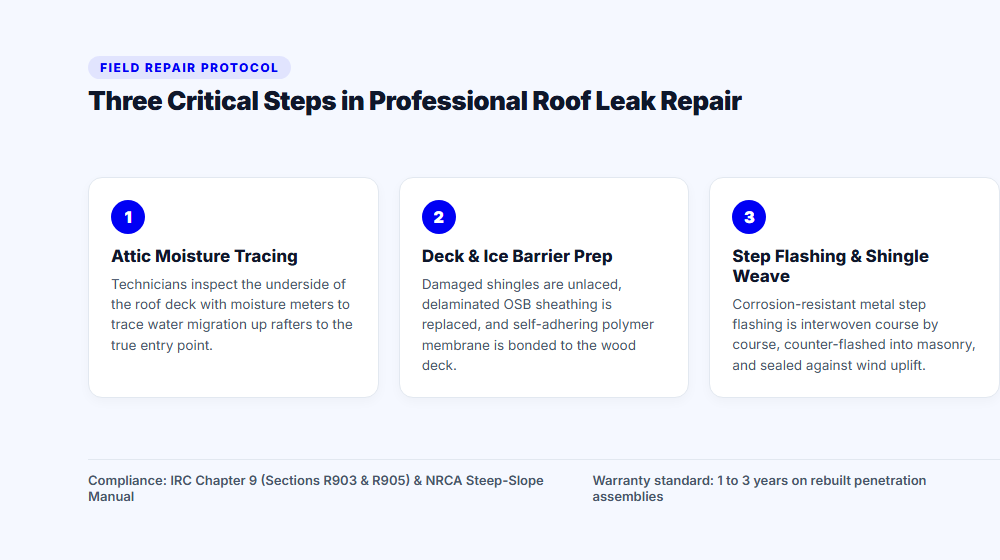
Properly rebuilding a leaking 15-to-20-foot valley costs $500 to $1,800. The crew strips back 3 feet of shingles on both sides of the trough, inspects the underlying plywood for rot, applies a 36-inch wide strip of self-adhering modified bitumen ice and water barrier directly to the deck, installs a 24-gauge pre-painted steel or copper W-valley flashing (with a central raised crimp rib that prevents water from washing up under the opposite slope), and installs new starter and field shingles trimmed 2 inches back from the valley channel.
Rotted Roof Decking, Fascia, and Structural Rafters ($600 to $5,000+)
When a slow roof leak goes unaddressed for multiple rainy seasons, moisture saturates the wooden roof sheathing (typically 7/16-inch or 1/2-inch oriented strand board [OSB] or CDX plywood). Once OSB swells and delaminates, it loses its structural nail-holding power; new roofing nails driven into spongy decking will pull out during the first 50-mph windstorm, violating IRC Section R905.2.3 requirement for solidly sheathed decks. Roofing contractors charge $75 to $150 per 4×8-foot sheet of decking replaced once the overlying shingles are already removed, or $600 to $2,500 as a standalone repair that includes shingle tear-off, wood replacement, synthetic underlayment, and reshingling.
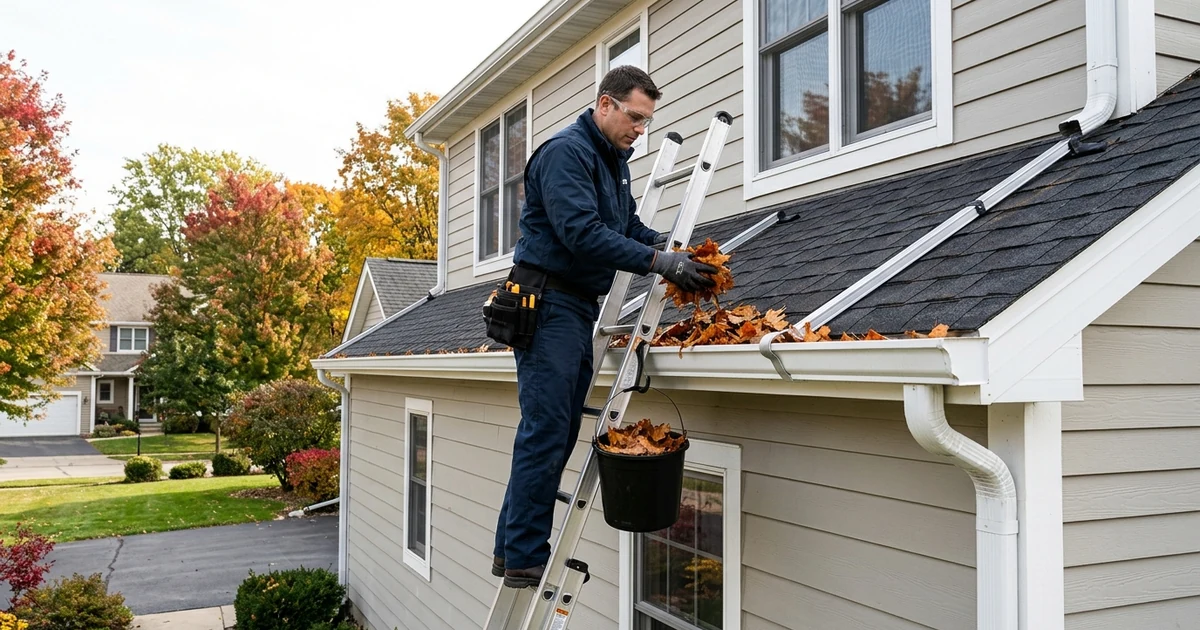
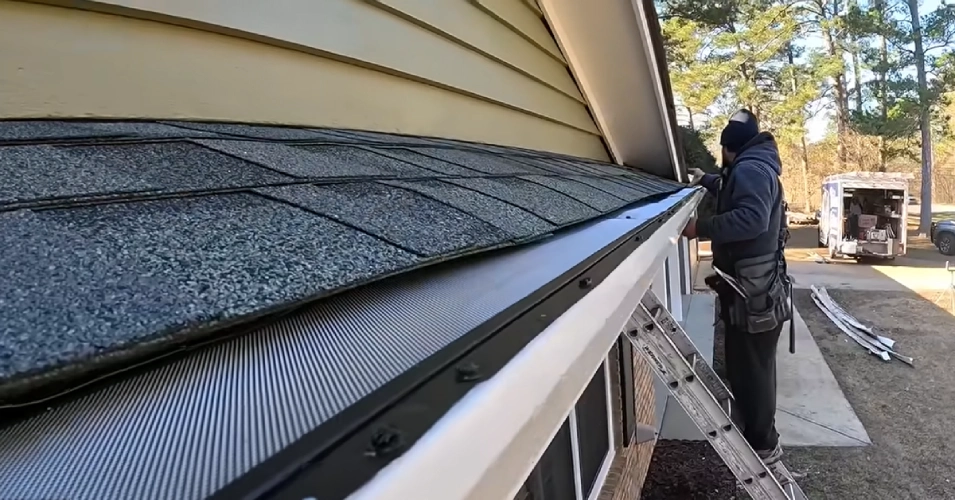
At the lower roof perimeter, missing metal drip edge or overflowing gutters frequently rot the horizontal soffit panels and vertical fascia boards where gutter brackets attach. Replacing rotted fascia and soffit runs $300 to $1,200 depending on whether you select primed pine, PVC composite trim, or aluminum-wrapped lumber, and often coordinates directly with gutter installation or re-hanging costs. If prolonged water intrusion has decayed the structural 2×6 or 2×8 rafters or caused the roofline to sag between trusses, carpenters must jack the roof plane level from inside the attic and bolt full-length structural lumber (“sistering” the rafters) alongside the damaged framing, which ranges from $1,500 to $5,000+.
Roof Repair Cost by Roofing Material
The material covering your roof dictates both the wholesale price of replacement components and the specialized trade skill required to execute a watertight patch. While any residential roofer carries architectural asphalt shingles and standard coil stock on their service truck, repairing interlocking standing seam metal panels, brittle clay Spanish tiles, or quarried natural slate requires specialty tools and material-specific fastening systems.
| Roofing Material | Typical Repair Cost | Cost per Sq. Ft. (Patch Area) | Material vs. Labor Split | Key Repair Complexity & Tooling |
|---|---|---|---|---|
| 3-Tab Asphalt Shingles | $200 – $850 | $4.00 – $8.00 | 20% Material / 80% Labor | Prone to brittle mat tearing if older than 12 years; color fading makes exact patch matching difficult |
| Architectural (Dimensional) Shingles | $250 – $1,200 | $5.00 – $11.00 | 25% Material / 75% Labor | Heavy laminated double-layer tabs require careful pry-bar separation along factory sealant strip |
| Corrugated / Exposed-Fastener Metal | $350 – $1,300 | $6.00 – $14.00 | 25% Material / 75% Labor | Replacing ratusan backed-out neoprene washer screws with oversized stitch screws and butyl tape |
| Standing Seam Metal Roof | $500 – $2,200 | $10.00 – $22.00 | 35% Material / 65% Labor | Unseaming mechanically locked ribs, custom brake-formed Z-flashing, high-temp silicone sealant |
| Cedar Wood Shake & Shingle | $450 – $1,900 | $9.00 – $18.00 | 35% Material / 65% Labor | Splitting curled shakes, weaving 30-lb felt interlayment between courses, stainless steel nails |
| Concrete & Clay Barrel Tile | $500 – $2,600 | $11.00 – $25.00 | 30% Material / 70% Labor | High walk-breakage risk; requires stacking out good tiles to repair rotted 40-lb underlayment felt beneath |
| Natural Quarried Slate | $650 – $3,200 | $15.00 – $35.00 | 35% Material / 65% Labor | Requires forged slate ripper, slate hammer, copper nail-and-bib hook system, and exact thickness matching |
| Flat Roof (TPO, EPDM, Modified Bitumen) | $350 – $1,900 | $6.00 – $16.00 | 30% Material / 70% Labor | Hot-air robotic/hand welding for TPO patches, EPDM primer and uncured flashing tape, scupper drainage work |
Asphalt Shingles: 3-Tab vs. Architectural ($200 to $1,200)
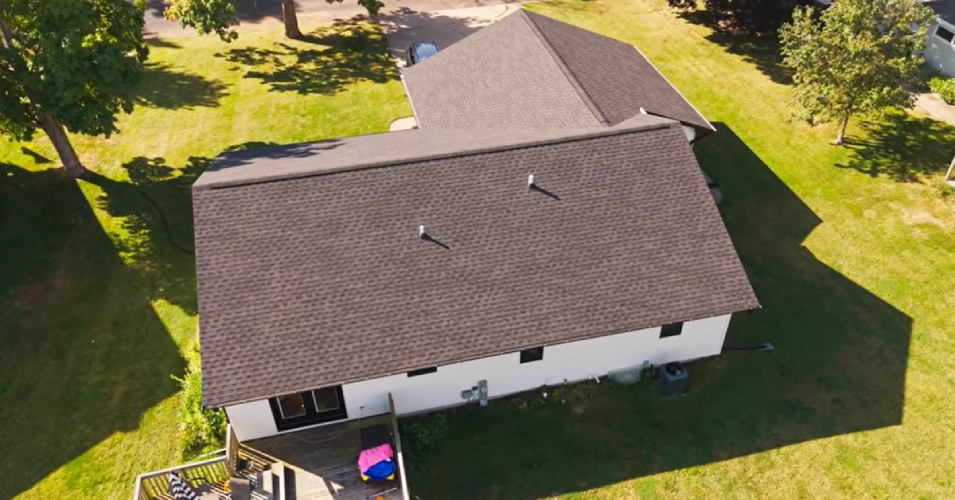
Asphalt composition shingles cover nearly 75% of detached single-family homes in North America, making them the most economical material to repair. A single bundle of architectural shingles covers approximately 33.3 square feet (one-third of a roofing square) and costs $38 to $55 retail. Consequently, when a wind gust tears off a dozen shingles along a rake edge or ridge cap, the material expense is negligible; you are paying $250 to $750 for a two-person crew to mobilize, match the granule blend, replace torn synthetic underlayment, hand-nail six fasteners per shingle along the reinforced nailing zone, and hand-seal each tab against future blow-offs.
Metal Roof Repairs: Exposed Fastener vs. Standing Seam ($350 to $2,200)
When evaluating metal roof leak expenses against initial metal roof installation costs, the panel fastening architecture makes all the difference. Agricultural or ribbed exposed-fastener metal roofs rely on thousands of self-tapping screws fitted with EPDM rubber washers driven directly through the flat pan of the metal sheet. Because steel panels expand and contract longitudinally with daily temperature swings, the screw holes gradually elongate and the rubber washers bake in the sun. After 10 to 15 years, a routine maintenance service ($350 to $950) is required to extract loose #10 screws and drive oversized #12 or #14 replacement screws with bonded stainless-steel washers.
Concealed-fastener standing seam metal roofs eliminate field screw leaks, so repairs ($500 to $2,200) almost exclusively involve penetration boots (high-temperature flexible EPDM or silicone pipe flashings with bendable aluminum bases), ridge cap closure foam degradation, or dent damage from fallen limbs. Replacing a single creased standing seam panel that runs continuously from eave to ridge requires unseaming the interlocking mechanical or snap-lock ribs on both adjacent panels, sliding the damaged sheet out, and crimping a custom-fabricated panel into place.
Clay Tile, Concrete Tile, and Natural Slate ($500 to $3,200)
Homeowners in the Southwest, Florida, and historic Northeastern neighborhoods often experience sticker shock when requesting quotes for tile or slate roof repairs. On a clay or concrete barrel tile roof, the heavy tiles themselves can last 50 to 75 years, yet the roof begins leaking at year 18 to 25. This happens because tile is a water-shedding shell rather than a sealed membrane; wind-driven rain and condensation pass between tile overlaps onto the asphalt-saturated organic felt or polymer underlayment beneath. Performing a “lift and relay” repair ($800 to $2,600) requires carefully removing and stacking intact tiles over a 100-to-200-square-foot zone, stripping rotten wood battens and deteriorated felt, laying new two-ply modified bitumen underlayment and copper flashing, and reinstalling the original tiles with foam adhesive or corrosion-resistant screws.
Flat and Low-Slope Membranes: TPO, EPDM, and Modified Bitumen ($350 to $1,900)
Roofs with a pitch below 2:12 (less than 2 inches of vertical rise per 12 inches of horizontal run) cannot shed water fast enough for overlapping shingles and instead require a continuous waterproof membrane. Flat roof repairs cost between $350 and $1,900 and focus on three vulnerabilities: open lap seams, punctured membrane from dropped HVAC tools or foot traffic, and ponding water where clogged scuppers or interior drains allow water to stand for more than 48 hours. Thermoplastic polyolefin (TPO) repairs require cleaning the weathered membrane with chemical solvent and using a calibrated 1,000-degree hot-air welder to fuse a reinforced patch over the puncture, whereas synthetic rubber (EPDM) repairs utilize specialized splice wash primer and vulcanized pressure-sensitive flashing tape.
Roof Repair Cost by Severity Tier: Minor, Moderate, and Major
Because residential roofing companies carry substantial commercial general liability and steep-slope workers compensation insurance policies, almost every contractor structures repair pricing around three distinct severity tiers. Understanding where your issue falls prevents overpaying for simple maintenance while setting realistic budget expectations when moisture has compromised structural sub-components.
| Severity Tier | Price Range | Crew & Mobilization | Typical Scope of Work Included | Warranty Coverage Provided |
|---|---|---|---|---|
| Tier 1: Minor Tune-Up & Service Call Minimum | $150 – $400 | 1 technician, 1 – 2 hours, service van | Replacing 1 cracked pipe boot, caulking exposed nail heads on ridge cap, re-attaching 3-5 lifted shingle tabs, clearing valley debris | 90-day to 1-year spot repair workmanship guarantee (excludes adjacent aging materials) |
| Tier 2: Moderate Leak & Flashing Overhaul | $450 – $1,500 | 1 – 2 technicians, 3 – 6 hours, material truck | Rebuilding chimney step/counter flashing, re-lining 15 ft of leaking valley with ice & water shield, replacing 1-2 squares of wind-damaged shingles | 1-year to 3-year leak-free warranty on the specific rebuilt penetration or slope section |
| Tier 3: Major Structural & Deck Restoration | $1,500 – $6,000+ | 2 – 4 crew members, 1 – 3 days, dump trailer | Tearing off 3-8 squares down to rafters, replacing 4-12 sheets of rotted OSB decking, sistering cracked rafters, rebuilding eaves after severe ice dams or tree impact | 2-year to 5-year workmanship warranty on reconstructed structural section and new materials |
Many homeowners on community forums question why a Tier 1 repair that consumes $30 in materials carries a $300 to $400 invoice. In the roofing trade, sending a dedicated repair technician involves 45 to 90 minutes of round-trip drive time, fuel, diagnostic attic inspection with a thermal imaging camera or pinless moisture meter, ladder stabilization setup, and post-repair water testing. A smart strategy to maximize the value of a contractor minimum dispatch fee is bundling preventative maintenance into the same visit: ask the technician to inspect and replace all plumbing vent boots on the roof simultaneously, seal every exposed fastener on flashings and gooseneck vents, and clear debris from high valleys.
Labor Rates, Roof Pitch, Story Height, and Permit Costs
Two identical shingle patches can vary in price by more than 100% depending on the geometric slope of the roof and how high the eaves sit above the ground. Skilled roofing labor typically bills at $75 to $150 per hour per technician, accounting for 60% to 80% of the total repair bill. Once a roof pitch exceeds walkable thresholds, OSHA safety regulations (29 CFR 1926.501) and physics slow down every step of the repair workflow.
| Cost Factor / Site Variable | Specification / Category | Hourly Rate or Cost Multiplier | Impact on Typical $800 Base Repair | Safety & Staging Requirements |
|---|---|---|---|---|
| Standard Roofing Labor | Licensed repair technician | $75 – $150 / hour | Baseline ($480 – $640 labor portion) | Standard ladder stabilizer, tool belt, moisture meter |
| Low-to-Moderate Pitch | 2/12 to 6/12 slope (walkable) | 1.0x (No surcharge) | $800 total | Rubber-soled roofing boots provide natural traction without toe-boards |
| Steep-Slope Pitch | 7/12 to 9/12 slope | 1.20x – 1.35x (+20% to +35%) | $960 – $1,080 total | Requires ridge hook ladders, foam pitch hoppers, and OSHA fall-arrest harnesses |
| Mansard / Extreme Steep Pitch | 10/12 to 12/12+ slope | 1.40x – 1.75x (+40% to +75%) | $1,120 – $1,400 total | Mandatory roof jacks nailed into rafters, walk-plank scaffolding, two-person rope belay |
| Single-Story Ranch Access | 10 – 14 ft eave height | 1.0x (Baseline) | $800 total | 20-ft extension ladder; materials carried easily by hand |
| Two-Story Colonial / Split | 18 – 25 ft eave height | 1.15x – 1.25x (+15% to +25%) | $920 – $1,000 total | 32-ft heavy-duty fiberglass ladder; higher wind exposure and material hoisting time |
| Three-Story / Historic Urban | 28 – 40+ ft eave height | 1.35x – 1.60x (+35% to +60%) | $1,080 – $1,280 total | 40-ft ladder, pump-jack scaffolding, or articulated boom lift rental ($350-$700/day) |
| Municipal Building Permit | Structural or >100 sq. ft. repair | $75 – $350 flat fee | +$75 – $350 when triggered | Exempt for minor patches; required under IRC R105.2 when replacing rafters or >1-2 squares of decking |
Beyond slope and story height, municipal permitting rules governed by local amendments to the International Residential Code (IRC) determine whether your repair requires an inspector sign-off. In almost all U.S. jurisdictions, minor repairs such as replacing a pipe boot, reflashing a chimney, or patching fewer than 100 square feet (one roofing square) of shingles are classified as ordinary maintenance and do not require a permit. However, if storm damage or chronic rot requires replacing more than 10% to 25% of the total roof area, or involves cutting and sistering structural roof rafters, cities require a building permit ($75 to $350) and an open-decking framing inspection before new underlayment covers the wood.
Regional and State Roof Repair Cost Comparison
Geography shapes roof repair expenses through three distinct mechanisms: regional prevailing wages and insurance rates, dominant architectural roofing materials, and climate-driven building code mandates. A valley repair on a concrete tile roof in Miami-Dade County, Florida must comply with High-Velocity Hurricane Zone (HVHZ) adhesive and mechanical fastening protocols, whereas an eave repair in Minnesota or Massachusetts centers on self-adhering ice barrier membranes and attic ventilation baffles.
| State / Climate Region | Minor Repair Range | Moderate Leak / Flashing | Major Structural / Valley | Dominant Regional Cost Drivers & Code Mandates |
|---|---|---|---|---|
| Florida (Miami, Tampa, Orlando) | $250 – $500 | $650 – $1,850 | $2,200 – $6,500+ | Florida Building Code HVHZ rules, ring-shank nail density, widespread concrete/clay barrel tile roofs |
| Texas & Plains (Dallas, Houston, Denver) | $175 – $375 | $450 – $1,400 | $1,500 – $4,800 | Severe hail impact fracturing fiberglass mats, Class 4 impact-resistant shingle matching, high wind uplift |
| Northeast (New York, Massachusetts, PA) | $250 – $475 | $600 – $1,750 | $2,000 – $6,200 | IRC R905.1.2 ice barrier mandates at eaves, steep historic pitches, slate and copper flashing prevalence |
| Midwest (Ohio, Illinois, Michigan, MN) | $180 – $380 | $450 – $1,350 | $1,500 – $4,900 | Freeze-thaw ice dam damage, wind-driven snow infiltration at ridge vents, 4/12 to 8/12 architectural shingle roofs |
| California & Southwest (LA, Phoenix, San Diego) | $275 – $525 | $700 – $2,100 | $2,400 – $7,000+ | Title 24 Cool Roof reflectance compliance, brittle clay S-tile underlayment lift-and-relay labor, high labor rates |
| Pacific Northwest (Seattle, Portland) | $225 – $450 | $550 – $1,650 | $1,800 – $5,500 | Persistent moisture moss growth lifting shingle edges, cedar shake maintenance, continuous rain window constraints |
In northern snow-belt states, ice dams represent one of the costliest winter roof emergencies ($800 to $2,800 for permanent remediation). An ice dam forms when heat escaping from the living space warms the upper roof deck, melting snow that trickles down to the cold overhang and refreezes into a thick ice ridge. Water pools behind this ice wall and backs up underneath the shingles. While roofers charge $300 to $700 for emergency low-pressure steam ice dam removal, permanently stopping repeat winter leaks requires stripping the lower 6 feet of shingles to install two courses of self-adhering ice and water shield AND addressing the root thermal defect inside the attic, which often pairs with upgrading attic insulation and air sealing.
Roof Repair vs. Full Roof Replacement: How to Decide
One of the hardest dilemmas homeowners face when handed a $1,400 to $2,800 repair estimate is deciding whether to authorize the patch or apply that capital toward a full roof replacement (which averages $8,500 to $16,500 for a standard architectural shingle home). Ethical roofing estimators and insurance adjusters evaluate three technical benchmarks before recommending a repair over a tear-off:
- The 25% Cost and Area Rule: If the cumulative cost of needed repairs exceeds 25% to 30% of the price of a brand-new roof, or if damage spans more than 25% of total roof square footage (a threshold codified in many state building codes such as the Florida Building Code 25% rule for older roofs), patching delivers poor return on investment.
- The Shingle Brittleness and Pliability Test: For a roofer to replace a damaged shingle or install step flashing, they must gently lift the overlapping shingle course above it to approximately a 45-degree angle to drive nails. If an asphalt roof is 16 to 22+ years old and sun-baked, lifting the upper shingle causes its fiberglass mat to crease or crack. When surrounding shingles fail this pliability test, attempting a localized patch simply breaks adjacent tabs in a chain reaction.
- Isolated Mechanical Failure vs. Systemic Granule Loss: If a 10-year-old roof leaks solely because a squirrel chewed a lead vent boot or wind lifted 12 ridge cap shingles, the remaining 98% of the roof still holds a decade or more of service life; repair is the clear winner. Conversely, if your gutters are filled with quarter-inch piles of black ceramic granules, shingle edges are curling upward (“cupping”), and fiberglass matting is shining through across the entire southern exposure, patching one leak will only precede three new leaks next winter.
- Two-Layer Code Restrictions (IRC Section R908.3): If your home currently has two layers of asphalt shingles nailed one over the other (a “roof-over”), building codes strictly prohibit adding a third layer, and pinpointing the exact entry point of a leak between two laminated shingle layers is notoriously unreliable.
How Professional Roofers Diagnose Hidden Leaks and What to Watch Out For
When water drips through a hallway ceiling or stains a bedroom wall, the actual breach on the exterior roof surface is rarely located directly above the interior stain. Water enters through a nail hole, cracked pipe boot, or open step flashing higher up the slope, runs down the top of the synthetic underlayment or along the underside of a 2×8 rafter for 6 to 15 feet, and drops off only when it hits a horizontal blocking board, drywall screw, or framing knot.
Because of this lateral water migration, you should be cautious of any salesperson who glances at your roof from the driveway or looks only at an interior ceiling stain and immediately demands a full replacement or quotes a vague $1,500 “sealant package.” A legitimate roof repair specialist follows a disciplined four-step diagnostic protocol:
- Interior Attic Tracing: Entering the attic space with a high-lumen inspection light and pinless moisture meter to find the exact wet rafter bay, rusted nail shanks (“shiners”), or stained OSB sheathing panel where water penetrates the deck.
- Up-Slope Exterior Inspection: Measuring the distance from the ridge and gable wall inside the attic, then climbing onto the roof to inspect the corresponding slope zone from the leak point all the way up to the ridge cap.
- Photo & Video Documentation: Taking clear close-up photographs of the cracked pipe collar, rusted valley metal, popped nails, or rotted decking so you can see the exact mechanical failure without climbing a ladder.
- Itemized Mechanical Repair Scope: Providing a written scope that specifies removing damaged courses, installing new metal flashing or ice barrier, and weaving new shingles rather than relying on surface caulk or asphalt tar.
Pricing Methodology and Industry Standards
The roof repair cost ranges and technical specifications presented in this guide are compiled from national residential contractor estimating databases, material distributor price sheets (ABC Supply, Beacon Building Products), and verified homeowner repair invoices across all U.S. census regions. Technical installation requirements and repair-versus-reroof thresholds reference the National Roofing Contractors Association (NRCA) Roofing Manual: Steep-Slope Roof Systems and International Residential Code (IRC) Chapter 9 (Roof Assemblies), specifically Sections R903 (Weather Protection and Flashing), R905 (Requirements for Roof Coverings and Ice Barriers), and R908 (Reroofing and Structural Deck Restoration). All pricing reflects turnkey contractor rates including commercial liability insurance, steep-slope safety equipment, disposal fees, and standard workmanship warranties.
Frequently Asked Questions About Roof Repair Costs
Why do roofing companies charge $300 to $400 for a tiny leak or single pipe boot?
Licensed roofing contractors enforce a minimum service call or dispatch fee (typically $250 to $400) because small repairs still require round-trip travel, vehicle fuel, high-risk steep-slope workers compensation insurance, attic leak diagnostics, ladder stabilization setup, and a minimum two-hour labor block. To get the best value from this minimum charge, ask the technician to replace all aging rubber pipe boots and seal all exposed flashing fasteners on the roof during the same visit.
Does homeowners insurance cover the cost of roof leak repairs?
Homeowners insurance covers roof repair costs only when the damage is caused by a sudden, accidental covered peril such as a severe windstorm, hailstorm, fallen tree limb, or lightning strike. Standard policies explicitly exclude leaks resulting from normal aging, worn-out rubber pipe boots, deteriorated chimney caulk, or deferred maintenance. Additionally, if a storm-related repair costs $800 and your policy carries a $1,000 to $2,500 wind/hail deductible, paying out of pocket is necessary and avoids placing a claim on your CLUE loss history report.
How much does it cost to replace rotted roof plywood or OSB decking?
When rotted roof sheathing is discovered beneath a leak, contractors charge $75 to $150 per 4×8-foot sheet of 7/16-inch OSB or 1/2-inch CDX plywood if the shingles are already removed. As a standalone repair project that includes stripping the existing shingles, cutting out the decayed wood between rafters, nailing down new decking, installing synthetic underlayment, and weaving in new shingles, replacing two to four sheets of rotted decking typically costs $600 to $1,800.
Can a leaking roof flashing or valley be fixed with roof tar or silicone caulk?
No, applying black asphalt roof cement (mastic) or silicone caulk over the surface of a leaking valley or chimney flashing is only a short-term emergency patch that typically fails within 3 to 12 months. Thermal expansion and UV rays cause surface tar to shrink and crack, and thick blobs of caulk often trap water behind the joint, accelerating wood rot. A permanent repair requires removing the overlapping shingles and weaving in new metal step flashing or valley liner so water sheds mechanically via gravity.
Why is repairing a clay or concrete tile roof leak so much more expensive than asphalt shingles?
On a clay or concrete tile roof, the heavy tiles act primarily as a UV and impact shield, while the actual waterproofing layer is the asphalt felt or peel-and-stick membrane underneath the tiles. To fix a tile roof leak ($500 to $2,600), roofers must carefully unfasten and stack 50 to 100 fragile tiles without breaking them, remove the wooden battens, replace the rotted underlayment and valley metal, and then relay and secure the original tiles.
Can roofers repair a roof leak in the rain or during winter?
Contractors cannot perform permanent shingle or flashing repairs during active rainfall because wet roofs are dangerously slick and adhesives, primers, and asphalt sealant strips will not bond to damp surfaces. During active storms, roofers install an emergency weighted or nailed tarp ($250 to $800) to stop interior water damage and return once the deck dries. Winter repairs are routine on clear days above 40 degrees Fahrenheit; in freezing weather, technicians must manually apply a dab of cold-weather roofing cement under every new shingle tab because factory thermal sealant strips require solar heat to activate.