
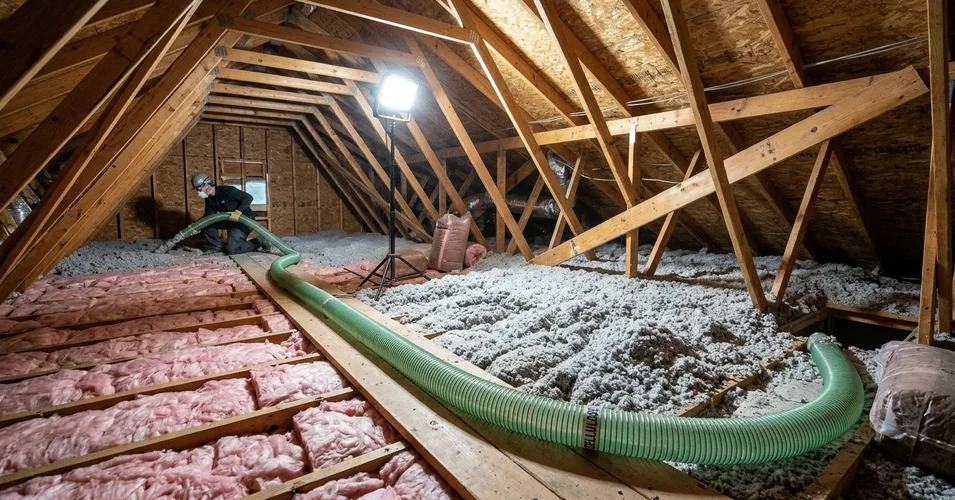
Attic insulation costs between $1,500 and $3,500 for an average 1,200-square-foot home, with most homeowners spending roughly $2,400 including air sealing. DIY projects using blown-in cellulose cost between $400 and $800, while high-performance closed-cell spray foam installations reach $4,000 to $7,500.
Attic Insulation Cost per Square Foot by Material
Material selection determines your thermal performance, installation speed, and total budget. Different insulation types provide varying levels of thermal resistance per inch of thickness.
| Insulation Material | Installed Cost / Sq Ft | R-Value per Inch | Best Use Case |
|---|---|---|---|
| Blown-In Cellulose | $1.20 to $2.30 | R-3.2 to R-3.8 | Attic floors with irregular joists and existing ductwork |
| Blown-In Fiberglass | $1.00 to $2.00 | R-2.2 to R-2.7 | Standard open attic floors and budget retrofits |
| Fiberglass Batts / Rolls | $1.10 to $2.50 | R-3.1 to R-3.4 | Standard 16-inch or 24-inch unhindered joist bays |
| Mineral Wool Batts (Rockwool) | $1.80 to $3.20 | R-3.3 to R-4.2 | Areas requiring maximum fire resistance and sound deadening |
| Open-Cell Spray Foam | $1.80 to $3.50 | R-3.6 to R-3.9 | Roof deck underside in conditioned or unvented attics |
| Closed-Cell Spray Foam | $3.00 to $5.50 | R-6.5 to R-7.0 | Extreme climates and spaces requiring a built-in vapor barrier |
Upgrading your attic insulation lowers heating and cooling bills by 15% to 25%. If your heating equipment is also near the end of its lifespan, pairing insulation with a new furnace replacement cost ensures your HVAC system is properly sized for your tighter building envelope rather than short-cycling.
Recommended R-Values by Climate Zone
The Department of Energy categorizes the United States into eight distinct climate zones. Meeting current building code targets ensures your home stays warm in winter and reduces the heavy summer burden on your air conditioner.
- Zone 1 to Zone 2 (Southern Florida, Texas Gulf, Deep South): Recommended R-30 to R-49. Requires roughly 9 to 14 inches of blown cellulose.
- Zone 3 to Zone 4 (Mid-Atlantic, Central Plains, Pacific Northwest): Recommended R-38 to R-60. Requires roughly 11 to 17 inches of blown cellulose.
- Zone 5 to Zone 8 (Northeast, Midwest, Northern Rockies, Alaska): Recommended R-49 to R-60. Requires roughly 14 to 19 inches of blown cellulose to block severe winter heat loss.
A properly insulated attic reduces thermal load during summer heatwaves, protecting your cooling equipment from burnout and extending operating life as outlined in our central AC replacement cost guide.
Blown-In vs. Batts: Which Is Better for an Attic Floor?
For horizontal attic floors, professional insulators and building scientists almost universally prefer blown-in insulation over batts. Understanding the physical differences explains why.
Why Blown-In Wins on Attic Floors
Blown-in cellulose flows like water into every crack, around electrical junction boxes, under plumbing runs, and across irregular joist spacing. Crucially, blown insulation covers the wooden ceiling joists themselves. Wood framing has an insulation rating of only R-1.2 per inch. Batts leave joist tops exposed, creating thermal bridging where heat conducts directly through the lumber. Blown-in creates a continuous, unbroken blanket across the entire ceiling plane.
When Batts Make Practical Sense
Batts remain useful for vertical attic surfaces, such as knee walls in finished half-story homes, or around attic access stair hatch covers. If you plan to lay down tongue-and-groove plywood boards over joists to preserve heavy attic storage, rigid foam board or dense batts prevent the insulation from becoming crushed.
Real-World Installation Realities: Traps and Essential Tips
Experienced builders and homeowners share practical field realities that contractors often omit during quick sales presentations.
1. The Mandatory Air Sealing Step
The number one mistake made by homeowners is blowing new insulation directly over unsealed attic drywall. Insulation slows down conductive heat transfer, but it does not stop airflow. Holes drilled for electrical wiring, gaps around plumbing soil stacks, and leaky can lights pull heated house air directly into the attic like a chimney. Spending $200 on five cans of expanding foam to seal these penetrations before insulating accounts for nearly half of your actual energy savings.
2. Soffit Baffles Prevent Winter Ice Dams
Contractors rushing through an installation sometimes blow insulation all the way to the exterior eaves, covering the soffit vents. Blocking soffit airflow traps hot air under your roof deck during winter. This melts rooftop snow, which runs down and freezes at the unheated gutter line, creating destructive ice dams. Always install polystyrene rafter baffles ($3 to $5 each) at every truss bay before blowing insulation, protecting your investment as detailed in our roof replacement cost guide.
3. The Big-Box Blower Rental Secret
Both Home Depot and Lowe’s offer free 24-hour rental on commercial insulation blowing machines if you purchase twenty or more bags of cellulose or fiberglass. For an average 1,200-square-foot attic, 25 to 30 bags of cellulose cost between $400 and $550. With one person loading bags into the hopper outside and one person directing the hose in the attic, the entire blowing process takes less than four hours.
Additional Cost Factors to Anticipate
| Service or Modification | Typical Added Cost | When It Is Necessary |
|---|---|---|
| Old Insulation Removal | $1,000 to $2,500 | Pest contamination, past rodent droppings, mold, or vermiculite |
| Professional Air Sealing | $400 to $1,000 | Sealing top plates, plumbing chases, and chimney flues |
| Soffit Baffle Installation | $150 to $350 | Installing 20 to 40 cardboard or foam vent chutes |
| Recessed Can Light Covers | $20 to $35 each | Fire-rated tenmat covers over non-IC-rated light fixtures |
| Attic Hatch Insulation Kit | $60 to $150 | Insulated drop-down stair tent or foam hatch seal |
Frequently Asked Questions (People Also Ask)
Can I just put new insulation over old insulation?
Yes, you can install new blown-in or unfaced batt insulation directly over old insulation, provided the existing material is dry, clean, and free from rodent droppings or mold. Never place faced insulation with a vapor barrier on top of existing insulation, as this traps moisture between the two layers.
How much money does adding attic insulation save?
According to EPA Energy Star estimates, adding attic insulation and air sealing saves an average of 15% on heating and cooling costs, or roughly $200 to $400 per year. In extreme northern or southern climates with high utility rates, annual savings can exceed $600, yielding a complete payback in three to five years.
How thick should attic insulation be for R-38 or R-49?
To achieve R-38, you need approximately 10 to 11 inches of blown cellulose or 14 to 15 inches of blown fiberglass. To reach R-49, you need approximately 13 to 14 inches of blown cellulose or 18 to 20 inches of blown fiberglass measured from the attic floor drywall.
Does attic insulation qualify for federal tax credits?
Yes. Under the Inflation Reduction Act Energy Efficient Home Improvement Credit (Section 25C), homeowners can claim a federal tax credit equal to 30% of the material cost for qualifying insulation and air sealing products, up to a maximum annual credit of $1,200.

