
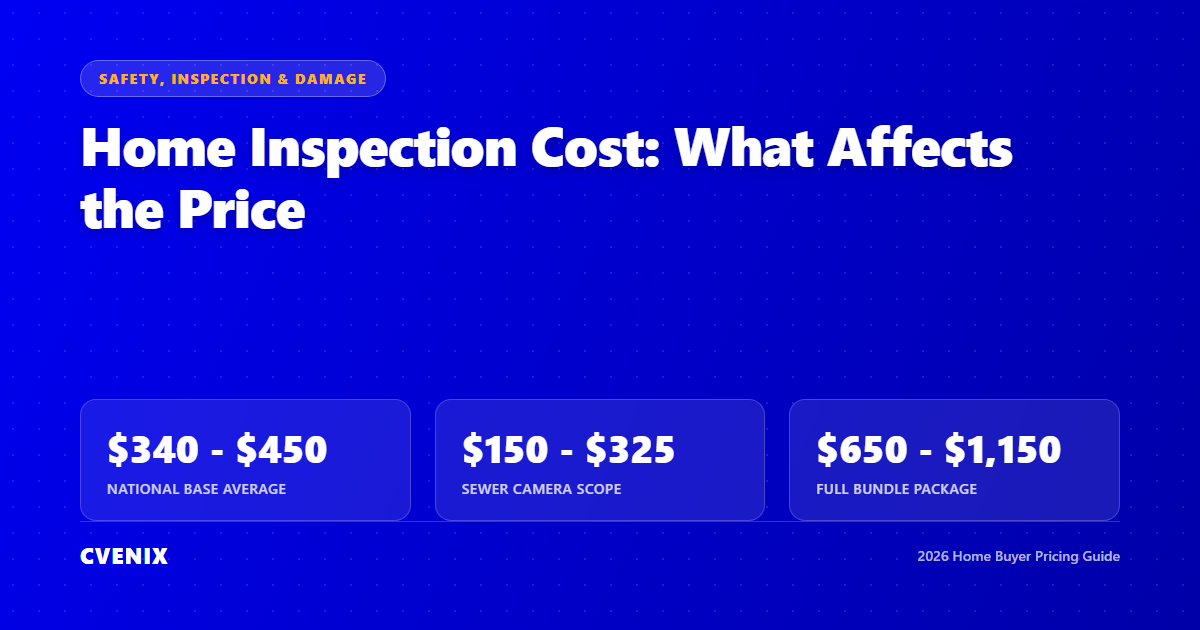
The national average home inspection cost is $340 to $450 for a standard 2,000-square-foot single-family residence, with most home buyers spending between $250 and $700 for the base visual evaluation depending on square footage, foundation configuration, and construction age. While a small urban condominium under 1,000 square feet frequently costs as little as $250 to $350 to inspect, historic homes built before 1950, multi-family duplexes, or luxury estates exceeding 4,000 square feet routinely command $650 to $1,000 or more for the core structural and mechanical walkthrough alone.
However, experienced buyers and real estate attorneys emphasize that the base inspection fee represents only the starting point of pre-purchase due diligence. Standard home inspections governed by the American Society of Home Inspectors (ASHI) and the International Association of Certified Home Inspectors (InterNACHI) are strictly visual and non-invasive. Once buyers bundle high-priority ancillary diagnostics such as a fiber-optic sewer camera scope ($150 to $325), a 48-hour continuous radon monitor test ($125 to $250), and a wood-destroying organism (WDO) termite evaluation ($75 to $175), a comprehensive pre-closing inspection package typically totals $650 to $1,150.
Home Inspection Cost by Property Size and Inspection Duration
Total conditioned and unconditioned square footage is the primary pricing metric used by residential inspection firms across the United States. Because a certified inspector must physically test every accessible electrical receptacle, operate every plumbing fixture, examine attic rafters, and document hundreds of high-resolution photographs, larger homes require substantially more time on-site and longer report compilation hours back at the office.
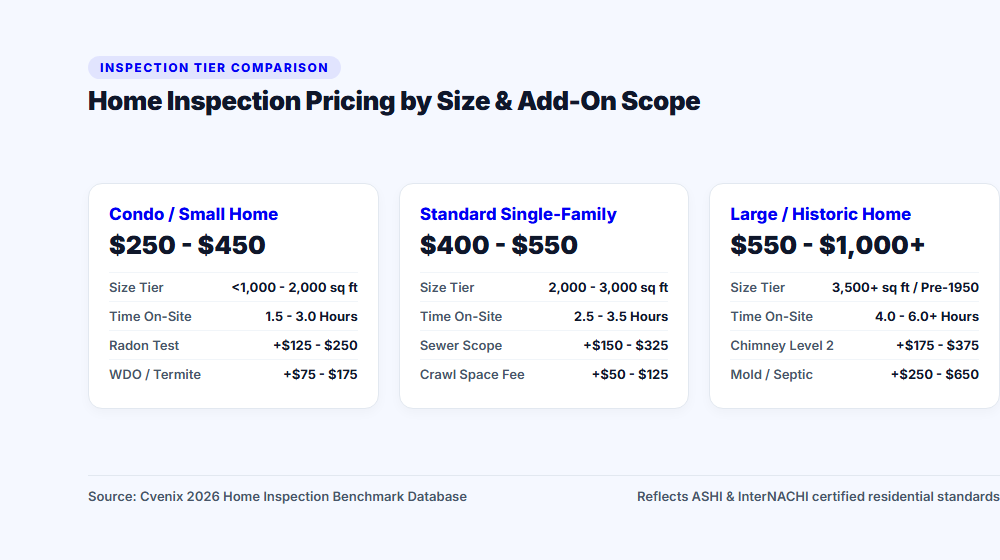
| Property Square Footage | Base Inspection Cost Range | National Average Price | On-Site Walkthrough Duration | Total With Common Add-Ons (Sewer + Radon + WDO) |
|---|---|---|---|---|
| Under 1,000 sq. ft. (Condo / Cottage) | $250 – $350 | $295 | 1.5 – 2.0 hours | $450 – $725 |
| 1,000 to 2,000 sq. ft. | $325 – $450 | $385 | 2.0 – 3.0 hours | $675 – $975 |
| 2,000 to 3,000 sq. ft. | $400 – $550 | $465 | 2.5 – 3.5 hours | $750 – $1,100 |
| 3,000 to 4,000 sq. ft. | $500 – $700 | $590 | 3.5 – 4.5 hours | $875 – $1,325 |
| 4,000 to 5,500 sq. ft. | $650 – $900 | $760 | 4.5 – 6.0 hours (or 2 inspectors) | $1,050 – $1,550 |
| Over 5,500 sq. ft. (Custom Estate) | $850 – $1,400+ | $1,050 | 6.0+ hours (2-inspector team) | $1,350 – $2,200+ |
Home buyers are often surprised when an inspection company quotes a higher square footage tier than the figure advertised on the Multiple Listing Service (MLS). Tax records and MLS listings typically report only above-grade heated living space. In contrast, home inspectors must evaluate the entire structural envelope, which includes unfinished basements, walk-up attics, attached two- or three-car garages, and enclosed three-season sunrooms. If a 2,200-square-foot colonial home sits over a 1,100-square-foot unfinished basement, many inspection firms bill the property as a 3,300-square-foot structure or apply a dedicated basement inspection fee.
How Pricing Scales Above 3,500 Square Feet
Once a single-family residence exceeds 3,500 to 4,000 square feet, mechanical complexity rarely scales in a simple linear fashion. Larger residences frequently house dual-zone or multi-zone HVAC split systems, two or more tankless water heaters, subpanels feeding detached workshops or pool equipment, and complex multi-gable roof valleys. To complete the walkthrough within a single afternoon contingency window without inspector fatigue, reputable firms either charge an incremental rate of $0.10 to $0.18 per additional square foot above 3,000 square feet or dispatch two licensed inspectors simultaneously.
Home Inspection Cost by Property Type, Foundation Access, and Age
Two properties with identical square footage can carry vastly different inspection fees depending on their structural classification, foundation accessibility, and year of construction. A modern slab-on-grade suburban tract home with PEX plumbing and Romex copper wiring is straightforward to document. Conversely, a 1920s craftsman bungalow resting on a damp pier-and-beam crawl space requires protective coveralls, respirator gear, moisture meter probing, and meticulous scrutiny of legacy electrical and drain systems.
| Property Type / Structural Factor | Typical Inspection Fee / Surcharge | Average Total Cost | Primary Technical Drivers & Scope Adjustments |
|---|---|---|---|
| Condominium or Co-op (Interior Unit) | $250 – $375 (Base) | $310 | Roof, exterior siding, foundation, and main grounds managed by HOA; focus on interior MEP systems |
| Townhouse / Rowhouse | $325 – $475 (Base) | $395 | Includes party-wall fire separation check in attic, individual roof section, and exterior grading |
| Single-Family Home (Slab-on-Grade) | $340 – $525 (Base) | $415 | Standard baseline; no under-floor crawl space access required, faster structural evaluation |
| Vented or Unvented Crawl Space Foundation | +$50 – $125 Surcharge | $450 – $625 | Physical entry under floor joists to check sill plates, piers, vapor barriers, and standing water |
| Historic / Older Home (Built Pre-1950) | +$75 – $200 Surcharge | $500 – $750 | Knob-and-tube or cloth wiring, Federal Pacific panels, galvanized pipes, cast-iron drains, brick mortar decay |
| Homes Built 1950 to 1985 | +$35 – $85 Surcharge | $425 – $585 | Aluminum branch wiring (1965-1973), polybutylene pipe checks, asbestos duct tape or vermiculite insulation |
| Multi-Family Duplex / Triplex / Fourplex | $550 – $1,100+ (+$125/unit) | $775 | Multiple kitchens, separate electrical meters and panels, duplicate furnaces, and tenant access coordination |
| Detached ADU, Guest House, or Barn | +$100 – $250 Surcharge | $525 – $775 | Separate roof structure, subpanel feeder wiring verification, and independent plumbing fixtures |
| New Construction 3-Phase Package | $750 – $1,400 Bundle | $1,025 | Includes Phase 1 Pre-Pour Foundation, Phase 2 Pre-Drywall Rough-In, and Phase 3 Final Walkthrough |
| 11-Month Builder Warranty Inspection | $350 – $525 (Standalone) | $425 | Conducted at month 11 before the 1-year builder structural and workmanship warranty expires |
Why Historic and Pre-1950 Homes Carry Age Surcharges
Nearly 80% of independent inspection companies add an age fee ranging from $50 to $200 for houses over 50 to 75 years old. Older residences rarely preserve their original floor plans or untouched mechanical systems; instead, they represent a patchwork of remodel eras, amateur homeowner modifications, and obsolete building materials. During an older home walkthrough, the inspector must investigate ungrounded two-prong outlets, double-tapped circuit breakers, discontinued Zinsco or Federal Pacific Stab-Lok panels, corroded galvanized steel water supply lines that restrict shower pressure, and settling fieldstone or unreinforced brick foundations. If significant differential settlement or bowed basement walls appear during the walkthrough, the general inspector will flag the issue for an engineered structural evaluation, helping you gauge potential foundation repair cost exposure before your inspection contingency expires.
New Construction: Why 3-Stage Inspections Are Critical
A widespread misconception among home buyers is that newly constructed homes do not require an independent inspection because municipal code enforcement officers sign off on building permits. In reality, municipal building inspectors in high-growth suburbs often spend less than 15 minutes on-site per phase and check only minimum statutory code compliance rather than installation craftsmanship. Hiring an independent inspector for a three-stage new construction package ($750 to $1,400 total) protects buyers across three vital milestones:
- Phase 1: Pre-Pour Foundation and Slab Inspection ($250 to $350): Executed after footing excavation, plumbing rough-in stub-outs, vapor barrier placement, and post-tension cable or steel rebar tying are complete, but immediately prior to concrete placement. Catching an uncompacted trench or missing rebar support here prevents irreversible slab cracking later.
- Phase 2: Pre-Drywall Framing and Mechanical Rough-In Inspection ($300 to $450): Conducted after roof dry-in, structural framing, window flashing, electrical wiring, supply plumbing, and HVAC ductwork are installed, but before fiberglass insulation and gypsum drywall conceal the wall cavities. Inspectors frequently discover notched load-bearing studs, missing nail plates over PEX pipes, disconnected bath exhaust ducts, and unsealed exterior shear panels during this window.
- Phase 3: Final Pre-Closing Walkthrough Inspection ($350 to $500): Performed five to seven days before closing once electricity, gas, and water meters are active. This mirrors a full residential home inspection, checking grading drainage, attic blown-in insulation depth, GFCI/AFCI trip functionality, HVAC temperature splits, and roof shingle nail pops caused by construction foot traffic.
- 11-Month Builder Warranty Inspection ($350 to $525): Scheduled during the eleventh month of occupancy so homeowners can present the builder with a documented punch list of nail pops, truss uplift, roof flashing leaks, or grading washouts before the standard one-year builder warranty expires.
Specialty and Ancillary Inspection Add-On Costs
Because a standard home inspection covers only visible and readily accessible components, concealed underground piping, invisible radioactive gases, indoor airborne fungal spores, and specialized systems like swimming pools or private septic tanks are excluded from the base fee. Ordering these specialty evaluations as bundled add-ons through your primary inspection company (or hiring specialized subcontractors during the same contingency window) typically reduces per-test travel charges by 20% to 35%.
| Specialty Add-On Inspection | Bundled Add-On Price | Standalone Specialist Price | When This Add-On Is Essential | Potential Uncaught Repair Exposure |
|---|---|---|---|---|
| Sewer Lateral Camera Scope | $150 – $325 | $250 – $450 | All homes 20+ years old, mature yard trees, cast iron/clay/Orangeburg pipes, or new builds | $4,500 – $20,000+ for trench or trenchless sewer replacement |
| Radon Continuous Monitor Test (48-Hr) | $125 – $250 | $175 – $300 | Homes with basements, crawl spaces, or slab foundations in EPA Radon Zones 1 and 2 | $900 – $2,500 for sub-slab depressurization mitigation system |
| WDO / Termite & Pest Inspection (NPMA-33) | $75 – $175 | $125 – $250 | Mandatory for VA loans and many FHA loans; critical in Southeast, South, and coastal zones | $1,200 – $8,000+ for chemical barrier, baiting, and sill joist repair |
| Mold Air Spore & Surface Swab Testing | $250 – $600 | $350 – $850 | Musty basement odors, prior roof/plumbing leaks, high indoor humidity, or visible staining | $2,000 – $12,000+ for containment, HEPA scrubbing, and drywall removal |
| Asbestos & Lead Paint Lab Sampling | $250 – $650 | $400 – $950 | Homes built before 1978 (lead paint) or before 1985 (9×9 vinyl tile, popcorn ceilings, pipe wrap) | $2,500 – $15,000+ for licensed hazardous abatement prior to remodeling |
| Septic Dye, Pump & Hydraulic Load Test | $300 – $650 | $400 – $850 | All rural or suburban properties relying on private onsite wastewater treatment tanks and leach fields | $6,000 – $28,000+ for tank replacement or engineered mound leach field |
| Well Water Flow Rate & Lab Quality Test | $175 – $400 | $250 – $550 | Homes on private groundwater wells (tests coliform bacteria, nitrates, lead, arsenic, and GPM flow) | $1,500 – $9,000 for UV filtration, water softeners, or deep well pump replacement |
| Chimney Level 2 Video Flue Scope | $175 – $375 | $250 – $500 | NFPA 211 standard for any real estate transfer involving wood-burning or gas masonry fireplaces | $2,000 – $9,500 for stainless steel flue liner, crown rebuild, or tuckpointing |
| Thermal Infrared (IR) Camera Scan | $0 (Included) – $150 | $150 – $300 | Detecting hidden moisture behind tiled showers, flat roof leaks, missing wall insulation, and hot breakers | $1,000 – $10,000+ in concealed water intrusion or electrical fire hazards |
| Swimming Pool & Spa Equipment Inspection | $150 – $300 | $225 – $450 | Properties with inground gunite, fiberglass, or vinyl pools (checks pumps, heaters, salt cells, plaster) | $2,500 – $18,000 for pool resurfacing, heater swap, or underground plumbing leaks |
| 4-Point & Wind Mitigation Inspection | $100 – $250 | $150 – $350 | Florida and coastal hurricane zones; required by insurers on homes 20-30+ years old to bind coverage | $1,500 – $4,500/yr in avoidable homeowners insurance premium surcharges |
1. Sewer Lateral Camera Scope ($150 to $325)
During a standard home inspection, the inspector runs bathroom sinks, flushes toilets, and fills bathtubs to confirm that water drains out of the house during a 30-minute test. However, a partially collapsed clay pipe or root-choked cast-iron main line 45 feet out under the front lawn can easily hold 50 gallons of test water without backing up into the basement during the walkthrough, only to flood the lower level during your first week of doing family laundry. A sewer lateral camera inspection sends a self-leveling HD fiber-optic video camera through the main building cleanout all the way to the municipal street tap (typically 50 to 120 linear feet). If the camera uncovers offset clay joints, crushed Orangeburg bituminized fiber pipe, or heavy root balls, you can use the timestamped video recording to negotiate a seller repair credit covering the full sewer line replacement cost before closing.
2. Continuous Radon Gas Testing ($125 to $250)
Radon is a colorless, odorless radioactive gas produced by the natural decay of uranium in soil and bedrock. It is the second leading cause of lung cancer in the United States according to the Environmental Protection Agency (EPA). Professional inspectors deploy calibrated Continuous Radon Monitors (CRMs) in the lowest livable level of the home for a minimum 48-hour closed-building test period, recording hourly barometric pressure, temperature, tamper sensors, and picocuries per liter (pCi/L). Whenever results equal or exceed the EPA action threshold of 4.0 pCi/L, buyers routinely request a seller concession of $1,000 to $2,200 to cover the radon mitigation system cost for an active sub-slab depressurization fan and vent stack.
3. WDO / Termite Inspection ($75 to $175) and Mold Testing ($250 to $600)
While a general home inspector notes obvious wood rot or visible mud tubes on foundation walls, most state pest control boards prohibit anyone without a structural pest control applicator license from issuing an official Wood-Destroying Organism (WDO) or Wood-Destroying Insect (WDI) clearance report (Form NPMA-33). If you are financing your purchase with a VA mortgage (or an FHA loan in designated high-risk termite states), the lender will mandate an official NPMA-33 inspection prior to loan funding. Discovering subterranean termite galleries, carpenter ants, or powderpost beetles early allows you to benchmark the required termite treatment cost and demand professional eradication by the seller.
Similarly, if the inspector detects elevated moisture behind basement drywall with a pinless hygrometer or notices dark organic spotting along attic roof decking caused by blocked soffit vents, ordering accredited laboratory mold testing ($250 to $600) provides scientific proof of elevated Stachybotrys, Aspergillus, or Penicillium spore counts compared to an outdoor baseline air cassette. Certified lab reports give buyers concrete leverage when negotiating credits toward professional mold remediation cost invoices.
4. 4-Point and Wind Mitigation Insurance Inspections ($100 to $250)
In hurricane-exposed coastal states like Florida, Louisiana, Texas, and the Carolinas, property insurance underwriters frequently refuse to bind a homeowners policy on residences over 20 to 30 years old without a standardized 4-Point Inspection. This concise underwriting form documents the remaining useful life, material type, and installation date of four high-claim systems: the roof covering, electrical panel and wiring, HVAC equipment, and plumbing supply/drain lines. Pairing the 4-Point check with a Uniform Wind Mitigation Inspection (which verifies roof-to-wall hurricane clips or straps, secondary water barriers, roof deck nailing patterns, and impact-rated glass) typically costs $100 to $250 when bundled with a pre-purchase inspection and can reduce annual windstorm insurance premiums by $800 to $3,500 per year.
What a Standard Home Inspection Covers vs. Excludes
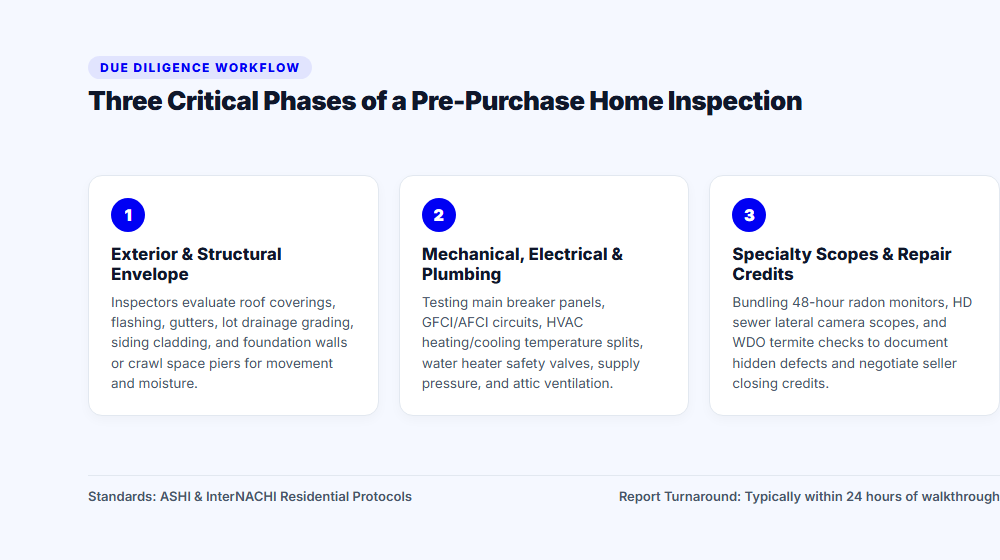
Both the American Society of Home Inspectors (ASHI) Standards of Practice and the InterNACHI Residential Standards of Practice define a general home inspection as a non-invasive, visual examination of the accessible systems and components of a residential building using normal operating controls. Understanding the exact boundary between included inspection scope and excluded engineering or invasive diagnostics prevents costly post-closing surprises and ensures you hire the right specialists before your due diligence period ends.
| Major Building System | What Is Included in Standard ASHI / InterNACHI Scope | What Is Strictly Excluded (Requires Specialist Add-On) | Average Seller Credit / Repair Cost If Flagged |
|---|---|---|---|
| 1. Roof, Flashing & Chimneys | Visual check of shingles, tile/metal panels, valleys, skylights, gutters, downspouts, and exterior chimney masonry | Walking wet/steep/fragile slate or clay roofs; internal chimney flue camera lining check (requires NFPA Level 2 scope) | $800 – $3,500 (flashing/boot repair) or $9,000 – $22,000 (full reroof) |
| 2. Foundation, Basement & Structure | Visible poured concrete/block walls, crawl space piers, floor joists, subfloor sheathing, and sill plate moisture | Engineering load calculations, soil borings, or defects hidden behind finished basement drywall and paneling | $2,500 – $15,000+ for piering, carbon fiber straps, or French drains |
| 3. Exterior Siding, Grading & Decks | Siding cladding (brick, stucco, vinyl, fiber cement), window trim, deck ledgers/guardrails, driveway slope, and lot drainage | Invasive moisture probing behind hard-coat or EIFS synthetic stucco (requires specialized stucco probe contractor) | $1,200 – $6,500 for ledger flashing, regrading, or rot replacement |
| 4. Plumbing Supply, Drains & Water Heater | Visible supply pipes, drain traps, fixture flow pressure, functional drainage, sump pumps, and water heater TPR valve/venting | Underground main sewer lateral lines, private septic tanks, well water potability, and fire sprinkler systems | $1,400 – $3,200 (water heater) or $5,000 – $18,000 (repiping/sewer) |
| 5. Electrical Service, Panels & Wiring | Service drop/mast, main panel dead-front removal, breaker sizing, grounding/bonding, AFCI/GFCI testing, and representative outlets | Low-voltage security/data cabling, solar PV array output testing, backup generator load banks, or wiring inside closed walls | $1,800 – $4,500 for 200-amp panel upgrade and safety rewiring |
| 6. Heating & Central Air Conditioning | Thermostat response, air filter/blower check, supply/return register temperature split, flue draft, and condenser coil condition | Disassembling furnace heat exchangers (requires HVAC combustion/camera check); testing A/C when outdoor temp is below 60-65°F | $4,500 – $12,500 for furnace or central heat pump replacement |
| 7. Attic, Insulation & Ventilation | Rafters/trusses, roof sheathing water stains, insulation type and depth (R-value estimate), soffit/ridge vents, and bath exhaust routing | Disturbing suspected asbestos vermiculite insulation or entering attics with insufficient clearance or hazardous framing | $1,500 – $4,000 for air sealing, baffle vents, and blown-in cellulose |
| 8. Interior Rooms, Doors, Windows & Built-Ins | Walls, ceilings, floors, stair handrails/balusters, window egress and glazing seals, garage doors/auto-reverse sensors, and kitchen appliances | Cosmetic paint/wallpaper flaws, window treatments, portable appliances (washer/dryer/fridge often optional), and acoustic insulation | $600 – $3,000 for fogged thermal window panes and safety glazing |
How Seasonal Weather Limits Roof and Air Conditioning Testing
Home buyers purchasing properties in late autumn, winter, or early spring across northern states must account for two critical seasonal limitations built into every state inspection standard. First, an inspector is prohibited from operating a central air conditioning compressor when the exterior ambient temperature has fallen below 60°F to 65°F within the preceding 24 hours. Running a standard split-system condenser in cold weather prevents liquid refrigerant from vaporizing properly in the evaporator coil, which can send liquid refrigerant slugs back into the compressor and destroy the unit. Second, if a roof is covered in snow or ice, the inspector cannot inspect the shingles directly. Modern inspectors mitigate roof access limitations by flying high-resolution 4K camera drones or extending 30-foot pole cameras over snow-free eaves and chimney crowns.
Regional and State Home Inspection Cost Comparison
Geographic location shapes home inspection pricing through three distinct mechanisms: state-mandated licensing and insurance overhead, regional cost of living, and dominant local construction hazards. Thirty-six states enforce dedicated home inspector licensing laws requiring between 80 and 200+ hours of classroom training, proctored National Home Inspector Examination (NHIE) passage, mentored ride-along inspections, and mandatory general liability plus Errors & Omissions (E&O) insurance policies.
| State / Metro Region | Average Base Inspection Cost (2,200 Sq. Ft.) | Typical Bundled Total (With Regional Add-Ons) | State Licensing & Regulatory Status | Dominant Regional Inspection Priorities |
|---|---|---|---|---|
| Northeast (NY, NJ, MA, CT, PA) | $450 – $650 | $850 – $1,350 | Strict state licensing (except PA which mandates statutory association membership & E&O insurance) | Pre-1940 basements, oil tank sweeps ($150-$300), radon, knob-and-tube wiring, slate/flat roofs |
| Florida & Gulf Coast (FL, LA, MS, AL) | $350 – $525 | $600 – $1,050 | Strict state licensing (FL DBPR 120-hr course); mandatory insurance inspection forms | 4-Point & Wind Mitigation insurance forms, WDO/subterranean & Formosan termites, cast-iron drain decay, polybutylene |
| Texas (Austin, Dallas, Houston, San Antonio) | $375 – $550 | $700 – $1,150 | Heavily regulated by Texas Real Estate Commission (TREC); standardized REI 7-6 report form | Expansive clay slab foundation differential movement (zip-level elevation surveys), hydrostatic sewer tests, roof hail damage |
| West Coast (CA, WA, OR) | $450 – $700 | $800 – $1,300 | WA & OR require strict state licensing; CA regulates via Business & Professions Code §7195 (Trade Practice Act) | Seismic foundation anchor bolting & cripple wall bracing, sewer lateral ordinances (EBMUD/city point-of-sale), wildfire roof ratings |
| Midwest & Great Lakes (IL, OH, MI, MN, WI) | $325 – $475 | $625 – $975 | Licensed in IL, OH, WI; local truth-in-housing point-of-sale inspections required in several MN cities | High EPA Zone 1 radon levels, bowed block basement walls from frost heave, sump pump/drain tile, ice dam attic ventilation |
| Mountain West & Southwest (CO, AZ, NV, UT) | $340 – $500 | $600 – $950 | Licensed in AZ and NV; CO and UT rely on national ASHI/InterNACHI certification and local contractor standards | Bentonite expansive soils (CO Front Range), high radon (CO), stucco cracking, desert subterranean termites, evaporative coolers/solar |
| Southeast & Mid-Atlantic (NC, VA, GA, TN, MD) | $350 – $500 | $650 – $1,050 | Strict state licensing in NC, VA, MD, SC, TN; mandatory continuing education and E&O coverage | High-humidity vented crawl spaces, fungal wood rot, WDO/termite clearance, red clay drainage, synthetic EIFS stucco moisture |
Unique Regional Surcharges: Buried Oil Tank Sweeps and Hydrostatic Tests
Depending on the state where you are purchasing property, your real estate attorney or buyer agent may advise ordering specialized regional diagnostics that rarely appear in national checklists:
- Underground Heating Oil Tank (UST) Metal Detector & GPR Sweep ($150 to $350): Essential in New Jersey, New York, Pennsylvania, and New England for homes built prior to 1980, even if the residence currently runs on natural gas. Many mid-century homes converted to municipal gas in the 1980s or 1990s while leaving an abandoned steel heating oil tank buried in the yard. If an abandoned tank corrodes and leaks fuel oil into the groundwater, state environmental remediation and contaminated soil excavation can cost the current property owner $15,000 to $75,000+.
- Foundation Digital Elevation Survey and Hydrostatic Plumbing Test ($150 to $350): Common across Texas and Oklahoma, where expansive bentonite and montmorillonite clay soils swell during rainy seasons and shrink during summer droughts. Inspectors use a high-precision digital altimeter (such as a ZipLevel) to map slab elevation variances to within a tenth of an inch across the floor plan, flagging whether under-slab plumbing drain leaks have eroded soil support.
- Municipal Point-of-Sale Sewer Lateral Compliance ($200 to $400): In the San Francisco East Bay (EBMUD jurisdiction) and dozens of older municipalities across California, Pennsylvania, and Ohio, city ordinances prohibit closing a real estate transfer or transferring water service until the private sewer lateral passes a municipal pressure test or camera verification confirming zero storm-water infiltration into the sanitary sewer system.
How to Choose a Home Inspector and Maximize Repair Negotiations
Shopping for the cheapest home inspector in town to save $75 on a $450,000 real estate transaction is one of the highest-risk mistakes a home buyer can make. High-volume budget inspection franchises often schedule three inspections per day per technician, allocating barely 75 to 90 minutes on-site and delivering generic checkbox reports that state “service recommended” without explaining root causes or severity. A thorough independent inspector typically schedules a maximum of one to two homes per day, spends 2.5 to 4 hours examining the property, and walks you through major findings in person during the final 30 minutes of the appointment.
5-Point Vetting Checklist Before Booking Your Inspector
- Verify Independent Credentials Beyond Your Agent Referral: While many buyer agents recommend diligent inspectors, an ethical conflict of interest can arise when an inspector relies entirely on real estate agent referrals to stay in business and fears being labeled a “deal killer.” Always cross-check agent recommendations against independent directory listings from ASHI (Certified Inspector) or InterNACHI (Certified Master Inspector), and verify an active state license number where applicable.
- Request a Sample Inspection Report Upfront: Before paying a deposit, ask to view a full redacted PDF or web report from a recent home of similar age. Look for narrative explanations written in plain English, high-resolution annotated photos and video clips, clear separation between minor maintenance items and major safety/structural defects, and turnaround guaranteed within 24 hours of the walkthrough.
- Confirm Standard Diagnostic Tools Are Included: Ask whether the base fee includes thermal infrared imaging, a pin/pinless digital moisture meter, a combustible gas leak detector, a receptacle GFCI/AFCI circuit analyzer, and drone or pole photography if the roof pitch exceeds a walkable 6/12 slope.
- Check Errors and Omissions (E&O) Insurance vs. Fee-Cap Clauses: Read the pre-inspection agreement carefully. Many budget contracts include a “limitation of liability” clause that caps the inspector’s legal liability at the exact cost of the inspection fee ($350 to $500) even if gross negligence occurs. Prefer inspectors who carry active E&O professional liability coverage ($100,000 to $1,000,000) alongside general liability insurance.
- Attend the Final Hour of the Walkthrough in Person: Reading a 70-page inspection report containing 95 flagged items can panic any buyer if read in isolation. Attending the final 45 to 60 minutes on-site lets the inspector show you where the main water shut-off valve and electrical disconnects are located, demonstrate which issues are normal aging versus urgent structural failures, and answer questions directly.
How Inspection Findings Translate Into Seller Closing Credits
Across balanced and buyer-leaning housing markets, a comprehensive home inspection routinely pays for itself five to twenty times over at the negotiation table. Rather than submitting a laundry list of 40 minor cosmetic requests (such as loose cabinet hinges, torn window screens, or missing caulk) that irritate sellers, experienced real estate negotiators focus strictly on four high-leverage categories: structural defects, active water intrusion or roof end-of-life, electrical/fire safety hazards, and inoperable HVAC or plumbing systems.
When an inspection uncovers a cracked heat exchanger, an active sewer lateral root blockage, elevated radon levels, or a 22-year-old roof with granule loss, buyers should request seller closing cost credits or a purchase price reduction supported by written contractor repair bids rather than asking the seller to perform repairs prior to closing. Sellers who arrange their own pre-closing repairs have a strong financial incentive to hire the lowest-priced handyman and choose the cheapest materials, whereas taking a closing credit allows you to select your own licensed contractor and oversee the warranty work after taking title.
Pre-Listing Seller Inspections vs. Buyer Due Diligence Inspections
While the buyer pays for the home inspection in roughly 90% of residential real estate transactions, an increasing number of homeowners order a pre-listing seller inspection ($340 to $500) before placing their property on the market. Ordering an inspection prior to listing offers sellers three tactical advantages: it eliminates last-minute surprises that derail escrow 10 days into a contract, allows the homeowner to repair simple defects (such as reversed outlet polarity, slow drains, or missing attic junction box covers) at their own pace without inflated emergency contractor quotes, and enables transparent property disclosures that encourage clean, confidence-backed offers.
However, home sellers must weigh state property disclosure laws before ordering a pre-listing inspection. In almost all U.S. jurisdictions, once a seller has actual written knowledge of a latent material defect documented in an inspection report, the seller is legally obligated to disclose that defect on the Seller’s Property Disclosure Statement if they choose not to repair it prior to listing. Furthermore, buyers should never rely solely on a seller-provided inspection report as a substitute for hiring their own independent inspector, as the seller’s inspector holds contractual privity only with the seller.
Methodology and Authoritative Inspection Standards
The pricing benchmarks, time durations, and scope boundaries presented in this guide are compiled from published fee schedules across more than 180 licensed residential inspection firms operating in 36 regulated states, cross-referenced with national industry standards and homeowner transaction reports from 2025 and 2026. Technical scope definitions adhere to the following regulatory and industry bodies:
- American Society of Home Inspectors (ASHI) Standards of Practice: Defines the national baseline for visual, non-invasive evaluation of structural, exterior, roofing, plumbing, electrical, heating, cooling, interior, insulation, and ventilation components.
- International Association of Certified Home Inspectors (InterNACHI) Residential Standards of Practice: Establishes inspection procedures, safety exclusions, and continuing education protocols for certified residential inspectors.
- U.S. Environmental Protection Agency (EPA) & AARST/NRPP Radon Protocols: Governs 48-hour closed-building continuous radon testing standards and the 4.0 pCi/L residential mitigation threshold.
- National Fire Protection Association (NFPA 211): Standard for Chimneys, Fireplaces, Vents, and Solid Fuel-Burning Appliances, which specifies a Level 2 internal video scan upon the sale or transfer of residential property.
- National Pest Management Association (NPMA-33): Standardized Wood-Destroying Insect Inspection Report mandated for U.S. Department of Veterans Affairs (VA) and select Federal Housing Administration (FHA) mortgage underwriting.
Frequently Asked Questions About Home Inspection Costs
Who pays for the home inspection, the buyer or the seller?
In a standard real estate transaction, the home buyer selects the inspector and pays for the home inspection out of pocket at the time the service is performed (or before the digital report is released). This payment occurs during the due diligence period, typically 5 to 10 days after the purchase contract is signed, and is separate from mortgage closing costs. If the buyer decides to walk away from the purchase due to major structural defects uncovered during the contingency window, the inspection fee is non-refundable, though it saves the buyer from inheriting tens of thousands of dollars in unbudgeted repairs.
Is a home inspection required to get a mortgage loan?
No, mortgage lenders do not require a general home inspection for Conventional, FHA, or VA loans, though they strongly recommend one. Lenders require a home appraisal ($400 to $600), which is a valuation check conducted for the bank to confirm the property is worth the loan amount. Even on FHA and VA loans where the appraiser checks minimum health and safety standards (such as peeling lead paint, missing handrails, or roof leaks), an FHA/VA appraisal is not a substitute for a 3-hour mechanical and structural home inspection. However, VA loans and certain FHA loans in high-risk zones do require a separate WDO/termite inspection ($75 to $175).
How much does a follow-up re-inspection cost after seller repairs?
If the seller agrees to repair flagged defects prior to closing rather than issuing a closing credit, hiring your original inspector to return for a targeted re-inspection typically costs between $100 and $225. During this 45-to-60-minute return visit, the inspector verifies that licensed contractors completed the specific punch-list items properly and reviews paid invoices and permit sign-offs.
Can a house fail a home inspection?
No, a residential home inspection is not a municipal building code pass-or-fail examination. Even a brand-new custom home will have 15 to 30 minor observations documented in an inspection report, while an older lived-in residence may have 50 to 90 items noted. Rather than issuing a pass or fail grade, the inspection report provides an objective assessment of the property’s physical condition and deferred maintenance so the buyer can make an informed financial decision or negotiate repair concessions.
Are home inspection costs tax-deductible or included in closing costs?
For a primary residence or vacation home, the cost of a home inspection is considered a personal due diligence expense by the IRS and is neither tax-deductible nor added to the property’s adjusted cost basis. However, if you are purchasing a residential rental or investment property (such as a duplex or single-family rental), inspection fees paid prior to acquisition can generally be capitalized into the property’s depreciable cost basis; consult a certified public accountant (CPA) for investment property tax treatment.
Which home inspection add-ons provide the highest return on investment?
The three add-on inspections with the highest financial return on investment are a sewer lateral camera scope ($150 to $325), a 48-hour continuous radon monitor test ($125 to $250), and a WDO/termite inspection ($75 to $175). Together, these three tests add roughly $350 to $750 to your inspection invoice, yet they routinely uncover concealed underground sewer failures ($6,000 to $20,000), hazardous radon concentrations ($1,000 to $2,500), and hidden sill-plate termite damage ($1,500 to $8,000) that a visual walkthrough can never detect.

