
Termite Treatment Cost Overview
The average professional termite treatment cost ranges from $225 to $2,500, with most US homeowners paying between $575 and $900 for a standard residential treatment. Your total price depends primarily on the eradication method, property size, and termite species. Liquid chemical soil barriers cost $3 to $20 per linear foot, in-ground bait station systems run $7 to $12 per linear foot, and whole-home tent fumigation ranges from $1 to $4 per square foot. Understanding your home’s foundation type and the specific insect biology helps you choose the right solution without overpaying.
When hiring an exterminator, termite exterminator cost breaks down into two core approaches: exterior perimeter barriers and whole-structure treatments. Subterranean termites require continuous soil barriers or baiting stations installed around the foundation footing. Drywood termites live entirely inside wooden framing members, demanding structural tent fumigation or thermal heat treatments. Localized spot treatments can temporarily suppress minor activity for $225 to $600, but whole-house protection remains essential to prevent severe structural damage.
| Treatment scope | Average cost range | Typical home cost | Application unit |
|---|---|---|---|
| Small localized spot treatment | $225 – $600 | $350 | Per spot or infested area |
| Liquid perimeter barrier (soil trenching) | $500 – $1,500 | $850 | $3 – $10 per linear foot |
| Liquid perimeter barrier (with slab drilling) | $800 – $2,500 | $1,400 | $15 – $20 per linear foot |
| In-ground bait station system (installation) | $1,000 – $2,500 | $1,500 | $7 – $12 per linear foot |
| In-ground bait station annual monitoring | $200 – $400 | $300 | Per year |
| Whole-home tent fumigation (gas) | $2,000 – $8,000 | $3,800 | $1 – $4 per square foot |
| Whole-home heat treatment | $1,500 – $5,000 | $3,200 | $1 – $4 per square foot |
| Structural wood damage repair | $600 – $3,000 | $1,800 | Per carpentry project |
Termite Treatment Cost by Eradication Method
Professional exterminators rely on five primary eradication technologies. Choosing the wrong method for your specific termite species can waste thousands of dollars while leaving active colonies untouched inside your walls or under your foundation.
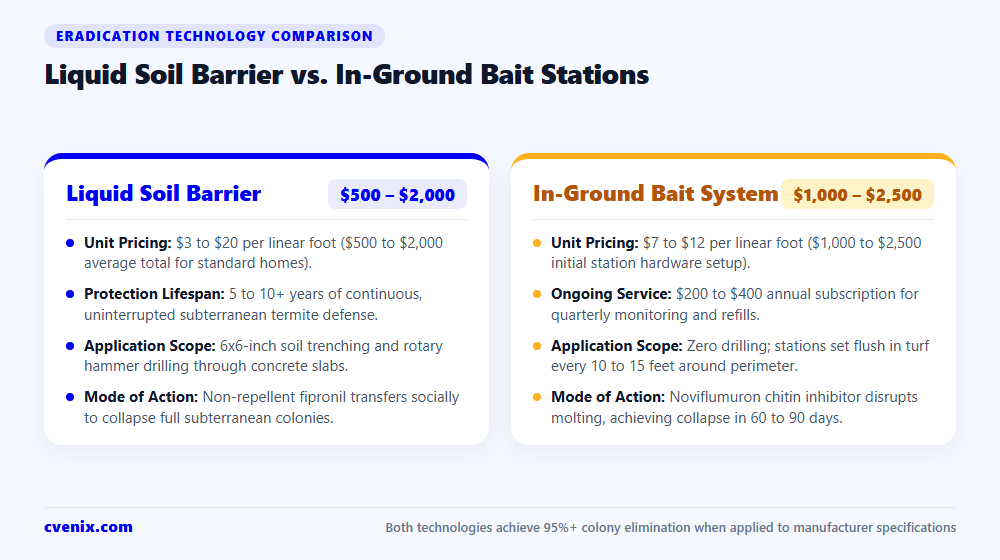
Liquid chemical soil barriers
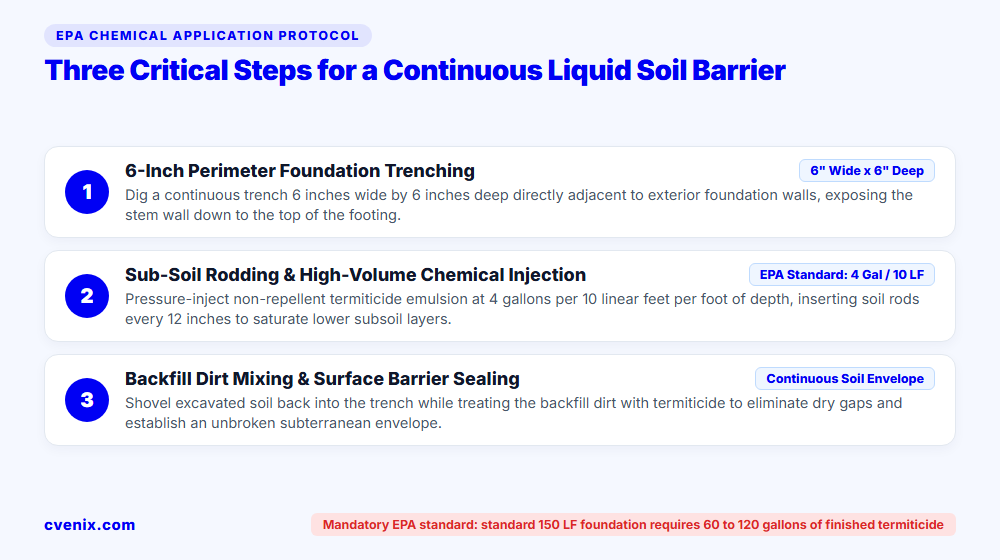
Liquid chemical treatments represent the most common and proven method for eliminating subterranean termites. Technicians dig a continuous 6-inch by 6-inch trench around your exterior foundation perimeter, pump termiticide into the soil, and rod the ground to reach down to the foundation footing. Once the chemical saturates the subsoil, the trench is backfilled with dirt, which is then treated with additional chemical emulsion.
Modern liquid treatments use non-repellent chemicals like fipronil (commonly sold under the brand name Termidor SC). Because termites cannot detect the chemical, they walk directly through the treated soil. The active ingredient clings to their bodies, and through grooming and social food sharing (trophallaxis), worker termites transfer the lethal dose throughout the subterranean colony. Liquid soil barriers cost $3 to $20 per linear foot, totaling $500 to $2,000 for standard single-family homes. A properly installed liquid barrier provides continuous soil protection for 5 to 10 years without requiring monthly contractor visits.
In-ground bait station systems
In-ground bait stations offer an alternative perimeter defense that requires no soil trenching or concrete drilling. Technicians install cylindrical plastic stations flush with the turf every 10 to 15 feet around your home perimeter. Inside each station, technicians place cellulose cartridges loaded with an insect growth regulator, such as noviflumuron in the Sentricon system.
Foraging worker termites feed on the cellulose and share it with the rest of the colony. The insect growth regulator disrupts chitin synthesis, preventing termites from molting. Unable to shed their exoskeletons, the workers die, causing the entire colony to collapse within 60 to 90 days. Initial bait station hardware installation costs $7 to $12 per linear foot, or $1,000 to $2,500 for an entire property. Homeowners must maintain an annual monitoring contract costing $200 to $400 per year for periodic inspections, station cleaning, and bait cartridge replenishment.
Whole-home tent fumigation
Structural tent fumigation is the definitive solution for widespread drywood termite infestations. Technicians wrap the entire house in heavy vinyl-coated tarpaulins, seal all seams with weighted sandbags, and pump sulfuryl fluoride gas (Vikane) into the enclosed structure. The gas penetrates deep into wall cavities, attic rafters, subfloors, and solid wooden beams, eradicating every drywood termite colony regardless of location.
Whole-home gas fumigation costs $1 to $4 per square foot, or $2,000 to $8,000 for typical residential homes. The process requires all occupants, pets, and houseplants to vacate the premises for 24 to 72 hours while the gas aerates safely.
Do not make the costly mistake of tenting your home for subterranean termites. Subterranean termites nest underground in the soil outside your home foundation. Sulfuryl fluoride gas dissipates into the outdoor atmosphere and does not penetrate moist ground soil. Tenting a home infested with subterranean termites costs thousands of dollars, yet the subterranean colony survives completely unharmed and re-enters the house through mud tubes within weeks. Tenting is designed strictly for drywood termites nesting entirely within above-ground structural lumber.
When budgeting for tent fumigation, factor in secondary out-of-pocket expenses. Homeowners typically spend $350 to $900 for 2 to 3 nights in a hotel or rental home, $150 to $350 for pet boarding, $40 to $80 for specialized Nylofume food bags, $100 to $300 for foundation shrub trimming, and $50 to $150 in gas utility turn-off and re-lighting fees.
Thermal heat treatments
Thermal heat treatments provide a chemical-free eradication alternative for drywood termites. Exterminators seal off infested rooms or entire structures using thermal tarps and blow heated air through high-output industrial heaters. The process requires raising the core temperature of all structural wood to 120°F and holding that temperature for at least 33 minutes, which denatures insect cellular proteins and eliminates colonies.
Heat treatments cost $1 to $4 per square foot, with total project prices typically ranging from $1,500 to $5,000. Because heat leaves no chemical residue, it is ideal for homeowners with severe chemical sensitivities, families with young infants, and attached condominium complexes where gas tenting is legally or structurally prohibited.
Localized spot and micro-treatments
Spot treatments target localized pockets of drywood termites caught in early development. Technicians drill small pilot holes into infested door jambs, window headers, or exposed ceiling beams, injecting expanding termiticide foams, precision borate solutions, or localized microwave energy directly into wood galleries. Micro-treatments cost $6 to $8 per square foot, with total bills ranging from $200 to $1,000.
Spot treatments work well for isolated drywood pockets, but they fail against subterranean termites. Applying a spot chemical to a single mud tube creates a classic whack-a-mole scenario: the subterranean colony simply reroutes 5 feet away to an untreated joist or sill plate.
Physical barriers and new construction pre-treatments
Preventing termites during home construction is significantly cheaper than treating an active infestation later. Pre-construction soil sprays under concrete foundation slabs and borate wood treatments applied to framing lumber cost $500 to $1,500. Builders can also install physical stainless steel woven mesh (such as TermiMesh) or graded basaltic sand barriers around foundation penetrations for $10 to $16 per linear foot, physically blocking termites without recurring chemical applications.
Termite Treatment Cost per Linear Foot and Square Foot
Pest control contractors quote termite treatments using two distinct pricing units: linear footage and square footage. Subterranean treatments focus on the exterior foundation perimeter, so pricing is calculated per linear foot. Whole-home drywood treatments require treating the enclosed building envelope, which contractors calculate per square foot of interior living area.
Linear foot pricing for perimeter treatments
To estimate the linear footage of your home, calculate the exterior perimeter: add the length and width of the foundation, then multiply by two. A standard 40-foot by 50-foot ranch home has 180 linear feet of perimeter.
The physical terrain around your foundation directly determines the final per-foot price. Digging trenches in soft lawn soil costs $3 to $10 per linear foot. If your perimeter includes attached concrete slabs, front porches, driveways, or rear patios, technicians must use rotary hammer drills to drill through the concrete every 12 inches to inject chemicals below the slab. Extensive slab drilling raises labor rates to $15 to $20 per linear foot.
| Foundation perimeter | Soft soil trenching | Mixed soil and concrete | Extensive slab drilling | In-ground bait system |
|---|---|---|---|---|
| 100 linear feet (small bungalow) | $300 – $800 | $600 – $1,200 | $1,200 – $1,800 | $700 – $1,200 |
| 150 linear feet (average ranch home) | $450 – $1,200 | $800 – $1,600 | $1,500 – $2,250 | $1,050 – $1,800 |
| 200 linear feet (two-story suburban home) | $600 – $1,600 | $1,100 – $2,100 | $2,000 – $3,000 | $1,400 – $2,400 |
| 250 linear feet (large footprint home) | $750 – $2,000 | $1,400 – $2,600 | $2,500 – $3,750 | $1,750 – $3,000 |
| 300 linear feet (estate or complex home) | $900 – $2,500 | $1,700 – $3,200 | $3,000 – $4,500 | $2,100 – $3,600 |
Square foot pricing for whole-home tenting and heat
Whole-home drywood treatments depend on total interior volume and square footage. Gas fumigation and thermal heat treatments both range from $1 to $4 per square foot. Multi-story homes with steep rooflines or attached architectural bump-outs require additional tarping labor and higher gas concentrations, pushing bids toward the upper end of the range.
| Home size | Gas tent fumigation cost | Thermal heat treatment cost | Secondary lodging allowance |
|---|---|---|---|
| 1,000 sq ft | $1,500 – $3,000 | $1,200 – $2,800 | $400 – $600 |
| 1,500 sq ft | $2,000 – $4,500 | $1,800 – $4,000 | $500 – $750 |
| 2,000 sq ft | $2,500 – $6,000 | $2,400 – $5,500 | $600 – $900 |
| 2,500 sq ft | $3,200 – $7,500 | $3,000 – $6,800 | $700 – $1,100 |
| 3,000 sq ft | $3,800 – $8,500 | $3,600 – $8,000 | $800 – $1,300 |
Termite Treatment Cost by Species
Termite behavior and biology vary dramatically across species. Identifying the exact insect attacking your home is critical, because an extermination method that eliminates one species can be completely ineffective against another.
Eastern subterranean termites
Eastern subterranean termites (Reticulitermes flavipes) represent the most common termite threat across the United States. They live in underground colonies containing 60,000 to 1,000,000 individuals in the moist subsoil. Because their soft bodies dry out quickly in open air, they construct protective earthen mud tubes over concrete foundations and brick footings to reach wooden sill plates and floor joists.
Treating subterranean termites requires creating a continuous chemical barrier in the soil using liquid termiticide (fipronil) or installing in-ground bait stations. Professional subterranean treatments cost $500 to $2,000 for standard residential perimeters.
Drywood termites
Drywood termites (Incisitermes species) live in small colonies of several thousand insects entirely within sound, dry wood framing, rafters, and furniture. Unlike subterranean species, drywood termites require no contact with the soil and extract all necessary moisture directly from the wood they consume.
The telltale sign of drywood termite activity is frass: tiny, six-sided concave fecal pellets pushed out of pinhole kick-out holes onto floors or window sills. Because colonies live scattered inside wall studs and roof trusses, structural tent fumigation or whole-structure thermal heat treatment is necessary for full eradication. Complete treatments cost $1,000 to $8,000 depending on home size and whether spot treatments are viable.
Formosan subterranean termites
Formosan subterranean termites (Coptotermes formosanus), often nicknamed super termites, are an aggressive invasive species prevalent throughout the Southeastern states, Gulf Coast, and Hawaii. Formosan colonies are massive, frequently exceeding several million insects that forage up to 300 feet through the soil, consuming structural lumber at several times the rate of native subterranean species.
In addition to soil nesting, Formosan termites can construct above-ground carton nests inside wall voids using chewed wood, soil, and saliva. If a plumbing leak or chronic roof issue provides moisture, an aerial colony can survive independently of the ground soil. If your home has recurring moisture intrusion, budgeting for roof replacement cost or plumbing repairs is just as critical as calling an exterminator. Eradicating Formosan termites requires a combined strategy: high-volume liquid perimeter barriers paired with direct wall void foam injections. Professional treatment costs range from $1,500 to $4,500 or more.
Dampwood termites
Dampwood termites are significantly larger than subterranean or drywood termites, but they rarely attack sound, dry structural lumber. They infest wood with high moisture content and active wood rot, commonly occurring in the Pacific Northwest and humid coastal climates.
Treating dampwood termites focuses on eliminating the water source and replacing rotted wood. Chemical spot treatments cost $300 to $1,000, but homeowners must also budget for carpentry repairs to resolve the underlying moisture intrusion.
Termite species comparison summary
| Termite species | Colony location | Key identification sign | Effective treatment method | Typical treatment cost |
|---|---|---|---|---|
| Subterranean | Underground in soil | Earthen mud tubes on foundation | Liquid soil barrier or bait stations | $500 – $2,000 |
| Drywood | Inside structural framing | Hexagonal frass pellets and shed wings | Tent fumigation or thermal heat | $1,500 – $8,000 |
| Formosan | Soil and aerial carton nests | Massive swarms and rapid wood loss | Soil barrier plus wall void foaming | $1,500 – $4,500+ |
| Dampwood | Wet rotting lumber | Velvety damp wood cavities | Moisture repair and spot wood treatment | $300 – $1,500 |
Itemized Cost Breakdown: Materials, Labor, and Permits
Understanding where your money goes during a professional termite treatment helps you evaluate contractor bids and avoid paying inflated markups.
Commercial termiticides and hardware materials
Commercial chemicals and hardware represent 35% to 45% of total project expenses, typically costing $300 to $900 for a standard home. Professional exterminators use commercial-grade termiticide concentrates, such as Termidor SC (fipronil) or Premise (imidacloprid), which feature high active ingredient concentrations designed to bond with soil particles for a decade. For bait systems, materials include weather-resistant exterior station housings and noviflumuron bait cartridges. Structural fumigation projects require multiple pressurized cylinders of commercial sulfuryl fluoride gas.
Specialized equipment and professional labor
Professional labor and specialized machinery make up 40% to 50% of the project total, running $350 to $1,100. A standard liquid perimeter barrier requires a two-person crew working 4 to 8 hours to dig trenches, inject chemicals, and backfill soil.
Contractors must transport and operate commercial machinery, including 100-gallon truck-mounted high-pressure pumping rigs, heavy rotary hammer drills equipped with 1/2-inch carbide bits, and sub-slab injector rods. When your perimeter includes attached concrete slabs, drilling through concrete every 12 inches, pressure-injecting chemical beneath the slab, and sealing each hole with hydraulic cement adds $300 to $800 in specialized labor.
Municipal permits, regulatory filings, and inspection fees
State regulatory filings and municipal permits account for 3% to 7% of project costs, typically $50 to $150. Licensed pest control companies must file chemical usage logs with state pesticide regulatory boards. While standard soil trenching rarely requires municipal building permits, structural tent fumigation often mandates formal fire department notifications, utility disconnect permits, and gas re-connection safety inspections.
Complete itemized cost breakdown table
| Cost component | Percentage of total cost | Typical dollar range | What is included |
|---|---|---|---|
| Commercial chemicals and hardware | 35% – 45% | $300 – $900 | Professional termiticide concentrate, bait stations, gas fumigants |
| Professional labor and drilling | 40% – 50% | $350 – $1,100 | Trenching, slab drilling, chemical rodding, sub-slab injection, clean-up |
| Equipment and vehicle overhead | 10% – 15% | $100 – $300 | High-pressure pump rigs, rotary hammer drills, safety gear, fuel |
| State regulatory fees and permits | 3% – 7% | $50 – $150 | Pest control board reporting, pesticide usage logs, local permits |
Termite Treatment Cost by Region and State
Geography, soil temperature, and relative humidity dictate termite activity levels across the United States. Homes in southern coastal climates face intense termite pressure, whereas northern climates experience lower activity.
Geographic termite pressure zones
The USDA Forest Service classifies the United States into four Termite Infestation Probability (TIP) zones:
- Zone 1 (Very Heavy): Southern states, the Gulf Coast, Hawaii, and Southern California. Termites are ubiquitous, swarming in large numbers every spring.
- Zone 2 (Heavy to Moderate): Mid-Atlantic, Lower Midwest, the Southwest, and Central California. Subterranean activity remains a persistent threat.
- Zone 3 (Slight to Moderate): Upper Midwest, Northern Plains, and Pacific Northwest. Cold winters keep subterranean activity limited, though dampwood termites occur in coastal forests.
- Zone 4 (None to Slight): Alaska and high-elevation Rocky Mountain regions where freezing soil prevents termite survival.
Regional pricing dynamics and contractor competition
In high-pressure southern markets, a dense network of competing exterminators keeps basic liquid perimeter trenching rates competitive, often $4 to $8 per linear foot. However, the presence of aggressive Formosan termites frequently requires more expensive dual-barrier treatments. In California and Florida, high rates of drywood termites make whole-home tent fumigation a regular homeowner expense, driving average regional spending to $2,200 to $8,000.
State and regional cost table
| Region and representative states | Termite pressure level | Predominant species | Average liquid barrier cost | Average tent fumigation cost |
|---|---|---|---|---|
| Southeast & Gulf Coast (FL, GA, LA, TX, NC) | Very heavy (Zone 1) | Subterranean, Formosan, Drywood | $650 – $1,800 | $2,200 – $6,500 |
| Southwest & Southern California (CA, AZ, NV) | Heavy (Zone 1 – 2) | Drywood, Subterranean | $700 – $2,000 | $2,500 – $8,000 |
| Mid-Atlantic & Lower Midwest (VA, MD, PA, OH, MO) | Moderate to heavy (Zone 2) | Eastern subterranean | $600 – $1,500 | Rarely required (N/A) |
| Pacific Northwest (WA, OR, Northern CA) | Slight to moderate (Zone 2 – 3) | Dampwood, Subterranean | $550 – $1,400 | $2,000 – $5,000 |
| Upper Midwest & Mountain West (MN, WI, CO, MT) | Slight (Zone 3 – 4) | Eastern subterranean | $500 – $1,200 | Rarely required (N/A) |
National Pest Control Companies vs. Local Independent Exterminators
One of the most frustrating aspects of hiring a pest control professional is quote variance. Homeowners frequently receive quotes ranging from $1,200 to $4,500 for the exact same house. Understanding the operational differences between national corporate chains and local independent contractors explains this pricing gap.
Corporate franchise pricing structures and sales commissions
National pest control franchises, such as Orkin and Terminix, carry substantial operating overhead. They invest heavily in national television advertising, maintain regional call centers, and employ commissioned sales inspectors. When an inspector visits your home, their commission often depends on selling an expensive baiting package with an ongoing recurring subscription.
National chains frequently quote $2,500 to $4,500 to install in-ground bait stations, paired with mandatory annual monitoring agreements costing $350 to $550 per year. Sales representatives may also rely on high-pressure tactics, offering same-day signing discounts or warning that your home will suffer immediate structural failure if you do not sign on the spot.
Local independent exterminator pricing and warranties
Local independent pest control companies operate with lower overhead. The person evaluating your property is often the business owner or a senior licensed technician rather than a commissioned salesperson. Independent operators frequently charge $800 to $1,800 (averaging $950 to $1,600) for a comprehensive liquid perimeter barrier using Termidor SC.
Local exterminators use the exact same EPA-registered active ingredients (fipronil) and adhere to the same federal application standards as national brands. Furthermore, independent companies typically include a 1 to 5 year retreatment warranty in their initial price without requiring mandatory monthly fees.
National company pricing comparison table
| Company or contractor type | Average initial treatment cost | Ongoing annual warranty fee | Preferred treatment approach | Contract terms |
|---|---|---|---|---|
| Orkin | $1,200 – $3,500 | $300 – $500 / year | Liquid barrier or Sentricon | Annual contract with regular check-ups |
| Terminix | $1,400 – $3,800 | $350 – $550 / year | Sentricon baiting systems | Subscription plan with ongoing monitoring |
| Ehrlich (Rentokil) | $1,100 – $3,200 | $275 – $450 / year | Baiting and liquid barriers | Annual renewal options |
| Western Pest Services | $1,000 – $2,900 | $250 – $400 / year | Integrated pest management | Customizable service contracts |
| Local independent licensed exterminator | $800 – $1,800 | $150 – $300 / year | Liquid soil barrier (Termidor SC) | Transparent warranty, flexible renewals |
How to negotiate pest control quotes
You can save hundreds of dollars on termite eradication by applying three practical negotiation steps:
- Get three independent quotes: Solicit written bids from at least two local independent exterminators and one national brand to establish an accurate pricing baseline.
- Demand chemical transparency: Ask each contractor for the specific brand name and active ingredient percentage they plan to use. Insist on non-repellent termiticide (such as Termidor SC) rather than cheaper repellent pyrethroids.
- Decline recurring monthly bundles: If you only have termites, avoid purchasing general pest control bundles that charge $50 to $80 per month to spray for spiders or ants. A properly installed liquid termite barrier needs no monthly maintenance.
Termite Bonds and Prevention Plans: Retreat-Only vs. Repair Guarantees
After completing initial eradication, exterminators will offer an ongoing termite warranty, commonly called a termite bond. A termite bond is an annual service agreement between the homeowner and the pest control company that guarantees regular inspections and future protection.
What is a termite bond and what does it cost?
Initial setup for a termite bond typically runs $500 to $2,000, which is usually bundled into the cost of the initial treatment. Homeowners then pay an annual renewal fee of $100 to $400 to maintain the bond. In exchange, the company conducts an annual inspection and maintains warranty coverage against future infestations.
Retreat-only bonds vs. damage repair guarantees
Homeowners must read contract fine print carefully. Termite bonds fall into two distinct legal categories:
- Retreat-only bond ($100 to $250 per year): If termites return during the active contract period, the exterminator will return and re-treat the affected area at no charge. However, the contract explicitly states that the company pays $0 toward repairing damaged floor joists, wall studs, or subflooring. The homeowner remains 100% financially responsible for all structural carpentry.
- Damage repair guarantee bond ($250 to $450 per year, $1,000 to $2,000 initial setup): The exterminator agrees to cover the full cost of licensed carpentry repairs for structural wood damaged by new termite activity after the initial treatment date, typically capped between $250,000 and $1,000,000.
Beware of warranty contract traps. Most damage repair bonds require the homeowner to maintain uninterrupted annual inspections. Missing your scheduled inspection by even 30 days can void the entire repair guarantee. Contracts also exclude damage caused by pre-existing infestations or structural moisture issues, such as active plumbing leaks.
Termite bond contract comparison table
| Warranty feature | Retreat-only bond | Damage repair guarantee bond |
|---|---|---|
| Average annual renewal cost | $100 – $250 / year | $250 – $450 / year |
| Initial contract setup cost | $500 – $1,200 (or included in treatment) | $1,000 – $2,000 |
| Re-treatment of re-infested areas | Included at no charge | Included at no charge |
| Replacement of damaged structural wood | Not covered (100% homeowner cost) | Covered up to policy cap ($250k – $1M) |
| Transferable to new home buyer | Usually yes (small transfer fee) | Yes, subject to re-inspection |
| Inspection requirement | Annual inspection mandatory | Annual inspection strictly mandatory |
Termite Inspections and Real Estate Transactions
Termite inspections play a pivotal role in residential real estate transactions, protecting buyers and lenders from purchasing structurally compromised homes.
Routine homeowner inspection vs. real estate WDO report
When you call an exterminator because you suspect termite activity in your home, many companies offer a free inspection in hopes of securing a treatment contract. However, these informal quote inspections cannot be used in a real estate transaction.
Home sales require an official Wood-Destroying Organism (WDO) or Wood-Destroying Insect (WDI) inspection report completed by a state-licensed inspector. A professional WDO inspection costs $75 to $150 as a standalone service, or $150 to $250 when bundled with a comprehensive home inspection. The technician inspects accessible framing, crawl spaces, and foundation perimeters, documenting active infestations, past damage, and conducive moisture conditions on official state reporting forms.
Who pays for the termite inspection: buyer or seller?
In conventional real estate transactions, the buyer typically pays for the WDO inspection as part of their due diligence contingency period. However, mortgage loan guidelines introduce important exceptions. For buyers using a VA (Veterans Affairs) loan, federal guidelines in many states legally prohibit the veteran buyer from paying the pest inspection fee, requiring the seller or lender to cover the cost.
How to handle termite issues during escrow
If an inspector discovers active termites during escrow, do not panic, but do not accept a quick fix. Sellers frequently hire a discount contractor to perform a cheap $300 to $800 localized spot spray just to obtain a clean inspection sign-off.
As a buyer, reject spot-treatment gimmicks. Request an escrow credit or seller concession of $1,200 to $1,800 to pay for a full continuous perimeter liquid treatment or bait station installation, along with a certified one-year transferable warranty from a licensed pest control firm.
Structural Damage Repairs and Insurance Realities
Pest control contractors are licensed to eradicate insects, but they do not perform structural carpentry. When termites hollow out load-bearing framing, homeowners face significant secondary carpentry expenses.
Common structural repairs and carpentry costs
Repairing structural termite damage costs an average of $1,800, with typical repair bills ranging from $600 to $3,000 for standard framing, subflooring, and drywall work. Minor cosmetic damage, such as patching drywall pinholes and replacing baseboards, costs $250 to $700.
Extensive infestations cause severe structural damage. Termites hollow out floor joists, rim joists, and structural sill plates resting on foundation stem walls. Repairing load-bearing framing requires jacking up floor systems with temporary hydraulic shoring posts while carpenters sister new dimensional lumber alongside damaged joists. When termite damage destabilizes foundation framing, evaluating total foundation repair cost is essential to restore structural integrity. Replacing rotted subfloors and warped floorboards also requires budgeting for hardwood floor installation cost per square foot, pushing extensive restoration projects beyond $5,000 to $10,000.
| Damaged structural component | Typical repair method | Average repair cost range | Project complexity |
|---|---|---|---|
| Baseboard and drywall trim | Patching drywall and replacing pine trim | $250 – $700 | Minor / Cosmetic |
| Structural stud replacement | Sistering 2×4 or 2×6 wall studs | $600 – $1,500 | Moderate |
| Subflooring repair | Cutting out damaged plywood subfloor | $800 – $2,200 | Moderate / High |
| Floor joist sistering | Bolting new structural lumber alongside joists | $1,200 – $3,500 | High |
| Sill plate replacement | Temporary shoring and lifting frame to replace plate | $2,500 – $6,500+ | Very high / Specialist |
Homeowners insurance exclusions and why claims are denied
Many homeowners mistakenly assume their property insurance policy will reimburse the cost of termite eradication or framing repairs. Standard ISO HO-3 and HO-5 homeowners insurance policies explicitly exclude all damage caused by termites, carpenter ants, and other insects.
Insurance carriers classify termite infestations as preventable maintenance issues that develop gradually over years. Unlike sudden accidental perils such as fires or burst plumbing pipes, insurers expect homeowners to maintain their property and schedule periodic inspections. The entire financial responsibility for extermination and structural reconstruction falls directly on the property owner.
Signs of Termite Infestation and Prevention Strategies
Early detection prevents four-figure structural repair bills. Recognizing visual warning signs allows you to intervene before termites hollow out load-bearing timbers.
Diagnostic signs of termite activity
- Mud tubes: Subterranean termites construct pencil-thick earthen tunnels along foundation walls, concrete piers, and wooden framing to maintain moisture while traveling between the soil and wood.
- Swarmers and discarded wings: Winged reproductive termites (alates) emerge in spring to mate and establish new colonies. Finding piles of shed wings on window sills or near exterior doors indicates an active, mature colony nearby.
- Hollow-sounding wood: Tapping baseboards, sill plates, or door headers with a screwdriver handle produces a dull, hollow thud when termites have consumed the interior wood cellulose.
- Drywood frass: Drywood termites kick out tiny, six-sided concave fecal pellets that resemble fine sand or ground pepper below infested rafters, eaves, and window casings.
- Blistering paint and pinholes: As termites tunnel through drywall paper and framing, paint surfaces can bubble and peel, resembling moisture damage. Look for tiny pinholes plugged with soil.
Practical foundation prevention checklist
Implementing physical moisture and landscape controls significantly lowers the probability of a termite infestation:
- Maintain ground clearance: Ensure at least 6 inches of clearance between soil grade and wooden siding or sill plates. If siding touches soil, review siding replacement cost to trim or replace exterior panels.
- Divert foundation moisture: Extend gutter downspouts and air conditioning condensate lines at least 5 feet away from foundation walls to prevent soil saturation.
- Eliminate wood-to-ground contact: Remove tree stumps, buried scrap lumber, and firewood piles stacked against the foundation. Maintain a 12-inch gravel buffer between garden mulch and foundation walls.
- Encapsulate crawl spaces: Install a 6-mil polyethylene vapor barrier over exposed crawl space soil and ensure proper foundation ventilation. Resolving excessive humidity lowers termite pressure and helps prevent separate mold remediation cost.
- Maintain roof and attic ventilation: Keep attic soffits and ridge vents clear to lower humidity, and inspect attic framing periodically. Upgrading old insulation also lets you check attic insulation cost while verifying that rafters remain free of drywood frass.
DIY vs. Professional Termite Treatment: The Application Math
When faced with professional extermination quotes, many homeowners explore retail pest control products at Home Depot, Lowe’s, or online retailers. While DIY sprays cost under $100, attempting to eradicate an active termite infestation without commercial equipment almost always fails due to simple physical chemistry and application volume.
The EPA 4-gallon volume rule and why DIY fails
The federal Environmental Protection Agency (EPA) product label standard for liquid termiticides mandates an application volume of 4 gallons of finished emulsion per 10 linear feet per foot of foundation depth. This legal requirement ensures that chemical saturates the subsoil deeply enough to create an unbroken barrier around foundation footings.
Consider the mathematics for a standard residential home with a 180 linear foot perimeter. A compliant treatment requires dividing 180 feet by 10 and multiplying by 4 gallons, equaling 72 gallons of finished chemical emulsion. If the home has a crawl space with foundation footings sitting 2 feet below grade, the required volume doubles to 144 gallons.
A homeowner attempting DIY treatment with a 1-gallon hand-pump garden sprayer applies less than 1% of the legally mandated chemical volume. Surface spraying creates an incomplete barrier that degrades quickly under ultraviolet light and rainfall. Furthermore, most retail store sprays contain repellent pyrethroids rather than non-repellent transfer chemicals like fipronil. Repellents merely scatter subterranean termites, diverting them a few feet away to an untreated foundation crack.
When DIY is viable vs. when to call a pro
DIY pest control has a narrow role in termite prevention. Applying borate wood preservatives to bare, unfinished lumber during a deck build or home remodeling project is an excellent preventive measure. Setting non-chemical wooden monitoring stakes around the yard can also help alert you to termite activity.
However, active infestations require professional intervention. If you observe indoor swarms, mud tubes on foundation stem walls, or frass falling from rafters, call a licensed exterminator immediately. Attempting to spot-treat an active colony with consumer sprays allows termites to continue feeding unnoticed inside load-bearing framing.
| Comparison factor | DIY treatment attempt | Professional licensed treatment |
|---|---|---|
| Upfront equipment and chemical cost | $50 – $250 | $575 – $1,500 |
| Chemical application volume | 1 to 3 gallons (superficial surface) | 60 to 150+ gallons (deep sub-soil trenching) |
| Chemical delivery equipment | 1-gallon hand pump sprayer | 100-gallon truck pump rig and hammer drills |
| Active ingredient effectiveness | Repellent pyrethroid (reroutes termites) | Non-repellent fipronil / IGR (kills colony) |
| Treatment longevity | 3 to 12 months | 5 to 10+ years |
| Warranty and damage protection | Zero warranty | 1 to 5 year retreatment or repair guarantee |
| Overall success rate | Under 15% for active subterranean nests | 95%+ first-year colony eradication |
How to Save Money and Hire a Licensed Exterminator
Protecting your home from termites does not require overspending on overpriced franchise packages. Using structured contractor vetting tactics protects your home equity and budget.
Practical ways to reduce termite treatment costs
- Obtain competitive bids: Always solicit three written bids from independent local exterminators. Independent operators frequently offer lower rates and longer warranties for identical fipronil applications.
- Insist on non-repellent active ingredients: Require your exterminator to write the exact chemical name on your contract (such as Termidor SC or generic fipronil). Non-repellent chemicals eliminate colonies faster and last longer in the soil.
- Skip general monthly pest subscriptions: General monthly spraying plans do not protect against termites. Decline ongoing monthly contracts unless you have separate recurring pest issues.
- Coordinate with neighbors: If termites swarm in your neighborhood, talk to adjacent homeowners. Pest companies frequently offer 10% to 20% discounts when treating multiple adjoining properties on the same service day.
Questions to ask a pest control contractor before signing
Before signing a treatment contract, ask each contractor these five critical questions:
- What specific chemical brand and active ingredient will you apply? Verify that the quote specifies a non-repellent termiticide such as fipronil rather than a cheap repellent pyrethroid.
- How many total gallons of finished termiticide will you pump? Confirm that the contractor plans to apply the EPA-mandated volume of 4 gallons per 10 linear feet per foot of depth.
- Does your bid include concrete drilling and hydraulic cement patching? Ensure there are no surprise surcharges for drilling attached garage slabs, porches, or walkways.
- Is your termite bond a retreat-only contract or a structural repair guarantee? Clarify whether the company pays for licensed carpentry repairs if termites re-enter and cause structural damage.
- Are you licensed by the state structural pest control board and insured? Ask for proof of active state pest control licensure and commercial general liability insurance.
Methodology and Data Sources
This termite treatment cost guide compiles real-world pricing and technical standards through structured data analysis, contractor invoice verification, and federal regulatory guidelines. All cost figures and biological data are verified through the following sources:
- EPA product registration standards: Federal pesticide application rates and chemical volumes established under the Environmental Protection Agency (EPA) product registration standards for fipronil and sulfuryl fluoride.
- University entomology extension research: Peer-reviewed termite foraging biology, thermal death thresholds, and colony dynamics published by the University of Florida Extension (EDIS), University of Kentucky Entomology, UC IPM, and Texas A&M AgriLife Extension.
- Property casualty insurance standards: Policy terms and standard exclusion clauses documented by the Insurance Information Institute (III).
- Construction and pricing aggregations: RSMeans residential repair data cross-referenced with national pest control pricing databases, verified homeowner invoice records, and active trade discussions on r/pestcontrol.
Frequently Asked Questions
How much does termite treatment cost on average?
The average termite treatment cost runs between $225 and $2,500, with most homeowners spending between $575 and $900 for typical professional eradication. Localized chemical treatments or spot applications start at $225 to $600, full liquid perimeter barriers cost $500 to $2,000, in-ground bait station setups cost $1,000 to $2,500, and structural tent fumigation runs $2,000 to $8,000.
Does whole-home tent fumigation kill subterranean termites?
No. Structural gas fumigation using sulfuryl fluoride (Vikane) is designed strictly for drywood termites nesting inside above-ground structural lumber. Subterranean termites nest underground in the soil outside your home foundation, where fumigation gas cannot penetrate. Subterranean infestations require continuous liquid soil barriers or in-ground bait stations.
How long does a professional termite treatment last?
A properly applied non-repellent liquid soil barrier (such as Termidor SC) remains lethal to subterranean termites in the soil for 5 to 10 years. In-ground bait station systems provide continuous protection as long as annual monitoring agreements and bait cartridges are maintained. Whole-home tent fumigation eliminates 100% of existing drywood colonies, but it leaves no residual chemical barrier against future swarms.
How long does the treatment process take?
Liquid perimeter trenching and rod injection take 4 to 8 hours for a standard residential home. Installing an in-ground bait station system takes 1 to 2 hours. Whole-home tent fumigation requires occupants to vacate the home for 24 to 72 hours while gas is released, held, and aerated.
Does homeowners insurance cover termite treatment or damage?
No. Standard property casualty insurance policies (including HO-3 and HO-5 forms) explicitly exclude all termite extermination and structural damage repairs. Insurance carriers classify insect infestations as preventable homeowner maintenance rather than covered sudden accidental losses.
How much does it cost to fix termite damage?
Repairing structural termite damage costs an average of $1,800, with most projects ranging from $600 to $3,000 for standard framing, subflooring, and drywall repairs. Severe infestations that require sistering load-bearing floor joists, replacing foundation sill plates, or jacking sagging foundation walls can exceed $5,000 to $10,000.
Is an annual termite bond worth the recurring cost?
An annual termite bond is worth the $100 to $400 annual renewal cost if you live in a high-pressure termite area (such as the Southeast, Gulf Coast, or California) or if your contract includes a certified damage repair guarantee that covers carpentry repairs. If your home is in a low-pressure area and the contract is retreat-only, a one-time 10-year liquid barrier is often more cost-effective.
Can I sell a house that has had termite damage?
Yes. Homes with past termite damage sell regularly, provided the infestation was professionally eradicated and all structural damage was repaired by a licensed carpenter. Buyers typically require a clean Wood-Destroying Organism (WDO) inspection report, written documentation of the treatment, and a transferable warranty.
Can exterminators save a severely termite-infested house?
Yes. Professional exterminators can achieve complete colony elimination using non-repellent liquid chemical barriers, in-ground bait stations, or structural tent fumigation. Once the active colony is eradicated, a licensed carpentry contractor can sister compromised floor joists, replace wall studs, and restore full structural integrity to the building.

