
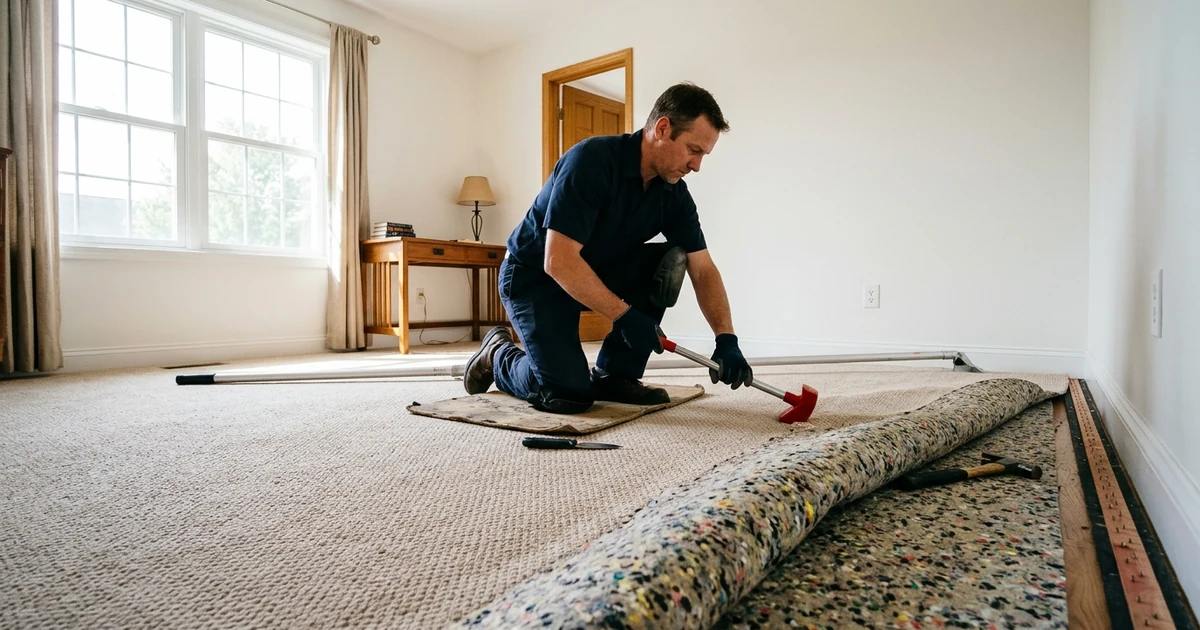
The national average carpet installation cost ranges from $3.50 to $11.00 per square foot, or $31.50 to $99.00 per square yard, including broadloom carpet material, high-density underlayment padding, perimeter tack strips, hot-melt seam tape, and professional power-stretching labor. For a standard 200-square-foot bedroom, homeowners typically pay between $750 and $2,100 once the mandatory 10% to 15% roll-width waste factor is added. Scaling up to a whole-house replacement covering 1,200 square feet across bedrooms, hallways, and a staircase brings turnkey project totals to $4,800 to $12,600.
While entry-level solution-dyed polyester and olefin carpets keep upfront square-foot prices low for guest rooms or rental properties, high-traffic family rooms and stairs require solution-dyed Type 6,6 nylon, triexta, or woven wool paired with an 8-pound rebond or moisture-barrier cushion. Below, you will find complete 2026 cost tables per square foot and per square yard by fiber chemistry, room dimensions, pile construction, underlayment specifications under Carpet and Rug Institute (CRI-105) standards, staircase labor, and regional market rates.
Carpet Installation Cost per Square Foot and per Square Yard by Fiber Material
Roughly 55% to 65% of your total invoice comes down to the polymer or natural fiber tufted into the primary backing. Flooring retailers frequently display shelf prices in either square feet or square yards (1 square yard equals 9 square feet). Because broadloom carpet is manufactured on 12-foot-wide (and occasionally 15-foot-wide) looms, understanding both unit metrics prevents sticker shock when comparing showroom samples against itemized installation bids.
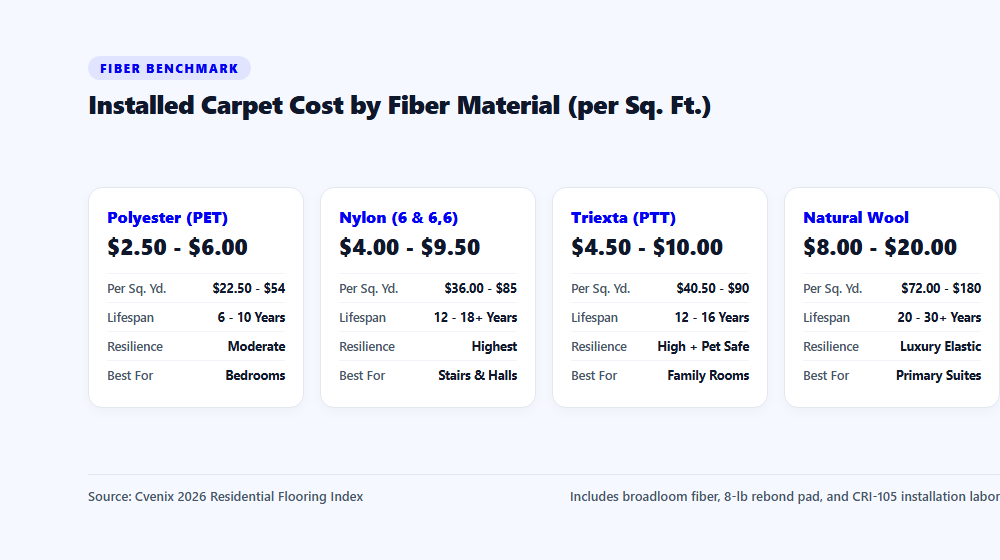
| Carpet Fiber Material | Material Only (per Sq. Ft.) | Total Installed Cost (per Sq. Ft.) | Total Installed Cost (per Sq. Yd.) | Expected Service Lifespan | Best Residential Application |
|---|---|---|---|---|---|
| Olefin (Polypropylene) | $1.00 – $3.00 | $2.00 – $5.50 | $18.00 – $49.50 | 5 – 8 years | Basements, enclosed sunrooms, low-traffic loop Berbers |
| Polyester (PET) | $1.25 – $3.50 | $2.50 – $6.00 | $22.50 – $54.00 | 6 – 10 years | Secondary bedrooms, guest suites, moderate-traffic areas |
| Nylon (Type 6 & Type 6,6) | $2.25 – $6.25 | $4.00 – $9.50 | $36.00 – $85.50 | 12 – 18+ years | Staircases, main hallways, high-traffic family rooms |
| Triexta (PTT / SmartStrand) | $2.75 – $6.75 | $4.50 – $10.00 | $40.50 – $90.00 | 12 – 16 years | Households with pets and children, active living spaces |
| Natural Wool (Woven or Tufted) | $5.50 – $15.50 | $8.00 – $20.00 | $72.00 – $180.00 | 20 – 30+ years | Primary suites, formal living rooms, hypoallergenic homes |
Nylon Carpet (Type 6 and Type 6,6): $4.00 to $9.50 per Square Foot Installed
Nylon remains the structural benchmark for residential broadloom durability because of its hydrogen-bonded molecular structure. When compressed by heavy sectionals or thousands of footsteps along a hallway pivot point, nylon filaments bounce back to their original vertical orientation, particularly after steam cleaning reactivates the hydrogen bonds. Solution-dyed Type 6,6 nylon locks color pigments throughout the entire extruded filament rather than just the outer layer, preventing bleach or UV fade. While basic piece-dyed nylon requires a factory fluorochemical stain treatment to block acid-based food dyes, its unmatched crush resistance makes it the top choice for staircases and main living zones.
Polyester (PET) Carpet: $2.50 to $6.00 per Square Foot Installed
Polyethylene terephthalate (PET) polyester is inherently hydrophobic, meaning the synthetic resin contains no natural dye sites to absorb water-soluble spills like coffee, red wine, or fruit juice. Often spun from recycled post-consumer containers, polyester offers exceptional luster and a plush hand feel at nearly half the material cost of premium nylon. Its primary engineering limitation is lower elastic memory. Once polyester fibers lose their heat-set twist under repeated concentrated foot traffic, the pile mats down permanently (“uglies out”) even though the yarn itself shows zero physical wear. Selecting a high-twist frieze or denser textured cut pile extends polyester longevity in bedrooms and offices.
Triexta (SmartStrand / PTT): $4.50 to $10.00 per Square Foot Installed
Classified by the Federal Trade Commission in 2009 as a distinct subclass of polymer (polytrimethylene terephthalate, or PTT), triexta bridges the performance gap between polyester and nylon. Formulated partly with renewable plant-based glucose polymers, triexta has a kinked semi-crystalline molecular chain that acts like a microscopic coil spring. Because it is completely non-absorbent, permanent stain protection is engineered into the fiber core and never washes off after hot-water extraction cleanings. It is widely specified by homeowners with indoor pets who want both permanent stain defense and strong resilience against traffic lanes.
Olefin (Polypropylene): $2.00 to $5.50 per Square Foot Installed
Olefin is a solution-dyed synthetic fiber engineered to resist moisture, mildew, static electricity, and chemical bleaching. Because olefin filaments have weak vertical bounce-back when cut cleanly at the tip, mills almost always weave polypropylene into tight, low-profile level-loop or multi-level Berber constructions. This structure holds the yarn loops under tension so they resist crushing. However, olefin has a low melting point and attracts oil-based soils (“oleophilic” bonding), meaning tracked-in driveway asphalt or cooking grease can dull light-colored olefin loops unless cleaned promptly. It excels in finished basements, bonus rooms, and three-season sunrooms.
Natural Wool Carpet: $8.00 to $20.00 per Square Foot Installed
Spun from sheared fleece (primarily New Zealand and British wool blends), natural wool is the premier luxury textile for residential flooring. Microscopic overlapping protein scales and natural lanolin coat the exterior of each wool fiber, keeping dry soil suspended near the top of the pile where vacuuming easily removes it. Wool also regulates indoor humidity by absorbing up to 30% of its weight in moisture vapor without feeling damp, and it is naturally self-extinguishing when exposed to sparks or embers. Because woven and tufted wool backings expand and contract slightly with seasonal humidity, installation requires a certified master mechanic using double-tacked perimeter strips and dense, breathable felt cushion.
Carpet Installation Cost per Room and by Whole-House Square Footage
When budgeting by room size, you cannot simply multiply the net floor area (length times width) by the showroom price tag. Unlike boxed plank flooring, broadloom carpet is cut from continuous 12-foot-wide (or 15-foot-wide) rolls. Every piece laid in a room must run in the exact same pile direction (known as the “quarter turn” or nap alignment); otherwise, light reflects differently across the seam and makes the two pieces look like mismatched dye lots.
Because of this directional rule and fixed 12-foot roll width, carpeting a room that measures 13.5 feet by 16 feet requires purchasing a full 12-by-16-foot drop plus a second cut from the roll to create the 1.5-foot fill strip. In practice, residential layouts require ordering 10% to 15% more square footage than the net floor footprint (and up to 18% to 20% when pattern matching geometric or plaid repeats). Furthermore, most independent flooring shops and big-box subcontractors enforce a minimum labor charge of $150 to $300 for single-room jobs to cover trip time and van staging.
| Room or Project Scope | Net Floor Area (Sq. Ft.) | Billed Carpet Area With 12% Roll Waste | Budget Tier: PET / Olefin ($3.00-$5.00/sf) | Mid-Range Tier: Nylon / Triexta ($5.50-$8.50/sf) | Luxury Tier: High-Face Nylon / Wool ($9.00-$16.00/sf) |
|---|---|---|---|---|---|
| Small Bedroom or Home Office (10' x 12') | 120 sq. ft. | 135 sq. ft. (15 sq. yd.) | $450 – $675 | $740 – $1,150 | $1,215 – $2,160 |
| Standard Guest Bedroom (12' x 15') | 180 sq. ft. | 202 sq. ft. (22.5 sq. yd.) | $605 – $1,010 | $1,110 – $1,715 | $1,820 – $3,230 |
| Primary Bedroom Suite + Walk-In Closet | 250 sq. ft. | 280 sq. ft. (31.1 sq. yd.) | $840 – $1,400 | $1,540 – $2,380 | $2,520 – $4,480 |
| Family Living Room (16' x 22') | 350 sq. ft. | 392 sq. ft. (43.5 sq. yd.) | $1,175 – $1,960 | $2,155 – $3,330 | $3,530 – $6,270 |
| Finished Basement Rec Room | 600 sq. ft. | 672 sq. ft. (74.7 sq. yd.) | $2,015 – $3,360 | $3,695 – $5,710 | $6,050 – $10,750 |
| 3-Bedroom Upper Level + Hallway | 900 sq. ft. | 1,008 sq. ft. (112 sq. yd.) | $3,025 – $5,040 | $5,545 – $8,570 | $9,070 – $16,130 |
| Whole-House Carpet (1,200 Sq. Ft.) | 1,200 sq. ft. | 1,344 sq. ft. (149.3 sq. yd.) | $4,030 – $6,720 | $7,390 – $11,425 | $12,100 – $21,500 |
| Large Two-Story Home (2,000 Sq. Ft.) | 2,000 sq. ft. | 2,240 sq. ft. (248.9 sq. yd.) | $6,720 – $11,200 | $12,320 – $19,040 | $20,160 – $35,840 |
If you are remodeling multiple rooms at once, scheduling painting and trim work before the flooring crew arrives saves significant labor. Review our guide on interior painting cost to see how spraying or rolling baseboards prior to new carpet installation eliminates masking fees and protects fresh pile from paint splatter. Likewise, homeowners finishing a lower level can compare subfloor thermal barrier requirements in our basement finishing cost breakdown.
Cost by Carpet Pile Style, Face Weight, and Twist Density
Two carpets made from the exact same nylon or polyester fiber can vary in price by $4.00 per square foot based on how the yarn is twisted, heat-set, and sheared at the mill. When evaluating samples, professional estimators look beyond showroom marketing labels and inspect four engineering specifications on the back of the architectural swatch card:
- Face Weight (Ounces per Square Yard): Measures the weight of the surface pile yarn strictly above the primary backing (excluding the latex and secondary ActionBac). Residential carpets typically range from 30 oz/sq yd (builder grade) to 60+ oz/sq yd (luxury plush). However, a high face weight with tall, loosely packed yarns will mat down faster than a medium face weight with tightly packed, shorter tufts.
- Twist Level (Turns per Inch / TUPI): Indicates how tightly individual fiber bundles are twisted together and heat-set to form a single tuft. Look for a TUPI rating of 5.0 to 7.5 turns per inch for cut-pile carpets. Higher twist levels resist untwisting (“tip blooming”) under sneaker and pet traffic.
- Density Rating (Ounces per Cubic Yard): Calculated by multiplying face weight by 36 and dividing by pile height in inches. A density rating of 3,000 to 5,000+ guarantees that adjacent yarn tufts support one another laterally so they cannot flatten out.
- PAR Rating (Performance Appearance Retention): A 1.0 to 5.0 scale based on hexapod drum walker laboratory testing. Aim for a PAR score of 3.5 to 4.0 for family rooms and 4.0 to 5.0 for staircases and main corridors.
| Carpet Pile Construction | Installed Cost Range (per Sq. Ft.) | Typical Face Weight (oz/sq yd) | Recommended Twist (TUPI) | Target PAR Rating | Performance Profile & Seaming Complexity |
|---|---|---|---|---|---|
| Textured Plush (Trackless Cut Pile) | $3.50 – $8.00 | 36 – 52 oz | 5.0 – 6.0 TUPI | 3.5 – 4.2 | Alternating yarn twists diffuse light to hide vacuum tracks and footprints; versatile for whole-house use. |
| Saxony / Velvet Plush | $4.50 – $9.50 | 45 – 65 oz | 4.5 – 5.5 TUPI | 3.0 – 3.8 | Uniform, upright sheared tips create a formal, velvety surface; shows footprints and shading in busy rooms. |
| Frieze (Twisted Shag / California Berber) | $4.00 – $8.50 | 42 – 60 oz | 6.0 – 8.0 TUPI | 3.8 – 4.5 | High-twist yarns curl in random directions, masking seams, dirt, and wear; not ideal for intricate stair wraps. |
| Level-Loop & Multi-Level Berber | $3.00 – $9.00 | 32 – 50 oz | Loop tensioned | 4.0 – 4.8 | Uncut continuous yarn loops resist crushing in hallways; requires row-cut seaming and guards against pet claw snags. |
| Cut-and-Loop Patterned (Sculpted / LCL) | $4.75 – $11.50 | 40 – 58 oz | 5.0 – 6.5 TUPI | 3.8 – 4.6 | Combines sheared tufts with lower loops to create geometric trellis or pin-dot patterns; adds 15% pattern-match waste. |
Carpet Padding, Power Stretching Labor, Stairs, and Subfloor Prep Costs
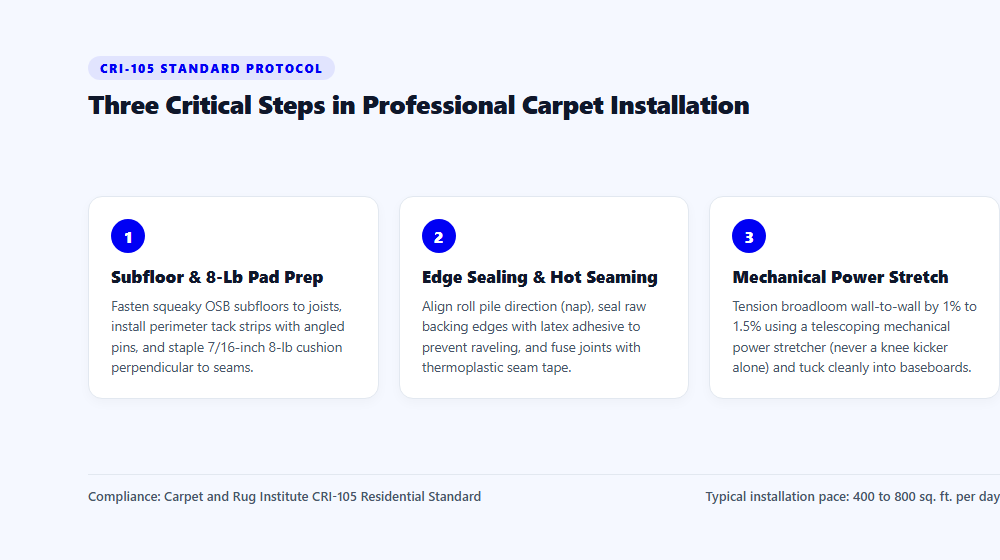
Even a $9.00-per-square-foot Type 6,6 nylon carpet will fail prematurely if installed over bargain 5-pound foam padding or stretched solely with a knee kicker. The Carpet and Rug Institute (CRI-105 Standard for Installation of Residential Carpet) and FHA/HUD Minimum Property Standards (UM 72a) establish strict mechanical benchmarks for underlayment cushion, perimeter tack strip fastening, and wall-to-wall tensioning.
| Installation Component or Add-On | Unit Cost Range | Standard 200 Sq. Ft. Room Cost | CRI-105 / FHA Technical Specification |
|---|---|---|---|
| 6-lb Rebond Polyurethane Pad (7/16") | $0.45 – $0.85 / sq. ft. | $90 – $170 | FHA Class 1 minimum for light-to-moderate bedroom traffic; recycled bonded urethane foam. |
| 8-lb High-Density Rebond Pad (7/16" or 3/8") | $0.65 – $1.25 / sq. ft. | $130 – $250 | FHA Class 2 heavy traffic standard; prevents backing flex and keeps warranty valid. |
| Moisture-Barrier Memory Foam Pad (8-lb+) | $0.90 – $1.60 / sq. ft. | $180 – $320 | Top breathable thermoplastic film blocks pet accidents and spills from reaching subfloor. |
| Flat Rubber or Synthetic Fiber Pad (3/8") | $0.85 – $2.10 / sq. ft. | $170 – $420 | Mandatory firm, low-profile support for Berber loops, woven wool, and radiant-heated floors. |
| Base Installation Labor (Power Stretch & Seams) | $0.75 – $2.00 / sq. ft. | $150 – $400 | Includes wood or concrete tack strips, hot-melt thermoplastic seaming, and mechanical power stretch. |
| Staircase Carpet Labor (Waterfall vs. Hollywood) | $15.00 – $35.00 / step | $210 – $490 (14 steps) | Includes individual step pad cutting, double-tack risers, and upholstery stapling under nosing. |
| Old Carpet & Pad Tear-Out + Dump Disposal | $0.50 – $1.50 / sq. ft. | $100 – $300 | Cutting old rolls into 4-foot bundles, pulling rusted staples, and hauling debris to landfill. |
| Furniture Moving & Resetting | $0.35 – $0.85 / sq. ft. | $70 – $170 | Moving standard beds, dressers, and sofas; pianos, pool tables, and aquariums billed extra. |
| Subfloor Squeak Screwing & Patch Leveling | $0.75 – $2.50 / sq. ft. | $150 – $500 | Driving 2.5" ring-shank screws into joists and troweling cementitious feather patch over joints. |
Why 8-Pound, 7/16-Inch Padding Beats Thicker Cushion
One of the most common mistakes homeowners make is paying extra for a thick 1/2-inch or 9/16-inch pad with a soft 5-pound or 6-pound density rating, assuming it will feel more luxurious underfoot. Padding density (measured in pounds per cubic foot) dictates structural support, while thickness determines vertical deflection. When a pad is thicker than 7/16 inch (for cut pile) or 3/8 inch (for loop Berber), every footstep forces the carpet backing to flex deeply downward. That excessive vertical travel shears the synthetic latex adhesive holding the tufts, causes seams to peak and split, and allows the carpet edge to unhook from the angled metal pins on the perimeter tack strips.
For virtually every cut-pile residential application, flooring engineers and major mills (Shaw, Mohawk, Stainmaster/Lowe’s, and Fabrica) recommend an 8-pound rebond foam pad at 7/16-inch thickness. If you are installing loop Berber, flatweave, or natural wool, step down in thickness to a 1/4-inch to 3/8-inch firm felt or flat rubber pad (8-pound to 10-pound density) so the heavy taut backing cannot deflect.
CRI-105 Mechanical Power Stretching vs. Knee Kicking
Under Section 9.7 of the CRI-105 Residential Installation Standard, all tufted wall-to-wall broadloom carpet must be stretched taut across the room using a mechanical power stretcher (a levered head attached to telescoping metal tubes that brace against the opposite wall) to achieve a 1% to 1.5% elongation stretch. A knee kicker is strictly a positioning tool used to hook edges onto tack strips after the power stretcher holds the tension. When hurried subcontractors skip the power stretcher and only knee-kick a bedroom, changes in indoor humidity cause the synthetic ActionBac backing to relax within 6 to 18 months, creating unsightly ripples and speed-bump wrinkles across the middle of the room. Always verify in writing that your installer follows CRI-105 power-stretching protocols and seals all cut edges prior to hot-melt seaming to prevent edge raveling.
Staircase Carpet Costs: Waterfall vs. Hollywood Style ($15 to $35 per Step)
Stairs are billed by the individual step (plus $75 to $175 per landing) because each tread and riser requires custom cutting, high-density step padding, tack strip placement, and pneumatic crown stapling. Installers use two primary methods on staircases:
- Waterfall Installation ($15 to $22 per step): The carpet flows smoothly over the bullnose edge of the tread and drops straight down to meet the base of the riser in the crotch of the step below, without being stapled tightly beneath the nosing lip. This method works best for thick, stiff carpets or bold geometric runners.
- Hollywood (Cap-and-Band / Contoured) Installation ($20 to $35 per step): The installer wraps the carpet tightly around the rounded bullnose of the step, staples it securely into the recessed underside of the overhang, and contours it flat down the riser. Hollywood wrapping looks tailored and prevents the carpet from sliding forward over the nosing under heavy downward foot traffic, making it the preferred technique for standard residential stairs.
If your staircase features open sides with exposed hardwood spindles (balusters) that require hand-turning, tucking, and upholstery tacking around each spindle base, expect labor to add an extra $10 to $20 per exposed step. Homeowners debating whether to re-carpet stairs or convert to solid oak treads can compare total pricing in our hardwood floor installation cost per square foot guide.
Regional and State Carpet Installation Cost Comparison
While wholesale broadloom prices are heavily centralized near North Georgia (Dalton, Georgia produces over 75% of the U.S. carpet supply), freight surcharges, state disposal regulations, and local installer labor rates create substantial regional price differences. Below is how turnkey carpet installation costs compare across major U.S. regions and states in 2026.
| U.S. Region & Representative States | Installed Cost Range (per Sq. Ft.) | Average 200 Sq. Ft. Bedroom (With Waste) | Average 1,200 Sq. Ft. Whole-House Project | Regional Market & Subfloor Drivers |
|---|---|---|---|---|
| Southeast (GA, NC, SC, TN, AL) | $3.20 – $8.50 | $720 – $1,910 | $4,300 – $11,420 | Proximity to Dalton, GA carpet mills minimizes freight charges; competitive independent labor. |
| South Central (TX, OK, AR, LA) | $3.40 – $9.00 | $765 – $2,025 | $4,570 – $12,100 | Concrete slab-on-grade subfloors require concrete-nail tack strips and moisture-vapor pads. |
| Midwest (OH, MI, IN, IL, MN, WI) | $3.75 – $9.75 | $845 – $2,190 | $5,040 – $13,100 | High demand for 8-lb thermal padding in basements and two-story OSB subfloor squeak repairs. |
| Mountain West & Southwest (CO, AZ, UT, NV) | $3.90 – $10.25 | $875 – $2,305 | $5,240 – $13,775 | Growing metro construction labor rates; anti-static nylon treatments preferred in arid climates. |
| Mid-Atlantic & Florida (FL, VA, MD, PA) | $4.00 – $10.50 | $900 – $2,360 | $5,375 – $14,110 | High humidity in coastal markets favors antimicrobial moisture-barrier padding and solution-dyed fibers. |
| Northeast & New England (NY, NJ, MA, CT) | $4.60 – $12.50 | $1,035 – $2,810 | $6,180 – $16,800 | Higher union/licensed installer labor, multi-floor walk-up staging, and strict landfill recycling fees. |
| West Coast (CA, WA, OR) | $4.85 – $13.00 | $1,090 – $2,925 | $6,520 – $17,470 | California AB 2398 Carpet Stewardship assessment fee ($0.35-$0.93/sq yd), CRI Green Label Plus VOC rules, and high metro labor. |
Big-Box Promotional Installs vs. Local Independent Flooring Showrooms
When comparing quotes, many homeowners wonder how national home improvement chains advertise “free” or “$0.49 per square foot” carpet installation while local independent flooring stores charge $1.25 to $2.00 per square foot for labor. In practice, final bottom-line invoices between the two channels often land within 5% to 10% of each other once all line items are tallied:
- Padding Markups: Promotional big-box installs typically require purchasing an upgraded in-house moisture-barrier pad priced at $1.10 to $1.65 per square foot, where the labor subsidy is recovered inside the cushion margin.
- Computerized Measure & Seam Waste: Third-party measuring services contracted by national chains use automated software that often adds 15% to 20% roll waste without optimizing closets or hallway T-seams. An experienced local estimator who measures your rooms in person can often orient the 12-foot drops and closet fills to keep waste closer to 10% to 12%.
- Itemized Add-On Charges: Promotional labor covers only laying new carpet over an empty, broom-swept room. Tear-out of existing carpet ($0.60-$1.20/sq ft), furniture moving, baseboard quarter-round adjustments, metal transition bars, and stair steps are billed at full a-la-carte rates.
- Installer Craftsmanship: Independent local dealers typically retain in-house or long-term CFI-certified (Certified Floorcovering Installers) mechanics who take the time to power-stretch in two directions, use seam sealers on every cut edge, and place seams out of direct window cross-lighting.
How We Compiled These Carpet Pricing Benchmarks (Methodology)
To provide accurate 2026 residential pricing, our cost analysis synthesizes wholesale mill price sheets (Dalton, Georgia broadloom indices for PET, Type 6 and Type 6,6 nylon, PTT triexta, and wool), regional labor surveys from Certified Floorcovering Installers (CFI) contractors, and technical installation standards from the following industry authorities:
- Carpet and Rug Institute (CRI-105): Standard for Installation of Residential Carpet, which governs subfloor moisture tolerances, perimeter tack strip pin angles, seam sealing, and mandatory mechanical power stretching.
- FHA / HUD Use of Materials Bulletin UM 72a: Federal Housing Administration density and thickness specifications for Class 1 (moderate traffic) and Class 2 (heavy traffic) carpet cushion underlayment.
- CRI Green Label Plus Indoor Air Quality Program: Low-VOC testing criteria for synthetic carpet backings, cushions, and thermoplastic seam adhesives.
Frequently Asked Questions About Carpet Installation Cost
How do you convert carpet price per square yard to price per square foot?
Divide the price per square yard by 9 to get the price per square foot, or multiply the price per square foot by 9 to get the price per square yard. Because 1 yard equals 3 feet, a 3-foot by 3-foot square contains exactly 9 square feet. For example, a nylon carpet priced at $45.00 per square yard equals $5.00 per square foot ($45 divided by 9).
Why am I billed for 10% to 15% more carpet square footage than my room dimensions?
Broadloom carpet is manufactured on fixed 12-foot-wide rolls (and occasionally 15-foot-wide rolls), and every piece installed in a room must run with the pile grain pointing in the exact same direction. If your bedroom is 14 feet wide by 15 feet long (210 net square feet), the installer cannot turn a leftover strip sideways to fill the extra 2 feet without creating a visible light-reflection mismatch. Ordering the required roll drop plus matching fill strips typically adds 10% to 15% roll waste.
Is 8-pound carpet pad worth the extra cost over 6-pound pad?
Yes, upgrading from a 6-pound to an 8-pound rebond foam pad (in a 7/16-inch thickness) typically adds only $0.20 to $0.40 per square foot ($40 to $80 for a 200-square-foot room) but can extend the life of your carpet by 3 to 5 years. The denser 8-pound cushion absorbs foot impact without allowing the carpet backing to flex excessively, preventing premature tuft loss and seam peaking.
How much does it cost to carpet a standard 12- to 14-step staircase?
Carpeting a standard 12- to 14-step residential staircase typically costs between $450 and $1,100 total, including durable nylon or wool carpet, 8-pound step padding, and specialized stair labor of $15 to $35 per step. Contoured Hollywood wrapping around each bullnose and hand-tucking around open balusters sit at the upper end of that range, while a straight boxed waterfall staircase sits at the lower end.
Should I paint my baseboards before or after new carpet is installed?
The best workflow is to apply primer and two finish coats to your walls and baseboards before the old carpet is torn out, then perform minor touch-ups after the new carpet is stretched in. Because new carpet and padding may sit slightly higher or lower than your previous floor, painting the very bottom edge of the baseboard beforehand ensures no unpainted stripe is exposed, while keeping heavy paint rollers away from your brand-new fibers.
Can new carpet be installed over existing carpet padding to save money?
No. Professional installers and carpet manufacturers strongly advise against reusing old padding, and doing so voids almost all mill wear warranties. Over years of foot traffic, urethane foam padding breaks down, compresses unevenly in walkways, and traps dust mites, pet dander, and moisture vapor. Always install fresh CRI-approved padding alongside new broadloom carpet.

