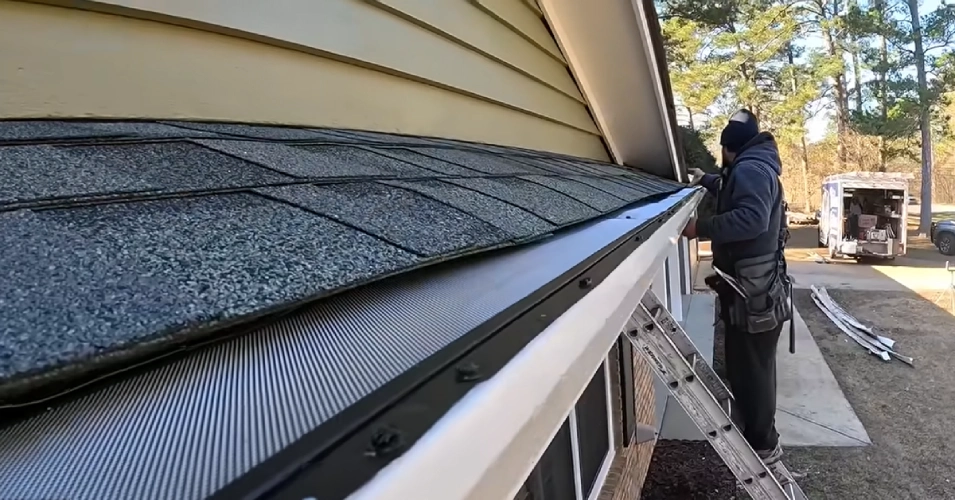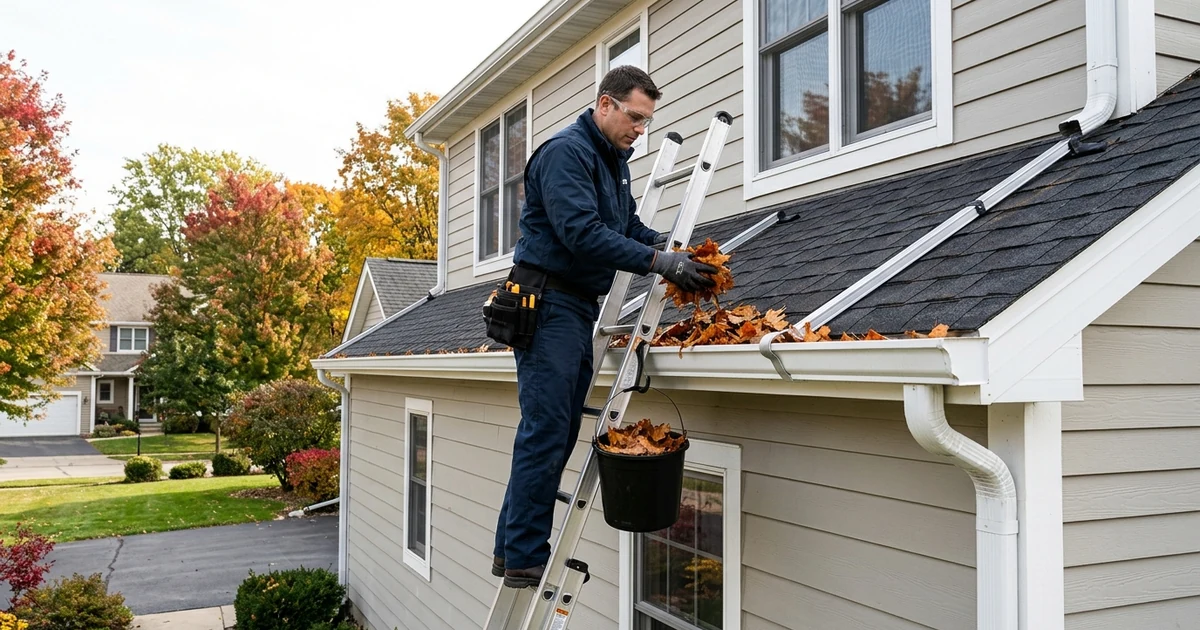
The national average gutter cleaning cost ranges from $120 to $280 for a standard residential home, with most homeowners paying approximately $185 for 150 to 200 linear feet of trough and downspout maintenance. Professional contractors calculate your final invoice primarily by measuring total linear footage ($0.80 to $2.50 per linear foot) and evaluating the vertical story count of your structure. While a walkable single-story ranch home with open aluminum K-style gutters typically costs $100 to $225 to service, a three-story Victorian or steep-pitched colonial requiring 32-foot extension ladders and OSHA fall-arrest harnesses costs between $225 and $500 or more.
Routine gutter maintenance is one of the highest-return preventative investments in residential property management. When decomposing oak leaves, pine needles, and asphalt shingle granules obstruct rainwater channels, roof runoff cascades over the fascia board and saturates the perimeter soil around your home. Left unchecked through heavy autumn storms and winter freeze-thaw cycles, clogged gutters lead to rotted roof decking, flooded basements, and structural settlement that can easily trigger major foundation repair cost liabilities or premature gutter installation cost expenses.
Gutter Cleaning Cost by Home Story Count and Linear Footage
Building height is the single largest labor multiplier in the exterior maintenance industry. Every additional story increases technician climb time, ladder repositioning complexity, and commercial general liability insurance premiums. On a single-story structure with a low-slope roof, a two-person crew can either walk the roof line with high-CFM backpack blowers or scoop troughs rapidly from a 12-foot step ladder, finishing the entire perimeter in 45 to 75 minutes.
Once a home reaches two or three stories, roof access protocols change dramatically. Technicians must deploy heavy fiberglass extension ladders equipped with stand-off stabilizers to prevent crushing the aluminum gutter apron. On three-story townhomes or homes built on walk-out basement grades where the rear roofline sits 35 to 40 feet above ground level, crews must anchor safety ropes to roof ridges or utilize towable boom lifts, pushing the per-foot rate from $0.80 up to $2.75 per linear foot.
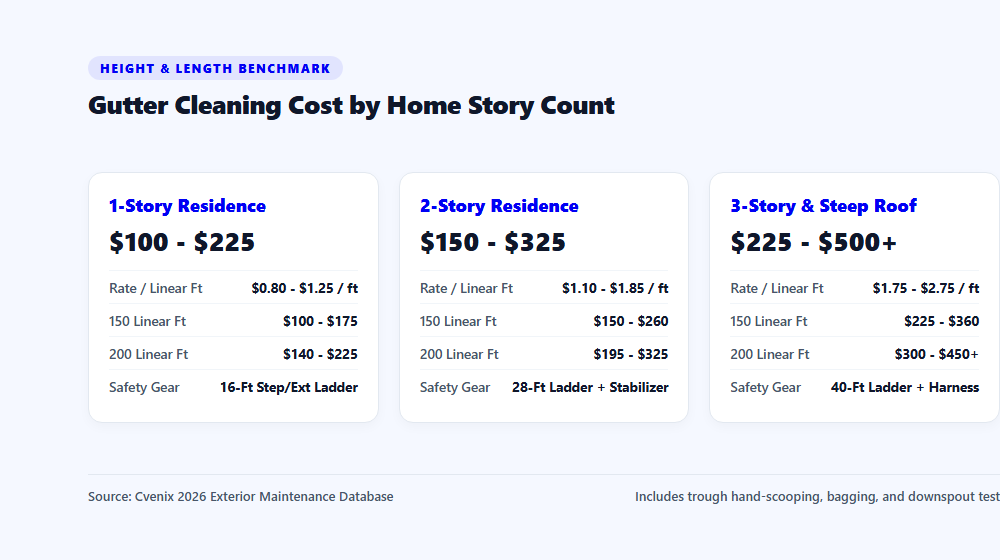
| Home Story Count | Cost per Linear Foot | 150 Linear Feet (Small/Mid Home) | 200 Linear Feet (Average Home) | 250+ Linear Feet (Large Home) | Ladder & Safety Protocol |
|---|---|---|---|---|---|
| 1-Story Home (8 – 12 ft eaves) | $0.80 – $1.25 / ft | $100 – $175 | $140 – $225 | $180 – $290 | 12-ft step or 16-ft extension ladder with stand-off bars |
| Split-Level / 1.5-Story Home | $0.95 – $1.50 / ft | $135 – $210 | $175 – $275 | $220 – $350 | Mixed 16-ft and 24-ft extension ladders; ridge transitions |
| 2-Story Home (18 – 22 ft eaves) | $1.10 – $1.85 / ft | $150 – $260 | $195 – $325 | $250 – $425 | 24-ft to 28-ft heavy-duty ladders; stabilizer arms mandatory |
| 3-Story Home (28 – 35 ft eaves) | $1.75 – $2.50 / ft | $225 – $360 | $300 – $450 | $380 – $575+ | 32-ft to 40-ft ladders; two-person spotting and rope harness |
| 3+ Stories or Steep Pitch (9/12+) | $2.10 – $2.75+ / ft | $280 – $415 | $375 – $525 | $475 – $685+ | Full OSHA fall-arrest anchor rig or articulated aerial lift |
Homeowners should also account for walk-out basements and hillside grading when estimating story height. A residence marketed as a two-story home on the street front often functions as a three-story elevation along the rear deck or daylight basement. Exterior contractors price each elevation run according to the actual ground-to-eave vertical drop where the ladder feet must rest, rather than interior floor count alone.
Gutter Cleaning Cost by Total Linear Footage
While some neighborhood handymen quote a flat visual rate from the driveway, established exterior cleaning companies measure your exact gutter perimeter using satellite roof-measurement software (such as EagleView or Hover) before dispatching a crew. Generally, total gutter length correlates closely with roof footprint square footage, though hip roofs, wrap-around porches, and detached two-car garages increase total linear footage relative to interior living space.
For instance, a simple gable-roof ranch home only requires gutters along two parallel eaves, frequently totaling just 100 to 130 linear feet. Conversely, a hip-roof residence of the exact same interior square footage has gutter troughs wrapping all four sides of the building perimeter, easily reaching 200 to 260 linear feet and requiring twice as many downspout elbows to be cleared.
| Total Gutter Length | Typical Home Size (Sq. Ft.) | 1-Story Price Range | 2-Story Price Range | 3-Story Price Range | Average Crew Service Time |
|---|---|---|---|---|---|
| 100 Linear Feet | 1,000 – 1,400 sq. ft. | $100 – $145 (Min. Call) | $140 – $195 | $200 – $275 | 45 – 60 minutes |
| 150 Linear Feet | 1,500 – 2,100 sq. ft. | $120 – $185 | $165 – $275 | $260 – $375 | 60 – 90 minutes |
| 200 Linear Feet | 2,200 – 2,800 sq. ft. | $160 – $240 | $220 – $360 | $350 – $490 | 90 – 120 minutes |
| 250 Linear Feet | 2,900 – 3,600 sq. ft. | $200 – $300 | $275 – $440 | $435 – $600 | 2 – 2.5 hours |
| 300+ Linear Feet | 3,700+ sq. ft. / Custom Estate | $245 – $375+ | $330 – $550+ | $525 – $750+ | 2.5 – 4 hours |
Minimum Service Call Fees Explained
If your home has less than 100 linear feet of guttering, such as a compact urban townhome, bungalow, or detached garage, multiplying your footage by $1.00 per foot will not reflect actual market pricing. Nearly all insured exterior maintenance companies enforce a minimum service call charge ranging from $125 to $175. This baseline fee covers commercial vehicle fuel, crew travel time between job sites, ladder setup, and waste disposal overhead. To maximize value on a smaller property, consider bundling your gutter service with roof moss treatment, window washing, or soft-washing exterior siding during the same appointment.
Add-On Service Pricing: Downspout Flushing, Gutter Guards, and Repairs
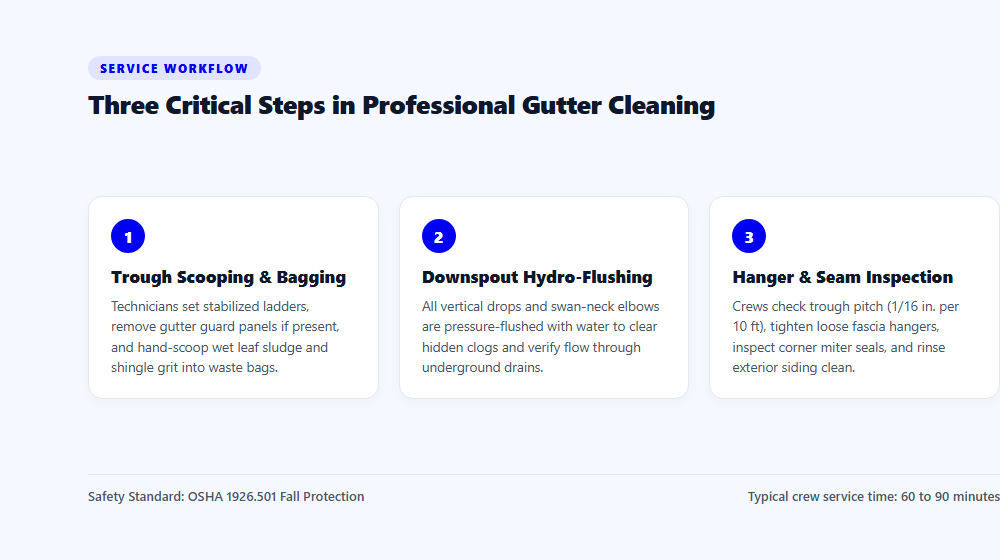
Scooping wet leaves out of horizontal troughs only solves half of a roof drainage problem. If a single pinecone, tennis ball, or compacted plug of decomposing maple helicopters lodges inside a vertical downspout elbow, the entire gutter run will overflow during the very next rainstorm. Furthermore, homes equipped with aftermarket leaf guards or underground drainage pipes require specialized labor beyond basic trough clearing.
| Add-On Service Item | Typical Pricing Structure | Average Total Cost | What the Technician Performs |
|---|---|---|---|
| Downspout Hydro-Flushing (Standard) | Included or $10 – $20 / drop | $0 – $80 | Water hose testing of all vertical drops and upper/lower elbows |
| Severely Clogged Downspout Disassembly | $25 – $50 per clogged drop | $50 – $150 | Unscrewing zip-screws at elbows, extracting root/shingle plugs, re-fastening |
| Underground Drain Pipe Hydro-Jetting | $75 – $175 per underground line | $100 – $300 | High-pressure jetting of buried PVC or corrugated lines to daylight or pop-up emitter |
| Gutter Guard Removal & Reinstallation | $0.50 – $1.50 per linear foot | $75 – $250 | Lifting or unscrewing screens/mesh, scooping silt pan, snapping guards back |
| Loose Hanger Re-Pitching & Fastening | $5 – $12 per hidden hanger | $75 – $225 | Replacing pulled-out spikes/ferrules with heavy-duty 6-inch hidden screw hangers |
| Miter Box & End Cap Seam Resealing | $25 – $60 per leaking corner | $60 – $180 | Wire-brushing old brittle caulk and applying tripolymer or polyurethane gutter sealant |
| Fascia & Soffit Moisture Inspection | Bundled or $50 – $100 flat fee | $0 – $100 | Probing wood fascia behind trough apron for dry rot and checking attic soffit vents |
Downspout Flushing and Underground Drain Clearing ($50 to $150)
Every reputable gutter cleaning quote should include testing vertical downspouts to verify unobstructed flow. However, when a downspout has been packed solid with decomposing organic muck and roof grit for multiple seasons, water pressure alone cannot dislodge the blockage. Technicians must remove the sheet-metal screws holding the upper swan-neck or lower discharge elbow, mechanically snake the vertical aluminum column, and flush the debris clear, adding $25 to $50 per impacted downspout.
Even more problematic are downspouts that tie directly into buried corrugated black pipe or Schedule 40 PVC storm drains. When fine shingle sediment and decomposing oak tannins wash down the vertical drop, they settle in the horizontal underground elbow and trap tree roots. Clearing a blocked subterranean line requires a specialized plumbing snake or pressure-washer hydro-jetter nozzle costing $100 to $300. If buried corrugated pipes have collapsed under soil weight, you may need to evaluate full french drain installation cost options to route roof water safely away from your basement walls.
Gutter Guard Removal and Reinstallation Surcharge ($0.50 to $1.50 per Foot)
One of the most frequent surprises reported by homeowners is that installing gutter guards does not make gutters 100% maintenance-free. Over two to four years, fine pine needles, silver maple seeds, shingle granules, and airborne dust wash through perforated screens and micro-mesh filters, forming a dense layer of nutrient-rich silt inside the enclosed trough. Because the cover blocks sunlight and airflow, this trapped mud stays perpetually damp, sprouting weeds and corroding aluminum seams from the inside out.
When you hire a contractor to clean gutters that already have guards installed, the crew must carefully pop off snap-in vinyl screens or unscrew sheet-metal micro-mesh panels tucked underneath the first course of roof shingles, scoop and flush the trough, scrub algae off the mesh screen so water stops sheeting over the top, and re-fasten every panel. This labor-intensive workflow adds $0.50 to $1.50 per linear foot ($75 to $250 on a typical 200-foot system) to the base cleaning bill.
Loose Hanger Re-Pitching and Seam Resealing ($75 to $250)
Water does not drain out of a dead-level gutter efficiently; professional installers pitch gutters at a subtle slope of 1/16 to 1/8 inch per 10 feet toward each downspout outlet. When clogged troughs fill with standing water and winter ice, the dead weight (up to 350 pounds per 50-foot section) pulls old smooth-shank gutter spikes out of the wooden fascia board. During a routine cleaning, technicians can upgrade sagging sections with heavy-duty hidden structural screws and reseal leaking corner miter boxes with industrial tripolymer sealant for $75 to $250, extending your system lifespan by a decade.
Key Cost Factors: Roof Pitch, Accessibility, and Debris Severity
Two houses on the same street with identical square footage and two-story elevations can easily receive gutter cleaning quotes that differ by $150 or more. Exterior estimators look closely at four site-specific risk and time multipliers before finalizing a price.
- Roof Pitch and Walkability (4/12 vs. 10/12 Slope): A low-to-moderate roof pitch between 4/12 and 6/12 allows experienced technicians wearing high-traction cougar-paw roofing boots to walk along the roof edge and clean the entire perimeter rapidly. Once roof pitch reaches 8/12 to 12/12 (steep Tudor, A-frame, or mansard roofs), walking the shingles without tied-off ridge ropes is impossible. Crews must clean the entire house from the ground by moving heavy extension ladders every 4 feet around the perimeter, increasing labor time by 40% to 75%.
- Fragile Roof Materials (Slate, Clay Tile, and Cedar Shake): Even on a gentle slope, technicians cannot walk across natural slate, Spanish terracotta barrel tile, or aged cedar shakes without cracking brittle roofing units and triggering expensive roof replacement cost repairs. Homes with specialty roofing materials require 100% ladder-based or boom-lift servicing, adding a $50 to $150 equipment handling surcharge.
- Landscaping Obstacles and Hilltop Grading: Dense rose bushes, Japanese maples, retaining walls, air conditioning condensers, or swimming pool enclosures positioned directly beneath the eaves prevent safe ladder footing. When crews must use ladder levelers on steep side-yard slopes or bridge across fragile conservatory sunrooms, expect an accessibility surcharge of 15% to 30%.
- Deferred Maintenance and Heavy Compost Buildup: Gutters cleaned twice a year contain loose, dry leaves that scoop or blow out in minutes. Gutters neglected for three or more years contain 4 inches of heavy, waterlogged organic compost, earthworms, and rooted maple saplings. Digging out compacted mud by hand and hauling away 10 to 15 heavy contractor trash bags adds a 25% to 50% heavy-debris fee ($60 to $150 extra).
How Gutter Profile and Material Affect Cleaning Labor
Beyond height and roof slope, the physical shape and metallurgy of your guttering system influence how long technicians spend at each elevation run. Roughly 80% of North American homes utilize 5-inch or 6-inch seamless aluminum K-style gutters secured with hidden screw hangers that sit flush inside the lip. However, historic properties, custom architectural estates, and older mid-century homes often feature specialized profiles that require gentler hand tools and slower debris extraction:
- Traditional Spike-and-Ferrule Gutters: Homes built or retrofitted prior to the late 1990s frequently use long 7-inch aluminum spikes driven through cylindrical metal ferrules every 24 to 36 inches across the open top of the trough. Technicians cannot slide a gutter scoop smoothly down the channel because the scoop hits a metal ferrule cross-bar every two feet, adding 15 to 25 minutes of tedious hand-clearing around each spike.
- Half-Round Copper and Galvanized Steel Gutters: Smooth semicircular half-round troughs flush cleanly with water, but soft architectural copper scratches easily if scraped with metal trowels or unpadded ladder rails. Crews must use soft neoprene ladder stand-off pads resting on the roof deck and non-marring nylon scoops to protect the natural verdigris patina.
- Built-In Yankee and Box Gutters: Found on historic Victorian, Colonial Revival, and commercial flat-roof structures, built-in box gutters are framed directly into the lower roof eave and lined with soldered copper, terne metal, or EPDM rubber membrane. Because an overflowing box gutter leaks directly into interior plaster walls and soffit framing, contractors inspect every soldered seam and internal drain scupper basket carefully, typically charging $1.50 to $2.75 per linear foot.
- Seamed Vinyl and Segmented Aluminum Systems: DIY sectional gutters joined every 10 feet with slip-joint connectors feature raised internal ridges and sealant beads at every seam. Wet twigs and pine needles snag against these joints, requiring thorough low-pressure rinsing while avoiding high-pressure streams that could blow apart brittle PVC slip-joints.
Cost of Routine Gutter Cleaning vs. Water Damage Repairs
Homeowners sometimes delay a $175 to $250 gutter cleaning appointment because the troughs appear functional from street level during dry weather. Yet a single 1,500-square-foot roof sheds approximately 935 gallons of water during a 1-inch rainstorm. When clogged troughs and downspouts force hundreds of gallons of roof runoff to sheet down fascia boards and pool against basement walls, minor deferred maintenance rapidly escalates into four-figure structural remediation:
| Water Damage Consequence | Cause Linked to Clogged Gutters | Typical Repair Cost Range | Cost Multiple vs. $200 Cleaning |
|---|---|---|---|
| Rotted Wood Fascia & Soffit Replacement | Water backing up over rear gutter apron and saturating rafter tails | $600 – $2,400 | 3x to 12x higher |
| Winter Ice Dam Roof & Ceiling Leak Repair | Frozen trough sludge blocking snowmelt drainage at cold roof eaves | $1,200 – $4,500 | 6x to 22x higher |
| Full Seamless Gutter System Replacement | 300+ lbs of standing water and ice pulling troughs off the house | $1,500 – $3,800 | 7.5x to 19x higher |
| Basement Waterproofing & Sump Pump Overhaul | Overflowing eaves dumping thousands of gallons beside foundation walls | $2,500 – $7,500 | 12.5x to 37x higher |
| Structural Foundation Piering & Crack Repair | Hydrostatic clay soil expansion and differential footing settlement | $4,500 – $15,000+ | 22x to 75x higher |
DIY Ladder Risk vs. Hiring a Professional Gutter Cleaner
Because gutter cleaning requires no specialized trade license, many homeowners consider tackling the chore themselves over a weekend. On a single-story ranch home with flat, firm lawn access and a quality step ladder equipped with a stand-off stabilizer, DIY cleaning is a straightforward project. However, for two-story and three-story residences, the financial calculus shifts sharply once you weigh equipment expenses and physical safety statistics.
According to data compiled by the Centers for Disease Control and Prevention (CDC), the National Institute for Occupational Safety and Health (NIOSH), and the U.S. Consumer Product Safety Commission (CPSC), more than 500,000 people are treated in hospital emergency rooms each year for ladder-related injuries, with residential gutter cleaning ranking as the leading seasonal cause of severe household falls every October and November. Leaning over to scoop heavy wet sludge shifts a homeowner center of gravity past the ladder side rails, while resting an un-stabilized ladder directly against thin aluminum gutter metal frequently crushes the trough lip.
| Comparison Factor | DIY Homeowner Cleaning | Professional Gutter Service | Key Cost & Safety Takeaway |
|---|---|---|---|
| Direct Monetary Cost | $0 (if tools owned) or $275 – $480 upfront equipment purchase | $140 – $325 per standard service visit (150 – 200 linear ft) | Buying a 28-ft fiberglass ladder ($320+) equals 2 years of pro service |
| Cleaning Methodology | Hand scooping from ladder or telescopic wand attachment | Hand scooping & bagging wet sludge + high-CFM blower + hydro-flushing | Ground-based telescopic wands blast mud onto siding and windows |
| Downspout & Underground Check | Surface garden hose test only | High-pressure flushing, elbow disassembly, and flow verification | Pros clear hidden elbow blockages that DIYers cannot reach |
| Safety & Liability Protection | High fall risk (500,000+ annual U.S. ladder ER visits); personal medical deductibles | OSHA fall-arrest harnesses, ladder stabilizers, $1M-$2M General Liability & Workers Comp | Eliminates catastrophic personal injury and homeowner liability risk |
| Time Commitment | 3 to 6 hours (including ladder moving, bagging, and rinsing siding) | 45 to 90 minutes with a trained 2-person crew | Professionals finish in a fraction of the time with zero mess left behind |
| Annual Contract Discounts | None | 15% – 20% off per visit on bi-annual (Spring/Fall) maintenance plans | Scheduled service locks in lower per-visit rates and priority booking |
Hand-Scooping and Bagging vs. Leaf Blowers and Pressure Washers
When vetting local gutter contractors, always ask how they remove debris from the troughs. When gutters are bone-dry in early autumn, using a commercial backpack leaf blower from the roof is clean and efficient. However, after autumn rains turn leaves into black decomposing sludge, using a high-powered leaf blower or pressure washer sprays dark tannin-stained mud across your white soffits, bedroom windows, patio furniture, and foundation shrubs. Top-tier professionals hand-scoop and bag wet debris into buckets on the ladder, wipe down the exterior gutter face if needed, and flush the empty channel with clean water.
Regional and State Gutter Cleaning Cost Comparison
Geographic location impacts gutter maintenance pricing through two primary mechanisms: local deciduous and coniferous tree canopy density, and regional contractor insurance and labor rates. In the Pacific Northwest (Washington and Oregon), towering Douglas firs, western red cedars, and bigleaf maples drop needles and organic debris year-round, while persistent dampness fuels thick roof moss growth that washes directly into gutter troughs. Similarly, heavily wooded suburbs across New England, the Mid-Atlantic, and the Upper Midwest experience intense autumn leaf drop followed by rapid December freezes, creating an urgent six-week service window where demand peaks.
Conversely, Sunbelt states such as Arizona, Nevada, and parts of Texas and Florida feature predominantly single-story stucco architecture or sparse desert and palm landscaping, keeping average cleaning bills lower, though summer monsoon dust and live oak catkins still require annual clearing.
| U.S. Region & Representative States | Average Cost per Linear Foot | Typical 2-Story Home (200 Linear Ft) | Recommended Cleaning Frequency | Primary Regional Debris & Climate Drivers |
|---|---|---|---|---|
| Pacific Northwest (WA, OR, ID) | $1.25 – $2.40 / ft | $240 – $420 | 2 to 4 times per year | Heavy Douglas fir/pine needles, year-round roof moss, constant rain |
| Northeast & New England (MA, NY, NJ, CT, PA) | $1.20 – $2.35 / ft | $230 – $410 | 2 times per year (June & late Nov) | Dense oak/maple foliage, steep historic 2.5-story roofs, winter ice dams |
| Upper Midwest & Great Lakes (IL, MI, MN, OH, WI) | $1.00 – $1.90 / ft | $190 – $340 | 2 times per year (Spring & Fall) | Silver maple helicopters in May, heavy fall foliage, severe freeze-thaw cycles |
| Southeast & Piedmont (GA, NC, SC, VA, TN) | $0.95 – $1.80 / ft | $180 – $325 | 2 to 3 times per year | Loblolly pine straw matting, sweetgum balls, spring oak pollen tassels |
| Gulf Coast & Florida (FL, TX, LA) | $0.85 – $1.65 / ft | $165 – $295 | 1 to 2 times per year | Live oak leaf drop in early spring, tropical storm debris, high humidity |
| Mountain West & Southwest (CO, AZ, NV, UT, CA) | $0.90 – $1.95 / ft | $175 – $350 | 1 to 2 times per year | Cottonwood seeds, ponderosa pine needles, wildfire ash, monsoon silt |
Seasonal Maintenance Schedule: How Often Should You Clean Gutters?
For the vast majority of American homes surrounded by moderate mature trees, industry standards dictate cleaning gutters twice per year: once in late spring (late May or June) and once in late autumn (late November or early December). Understanding the seasonal biology of trees explains why both visits are critical to protecting your roof and foundation.
- Late Spring Cleaning (May to June): In early spring, maple, oak, birch, and pine trees release massive volumes of winged samaras (“helicopters”), stringy pollen catkins, and seed pods. Because spring debris is fine and fibrous, it mats together over downspout strainer baskets like papier-mache just as heavy June thunderstorms arrive. Clearing gutters in early June prevents summer basement dampness and mosquito breeding in stagnant trough water.
- Late Autumn Cleaning (Late November to Early December): Timing your autumn cleaning is crucial. If you schedule service too early in October while oak and beech trees still hold 50% of their leaves, your gutters will fill right back up before winter. Wait until 90% to 95% of deciduous leaves have fallen, but before sustained sub-freezing temperatures solidify wet trough debris into solid blocks of ice that cause destructive winter ice dams under roof shingles.
- Quarterly Cleaning for Pine and Wooded Lots (3 to 4 Times/Year): If your roof sits directly beneath white pines, loblolly pines, or Pacific Northwest conifers, needles drop continuously throughout late summer and autumn. Quarterly service contracts keep fine pine straw from bridging across downspout outlets.
Proven Ways to Lower Your Annual Gutter Maintenance Bill
You can trim 15% to 30% off your annual gutter maintenance expenditures without cutting corners on quality by applying three practical contractor scheduling strategies:
- Sign Up for an Annual Bi-Annual Service Agreement: Exterior maintenance companies strongly prefer predictable route density. Enrolling in an automatic spring-and-fall service agreement typically locks in a 15% to 20% discount per visit ($30 to $65 saved per year) and guarantees you a slot during the hectic late-November rush.
- Organize a Neighborhood Group Booking: Because travel time and truck setup represent up to 35% of a contractor operating cost on a single job, booking three or four adjacent homes on the same street for the same morning routinely earns each homeowner a $25 to $45 multi-home route discount.
- Install Oversized 3×4-Inch Downspouts and Hinged Cleanout Traps: Standard builders-grade homes often use narrow 2×3-inch downspouts that clog effortlessly at the top elbow. Upgrading to wide-mouth 3×4-inch commercial downspouts during a repair or cleaning allows small twigs and leaves to wash straight through without bridging, cutting down on extra unclogging surcharges.
Pricing Methodology and Industry Sources
To establish accurate, verifiable 2026 residential gutter cleaning cost benchmarks, our research team analyzed national contractor rate cards, satellite linear-footage billing models, and verified homeowner invoices across all major U.S. climate zones. Base linear-foot pricing reflects standard 5-inch and 6-inch K-style and half-round gutter systems serviced by licensed, insured exterior maintenance firms carrying both commercial general liability and workers compensation coverage.
Safety, fall-protection, and ladder injury metrics reference public occupational and consumer health reports from the Occupational Safety and Health Administration (OSHA 1926.501 Fall Protection Standards), the Centers for Disease Control and Prevention (CDC/NIOSH ladder safety studies), and the U.S. Consumer Product Regional cost variations incorporate prevailing metropolitan labor rates and regional arboreal canopy density data across the Pacific Northwest, Northeast, Midwest, Southeast, and Southwest.
Frequently Asked Questions About Gutter Cleaning Costs
How much does gutter cleaning cost per linear foot in 2026?
Professional gutter cleaning costs between $0.80 and $2.50 per linear foot in 2026, depending primarily on the story height of your home and the steepness of your roof. Single-story homes average $0.80 to $1.25 per linear foot, two-story homes average $1.10 to $1.85 per linear foot, and three-story or steep-pitched homes cost $1.75 to $2.75+ per linear foot due to heavy extension ladder and safety harness requirements.
Does professional gutter cleaning include flushing the downspouts?
Yes, standard professional gutter cleaning includes checking and flushing all vertical downspouts with water or high-CFM air to verify clear drainage from the roof eave to ground level. However, if a downspout is tightly compacted with years of shingle grit or tree roots and requires mechanical disassembly of the elbows or underground hydro-jetting, contractors typically charge an additional $50 to $150.
Why do contractors charge extra to clean gutters that have gutter guards?
Even top-rated mesh and screen gutter guards allow fine pine needles, shingle granules, and decomposed leaf silt to filter into the trough over two to four years. To clean underneath existing guards, technicians must unscrew or unsnap each guard panel, scoop and rinse the interior channel, scrub algae off the mesh screen, and reinstall the panels, which adds $0.50 to $1.50 per linear foot ($75 to $250 total) in extra labor.
How long does it take a professional crew to clean a 2,000-square-foot house?
A trained two-person professional crew typically takes 60 to 90 minutes to clean and flush a standard 2,000-square-foot home with approximately 150 to 200 linear feet of gutters. If the home is three stories tall, has a steep non-walkable roof pitch (8/12 or higher), or has heavily neglected gutters filled with compacted mud and saplings, the appointment can take 2 to 3 hours.
Do I need to be home when the gutter cleaning crew arrives?
No, you generally do not need to be home during a professional gutter cleaning appointment as long as all exterior gates are unlocked, pets are secured indoors, and an exterior water spigot is turned on for downspout flushing. Most modern exterior maintenance companies send before-and-after digital photos of your clean troughs and downspouts along with the electronic invoice.
What happens if I skip gutter cleaning before winter?
Skipping late-autumn gutter cleaning leaves wet, decomposing leaves sitting inside the aluminum trough when winter temperatures drop below freezing. This frozen blockage prevents snowmelt from draining off the roof eaves, creating heavy ice dams that force water backward underneath your roof shingles, rotting the wooden fascia board and causing interior ceiling drywall leaks and foundation perimeter flooding.