
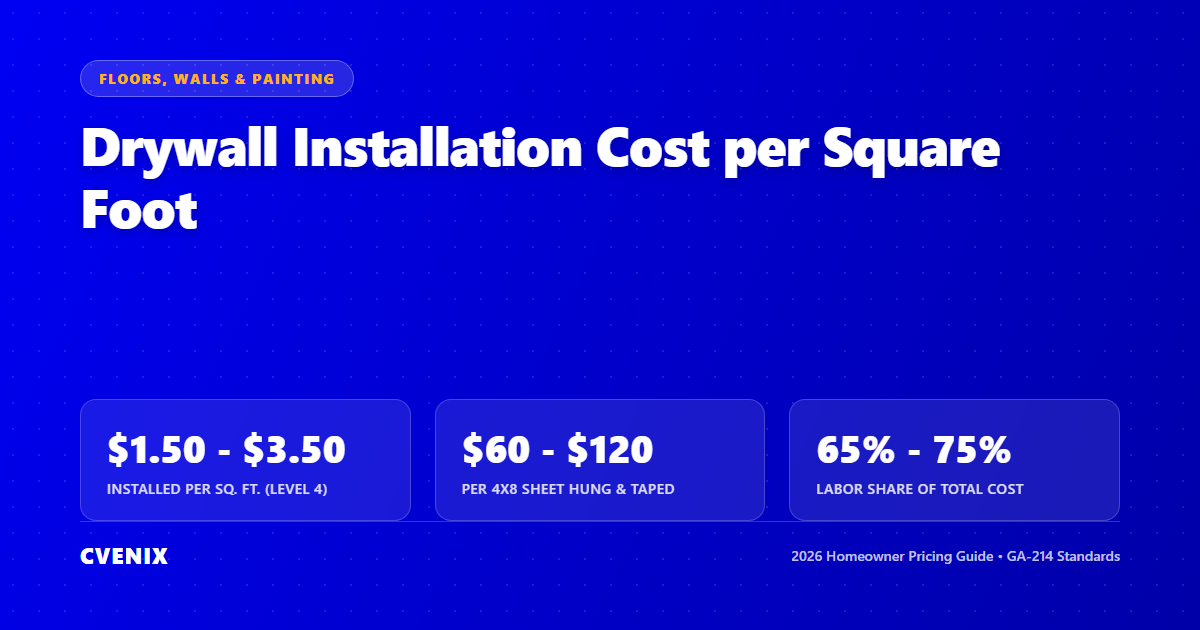
The national average drywall installation cost ranges from $1.50 to $3.50 per square foot of wall and ceiling surface area, or $60 to $120 per standard panel hung, taped, mudded, and sanded to a paint-ready finish. For a typical 12-by-12-foot bedroom requiring roughly 528 square feet of gypsum board across four walls and the ceiling, most homeowners spend between $850 and $1,850 for a complete turnkey installation. Whole-house drywall projects covering 6,500 to 8,000 square feet of interior wall and ceiling area inside a 2,000-square-foot home generally total $10,500 to $24,000 depending on board specifications, ceiling elevations, and surface texture requirements.
Because professional drywall contractors price projects based on actual surface square footage rather than floor plan square footage, understanding how panel count, board thickness, and Gypsum Association GA-214 finish levels interact is essential before reviewing contractor bids. Below is a complete breakdown of material and labor rates across standard 1/2-inch panels, fire-rated 5/8-inch Type X boards, moisture-resistant assemblies, and multi-coat finishing stages.
Drywall Installation Cost by Room Size and Surface Square Footage
The most common pricing error homeowners make when budgeting for new walls is multiplying their room’s floor area by a per-square-foot drywall rate. Drywall covers vertical perimeter walls as well as the overhead ceiling plane. In a room with standard 8-foot or 9-foot ceilings, the actual wall and ceiling surface area requiring gypsum board is typically 3.2 to 4.0 times larger than the floor footprint.
| Project or Room Scope | Floor Footprint | Wall + Ceiling Drywall Area | 4×8 Sheet Count (with 10% Waste) | Turnkey Installed Cost (Level 4) |
|---|---|---|---|---|
| Small Bathroom or Laundry Room (8×10 ft) | 80 sq. ft. | 368 sq. ft. | 13 sheets | $650 – $1,350 |
| Standard Bedroom or Home Office (12×12 ft) | 144 sq. ft. | 528 sq. ft. | 18 sheets | $850 – $1,850 |
| Primary Suite with Walk-In Closet (16×20 ft) | 320 sq. ft. | 960 sq. ft. | 33 sheets | $1,500 – $3,350 |
| Two-Car Attached Garage (20×24 ft, 5/8″ Type X) | 480 sq. ft. | 1,050 sq. ft. | 36 sheets | $1,850 – $3,800 |
| Full Basement Remodel (1,000 sq. ft. footprint) | 1,000 sq. ft. | 2,200 – 2,600 sq. ft. | 75 – 90 sheets | $3,600 – $8,200 |
| Whole House Interior (1,500 sq. ft. home) | 1,500 sq. ft. | 5,000 – 6,000 sq. ft. | 170 – 205 sheets | $8,000 – $18,500 |
| Whole House Interior (2,000 sq. ft. home) | 2,000 sq. ft. | 6,500 – 8,000 sq. ft. | 220 – 275 sheets | $10,500 – $24,500 |
| Custom Two-Story Home (3,000 sq. ft. home) | 3,000 sq. ft. | 9,800 – 12,000 sq. ft. | 335 – 410 sheets | $16,000 – $38,000 |
When contractors bid on larger remodel scopes, such as when calculating total basement finishing cost, they also account for HVAC bulkhead soffits, structural beam wraps, closet interiors, and utility room partitions. A 1,000-square-foot basement with four divided rooms and a dropped mechanical soffit can easily require 75 to 90 sheets of drywall despite its modest floor footprint. Conversely, open-concept living areas with large sliding glass doors and expansive window banks require fewer full sheets, though contractors still charge for the additional cutting and corner-bead detailing around each rough opening.
Drywall Cost per Sheet: 4×8 vs. 4×12 Panel Pricing
Many independent hanging and taping crews quote residential jobs by the piece rather than by the square foot. A standard 4-by-8-foot drywall sheet covers 32 square feet and costs $60 to $105 installed ($1.88 to $3.28 per square foot). In larger rooms with straight framing runs, professional crews prefer 4-by-12-foot panels (covering 48 square feet each), which cost $85 to $145 per sheet installed.
Using 12-foot or 14-foot panels placed horizontally perpendicular to the wall studs reduces the total linear footage of vertical butt joints by up to 35%. Because butt joints lack the recessed factory taper found along the long edges of gypsum boards, they require wider 18-to-24-inch feathering coats to disguise. Fewer butt joints translate directly into lower taping labor, smoother walls under side lighting, and reduced risk of hairline joint cracking during seasonal framing movement.
How to Calculate Drywall Surface Area, Sheet Count, and Joint Compound
Before soliciting contractor bids or ordering building materials, you can verify the exact gypsum panel and accessory quantities required for any rectangular room using standard trade takeoff formulas:
- Step 1 (Perimeter Wall Area): Add the length of all four walls together to find the room perimeter in linear feet, then multiply by the floor-to-ceiling height. For a 12-by-16-foot bedroom with 9-foot ceilings, the perimeter is 56 linear feet multiplied by 9 feet, yielding 504 square feet of wall area.
- Step 2 (Ceiling Surface Area): Multiply room length by room width (12 feet by 16 feet = 192 square feet of ceiling area). Combined with the walls, total gross surface area equals 696 square feet.
- Step 3 (Window and Door Deductions): Professional estimators do not deduct standard single interior doors or windows smaller than 15 square feet because those cutouts become unusable scrap while their perimeters require extra corner bead and L-cut labor. Only deduct double closet doors, large patio sliders, or open archways exceeding 30 square feet at 50% of their opening area.
- Step 4 (Material Waste Factor & Accessory Ratios): Divide total square footage by 32 for 4×8 panels (or by 48 for 4×12 panels) and add 10% waste for rectangular rooms or 15% waste for rooms with dormers, vaulted gables, or angled hallways. Every 1,000 square feet of drywall requires approximately 4.5 to 5.5 gallons (1 bucket) of pre-mixed joint compound, 370 linear feet of joint tape, and 1,000 coarse-thread 1-1/4-inch drywall screws (roughly 32 screws per 4×8 panel when fastened alongside construction adhesive).
Drywall Installation Cost by Panel Type and Thickness
Residential gypsum boards are manufactured under ASTM C1396 standards in specialized core formulations and thicknesses tailored to structural span ratings, moisture exposure, acoustic isolation, and municipal fire codes. Selecting the wrong panel thickness or core type can cause ceiling sag between trusses, fail municipal building inspections, or invite mold growth behind bathroom vanities.
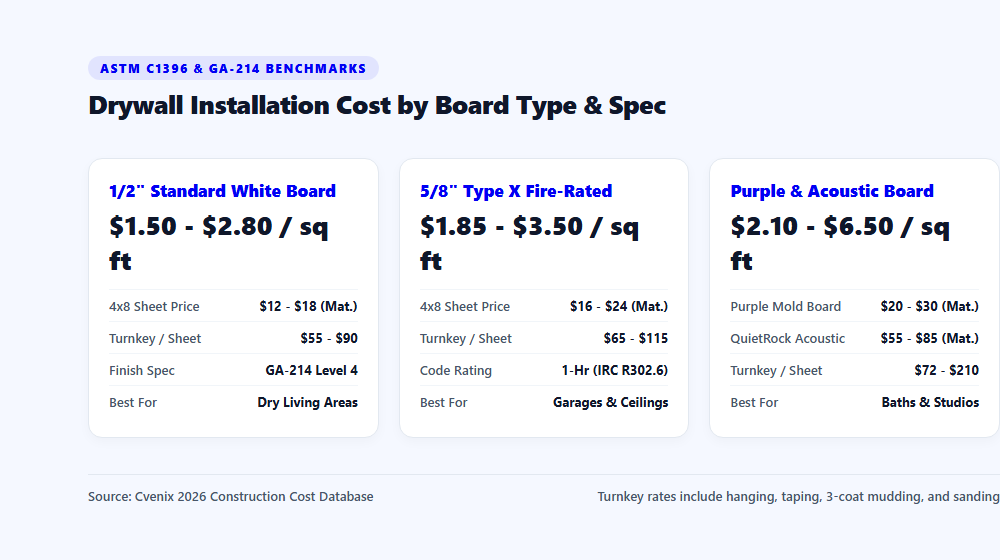
| Drywall Board Type | Standard Thickness | Material Cost (per 4×8 Sheet) | Installed Cost (per Sq. Ft.) | Installed Cost (per 4×8 Sheet) | Primary Residential Application |
|---|---|---|---|---|---|
| Standard White Gypsum Board | 1/2 inch | $12 – $18 | $1.50 – $2.80 | $55 – $90 | Dry interior walls and ceilings with 16″ o.c. framing |
| Lightweight High-Strength Board | 1/2 inch | $14 – $20 | $1.60 – $2.95 | $58 – $95 | Overhead ceilings and standard residential partitions |
| Flexible Bending Drywall | 1/4 inch or 3/8 inch | $13 – $19 | $1.80 – $3.40 | $62 – $110 | Curved archways, barrel ceilings, or Laminating over old plaster |
| Type X Fire-Rated Gypsum Board | 5/8 inch | $16 – $24 | $1.85 – $3.50 | $65 – $115 | Attached garages (IRC R302.6), furnace rooms, 24″ o.c. ceiling trusses |
| Type C Enhanced Fire-Rated Board | 1/2 inch or 5/8 inch | $22 – $32 | $2.20 – $3.85 | $75 – $125 | Multi-family party walls, townhome demising assemblies |
| Green Board (Moisture Resistant) | 1/2 inch | $18 – $26 | $1.90 – $3.40 | $68 – $110 | Powder rooms, laundry walls, utility sinks (non-shower zones) |
| Purple Board (Mold & Mildew Resistant) | 1/2 inch or 5/8 inch | $20 – $30 | $2.10 – $3.65 | $72 – $120 | Full bathrooms, damp basements, kitchens, coastal homes |
| Paperless Fiberglass-Mat Board | 1/2 inch or 5/8 inch | $24 – $36 | $2.40 – $4.10 | $80 – $135 | High-humidity subterranean basements, flood-prone lower levels |
| Cement Backer Board (Durock / Hardie) | 1/2 inch (3×5 ft) | $15 – $24 (per 3×5) | $3.00 – $5.50 | $60 – $95 (per 3×5) | Direct tile substrate inside tub surrounds and walk-in showers |
| Soundproof Damped Drywall (QuietRock) | 1/2 inch or 5/8 inch | $55 – $85 | $3.80 – $6.50 | $120 – $210 | Home theaters, music studios, nursery walls, shared bedroom walls |
Standard 1/2-Inch Gypsum Board vs. 5/8-Inch Type X Fire-Rated Board
Standard 1/2-inch regular gypsum board ($12 to $18 per 4×8 sheet for material, or $1.50 to $2.80 per square foot installed) accounts for roughly 75% of residential interior wall surfaces. Modern ultralight formulations weigh approximately 1.3 pounds per square foot (about 42 pounds for a 4×8 panel), allowing two-person hanging crews to install 50 to 70 sheets per day across standard 16-inch on-center wood or steel studs.
5/8-inch Type X fire-rated drywall ($16 to $24 per sheet for material, or $1.85 to $3.50 per square foot installed) incorporates non-combustible glass fibers inside its dense gypsum core. When exposed to a structure fire, the chemically combined water within the calcium sulfate dihydrate core slowly vaporizes in a process known as calcination, while the reinforcing fiberglass mesh holds the charred board in place on the framing to provide a certified 1-hour fire-resistance rating. Under International Residential Code (IRC) Section R302.6, 1/2-inch gypsum board is required on the garage side of walls separating an attached garage from habitable rooms, while 5/8-inch Type X board is strictly mandatory on garage ceilings located beneath habitable second-floor living spaces. Additionally, builders install 5/8-inch board on any residential ceiling framed at 24 inches on center to prevent gravity-induced sagging between roof trusses.
Moisture-Resistant (Green), Mold-Resistant (Purple), and Paperless Boards
In bathrooms, laundry rooms, and subterranean basements, standard kraft paper facing absorbs ambient vapor and becomes an organic food source for Aspergillus and Stachybotrys mold spores. Upgrading to specialized moisture-tolerant panels adds minimal material cost while protecting wall cavities from biological decay:
- Green Board ($18 to $26 per sheet material; $1.90 to $3.40/sq. ft. installed): Features a wax-treated gypsum core and water-resistant green paper facings designed for moderate-humidity zones such as half-baths, utility rooms, and kitchen backsplashes. Modern building codes prohibit green board inside direct wet zones like shower enclosures or tub surrounds if not covered by a dedicated waterproof membrane.
- Purple Board ($20 to $30 per sheet material; $2.10 to $3.65/sq. ft. installed): Combines a moisture-resistant core with antimicrobial paper treatment that scores a 10 out of 10 on ASTM D3273 mold-resistance testing. High-impact purple boards also resist scuffs and dents in high-traffic mudrooms and hallways.
- Paperless Fiberglass-Mat Drywall ($24 to $36 per sheet material; $2.40 to $4.10/sq. ft. installed): Eliminates organic paper facing entirely in favor of woven fiberglass mats embedded on both sides of the core. Because fiberglass is inorganic, these boards cannot support mold growth even in chronically damp basements. However, fiberglass-mat panels require a full skim coat or specialized primer to conceal the woven glass texture before final painting.
Soundproof Acoustic Drywall (QuietRock) vs. Resilient Channel Assemblies
Homeowners seeking to block airborne noise between home offices, nurseries, bedrooms, or multi-family units often compare constrained-layer damped drywall (such as QuietRock) against double-layer standard drywall hung on resilient channels. A standard interior wall framed with 2×4 studs and 1/2-inch regular drywall on both sides achieves a Sound Transmission Class (STC) rating of just STC 33 to 34, meaning loud speech is clearly audible through the partition.
Installing 5/8-inch QuietRock ES ($55 to $85 per sheet material; $3.80 to $6.50 per square foot installed) replaces a single layer of standard board with a laminated Viscoelastic polymer core that converts acoustic vibration into microscopic heat energy, boosting the wall to STC 49 to 53 without sacrificing floor space or requiring complex door-jamb extensions. Alternatively, hanging two layers of standard 5/8-inch Type X board decoupled with Green Glue damping compound and metal RC-1 resilient channels costs $3.20 to $5.10 per square foot installed (mostly in additional labor), achieving comparable acoustic isolation while adding 1.25 inches to wall thickness.
Drywall Cost by Gypsum Association GA-214 Finish Level (Level 0 to Level 5)
Over 60% of residential drywall disputes occur because the homeowner and contractor never specified the exact finish grade in the written contract. To eliminate subjective terms like “paint-ready” or “smooth coat,” the construction industry adheres to Gypsum Association Specification GA-214 (Recommended Levels of Finish for Gypsum Board). Each successive level adds distinct joint compound coats, drying intervals, and sanding labor.
| GA-214 Finish Level | Turnkey Cost (per Sq. Ft.) | Taping & Finishing Labor Only | Joint Compound & Tape Coats Required | Recommended Surface & Lighting Use Case |
|---|---|---|---|---|
| Level 0 (Hang Only) | $0.95 – $1.65 | $0.00 (No taping) | Boards screwed/glued to studs only; no tape or joint mud | Temporary construction partitions or pre-design staging |
| Level 1 (Fire-Taped) | $1.20 – $2.00 | $0.35 – $0.65/sq. ft. | Paper tape embedded in joint compound; fastener heads bare | Attic plenums, concealed crawlspaces, above drop ceilings |
| Level 2 (Utility / Tile Prep) | $1.40 – $2.35 | $0.55 – $0.95/sq. ft. | Tape embedded + 1 skim coat wiped over joints and screw heads | Unconditioned garages, storage sheds, substrate under wall tile |
| Level 3 (Heavy Texture Prep) | $1.65 – $2.75 | $0.75 – $1.25/sq. ft. | Tape embedded + 1 fill coat over joints + 2 coats on fasteners | Walls receiving medium/heavy spray texture or heavy vinyl wallpaper |
| Level 4 (Standard Smooth) | $1.85 – $3.50 | $0.95 – $1.75/sq. ft. | Tape embedded + 2 separate fill/feather coats on joints + 3 on screws | Standard residential living rooms/bedrooms with flat or eggshell paint |
| Level 5 (Full Skim Coat) | $2.80 – $5.00+ | $1.75 – $3.10/sq. ft. | Full Level 4 + thin skim coat of mud troweled across 100% of wall surface | Critical side lighting, floor-to-ceiling windows, satin or semi-gloss paint |
For most interior bedrooms, hallways, and living spaces finished with flat, matte, or low-sheen eggshell paint, Level 4 ($1.85 to $3.50 per square foot turnkey) serves as the residential gold standard. At Level 4, all flat seams receive paper or fiberglass tape set in bedding compound, followed by two progressively wider topping coats feathered out 12 to 14 inches on tapered edges and 18 to 24 inches on butt joints, with three coats over all screw dimples.
However, Level 4 still leaves two differing surface porosities exposed across the wall: smoothed joint compound over the seams and raw gypsum paper across the field of the board. Under harsh “critical lighting” conditions, such as recessed grazing LEDs, long hallways with end windows, or rooms painted in satin or semi-gloss enamels, this porosity difference creates visible “joint photographing” or flashing even after priming. Upgrading to a Level 5 finish ($2.80 to $5.00+ per square foot) solves this permanently by troweling or spraying a thin skim coat of joint compound across 100% of the board face, equalizing surface texture and absorption before you budget for your interior painting cost.
Drywall Labor vs. Material Cost Breakdown by Phase
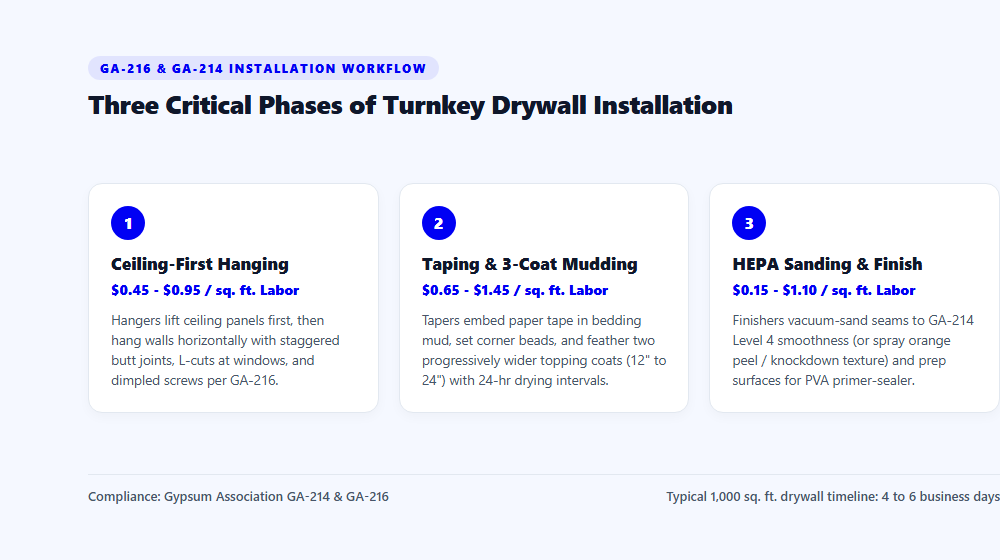
In a professional turnkey drywall contract, labor accounts for 65% to 75% of the total invoice ($1.05 to $2.65 per square foot), while raw materials represent just 25% to 35% ($0.45 to $0.85 per square foot). On medium-to-large residential jobs, general contractors frequently divide the scope between two specialized sub-crews: hangers (who measure, cut, lift, glue, and screw the panels to framing in 1 to 2 days) and tapers/finishers (who apply corner bead, tape, and three coats of joint compound over 3 to 5 days to allow proper evaporative curing between coats).
| Installation Phase or Add-On | Cost per Sq. Ft. (Surface) | Cost per 4×8 Sheet Equivalent | Share of Total Turnkey Job | Technical Scope & Crew Requirements |
|---|---|---|---|---|
| Drywall Boards & Fasteners (Materials) | $0.38 – $0.65 | $12 – $21 | 20% – 25% | Gypsum panels, coarse/fine phosphate screws, subfloor/stud adhesive |
| Tape, Mud & Corner Bead (Materials) | $0.08 – $0.20 | $3 – $7 | 5% – 8% | Paper/mesh tape, all-purpose & topping mud, vinyl/metal corner beads |
| Phase 1 Labor: Stocking & Hanging | $0.45 – $0.95 | $15 – $30 | 25% – 30% | Unloading, carrying sheets, cutting openings, gluing & screwing per GA-216 |
| Phase 2 Labor: Taping & 3-Coat Mudding | $0.65 – $1.45 | $22 – $46 | 35% – 42% | Embedding tape, installing corner bead, 2-3 feather coats, drying intervals |
| Phase 3 Labor: Vacuum Sanding & Prep | $0.15 – $0.35 | $5 – $12 | 8% – 10% | HEPA dustless power sanding, sponge detailing inside corners, floor cleanup |
| Optional: Wall/Ceiling Texture Spray | $0.35 – $1.10 | $11 – $35 | Add-on | Hopper spray application of orange peel, knockdown, or hand skip-trowel |
| Optional: Old Drywall/Plaster Demolition | $0.50 – $1.75 | $16 – $56 | Add-on | Tear-out, nail/screw pulling from studs, bagging, and roll-off dumpster haul |
| Optional: Vaulted / High Ceiling Fee (10ft+) | +$0.40 – $0.95 | +$13 – $30 | Add-on | Baker scaffolding setup, stilted finishing, two-person lift operation |
Why Finishing Costs More When Homeowners Hang Their Own Drywall
A frequent strategy among DIY homeowners is hanging the drywall sheets themselves over a weekend and hiring a professional taper solely for the mudding and sanding phase. While professional taping-only labor normally runs $0.80 to $1.60 per square foot ($25 to $50 per sheet) when applied over professionally hung board, experienced finishers routinely add a 25% to 50% remediation surcharge when bidding over DIY hanging work.
Under Gypsum Association GA-216 standards, professional hangers stagger vertical butt joints across adjacent courses, hold bottom wall panels 1/2 inch above the subfloor to prevent moisture wicking, cut window and door openings out of single sheets (“L-cuts”) to prevent stress cracks above header corners, and drive screws to a precise depth that dimples the face paper without fracturing the gypsum core. When an amateur hang job leaves 1/4-inch gaps at corners, aligned four-way intersections, or hundreds of torn screw holes, the finisher must spend hours pre-filling voids with fast-setting “hot mud” (chemically curing joint compound) and driving supplemental screws before the first strip of paper tape can even be applied.
Wall and Ceiling Texture Costs: Smooth vs. Orange Peel vs. Knockdown
Applying a decorative texture to walls or ceilings after a Level 3 joint finish is a widely used technique in residential construction throughout the South, Midwest, and Southwest. Because sprayed or troweled textures scatter reflected light across the surface, they effectively hide minor framing irregularities and eliminate the need for an expensive Level 4 or Level 5 smooth finish:
- Orange Peel Texture ($0.35 to $0.75 per sq. ft.): Applied with a pneumatic hopper gun using thinned joint compound, creating a subtle, dimpled splatter resembling citrus rind. It is durable, easy to wipe clean, and the most economical texture to spray across entire tract homes.
- Knockdown Texture ($0.50 to $0.95 per sq. ft.): Sprayed slightly heavier than orange peel and allowed to set for 10 to 15 minutes before a wide drywall knife is lightly drawn (“knocked down”) across the peaks, producing a rustic Mediterranean stucco relief.
- Skip-Trowel / Santa Fe Hand Texture ($0.85 to $1.50 per sq. ft.): Applied manually by skilled finishers using a curved broad knife to create layered artisanal swirls or flat plaster planes. While labor-intensive, hand textures add distinct architectural character and pair well with custom homes.
- Popcorn Ceiling Removal & Skim Coating ($1.50 to $3.50 per sq. ft.): Scraping legacy acoustic popcorn texture (after testing pre-1980 ceilings for chrysotile asbestos) and applying a fresh knockdown texture or Level 4 smooth skim coat is one of the highest-return cosmetic upgrades before repainting.
Ceiling Drywall, Vaulted Framing, and Structural Cost Drivers
While standard 8-foot perimeter walls allow a two-person crew to hang and tape from the floor and low aluminum benches, architectural features and framing irregularities can increase labor hours by 30% to 75%. When evaluating contractor estimates, pay close attention to these five structural cost multipliers:
- Overhead Ceiling Installation ($1.95 to $3.85 per sq. ft.): Hanging boards overhead against gravity requires mechanical drywall lifts or two-person T-brace staging, plus closer screw spacing (12 inches on center vs. 16 inches on walls per GA-216). When trusses sit 24 inches on center, upgrading from 1/2-inch lightweight board to 5/8-inch Type X or sag-resistant ceiling board adds both material cost and physical weight (70+ pounds per 4×8 sheet).
- Two-Story Foyers & Cathedral Ceilings (+$0.40 to $0.95 per sq. ft. surcharge): Any wall or ceiling plane exceeding 10 feet in height requires rolling baker scaffolding, full plank staging over stairwells, or high-extension stilts. Acute inside angles at vaulted ridge beams also require flexible metal-backed paper tape (such as Strait-Flex) rather than standard 90-degree corner folds.
- Curved Walls, Archways & Coffered Ceilings ($4.50 to $8.50 per sq. ft.): Tight radii require double-layer 1/4-inch flexible gypsum panels wetted and bent over curved templates, alongside flexible vinyl archway bullnose or chamfered corner beads that demand meticulous hand-tooling on every coat.
- Out-of-Plumb Historic Framing & Furring Strips ($0.60 to $1.50 per sq. ft.): In pre-1960 remodels where plaster and wood lath have been demolished, rough-sawn dimensional studs rarely sit in a flat plane. Hangers must plane proud studs and install cardboard drywall shims or 1×3 wood strapping across sunken framing so the new gypsum sheets do not bow or crack when screwed tight.
- Demolition, Lead/Asbestos Containment & Dumpster Hauling ($0.50 to $1.75 per sq. ft.): Tearing out water-damaged drywall costs $0.50 to $0.95 per square foot, whereas demolishing heavy 3-coat rock lath or wire-mesh plaster walls runs $1.25 to $2.50+ per square foot due to extreme debris weight (often requiring a dedicated 20-yard roll-off dumpster at $450 to $750).
Regional and State Drywall Installation Cost Comparison
Drywall installation pricing varies by up to 65% across United States metropolitan areas due to prevailing trade wages, union vs. open-shop residential markets, state workers’ compensation insurance rates for overhead work, and local architectural norms (such as textured Level 3 walls in Texas and Florida versus smooth Level 4 and Level 5 plaster-style walls in New England and the Mid-Atlantic).
| State / Metro Region | Cost per Sq. Ft. (Turnkey) | Cost per 4×8 Sheet Installed | 12×12 Room Benchmark (528 Sq. Ft.) | Regional Market & Code Drivers |
|---|---|---|---|---|
| California (Los Angeles, Bay Area) | $2.40 – $4.50 | $85 – $145 | $1,250 – $2,375 | Strict Title 24 energy sealing, seismic shear wall nailing, high labor rates |
| New York & New England (NY, MA, CT) | $2.30 – $4.25 | $80 – $135 | $1,210 – $2,240 | Strong preference for smooth Level 4/5 walls; older framing requires shimming |
| Texas (Dallas, Houston, Austin) | $1.45 – $2.65 | $50 – $85 | $765 – $1,400 | High crew availability; Level 3 orange peel or knockdown texture is standard |
| Florida (Miami, Orlando, Tampa) | $1.60 – $2.95 | $55 – $95 | $845 – $1,550 | High usage of Purple mold-resistant board due to subtropical coastal humidity |
| Illinois & Upper Midwest (IL, MN, WI) | $1.85 – $3.40 | $62 – $110 | $975 – $1,795 | Vapor retarder poly barriers behind exterior drywall; union-influenced metro rates |
| Ohio, Indiana & Southeast (OH, NC, GA) | $1.50 – $2.80 | $52 – $90 | $790 – $1,480 | Balanced open-shop subcontractor pricing; moderate material freight costs |
| Pacific Northwest & Mountain (WA, CO) | $2.10 – $3.85 | $72 – $125 | $1,110 – $2,030 | High custom home demand; airtight drywall approach (ADA) detailing common |
When replacing exterior wall drywall or finishing a new addition in northern climate zones, coordinating your drywall hang schedule with your attic insulation cost and wall cavity air-sealing upgrade yields substantial energy savings. Before the drywall crew hangs the ceiling and exterior perimeter sheets, municipal building inspectors must sign off on rough-in framing, electrical, plumbing, and insulation baffles.
Cost Estimation Methodology and Building Code Standards
The pricing benchmarks in this guide are compiled from national construction estimating databases, retail building supply price indexes for ASTM-certified gypsum panels, and real-world residential subcontractor bids across 50 U.S. metropolitan markets. All installation specifications and labor productivity rates align with four governing technical standards:
- Gypsum Association GA-214 (Recommended Levels of Finish for Gypsum Board): Establishes the universal 0-through-5 finish grading system used to calculate taping passes, compound volume (roughly 0.05 gallons per square foot at Level 4), and sanding hours.
- Gypsum Association GA-216 (Application and Finishing of Gypsum Panel Products): Dictates structural fastener spacing (typically 12 inches on center on ceilings and 16 inches on center on walls when single-nailing/screwing, or wider with panel adhesive), perpendicular board orientation, and framing tolerances.
- ASTM C1396 (Standard Specification for Gypsum Board): Governs physical core density, flexural strength, tapered edge geometry, water-absorption resistance, and Type X fire-endurance performance across residential wallboard products.
- International Residential Code (IRC) Section R302.6 (Dwelling-Garage Fire Separation): Mandates minimum 1/2-inch gypsum board on garage walls adjacent to living areas and minimum 5/8-inch Type X fire-rated gypsum board on garage ceilings beneath habitable rooms, along with self-closing fire-rated doors and fire-taped joints.
Frequently Asked Questions About Drywall Installation Costs
How much does drywall installation cost per square foot in 2026?
Professional drywall installation costs between $1.50 and $3.50 per square foot of actual wall and ceiling surface area for a standard Level 4 paint-ready finish. This turnkey rate includes $0.45 to $0.85 per square foot for materials (gypsum panels, screws, tape, corner bead, and joint compound) and $1.05 to $2.65 per square foot for hanging, taping, mudding, and sanding labor. Upgrading to a Level 5 full skim coat or acoustic QuietRock boards raises total costs to $3.50 to $6.50 per square foot.
How much do contractors charge per sheet to hang and finish drywall?
Most drywall subcontractors charge $60 to $120 per standard 4×8 sheet (32 square feet) for a complete hang, tape, and Level 4 finish, including materials. When broken down by trade phase, materials cost $15 to $25 per sheet, hanging labor runs $15 to $30 per sheet, and three-coat taping, mudding, and sanding labor runs $25 to $55 per sheet. Using larger 4×12 sheets (48 square feet) typically costs $85 to $145 per sheet installed.
How do I estimate how many sheets of drywall a room needs?
To find your required sheet count, calculate the surface area of each wall (length multiplied by ceiling height), add the ceiling area (length multiplied by width), and divide the total surface square footage by 32 for 4×8 sheets (or by 48 for 4×12 sheets). Always add 10% to 15% for cutting waste around windows, doors, and angled walls. For example, a 12×12 room with 8-foot ceilings has 384 square feet of wall area plus 144 square feet of ceiling area (528 square feet total), requiring 17 sheets of 4×8 board before waste, or 18 to 19 sheets including a 10% waste factor.
What is the difference between a Level 4 and Level 5 drywall finish?
Under Gypsum Association GA-214 standards, a Level 4 finish applies joint tape and three separate coats of compound solely over the panel seams, inside corners, and screw heads, leaving the factory paper exposed across the rest of the board. It is the standard specification for flat or eggshell paint in normal lighting. A Level 5 finish adds a thin skim coat of joint compound troweled or sprayed across 100% of the entire wall and ceiling surface, creating uniform porosity and eliminating visible seam flashing under harsh natural side lighting or glossy paints. Level 5 adds $0.85 to $1.50 per square foot to finishing costs.
Where does building code require 5/8-inch Type X fire-rated drywall?
Under International Residential Code (IRC) Section R302.6, 5/8-inch Type X fire-rated gypsum board is legally required on any garage ceiling located directly beneath a habitable second-floor bedroom, bonus room, or hallway, as well as on walls supporting that floor assembly. Many local building codes also require 5/8-inch Type X board inside mechanical utility rooms housing gas furnaces or boilers, along shared townhome party walls, and on any ceiling where roof trusses are spaced 24 inches on center to prevent board sag.
Does drywall installation include priming and painting?
No, standard drywall installation bids conclude after final sanding and dust cleanup (ready for primer). Professional priming and painting is a separate trade scope that typically costs an additional $1.50 to $3.50 per square foot of surface area. Freshly sanded drywall must always be sealed with a dedicated PVA (polyvinyl acetate) drywall primer-sealer before applying topcoat paint so that the porous joint compound and raw paper absorb paint evenly without leaving dull blotches.

