
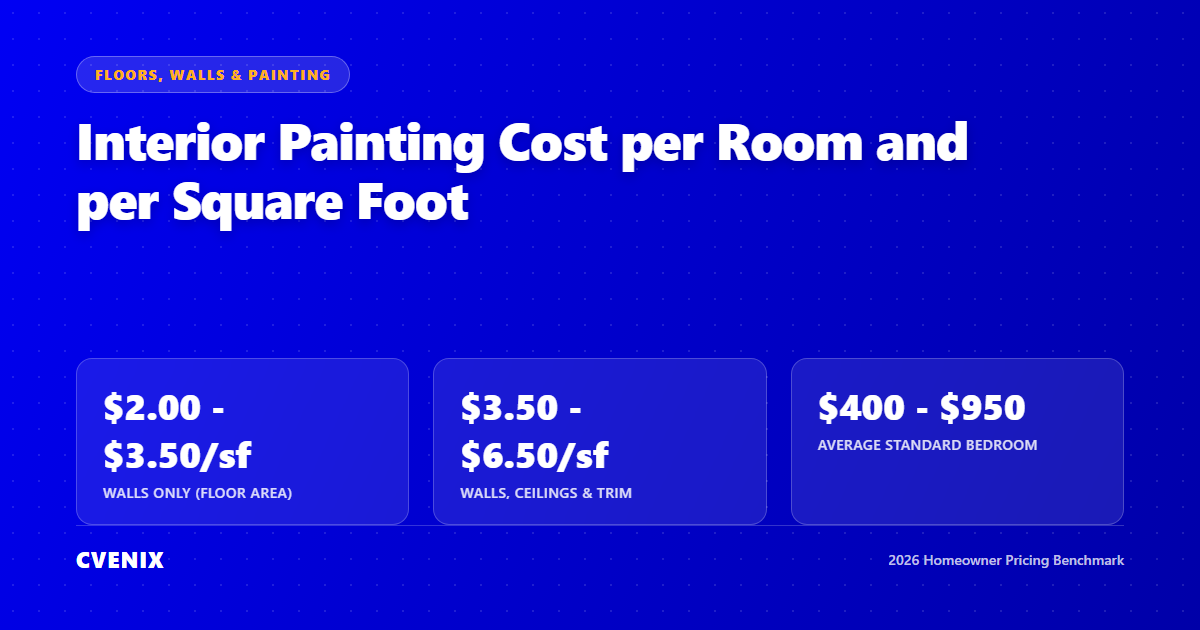
The national average interior painting cost ranges from $2,100 to $5,400 for a standard 1,800- to 2,200-square-foot home when painting walls only, and between $4,200 and $9,800 for a comprehensive full-interior repaint that includes walls, ceilings, baseboards, doors, and window casings. When priced by floor footprint, professional residential painters charge $2.00 to $3.50 per square foot for two coats on drywall walls, or $3.50 to $6.50 per square foot when ceilings and architectural millwork are added to the scope. For individual single-room projects, homeowners typically spend between $400 and $950 for a standard bedroom and up to $1,800 for a large living room with high ceilings.
Because professional labor represents 70% to 85% of a residential painting invoice, your final expenditure depends far more on surface preparation, trim complexity, and ceiling height than on the retail price per gallon of paint. Understanding how contractors distinguish between floor area and actual paintable wall area, how sheen levels impact durability, and when primers or drywall repairs are mandatory ensures you can evaluate itemized bids with confidence.
Interior Painting Cost by Room Type
When you hire a painting contractor for one or two rooms rather than an entire house, crews typically price the project on a per-room flat rate or a minimum daily labor charge rather than strict floor square footage. Small rooms with dense fixtures require intensive masking and brush cutting around obstacles, while expansive spaces with vaulted ceilings demand extension ladders and scaffolding setups.
| Room Type and Typical Dimensions | Walls Only (2 Coats) | Full Room (Walls, Ceiling, and Trim) | Paint Needed (Gallons) | Primary Cost Drivers |
|---|---|---|---|---|
| Bathroom or Powder Room (50 – 80 sq ft) | $250 – $425 | $375 – $650 | 1 gallon | Tight maneuvering around vanity and toilet, moisture-resistant satin or semi-gloss finish |
| Standard Bedroom or Office (120 – 160 sq ft) | $400 – $650 | $600 – $950 | 1.5 – 2 gallons | Window casing masking, closet interior shelving, standard 8-foot to 9-foot drywall walls |
| Primary Bedroom Suite (220 – 350 sq ft) | $600 – $950 | $900 – $1,400 | 2.5 – 3.5 gallons | Tray or vaulted ceiling transitions, multiple doorways, walk-in closet walls and trim |
| Kitchen (150 – 250 sq ft footprint) | $450 – $750 | $650 – $1,100 | 1 – 2 gallons | Degreasing cooking residue, extensive masking along upper cabinets, appliances, and tile backsplash |
| Living Room or Family Room (250 – 400 sq ft) | $700 – $1,150 | $1,050 – $1,800 | 3 – 4.5 gallons | Large wall spans, fireplace mantel cutting-in, heavy furniture moving and floor protection |
| Dining Room with Chair Rail (160 – 240 sq ft) | $500 – $850 | $850 – $1,550 | 2 – 3 gallons | Two-tone wall color breaks, shadowbox wainscoting, crown molding enamel work |
| Two-Story Foyer or Stairwell (100 – 220 sq ft) | $1,000 – $1,750 | $1,450 – $2,500 | 2.5 – 4 gallons | 16-foot to 20-foot vertical reach, stair ladder leveling, spindle and handrail masking |
Why Bathrooms and Kitchens Cost More per Paintable Square Foot
At first glance, a kitchen or bathroom appears inexpensive to paint because upper cabinetry, mirrors, shower enclosures, and backsplashes cover up to 50% of the vertical wall surface. However, the effective price per square foot of exposed drywall is significantly higher than in an open bedroom. Painters must spend hours washing aerosolized cooking oils with trisodium phosphate (TSP) substitutes, taping off countertop edges, removing switch plates around GFCI outlets, and cutting neat brush lines in narrow 6-inch soffit gaps above cabinets.
If you are coordinating fresh paint alongside broader room upgrades, sequencing the painters after plumbing and carpentry work prevents costly touch-ups. Homeowners budgeting for a complete overhaul can review our breakdown of kitchen remodel cost benchmarks and bathroom remodel cost line items to see how finish painting fits into a multi-trade renovation schedule.
Whole-House Interior Painting Cost per Square Foot
Commissioning a whole-house repaint delivers the lowest per-square-foot unit rate because contractors achieve substantial setup and workflow efficiencies. Instead of mobilizing drop cloths, cleaning brushes, and waiting for patches to dry in a single room, a three-person crew can stage continuous prep, priming, trim spraying, and wall rolling across multiple rooms simultaneously.
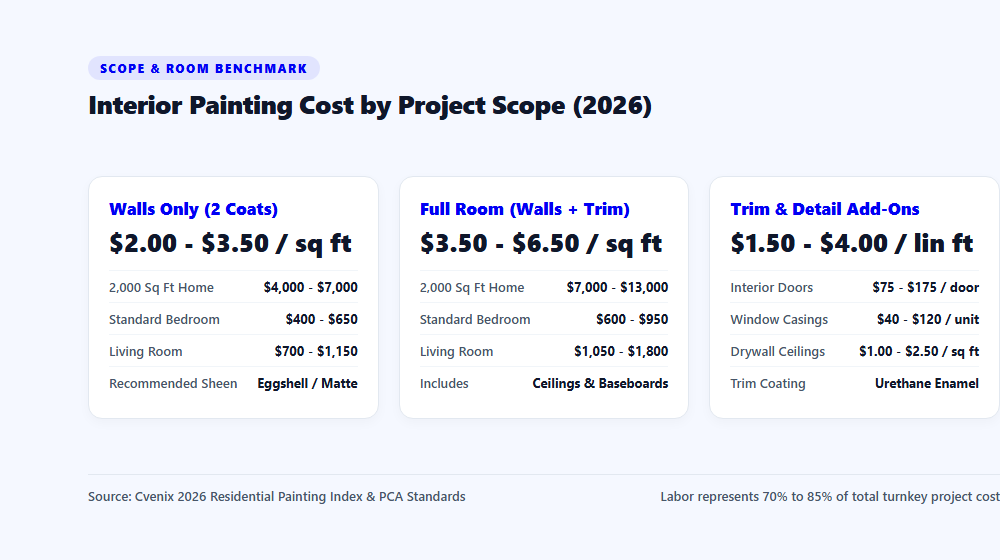
| Home Floor Area (Footprint) | Walls Only ($2.00 – $3.50/sq ft) | Walls, Ceilings, and Trim ($3.50 – $6.50/sq ft) | Estimated Paint Volume | Typical Crew Timeline |
|---|---|---|---|---|
| 1,000 sq ft (Condo or Starter Home) | $2,000 – $3,500 | $3,500 – $6,500 | 10 – 16 gallons | 2 – 3 business days |
| 1,500 sq ft (3-Bed Ranch or Townhome) | $3,000 – $5,250 | $5,250 – $9,750 | 15 – 24 gallons | 3 – 5 business days |
| 2,000 sq ft (Standard 2-Story Family Home) | $4,000 – $7,000 | $7,000 – $13,000 | 20 – 32 gallons | 4 – 6 business days |
| 2,500 sq ft (4-Bed Suburban Residence) | $5,000 – $8,750 | $8,750 – $16,250 | 25 – 40 gallons | 5 – 8 business days |
| 3,500 sq ft (Large Executive Home) | $7,000 – $12,250 | $12,250 – $22,750 | 35 – 55 gallons | 7 – 11 business days |
| 4,500+ sq ft (Custom Luxury Estate) | $9,500 – $16,500+ | $16,500 – $31,000+ | 50 – 75+ gallons | 10 – 15+ business days |
Floor Square Footage vs. Paintable Surface Area Explained
One of the most common points of confusion when comparing residential painting bids is the difference between livable floor square footage and paintable wall surface square footage. Real estate listings measure the horizontal floor footprint of your home, whereas professional estimating software measures the vertical drywall surface area that actually receives paint.
- The 2.8x to 3.5x Wall Surface Multiplier: In a standard house with 8-foot ceilings and typical interior partition walls, the total paintable wall area equals roughly 2.8 to 3.2 times the floor square footage. For example, a 2,000-square-foot home contains approximately 5,600 to 6,400 square feet of vertical wall surface, plus another 2,000 square feet of ceiling surface.
- Unit Rate Conversion: When a contractor charges $1.00 to $1.75 per square foot of actual wall surface, that translates directly to $2.80 to $5.25 per square foot of floor space once all partition walls and hallways are tallied. Always ask your estimator which measurement basis appears on the contract worksheet.
- Vacant vs. Occupied Home Pricing: Painting a vacant house before move-in reduces total labor costs by 15% to 25% ($600 to $2,200 on a 2,000-square-foot house). When rooms are unoccupied and carpets or floors are scheduled for replacement, crews do not have to move beds, center dressers, or carefully tape around furnishings. If you are also replacing flooring, review our guide on hardwood floor installation cost per square foot to coordinate painting before final floor sanding or plank installation.
Interior Painting Cost by Surface Component: Ceilings, Trim, Doors, and Windows
While rolling broad drywall expanses progresses rapidly at 150 to 250 square feet per hour, architectural trim, doors, and overhead ceilings require specialized brushes, fine-finish sprayer tips, and physically demanding overhead work. Most professional painting companies itemize these components separately so homeowners can tailor the project scope to fit their budget.
| Interior Surface Component | Unit Pricing Range | Typical Cost per 2,000 Sq Ft Home | Recommended Paint Formulation | Execution and Labor Notes |
|---|---|---|---|---|
| Interior Drywall Walls (2 Coats) | $1.25 – $2.50 / wall sq ft ($2.00 – $3.50 / floor sq ft) | $4,000 – $7,000 | 100% Acrylic Eggshell or Matte | Includes light pole-sanding, spot priming spackle patches, cutting-in edges, and rolling two uniform coats |
| Flat Smooth Drywall Ceilings | $1.00 – $2.00 / ceiling sq ft | $1,600 – $3,400 | Dead-Flat Ceiling Acrylic | Requires overhead neck strain, perimeter masking, and dead-flat sheen to hide drywall tape joints under grazing light |
| Textured or Acoustic Ceilings (Knockdown / Popcorn) | $1.50 – $2.75 / ceiling sq ft | $2,400 – $4,800 | High-Build Flat Spray Coating | Thick nap rollers (3/4-inch) or airless spraying required; unpainted acoustic popcorn absorbs 40% more paint |
| Baseboards, Shoe Molding, and Casing | $1.50 – $3.50 / linear ft | $900 – $2,200 | Waterborne Alkyd or Urethane Semi-Gloss | Requires de-glossing sand, caulk bead along drywall gap, floor tape masking, and two brush or spray enamel coats |
| Crown Molding and Coffered Beams | $2.25 – $4.50 / linear ft | $650 – $1,800 | Acrylic Urethane Satin or Semi-Gloss | Ladder repositioning every 5 feet, miter-joint filling, and precision cut lines against both wall and ceiling |
| Interior Doors and Frames (Both Sides) | $75 – $175 / door assembly | $900 – $2,100 (12 doors) | Self-Leveling Urethane Trim Enamel | Flat flush slabs run $75-$100; six-panel colonial or French doors with glass panes run $125-$175 per unit |
| Window Casings, Sills, and Sash Frames | $40 – $120 / window | $600 – $1,600 (14 windows) | Moisture-Resistant Semi-Gloss Enamel | Simple drywall-return windows with wood sills sit at the low end; traditional Colonial grids require fine sash brushwork |
| Wainscoting and Board-and-Batten Panels | $4.00 – $8.50 / surface sq ft | $500 – $1,500 per room | Scuff-Resistant Satin Enamel | Extensive caulking at stiles and rails, fine sanding between coats, and HVLP or airless fine-finish spraying |
| Closet Interiors (With Wire or Wood Shelving) | $85 – $225 / closet | $500 – $1,350 (6 closets) | Washable Eggshell or Satin | Removing or masking wire racks, cutting around closet rods, and working in tight, unventilated alcoves |
How Ceiling Height Multiplier Tiers Affect Your Estimate
Standard residential quotes assume 8-foot ceilings, which allow a painter standing on the floor or a 2-step work platform to cut in the ceiling line and roll the full vertical sheet in one fluid pass. Once ceilings exceed 9 feet, both material consumption and labor time rise on a stepped multiplier curve:
- 9-Foot to 10-Foot Ceilings (+15% to +25% Cost Multiplier): Adds 12.5% to 25% more wall surface area and requires 6-foot stepladders for perimeter cutting and heavy extension poles for rolling.
- 11-Foot to 14-Foot Vaulted Ceilings (+30% to +45% Cost Multiplier): Requires A-frame ladders, multi-position articulating ladders, and two-stage rolling to maintain a wet edge across tall drywall seams without lap marks.
- 16-Foot to 22-Foot Two-Story Great Rooms and Foyers (+50% to +85% Cost Multiplier): Demands 24-foot extension ladders with padded wall standoffs, aluminum walk-boards, or rolling Baker scaffolding. Two crew members are required for safe ladder spotting and high-elevation cutting.
Paint Quality Tiers, Sheen Selection, and Surface Prep Costs
Material expenses typically account for only 15% to 30% of a turnkey painting bill, which makes upgrading from builder-grade vinyl-acrylic paint to a top-tier 100% acrylic or urethane-modified coating one of the highest-return investments in home maintenance. Higher-solids architectural paints contain superior titanium dioxide (TiO2) pigment concentrations and cross-linking resins that resist burnishing, hide previous wall colors in fewer coats, and withstand repeated scrubbing.
| Paint Tier, Sheen, or Prep Category | Material or Service Cost | Coverage and Volume Rate | Durability and Washability Rating | Recommended Residential Application |
|---|---|---|---|---|
| Contractor / Builder Grade (Vinyl-Acrylic) | $28 – $45 / gallon | 300 – 350 sq ft / gallon | Low (Chalks or burnishes when scrubbed; 2 – 4 year life) | Ceilings, low-traffic rental turnovers, or temporary staging |
| Mid-Tier Architectural (100% Acrylic Latex) | $50 – $72 / gallon | 350 – 400 sq ft / gallon | High (Washable film, strong color retention; 6 – 8 year life) | Bedrooms, living rooms, dining rooms, and home offices |
| Premium Scuff-Resistant and Zero-VOC Acrylic | $75 – $115 / gallon | 375 – 425 sq ft / gallon | Superior (Stain-blocking, antimicrobial, zero odor; 8 – 12+ year life) | Hallways, kids rooms, kitchens, baths, and allergy-sensitive homes |
| Flat / Ultra-Matte Sheen (0% – 5% Gloss) | Standard base rate | 350 – 400 sq ft / gallon | Low to Moderate (Absorbs light to conceal drywall flaws) | Ceilings, formal dining rooms, and older plaster walls with surface waves |
| Eggshell / Matte Sheen (10% – 25% Gloss) | Standard base rate | 350 – 400 sq ft / gallon | High (Velvety low luster that wipes clean without shiny spots) | Primary wall finish for living spaces, bedrooms, and open-concept foyers |
| Satin / Pearl Sheen (25% – 35% Gloss) | +$0.10 – $0.25 / sq ft | 350 – 400 sq ft / gallon | Very High (Moisture-resistant film; highlights wall imperfections if unskimmed) | Hallways, mudrooms, laundry rooms, kids bedrooms, and guest baths |
| Semi-Gloss and Waterborne Alkyd Enamel (40% – 70% Gloss) | +$0.25 – $0.50 / sq ft | 325 – 375 sq ft / gallon | Maximum (Hard cured shell resistant to grease, steam, and impact) | Baseboards, crown molding, interior doors, window sills, and full bathrooms |
| High-Hide Tinted Primer or Stain Blocker | $0.50 – $1.10 / sq ft ($150 – $350 / room) | 300 – 350 sq ft / gallon | Essential substrate sealer (Acrylic, oil-based, or shellac) | Dramatic dark-to-light color changes, bare drywall, water stains, or smoke odors |
| Moderate Drywall Patching and Seam Repair | $150 – $500 / room ($75 – $120 / hr) | Spot compound & mesh tape | Restores PCA Level 3 or Level 4 smoothness | Anchor holes, settling cracks, corner-bead dents, and drywall tape blisters |
| Wallpaper Removal and Skim Coating | $2.00 – $4.50 / wall sq ft ($450 – $1,200 / room) | Enzyme wash + joint compound | Required before applying new acrylic topcoats | Stripping vinyl/paper facing, scraping paste residue, oil-base priming, and skimming |
| EPA RRP Lead-Safe Containment (Pre-1978 Homes) | $400 – $1,500+ per project | Certified Renovator protocol | Mandatory federal safety compliance | 6-mil poly containment, HEPA vacuum sanding, wet scraping, and sealed debris disposal |
How Paint Sheen Impacts Both Application Cost and Surface Prep
Selecting a higher-gloss sheen does not substantially increase the retail price of a gallon of paint, yet contractors often charge 10% to 20% more labor when applying satin or semi-gloss coatings across large walls. The reason comes down to specular light reflection and drywall telegraphing. Flat and matte finishes scatter incoming daylight, naturally masking minor drywall joint ridges, fastener indentations, and roller texture variations.
Conversely, satin and semi-gloss coatings reflect light like a subtle mirror, magnifying every sanded patch or uneven tape seam. Furthermore, higher-resin enamels set up faster at the edges, requiring painters to maintain a strict wet edge and perform extra pole-sanding between coats to prevent picture-framing (visible sheen differences between the brushed perimeter border and the rolled center field).
Labor vs. Materials Breakdown and Professional Preparation Standards
On a typical $5,000 residential interior painting contract, $3,750 to $4,250 (75% to 85%) pays for skilled labor, workers compensation insurance, general liability coverage, and crew supervision, while $750 to $1,250 (15% to 25%) covers primers, topcoat gallons, elastomeric caulk, spackling compound, masking tape, rosin paper, and roller covers. Professional painters bill between $55 and $100 per hour per technician, with a seasoned two-person crew completing roughly 1,000 to 1,400 square feet of wall area (prepped and two-coated) per eight-hour shift.
What Painting Contractors Association (PCA) Surface Prep Includes
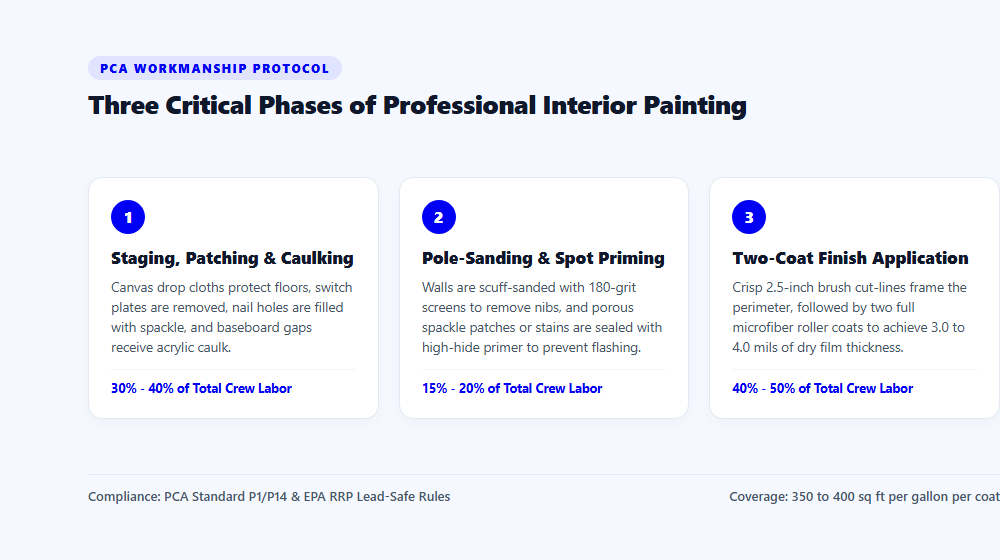
Reputable residential contractors adhere to workmanship standards published by the Painting Contractors Association (PCA), specifically Standard P1 (Touch-Up and Full Repaint definitions) and Standard P14 (Levels of Surface Preparation). In any professional bid, roughly 40% to 50% of total crew hours take place before the first finish coat is opened:
- Room Staging and Containment: Moving furniture to the center of the room, wrapping upholstery in 0.7-mil high-density painter plastic, laying heavyweight canvas drop cloths over hardwood or tile floors, and removing all electrical faceplates, HVAC register grilles, and drapery brackets.
- Drywall Patching and Acrylic Caulking: Filling picture-hanger holes and nail pops with lightweight spackle or setting-type joint compound (such as 20-minute or 45-minute hot mud), resetting loose drywall screws, and running continuous beads of siliconized acrylic latex caulk along gaps where baseboards and door casings meet the wall.
- Radial Pole-Sanding and Spot Priming: Scuff-sanding entire wall planes with 150- to 180-grit abrasive screens to knock down old paint nibs and open the surface profile, vacuuming dust, and spot-priming every spackle patch with a dedicated PVA or acrylic sealer. Skipping spot priming causes porous spackle to absorb resin out of the topcoat, leaving dull, chalky blotches known in the trade as flashing.
- Two-Coat Finish Application: Cutting in 2.5-inch perimeter brush bands at ceiling lines and corners, rolling the first full body coat with a 3/8-inch or 1/2-inch microfiber nap cover, allowing 2 to 4 hours of recoat cure time, lightly de-nibbing between coats, and applying the second finish coat to achieve a uniform 3.0 to 4.0 mils of dry film thickness (DFT).
Lead Paint Rules for Pre-1978 Homes (EPA RRP Compliance)
If your home was built before 1978, federal law under the U.S. Environmental Protection Agency (EPA) Renovation, Repair, and Painting (RRP) Rule requires any contractor disturbing more than 6 square feet of painted surface per interior room (or replacing windows) to hold active Lead-Safe Certified Firm credentials. Because dry sanding or scraping vintage oil-based trim paint releases hazardous lead dust, certified crews must seal HVAC vents, tape 6-mil polyethylene sheeting extending 6 feet from the work zone, connect power sanders to HEPA-filtered dust extractors, and perform wet-wipe clearance verification. Expect EPA RRP compliance protocols to add $400 to $1,500+ to an interior repaint depending on the condition of existing trim and plaster.
Interior Painting Cost by Region and State
While retail paint prices remain relatively consistent across national suppliers like Sherwin-Williams, Benjamin Moore, and PPG, prevailing contractor hourly wages, state licensing rules, and local air-quality regulations create a 35% to 65% price spread between major coastal metros and southern or midwestern markets. Furthermore, states following strict South Coast Air Quality Management District (SCAQMD) or California Air Resources Board (CARB) rules restrict high-VOC solvent primers and alkyd enamels, requiring specialized waterborne urethane formulations.
| Region and Representative States | Walls-Only Rate (per Floor Sq Ft) | Full Interior Rate (per Floor Sq Ft) | 2,000 Sq Ft Whole-House Average | Regional Market and Regulatory Factors |
|---|---|---|---|---|
| Northeast (NY, MA, NJ, CT, PA) | $2.60 – $4.25 | $4.50 – $7.75 | $5,200 – $14,500 | High union-influenced wage benchmarks, older pre-1978 plaster walls requiring skim coating and EPA RRP lead prep |
| West Coast (CA, WA, OR) | $2.75 – $4.50 | $4.75 – $8.25 | $5,500 – $15,500 | Strict CARB/SCAQMD low-VOC coating mandates, high contractor workers comp rates, textured knockdown walls |
| Mountain West (CO, UT, AZ, NV) | $2.10 – $3.50 | $3.60 – $6.25 | $4,200 – $11,800 | Dry climate accelerates latex open-time drying (requires extender additives); heavy orange-peel drywall textures |
| Midwest (IL, OH, MI, MN, MO) | $1.90 – $3.25 | $3.35 – $5.75 | $3,800 – $11,000 | Competitive seasonal winter indoor discounts (10% – 20% off between November and March when exterior work halts) |
| Southeast (FL, GA, NC, TN, VA) | $1.85 – $3.15 | $3.20 – $5.50 | $3,700 – $10,500 | Lower labor overhead; high indoor humidity requires mildewcide-fortified bath coatings and AC dehumidification |
| South Central (TX, OK, LA) | $1.75 – $3.00 | $3.10 – $5.25 | $3,500 – $10,000 | Large suburban floor plans with tall 10-foot to 12-foot ceilings and textured tape-and-bed drywall finishes |
How to Evaluate Painting Bids and Reduce Project Costs
When gathering three competitive bids for an interior repaint, quotes often vary by 40% or more even when looking at the exact same rooms. Rarely is that gap explained by contractor profit margins alone; instead, the lowest bid usually omits a second finish coat, excludes closet interiors, or substitutes a cheap contractor vinyl-acrylic flat paint for washable 100% acrylic eggshell.
- Verify Exact Product Lines and Coat Counts in Writing: Require every proposal to name the exact manufacturer product line (for example, Sherwin-Williams Emerald or Duration vs. ProMar 400, or Benjamin Moore Regal Select vs. Ultra Spec) and specify two full finish coats on all walls. A “one coat with touch-up” bid will show roller holidays under angled window light.
- Book During the Winter Off-Season (November through February): In northern, midwestern, and mid-Atlantic states, residential painting companies lose exterior work once nighttime temperatures drop below 40 degrees Fahrenheit. Booking your interior project during winter months frequently unlocks 10% to 20% seasonal labor discounts as contractors work to keep their best full-time painters on payroll.
- Handle Pre-Arrival Room Clearing Yourself: Taking down curtains, clearing bookshelves, removing wall art, and moving small furniture into the garage before the crew arrives saves 3 to 6 hours of billable painter time. However, avoid doing your own drywall patching unless you are experienced with feathering joint compound, as painters often charge extra to sand down rough DIY spackle humps.
- Standardize Your Color Palette: Every additional wall color requires separate five-gallon bucket pricing breaks, clean roller sleeves, brush washouts, and hard tape cut-lines at corner transitions. Limiting a whole-house repaint to one primary field neutral, one ceiling white, one trim enamel white, and one or two accent room colors keeps both material waste and cutting-in hours down.
Pricing Methodology and Industry Standards
The residential painting cost benchmarks in this guide are compiled from national contractor production rates, architectural coating technical data sheets (TDS), and regulatory compliance frameworks across the United States:
- Painting Contractors Association (PCA) Industry Standards: Surface preparation tiers, dry film thickness (DFT) verification, and acceptable visual inspection distances (viewing walls at a 90-degree angle from 5 feet under normal lighting) follow PCA Standard P1 and Standard P14 guidelines.
- U.S. Environmental Protection Agency (EPA) RRP Rule (40 CFR Part 745): Pre-1978 lead-safe containment, HEPA vacuum attachment rules, and certified renovator labor surcharges reflect mandatory federal lead hazard regulations.
- Manufacturer Coverage & VOC Specifications: Gallon spread rates (350 to 400 square feet per gallon at 4.0 mils wet / 1.5 mils dry per coat) and VOC classifications (Zero-VOC under 5 g/L per EPA Method 24) are cross-referenced against architectural data sheets from Sherwin-Williams, Benjamin Moore, and PPG Architectural Coatings.
Frequently Asked Questions About Interior Painting Cost
How much does it cost to paint the interior of a 2,000-square-foot house?
Painting the interior of a 2,000-square-foot house costs between $4,000 and $7,000 if you are only painting the drywall walls with two coats of standard acrylic paint. If your scope includes ceilings, baseboards, interior doors, window casings, and closets, the total cost ranges from $7,000 to $13,000 depending on ceiling heights, wall repairs, and regional labor rates.
Is it cheaper to buy my own paint or let the painting contractor supply it?
In nearly all cases, it is cheaper and safer to let your painting contractor purchase the paint. Established painting companies receive commercial contractor trade discounts of 25% to 45% off retail list prices at Sherwin-Williams, Benjamin Moore, and PPG stores. Even after a modest handling markup, contractor-supplied pricing usually matches or beats homeowner retail prices, and the contractor assumes full warranty responsibility if the coating peels or fails to cover.
How much more does it cost to paint dark walls a light color?
Transitioning from a deep navy, burgundy, charcoal, or forest green wall to a soft white or light gray adds $0.50 to $1.10 per square foot ($150 to $350 per average room). Rather than applying three or four coats of expensive finish paint, professional painters apply one coat of high-hide acrylic primer tinted toward the new color followed by two coats of top-tier finish paint.
Why do painting quotes double when adding baseboards, doors, and ceilings?
While open drywall walls can be rolled rapidly with an 18-inch roller frame, baseboards, doors, and ceilings require slow, meticulous detail work. Trim and six-panel doors must be hand-sanded, caulked at every gap, masked with painter tape, and coated with slower-leveling semi-gloss or urethane enamel. Together, ceilings, doors, and trim often require as many labor hours as the walls themselves.
How long does interior paint last before rooms need to be repainted?
When applied over properly prepped and primed drywall using two coats of 100% acrylic latex paint, interior walls last 7 to 10 years in low-traffic bedrooms, dining rooms, and living rooms. High-traffic hallways, mudrooms, children bedrooms, kitchens, and bathrooms typically require fresh paint every 4 to 6 years due to frequent scrubbing, hand oils, and moisture exposure.
Should I paint my house before or after installing new flooring?
If you are installing carpet, luxury vinyl plank (LVP), or prefinished hardwood, professional contractors strongly recommend completing all ceiling, wall, and baseboard painting first, or installing baseboards after the floor goes down and doing a quick final trim touch-up. Painting before new flooring is laid eliminates the need for intensive floor masking and prevents accidental paint splatters on brand-new surfaces.

