
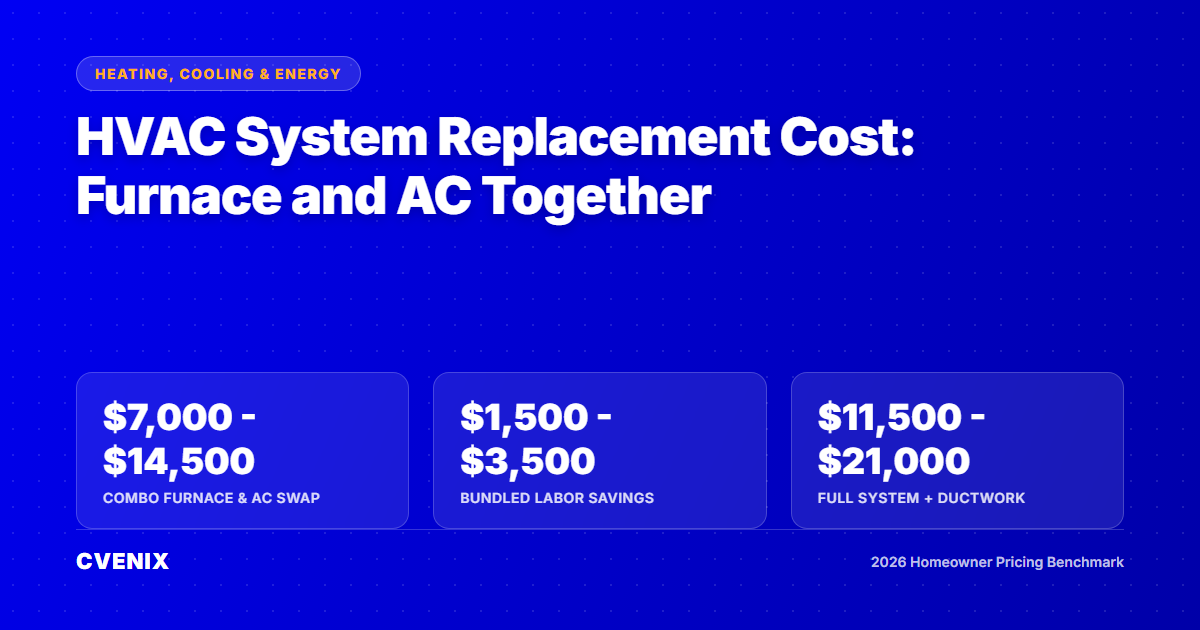
The national average hvac replacement cost ranges from $7,000 to $14,500 when replacing a gas furnace and central air conditioner together using existing ductwork, with most homeowners paying approximately $10,200 for a matched 3-ton, mid-efficiency split system. If your project requires full trunk-and-branch ductwork replacement, upgrading from an 80% atmospheric flue to 96% PVC direct-vent piping, or stepping up to variable-speed inverter equipment, total turnkey expenses typically span from $11,500 to $21,000.
Replacing both heating and cooling units during a single service appointment saves between $1,500 and $3,500 compared to staggering the installations years apart. Bundling the installation eliminates duplicate sheet-metal plenum fabrication, combines refrigerant recovery and electrical commissioning into one crew mobilization, and ensures your indoor furnace blower motor is mathematically matched to the outdoor condenser and cased evaporator coil.
| Project Scope and Configuration | Equipment Cost | Labor and Materials | Total Installed Cost | Best Residential Application |
|---|---|---|---|---|
| Combo Gas Furnace and Central AC (Existing Ducts) | $3,800 – $7,500 | $3,200 – $7,000 | $7,000 – $14,500 | Standard split-system swap in homes with intact, properly sized ductwork |
| Combo Furnace, Central AC, and New Ductwork | $4,200 – $8,000 | $7,300 – $13,000 | $11,500 – $21,000 | Older homes with leaky fiberglass flex ducts, asbestos wrap, or undersized returns |
| Dual-Fuel Heat Pump and Gas Furnace Hybrid | $5,200 – $9,800 | $4,300 – $8,200 | $9,500 – $18,000 | Cold and mixed climates optimizing electric heat above 35°F and gas backup below freezing |
| Packaged Rooftop or Ground Slab Combo Unit | $3,600 – $6,800 | $2,900 – $6,200 | $6,500 – $13,000 | Southwest and Southeast homes without basements or attic air-handler clearance |
| High-Efficiency Variable-Speed Communicating System | $7,500 – $12,500 | $5,000 – $8,500 | $12,500 – $21,000+ | Multi-story homes requiring strict humidity control, zoning dampers, and maximum energy savings |
Replacing Furnace and AC Together vs. Separately: Why Bundling Saves $1,500 to $3,500
When either a furnace heat exchanger cracks in January or an air conditioner compressor grounds out in July, homeowners face an immediate financial dilemma: replace only the failed appliance or invest in a complete system overhaul. While a standalone furnace replacement cost averages $3,800 to $7,200 and an isolated central AC replacement cost runs $4,500 to $8,500, purchasing them on separate timelines totals $9,500 to $16,500+ once overlapping labor is billed twice.
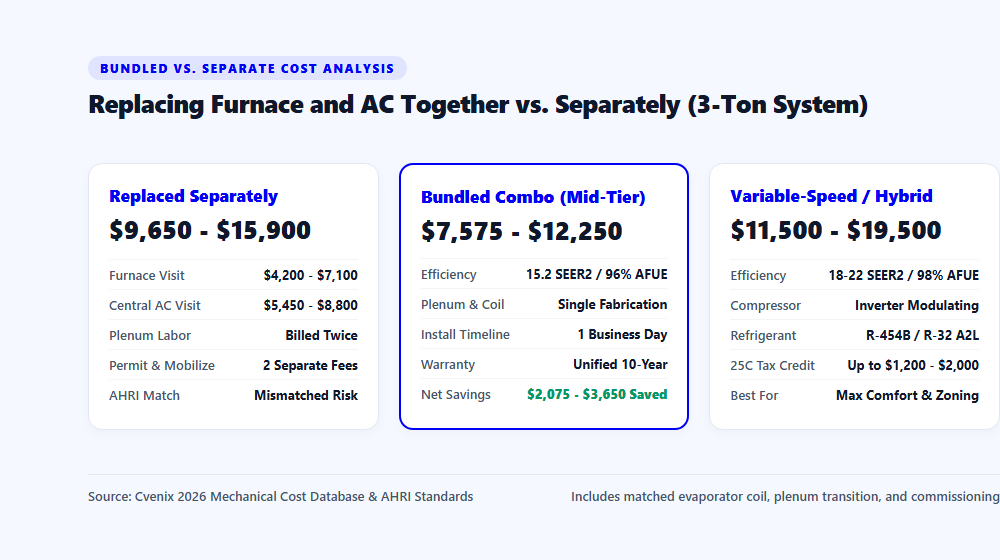
In a standard residential split system, the gas furnace and central air conditioner are not independent appliances. They share the indoor air handler cabinet, the variable-speed or multi-speed ECM blower motor, the sheet-metal supply plenum, the return air drop, and the low-voltage control wiring. Because the cased evaporator coil sits directly on top of (or beside) the furnace inside the sealed plenum, replacing one component without the other requires dismantling and rebuilding the exact same mechanical junction twice.
| Cost Component (3-Ton / 80,000 BTU System) | Replaced Separately (Two Visits) | Replaced Together (Bundled Visit) | Net Homeowner Savings |
|---|---|---|---|
| Gas Furnace Unit (96% AFUE Two-Stage) | $2,400 – $3,800 | $2,150 – $3,400 (Package Discount) | $250 – $400 |
| Central AC Condenser and Matched Evaporator Coil | $2,900 – $4,600 | $2,600 – $4,100 (Package Discount) | $300 – $500 |
| Sheet-Metal Plenum Transition and Uncasing Labor | $1,200 – $2,200 (Billed Twice) | $650 – $1,100 (Done Once) | $550 – $1,100 |
| Crew Mobilization, Crane/Delivery, and Vacuum Decay Test | $2,800 – $4,600 (Two 1-Day Jobs) | $2,000 – $3,300 (One 1-Day Job) | $800 – $1,300 |
| Municipal Mechanical and Electrical Permits | $350 – $700 (Two Filing Fees) | $175 – $350 (Single Combined Permit) | $175 – $350 |
| Total Cumulative Investment | $9,650 – $15,900 | $7,575 – $12,250 | $2,075 – $3,650 Saved |
Three Technical Reasons to Replace Both Units Simultaneously
- AHRI Matched Coil and Blower Efficiency: The Air-Conditioning, Heating, and Refrigeration Institute (AHRI) certifies SEER2 and EER2 efficiency ratings based on a tested pairing of a specific outdoor condenser, indoor evaporator coil, and furnace blower motor. Pairing a new 16 SEER2 condenser with a 14-year-old furnace that uses an outdated permanent split capacitor (PSC) blower motor reduces actual cooling efficiency to 12.5 or 13 SEER2 and disqualifies the installation from utility rebates and federal tax credits.
- Eliminating Double Evaporator Coil Labor: If you replace your furnace today but keep an older R-410A air conditioner, the technician must carefully unbolt or cut around the existing pressurized evaporator coil, build a temporary sheet-metal adapter box to bridge cabinet width differences, and reseal the plenum. When the old AC fails two years later, the new A2L condenser will require a brand-new R-454B or R-32 evaporator coil, forcing you to pay a second time to tear out the plenum transition you just funded.
- Unified 10-Year Parts and Labor Warranty Alignment: Major manufacturers including Trane, Carrier, Lennox, Rheem, and Daikin grant full 10-year registered parts warranties when a matched system is commissioned on the same date. Mixing old and new cabinets leaves you with fragmented warranty expiration dates and frequent contractor disputes over whether an airflow restriction in the old furnace caused a premature compressor failure in the new condenser.
The 10-Year Age Rule: When Separate Replacement Still Makes Sense
Replacing both units together is not mandatory if one appliance is relatively new. Industry engineers use the 10-year threshold to guide homeowners: if your working furnace or air conditioner is under 8 to 10 years old, utilizes an electronically commutated motor (ECM) blower, and has an intact heat exchanger or compressor under warranty, replacing only the failed unit is financially justified. Conversely, if both units are 12 to 15+ years old, or if an older R-22 or early R-410A condenser faces a major repair like an AC compressor replacement cost of $1,800 to $3,200, full combo replacement is the lower total-cost decision over a 5-year horizon.
HVAC Replacement Cost by Home Size, Cooling Tonnage, and Heating BTU
Equipment capacity is the primary hardware cost driver in any residential HVAC overhaul. Air conditioners and heat pumps are measured in tons of refrigeration (where 1 ton equals 12,000 BTUs of heat removal per hour), while gas furnaces are rated by hourly British Thermal Unit (BTU) heat input and output. Every half-ton increase in cooling capacity and 20,000 BTU increase in heating capacity adds approximately $650 to $1,400 to the combined equipment and installation price.
| Home Square Footage | Cooling Capacity (Tons) | Furnace Output (BTU/hr) | Required Airflow (CFM) | Turnkey Combo Cost (Installed) |
|---|---|---|---|---|
| 800 – 1,200 sq. ft. | 1.5 Tons (18,000 BTU) | 40,000 – 45,000 BTU | 600 CFM | $6,500 – $9,800 |
| 1,200 – 1,600 sq. ft. | 2.0 Tons (24,000 BTU) | 45,000 – 60,000 BTU | 800 CFM | $7,200 – $10,800 |
| 1,600 – 2,000 sq. ft. | 2.5 Tons (30,000 BTU) | 60,000 – 70,000 BTU | 1,000 CFM | $7,800 – $11,900 |
| 2,000 – 2,400 sq. ft. | 3.0 Tons (36,000 BTU) | 70,000 – 80,000 BTU | 1,200 CFM | $8,500 – $13,500 |
| 2,400 – 2,800 sq. ft. | 3.5 Tons (42,000 BTU) | 80,000 – 90,000 BTU | 1,400 CFM | $9,200 – $14,800 |
| 2,800 – 3,300 sq. ft. | 4.0 Tons (48,000 BTU) | 90,000 – 100,000 BTU | 1,600 CFM | $10,200 – $16,500 |
| 3,300 – 4,200+ sq. ft. | 5.0 Tons (60,000 BTU) | 100,000 – 120,000 BTU | 2,000 CFM | $11,800 – $19,500 |
Never allow an estimator to size your new HVAC system solely by multiplying square footage or copying the nameplate of a 20-year-old furnace. If you have upgraded to low-E double-pane windows, air-sealed your rim joists, or added blown-in attic cellulose insulation since the previous system was installed, your home thermal envelope has tightened significantly. Reputable contractors perform an ACCA Manual J block load calculation that accounts for window solar heat gain coefficients, wall R-values, ceiling height, air infiltration rates, and local 99% winter / 1% summer design temperatures.
Installing an oversized 4-ton air conditioner and 100,000 BTU furnace in a home that only requires 3 tons and 70,000 BTUs causes severe operational defects. An oversized air conditioner blasts the thermostat sensor with cold air and satisfies the temperature setting in 5 to 7 minutes, shutting off before the evaporator coil can condense latent moisture out of the house. This rapid short-cycling leaves indoor relative humidity above 60%, creates clammy rooms, stresses the compressor start capacitor, and drives up electric bills.
HVAC Replacement Cost by Efficiency Tier: SEER2, AFUE, and A2L Refrigerant Standards
Beyond physical tonnage, the sophistication of the compressor, gas valve, and blower motor dictates both your upfront invoice and your 15-year utility operating expenses. Modern split systems are categorized into three primary engineering tiers defined by their Seasonal Energy Efficiency Ratio 2 (SEER2) for cooling and Annual Fuel Utilization Efficiency (AFUE) for gas heating.
| Efficiency Tier and Stage Design | Cooling Rating (SEER2) | Furnace Rating (AFUE) | Compressor and Blower Type | Turnkey Installed Cost |
|---|---|---|---|---|
| Baseline Entry Tier (Single-Stage) | 13.4 – 14.3 SEER2 | 80% AFUE | 100% Fixed-Output Compressor + Multi-Speed ECM Blower | $7,000 – $10,500 |
| High-Heat Cold Climate Baseline | 13.4 – 14.3 SEER2 | 92% – 95% AFUE | Single-Stage Condenser + Condensing Secondary Heat Exchanger | $8,200 – $12,000 |
| Mid-Range Comfort Tier (Two-Stage) | 15.2 – 16.5 SEER2 | 96% AFUE | Two-Stage (65% / 100%) Scroll Compressor + Variable-Speed Blower | $9,800 – $14,800 |
| Premium Modulating Inverter Tier | 18.0 – 23.0+ SEER2 | 97% – 98.5% AFUE | Variable-Capacity Inverter (25%-100% in 1% Steps) + Modulating Gas Valve | $13,500 – $21,000+ |
Understanding 80% vs. 96%+ AFUE Condensing Furnaces
An 80% AFUE furnace converts 80 cents of every natural gas or propane dollar into usable indoor warmth, exhausting the remaining 20% as hot combustion gas (over 300°F) up a galvanized metal B-vent chimney flue. Because it operates with a single tubular heat exchanger and does not produce acidic liquid condensate during heating mode, an 80% unit is less expensive to purchase and avoids freezing drain-line concerns when installed in unconditioned attics or crawlspaces across warmer southern states.
A 96% to 98% AFUE condensing furnace adds a sealed stainless-steel secondary heat exchanger that captures latent heat from the exhaust vapor until the gas cools below its dew point (around 110°F to 125°F) and condenses into water. Because the exhaust is cool and slightly acidic, it cannot draft naturally up a metal brick chimney; instead, the installer must run dedicated 2-inch or 3-inch Schedule 40 PVC intake and exhaust pipes through an exterior sidewall or roof, plus route a condensate drain line with an acid neutralizer capsule to a floor drain or condensate pump. In northern states where winter gas bills exceed $200 per month, upgrading from 80% to 96% AFUE typically pays back its $1,200 to $1,800 installation premium within 4 to 6 winters.
How the 2025/2026 EPA A2L Refrigerant Mandate (R-454B and R-32) Affects Pricing
Under the American Innovation and Manufacturing (AIM) Act, the U.S. Environmental Protection Agency mandated a strict phasedown of high-global-warming-potential hydrofluorocarbon refrigerants. Legacy R-410A refrigerant (which carries a Global Warming Potential of 2,088) has been replaced across 2025 and 2026 residential manufacturing lines by lower-GWP A2L refrigerants: specifically R-454B (Opteon XL41, GWP 466) adopted by Carrier, Bryant, Trane, American Standard, Lennox, and Rheem, and R-32 (GWP 675) adopted by Daikin, Goodman, and Amana.
Because R-454B and R-32 are classified by ASHRAE Standard 34 as Class A2L (lower toxicity, mild flammability), UL 60335-2-40 safety standards require new indoor evaporator coils and furnaces to incorporate factory-installed refrigerant leak detection sensors and a dissipation relay board. If the sensor detects a refrigerant leak inside the coil cabinet, it automatically blocks furnace ignition and energizes the indoor blower motor to dilute the refrigerant concentration safely through the ductwork. These integrated safety controls, alongside new left-hand-thread service valves and updated technician manifold tooling, have added roughly $600 to $1,400 (8% to 12%) to baseline equipment costs compared to pre-2025 R-410A systems.
HVAC Replacement Cost With vs. Without Ductwork Modifications
Reusing structurally sound, properly sized sheet-metal ductwork keeps your project inside the standard $7,000 to $14,500 change-out window. However, field studies from the U.S. Department of Energy and Lawrence Berkeley National Laboratory show that the average residential duct system loses 20% to 30% of conditioned air through unsealed take-off collars, disconnected crawlspace flex runs, and undersized return air drops. Even more critically, modern variable-speed ECM furnace blowers are sensitive to external static pressure (measured in inches of water column, or in. w.c.).
- Targeted Return Air Drop and Filter Rack Upgrade ($550 to $1,400): Older furnaces often breathe through a cramped 8×20-inch metal return drop and a restrictive 1-inch filter slot, pushing total external static pressure above 0.80 in. w.c. (well above the 0.50 in. w.c. design maximum). Installing a wider 12×25-inch radiused return drop with a 4-inch or 5-inch deep media filter cabinet (such as an AprilAire or Honeywell F100) cuts static pressure in half, quiets airflow noise, and prevents premature ECM blower module burnout.
- Aeroseal or Mastic Duct Sealing and Insulation Repair ($1,200 to $2,800): If your supply trunks are properly sized per ACCA Manual D but leak air into an unconditioned attic or vented crawlspace, sealing all boots and seams with UL-181 fiberglass mesh and water-based mastic (or pressurized aerosol polymer sealing) restores 250 to 400 CFM of lost airflow without tearing out walls.
- Full Trunk-and-Branch Ductwork Replacement ($4,000 to $8,500): Required when existing R-4 or R-6 flex ducts have delaminated inner plastic liners, rodent damage, crushed kinks, or obsolete 4-inch round branches originally designed for 1960s gravity furnaces without air conditioning. In hot attics, upgrading to R-8 insulated ductwork with sealed galvanized main trunks lowers summer cooling loads by up to 25%.
Line-Item Breakdown: Labor, Evaporator Coil, Line Set, Venting, and Permits
When reviewing itemized contractor bids, wholesale equipment hardware typically accounts for 45% to 55% of the bottom-line price. The remaining 45% to 55% covers skilled EPA Section 608-certified mechanical labor, custom sheet-metal fabrication, brazing materials, electrical code upgrades, and municipal inspection fees.
| Installation Line Item | Typical Cost Range | Technical Specification and Code Requirement |
|---|---|---|
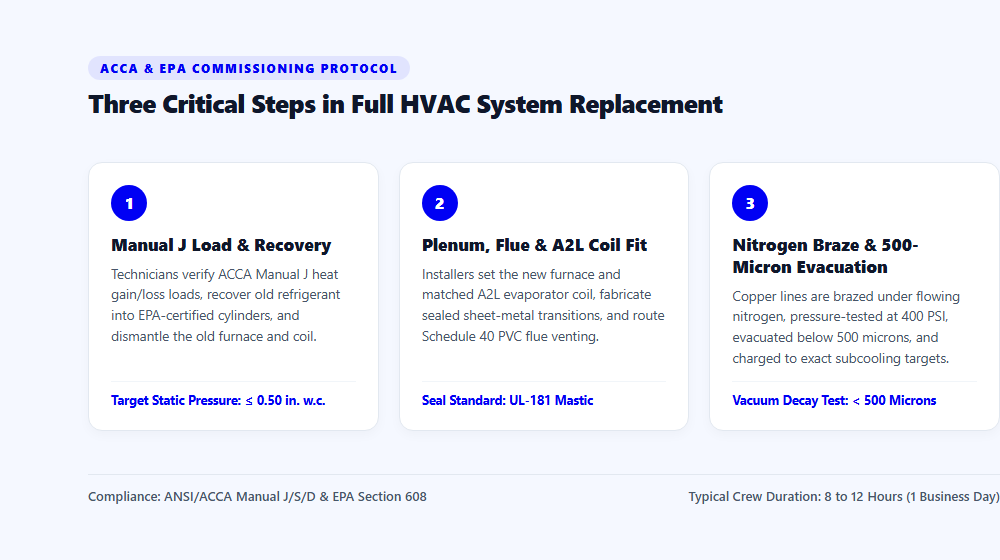
| Skilled Mechanical Installation Labor (2-Person Crew) | $2,200 – $4,800 | 8 to 14 hours of licensed HVAC sheet-metal, brazing, nitrogen purging, and 500-micron evacuation labor |
| Cased Indoor Evaporator Coil and TXV Valve | $950 – $2,100 | All-aluminum A-coil or N-coil with factory thermostatic expansion valve matched to outdoor condenser |
| Copper Refrigerant Line Set (Flush vs. New Run) | $350 – $1,500 | Rx11 solvent flush and pressure test ($350-$550) or running new insulated ACR copper lines ($850-$1,500) |
| Flue Venting Modification (B-Vent vs. Schedule 40 PVC) | $400 – $1,450 | Dual 2-inch or 3-inch PVC intake/exhaust piping with concentric wall/roof termination kit for 96% AFUE units |
| Supply and Return Sheet-Metal Plenum Fabrication | $450 – $1,100 | Custom brake-formed galvanized transitions, canvas vibration isolators, and UL-181 mastic sealing |
| Electrical Disconnect Box, Whip, and Circuit Upgrade | $300 – $950 | Outdoor NEMA 3R fused/non-fused pullout disconnect, liquid-tight whip, and dedicated 15A-40A breaker |
| Condensate Drain Pan, Float Switch, and Pump | $250 – $650 | Auxiliary overflow drain pan with Safe-T-Switch shutoff, 3/4-inch PVC trap, and condensate pump if below grade |
| Composite Condenser Pad or Wall Brackets | $150 – $450 | Level 3-inch UV-stabilized composite equipment pad, hurricane tie-down anchors, or snow-elevation risers |
| Smart or Communicating Thermostat Integration | $250 – $850 | 8-wire thermostat cable pull (for 2-stage/variable control) plus Ecobee, Honeywell T10, or OEM communicating stat |
| Municipal Mechanical, Gas, and Electrical Permits | $150 – $550 | City/county permit filing, Manual J load sheet submission, gas pressure test, and final inspector sign-off |
Why Nitrogen Brazing and a 500-Micron Vacuum Test Are Non-Negotiable
The longevity of any new air conditioner or heat pump installation cost depends far more on commissioning discipline on installation day than on the brand sticker on the cabinet. When a technician brazes copper refrigerant joints at 1,350°F without flowing dry nitrogen at 2 to 3 PSI through the interior of the tubing, oxygen reacts with the heated copper to form black cupric oxide scale inside the pipe. Once the system starts, synthetic polyolester (POE) oil scrubs those microscopic oxide flakes off the pipe walls and washes them directly into the tiny orifice of the thermostatic expansion valve (TXV) and compressor bearings.
Before signing a contract, verify in writing that your installer flows nitrogen while brazing, pressure-tests the sealed copper circuit with dry nitrogen to 350-450 PSI for at least 20 minutes, and pulls a deep vacuum down below 500 microns using a digital micron gauge (performing a 10-minute standing decay test to confirm moisture and non-condensables are completely eliminated) before releasing the factory refrigerant charge.
Regional and State HVAC Replacement Costs by DOE Climate Zone
Where you live in the United States dictates both the legal minimum equipment efficiency a distributor is allowed to sell you and the dominant heating-to-cooling balance of your system. The U.S. Department of Energy enforces three distinct regional regulatory zones (North, Southeast, and Southwest), each with tailored SEER2, EER2, and furnace installation norms.
| DOE Region and Representative States | Legal Minimum SEER2 | Dominant System Specification | Average Turnkey Combo Cost | Regional Installation Drivers |
|---|---|---|---|---|
| DOE North Region (MN, WI, MI, IL, OH, PA, NY, MA, CO, WA) | 13.4 SEER2 (14 SEER) | 96%+ AFUE Two-Stage Gas Furnace + 2.5 to 3.5 Ton 14.3-16 SEER2 AC | $8,200 – $14,800 | Basement installations, PVC sidewall venting, high BTU heating demands (80k-100k BTU), snow clearance brackets |
| DOE Southeast Region (FL, GA, NC, SC, TN, AL, LA, TX, VA, MD) | 14.3 SEER2 (15 SEER) | 80% AFUE Furnace or Dual-Fuel Heat Pump + 3.0 to 5.0 Ton 15.2+ SEER2 AC | $7,500 – $13,900 | High latent humidity loads, extreme attic temperatures (requiring auxiliary drain pans and float switches), hurricane tie-downs |
| DOE Southwest Region (CA, AZ, NV, NM) | 14.3 SEER2 + 11.7/12.2 EER2 | Ultra-Low NOx Furnace or Packaged Rooftop Unit + 3.5 to 5.0 Ton High-EER2 AC | $8,800 – $16,500 | Strict peak-heat EER2 rules, California South Coast Ultra-Low NOx (14 ng/J) furnace mandates, rooftop crane rigging |
Homeowners in California (particularly within the South Coast and San Joaquin Valley Air Pollution Control Districts) face unique regulatory surcharges. California mandates Ultra-Low NOx gas furnaces that limit nitrogen oxide emissions to 14 nanograms per Joule, which adds $700 to $1,300 to the wholesale cost of the furnace cabinet compared to standard 40 ng/J furnaces sold in other states, plus Title 24 HERS rater third-party duct leakage testing ($250 to $450) before the municipal building inspector can close the permit.
How Equipment Location Impacts Labor Cost: Basement, Attic, Crawlspace, and Closet Installs
Two identical 3-ton furnace and air conditioner packages in the same neighborhood can differ by $1,200 to $2,600 on the final invoice based purely on where the indoor air handler is mounted. Physical access, safety rigging, condensate drainage protection, and combustion air clearances dictate how many hours the installation crew spends on site.
- Unfinished Full Basement ($0 Baseline Labor Adder): Vertical upflow or counterflow furnaces sitting on concrete basement floors provide 360-degree technician access, exposed ceiling floor joists for running PVC flue pipes and copper refrigerant lines, and a gravity floor drain within a few feet of the cabinet. A two-person crew can typically complete a basement change-out in 7 to 9 hours.
- Interior Hallway or Garage Utility Closet (+$400 to +$1,100): Older townhomes and slab-on-grade ranch houses often house vertical furnaces inside tight 24-inch or 30-inch hallway alcoves. Because modern high-efficiency cabinets and cased A2L coils have wider footprints or require front service clearance, technicians frequently have to remove door frames, rebuild the return air platform box, or install louvered combustion-air grilles.
- Horizontal Attic Installation (+$750 to +$1,900): Hoisting a 150-pound horizontal furnace and 75-pound cased evaporator coil up a narrow pull-down attic ladder requires block-and-tackle rigging and plywood catwalk staging. Furthermore, building codes mandate an auxiliary galvanized or polymer secondary drain pan suspended beneath the entire horizontal furnace and coil assembly, wired to an inline float switch (Safe-T-Switch) that cuts 24-volt power before water can overflow onto bedroom drywall ceilings.
- Sub-Floor Vented or Encapsulated Crawlspace (+$800 to +$2,200): Working inside a 24-to-36-inch crawlspace slows sheet-metal plenum assembly and brazing significantly. Horizontal crawlspace units must be suspended from floor joists using threaded steel rods and vibration-isolating neoprene hangers or set on elevated concrete blocks above seasonal flood levels, and require an electric condensate pump ($200 to $450) to lift water out to grade.
HVAC Brand Comparison: Equipment Pricing and Warranty Tiers
Seven major parent corporations manufacture over 85% of all residential gas furnaces and central air conditioners sold in North America. While sister brands rolled off the same assembly line often share identical scroll compressors, tubular heat exchangers, and ECM blower motors, flagship nameplates carry higher wholesale pricing due to proprietary communicating thermostats, thicker sound-insulated steel cabinets, and extended unit-replacement warranties.
| Manufacturer Tier and Brand | 3-Ton Combo Installed Cost | A2L Refrigerant Used | Standard Registered Warranty | Engineering Highlights and Trade-Offs |
|---|---|---|---|---|
| Value Tier: Goodman, Coleman, Payne, RunTru | $6,800 – $10,800 | R-32 (Goodman) / R-454B (Others) | 10-Yr Parts / 10-Yr Heat Exchanger | Widely stocked non-proprietary service parts; slightly louder outdoor condenser fan dBA ratings |
| Mid-Market Tier: Rheem, Ruud, Amana, York, Heil | $7,800 – $12,900 | R-454B (Rheem/Ruud) / R-32 (Amana) | 10-Yr Parts / Limited Lifetime Heat Exchanger | Strong balance of quiet composite base pans, spark ignition reliability, and diagnostic service ports |
| Premium Tier: Carrier, Bryant, Trane, American Standard, Lennox, Daikin | $9,500 – $18,500+ | R-454B (Carrier/Trane/Lennox) / R-32 (Daikin) | 10-to-12-Yr Parts / Lifetime Heat Exchanger | Industry-leading variable-speed inverter modulation (Greenspeed, TruComfort, Dave Lennox Signature) and ultra-quiet 54-58 dBA operation |
How to Cut Your Net Replacement Cost: Federal Tax Credits, Rebates, and Quote Comparison
Strategic timing and incentive stacking can trim $1,200 to $4,000 off your out-of-pocket HVAC investment. Because heating and cooling contractors experience sharp seasonal demand spikes during the first heat wave of June and the first hard freeze of November, scheduling a proactive replacement during the shoulder months (March through early May, or September through October) unlocks manufacturer dealer rebates and reduced contractor markups.
- Federal Section 25C Energy Efficient Home Improvement Tax Credit: Under Internal Revenue Code Section 25C, homeowners who install qualifying Consortium for Energy Efficiency (CEE) highest-tier equipment can claim a 30% federal tax credit: up to $600 for a qualifying central air conditioner (typically 16+ SEER2 and 12.0+ EER2 with an AHRI certificate), up to $600 for a natural gas furnace rated at 97%+ AFUE, or up to $2,000 when opting for a qualifying cold-climate heat pump or dual-fuel hybrid system.
- Local Electric and Natural Gas Utility Rebates ($300 to $1,800): Most investor-owned electric and gas utilities offer direct bill credits or check rebates when you upgrade to a variable-speed ECM furnace blower, a 96%+ AFUE condensing furnace, or a high-SEER2 air conditioner. Always verify that your contractor provides the official AHRI Reference Number on your final invoice, as utility rebate administrators require that 7-to-9-digit certificate number to verify matched efficiency.
- Comparing Independent Local Mechanical Contractors vs. Private-Equity Roll-Ups: Across major metropolitan markets, large private-equity-backed residential service chains spend heavily on television and billboard advertising and compensate commissioned sales representatives on a tiered price-book margin. Obtaining at least two bids from established, locally owned master mechanical contractors routinely saves $3,000 to $6,000 on identical AHRI-matched equipment while delivering higher-seniority installation crews.
Pricing Methodology and Authoritative Industry Standards
The cost benchmarks in this guide are compiled from 2025 and 2026 wholesale HVAC distributor equipment sheets, licensed mechanical contractor labor rates across 50 U.S. metropolitan statistical areas, and verified homeowner invoices. All technical specifications and sizing matrices align with the following federal and mechanical engineering authorities:
- U.S. Department of Energy (DOE) Regional Standards (10 CFR Part 430): Establishes M1 testing procedures and minimum SEER2, EER2, HSPF2, and AFUE efficiency mandates across the North, Southeast, and Southwest compliance zones.
- Air Conditioning Contractors of America (ACCA) Technical Manuals: Specifically ANSI/ACCA 2 Manual J (Residential Load Calculation), ANSI/ACCA 3 Manual S (Residential Equipment Selection), and ANSI/ACCA 1 Manual D (Residential Duct Systems).
- Air-Conditioning, Heating, and Refrigeration Institute (AHRI): Directory of Certified Product Performance used to validate matched condenser, evaporator coil, and furnace blower efficiency ratings.
- U.S. EPA Technology Transitions Program (40 CFR Part 84) & ENERGY STAR V6.1: Governs the residential transition to low-GWP A2L refrigerants (R-454B and R-32) and defines federal high-efficiency verification criteria.
Frequently Asked Questions About Replacing a Furnace and AC Together
Is it cheaper to replace a furnace and air conditioner at the same time?
Yes. Replacing your gas furnace and central air conditioner together saves between $1,500 and $3,500 compared to replacing them in separate years. Bundling both units into a single visit eliminates duplicate sheet-metal plenum transitions, consolidates crew mobilization and crane fees, requires only one municipal mechanical permit, and typically unlocks $400 to $1,000 in manufacturer matched-system package rebates.
How long does it take to replace a full HVAC system (furnace and AC)?
A straightforward like-for-like replacement of a gas furnace, evaporator coil, and outdoor AC condenser takes a two-person licensed installation crew 1 full business day (typically 8 to 10 hours). If your project involves converting from an 80% B-vent furnace to a 96% PVC direct-vent furnace, relocating equipment from a closet to an attic, or replacing trunk-and-branch ductwork, the installation takes 2 to 3 business days.
Can I pair a new R-454B or R-32 air conditioner with my old R-410A furnace?
You can reuse an existing furnace cabinet only if you install a brand-new A2L-rated indoor evaporator coil equipped with a factory refrigerant leak detection sensor and dissipation control board that wires into the furnace blower relay. However, if your existing furnace is more than 10 years old or uses an older PSC blower motor, pairing it with a new A2L condenser will degrade SEER2 efficiency, void matched AHRI ratings, and leave you paying twice for plenum labor when the old furnace fails.
Should I replace my gas furnace and AC with a dual-fuel heat pump system?
A dual-fuel hybrid system pairs an electric heat pump outside with a gas furnace inside and costs $9,500 to $18,000 installed. It is an ideal upgrade in mixed and cold climates where electricity rates are moderate: the heat pump provides high-efficiency heating down to 35°F or 40°F, and the gas furnace automatically takes over during sub-freezing polar vortex events when heat pump capacity drops.
How long do a new furnace and central air conditioner last?
With annual preventive maintenance, regular filter changes every 60 to 90 days, and proper duct static pressure below 0.50 in. w.c., a central air conditioner lasts 15 to 20 years and a gas furnace lasts 18 to 25 years. In coastal environments within 5 miles of saltwater, outdoor AC condensers typically last 10 to 14 years unless protected with factory epoxy-coated fins and stainless-steel fasteners.
Do I need to replace the copper refrigerant line set when replacing my HVAC system?
If the existing copper line set is the correct diameter required by the new condenser manufacturer, is free of kinks or solder restrictions, and passes a nitrogen pressure test, technicians can flush it clean with Rx11 solvent for $350 to $550. However, if the old system suffered a compressor burnout that contaminated the oil with acid, or if the line diameter does not match the new A2L system specification, running a new insulated copper line set ($850 to $1,500) is required.

