
Heat pump installation cost averages about $15,400 before incentives in 2026, according to EnergySage marketplace quotes (data updated March 19, 2026). That is an average of quotes, not a range most homeowners pay, and it leans toward a high-cost market because most of EnergySage’s quotes come from Massachusetts. Ducted systems averaged $14,529, while whole-home ductless systems averaged $25,957. Your price depends on size, ducts, electrical work and where you live, so treat every figure here as an estimate and not a quote.
Heat Pump Installation Cost at a Glance
The table below lines up the sources we could verify. Where a source gives only an average, the low and high cells say so instead of guessing. Sources use different scopes (a whole-home quote, one installer’s price book, a single unit), so the rows are not meant to be averaged together.
| System type | Low | Average | High | Source and scope |
|---|---|---|---|---|
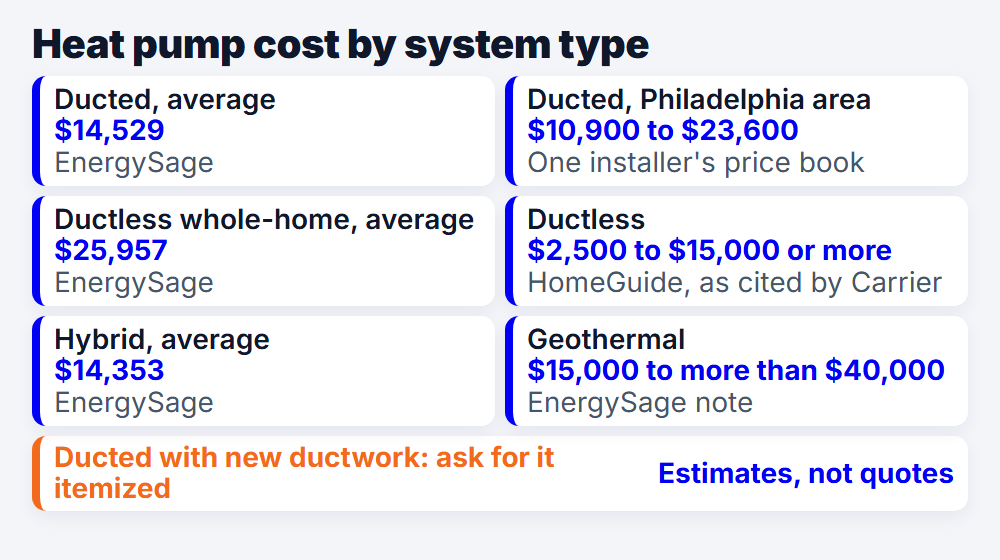
| Ducted air-source (existing ducts assumed) | n/a, source gives average only | $14,529 before incentives; $13,527 after | n/a | EnergySage marketplace quotes, updated March 19, 2026 |
| Ducted air-source, Philadelphia area | $10,900 | n/a | $23,600 | One Philadelphia-area installer’s price book, page revised October 22, 2026 (1.5 to 5 tons, standard to premium tiers); regional, high-cost area |
| Ducted with new ductwork | Ask for ductwork itemized | n/a | n/a | No sourced figure found; see the ductwork section below |
| Ductless, whole home | n/a, source gives average only | $25,957 before incentives; $23,157 after | n/a | EnergySage marketplace quotes (whole-home scope) |
| Ductless, single unit to multi-zone | $2,500 | n/a | $15,000 or more | HomeGuide, as cited by Carrier’s ductless guide |
| Hybrid (heat pump plus furnace) | n/a | $14,353 before incentives; $10,695 after | n/a | EnergySage marketplace quotes |
| Geothermal (ground-source) | $15,000 | n/a | More than $40,000 | EnergySage’s note; it does not sell geothermal, so these are not marketplace quotes |
EnergySage lists the ductless average as $25,957 in its table and $25,393 in its takeaways. We use the table value and do not average the two. It also reports typical whole-home setups from roughly $8,000 in New Mexico to $33,000 in New York, which shows how widely whole-home prices vary by market.
Heat Pump Installation Cost by System Type
Ducted air-source heat pump on existing ductwork
Installing a ducted heat pump on existing ductwork averaged $14,529 before incentives in EnergySage quotes, or $13,527 after. The Philadelphia-area installer’s price book runs from $10,900 to $23,600 depending on size and efficiency. Reusing ducts avoids a big line item, but the blower and air handler must be compatible, and homeowners report that this is not always the case.
Ducted heat pump with new ductwork
We could not find a sourced national price for a heat pump plus new ducts, and we won’t invent one. New ductwork is its own line item with its own labor, so ask for it priced separately. If a contractor says your ducts need replacing, ask why, and ask what a duct leakage test showed.
Ductless mini-split cost (single-zone and multi-zone)
HomeGuide puts ductless installs at $2,500 to $15,000 or more, as cited by Carrier’s ductless guide. EnergySage’s whole-home ductless quotes averaged $25,957, which reflects several indoor heads and a larger scope. One outdoor unit can serve up to five indoor units, per Carrier, and each extra head adds equipment, line set and labor. Homeowners in one Denver thread report about $6,500 for a single head and $18,000 to $25,000 for four heads. Those are individual reports, not averages. We found no sourced labor-only price for installing a mini split; see the labor row of the breakdown table for wage context.
Geothermal heat pumps
Geothermal costs far more because of the buried loop field. EnergySage notes installs range from $15,000 to more than $40,000, and says that is its note, not marketplace quotes.
Heat Pump Installation Cost by Size
Size is priced in tons. One ton is 12,000 BTU per hour, according to Carrier. The table below shows one Philadelphia-area installer’s price book (page revised October 22, 2026), which is a high-cost region, so read it as a regional example and not a national price. EnergySage’s ducted average works out to $3,790 per ton before incentives, so a 3-ton system averages about $11,400 on that math (derived: 3 tons x $3,790 = $11,370).
| Size | BTU per hour (derived) | Standard efficiency | High efficiency | Premium efficiency |
|---|---|---|---|---|
| 1.5 to 2 tons | 18,000 to 24,000 | $10,900 – $15,200 | $12,500 – $16,100 | $13,400 – $17,000 |
| 2.5 to 3 tons | 30,000 to 36,000 | $11,700 – $16,400 | $13,200 – $18,400 | $14,000 – $19,300 |
| 3.5 to 4 tons | 42,000 to 48,000 | $12,500 – $19,900 | $15,500 – $22,200 | $18,000 – $23,000 |
| 5 tons | 60,000 | $14,100 – $20,500 | $16,600 – $23,500 | $18,300 – $23,600 |
Why sizing needs a Manual J
A square footage rule of thumb is not enough, and we don’t publish one because we found no source that backs it. A load calculation (the industry method is Manual J from the Air Conditioning Contractors of America, ACCA) looks at insulation, windows, climate and air leakage. Oversizing is a common complaint: homeowners report that an oversized unit can trigger an unnecessary panel upgrade, and some report quotes that show no Manual J.
Heat Pump Cost Breakdown: Equipment, Labor, Permits and Extras
Installed prices run well above the equipment alone because you are paying for labor, electrical work, permits, refrigerant handling and a warranty on the installation. Homeowners often report an installed price two to three times the equipment price on its own. The table below lists each line you should see on a quote. We give a number only where we found a named source.
| Line item | What it covers | Typical cost | Source |
|---|---|---|---|
| Equipment | Outdoor unit plus indoor coil, air handler or heads | Ask for model numbers and price itemized | No sourced figure |
| Labor | Removal, setting, refrigerant lines, vacuum and commissioning | Context: HVAC mechanics and installers earn a national median of $29.33 an hour | Bureau of Labor Statistics (BLS) Occupational Employment and Wage Statistics (OEWS), May 2025 (a wage, not a per-job total) |
| Ductwork changes | Sealing, repair, resizing or new runs | Ask for it itemized | No sourced figure |
| Electrical | Dedicated circuit, disconnect, wiring | Context: electricians earn a national median of $30.38 an hour | BLS OEWS, May 2025 (a wage, not a per-job total) |
| Panel upgrade | Service upgrade, for example 100 amp to 200 amp | Ask for it itemized | No sourced figure |
| Line set, pad, condensate | Copper lines, outdoor pad or brackets, drain | Ask for it itemized | No sourced figure |
| Permit and inspection | Local fees and inspector visit | Varies by city; ask for it as its own line | Local fee schedule |
| Home Energy Rating System (HERS) verification (California) | Third-party diagnostic testing on some HVAC changeouts | Ask for it itemized | California Energy Commission |
| Old equipment removal | Furnace or AC removal and disposal | Ask for it itemized | No sourced figure |
| Add-ons | Thermostat, dehumidifier, heat kit | Smart thermostat $700 – $1,200; dehumidifier $3,000 – $4,300; heat kit up to $1,000 or more | One Philadelphia-area installer’s price book (regional) |
On California work, the California Energy Commission says HERS testing may be mandatory depending on the work, and properly permitted work will trigger it. Cheaper bids that skip permits and HERS testing are a red flag, not a bargain.
A real quote, line by line
One Bay Area homeowner reports a $13,000 quote (equipment, labor, permits, HERS), with a $2,500 heat-pump conversion rebate available (about $10,500 net). The job was a 3-ton heat pump replacing a gas furnace in a 1,400 sq ft home with existing ducts. By the homeowner’s math, equipment was about $5,500 and labor about $6,000, with the rest in permits and testing. This is one person’s report, not an average, but it shows how the gap between equipment and total price forms.
What Drives Heat Pump Installation Cost Up
The table below lists the factors that move a quote. The effects are qualitative because no source we found puts a dollar value on most of them.
| Factor | Why it raises the price | Effect |
|---|---|---|
| System type | Ductless multi-zone needs several heads and line sets; geothermal needs a loop field | Large |
| Size | More tons means a bigger outdoor unit and air handler | Large |
| Efficiency tier | Variable-speed and higher seasonal energy efficiency ratio (SEER2) and heating seasonal performance factor (HSPF2) models cost more | Moderate |
| Cold-climate model | Built to keep capacity at low temperatures | Moderate |
| Ductwork condition | Leaky, undersized or damaged ducts need repair or replacement | Moderate to large |
| Zones and line-set length | More heads and longer refrigerant runs add parts and labor | Moderate |
| Electrical capacity | An older panel may need a new circuit or a service upgrade | Moderate to large |
| Home access | A tight attic, crawl space or second-floor air handler slows the job | Moderate |
| Equipment matching | The air handler or furnace must be compatible with the new outdoor unit | Moderate |
| Refrigerant transition | New systems follow U.S. Environmental Protection Agency (EPA) limits on hydrofluorocarbon (HFC) refrigerants | Small to moderate |
| Region and season | Local labor rates, demand and weather | Moderate |
| Permits and HERS | Required inspections and testing in some places | Small to moderate |
| Contractor overhead and warranty | Insurance, callbacks and a labor warranty are built into the price | Moderate |
SEER2, HSPF2 and cold-climate ratings
SEER2 rates cooling efficiency and HSPF2 rates heating efficiency. A testing update renamed the older SEER and HSPF scales, so compare numbers only on the new scales. You can check certified models in the ENERGY STAR certified heat pump list. Ask your contractor for the exact model number so you can look up its rating yourself. Higher ratings cost more up front, so match the tier to your climate and energy rates.
Existing Ductwork vs New Ducts vs Ductless: Which Fits Your Home
The right system depends mostly on what you already have. Contractors often give opposite advice for the same house, so know the tradeoffs before you compare quotes.
| Your home | Best fit | Cost note |
|---|---|---|
| Sound, well-sealed ducts and a compatible air handler | Ducted heat pump on existing ducts | Avoids ductwork cost; EnergySage ducted average $14,529 |
| Leaky or undersized ducts | Fix the ducts, or go ductless | Ask for duct work priced as its own line |
| No ducts, an addition or one problem room | Ductless single-zone | HomeGuide’s range starts at $2,500 |
| Many rooms and no ducts | Ductless multi-zone | EnergySage whole-home ductless average $25,957; compare heads and line sets |
| Gas furnace still works and winters are cold | Dual fuel: add a heat pump, keep the furnace as backup | EnergySage hybrid average $14,353 before incentives |
| Only the AC is failing | Replace the AC with a heat pump | Homeowners report keeping the furnace this way |
Dual fuel is worth a look in cold regions. Homeowners in Massachusetts and Pittsburgh report keeping a gas furnace for the coldest days. See our guides to furnace replacement cost and central AC replacement cost to compare against replacing those systems. We found no sourced head-to-head install price for a heat pump versus a furnace plus AC, so compare itemized quotes for both.
Heat Pump Installation Cost by State
These are derived estimates, not state quotes. The method: we took EnergySage’s all-types national average of $15,393 before incentives and multiplied it by each state’s 2024 regional price parity (RPP, all items) from the Bureau of Economic Analysis (BEA) divided by 100, then rounded to the nearest $100. RPP measures overall price levels, not HVAC prices, so the result is indicative only. The 12 states are the most populous in the Census Bureau’s Vintage 2025 estimates.
| State | RPP, all items (2024) | HVAC median wage per hour (May 2025) | Derived average before incentives |
|---|---|---|---|
| California | 110.7 | $34.88 | $17,000 |
| Texas | 97.1 | $27.77 | $14,900 |
| Florida | 103.4 | $27.24 | $15,900 |
| New York | 107.9 | $35.78 | $16,600 |
| Pennsylvania | 97.6 | $30.00 | $15,000 |
| Illinois | 100.0 | $37.21 | $15,400 |
| Ohio | 92.8 | $30.06 | $14,300 |
| Georgia | 96.3 | $27.11 | $14,800 |
| North Carolina | 94.3 | $27.53 | $14,500 |
| Michigan | 96.2 | $29.26 | $14,800 |
| New Jersey | 108.8 | $35.79 | $16,700 |
| Virginia | 101.1 | $28.72 | $15,600 |
Treat the derived column as a sanity check. EnergySage’s own state data differs: California averaged $19,844 and Texas $11,874 before incentives, against our derived $17,000 and $14,900. A state with strong incentive programs or a heavy cold-weather share of quotes can depart a lot from this table.
Rebates, Tax Credits and Ways to Save in 2026
The federal 25C tax credit ended after 2025
The IRS says the energy efficient home improvement credit (25C) applies to property placed in service before December 31, 2025, with a limit of $2,000 per year for qualified heat pumps. So the credit is not available for installs in 2026. If you installed a heat pump in 2025, you claim it with Form 5695 on your 2025 return. This is not tax advice, so ask a tax professional or read the IRS page.
State rebates (HEEHR and HOMES) and utility programs
The Department of Energy says its Home Energy Rebates offer up to $14,000 for electrification upgrades (High-Efficiency Electric Home Rebates, HEEHR) and up to $8,000 for whole-home upgrades (Home Owner Managing Energy Savings rebates, HOMES), and they are now available in select states. Each state runs its own program, so contact your state energy office for status and eligibility. We did not find per-item caps on the DOE page, so we don’t quote them. Utility rebates also exist; look yours up on ENERGY STAR Rebate Finder or Database of State Incentives for Renewables and Efficiency (DSIRE), and be wary of any contractor who leads with a rebate instead of a scope.
Other ways to save
- Get at least three itemized quotes, and compare scope, not just the total.
- Air seal and insulate first, so you may need a smaller system. See our attic insulation cost guide.
- Consider dual fuel if your furnace is still in good shape.
- Ask about timing. One homeowner tip is that installers may be less busy outside peak heating and cooling seasons (a tip, not a statistic).
Will a Heat Pump Save You Money?
It depends on what you replace and what you pay for energy. The Department of Energy says today’s heat pump can reduce electricity use for heating by about 65% compared with electric resistance heating such as baseboards and electric furnaces (see energy.gov). Against a cheap gas furnace, the savings can shrink or disappear.
Local rates matter as much. Homeowners in Massachusetts report paying 30 to 35 cents per kWh, which they say erases the savings. Compare your electric and gas rates using the U.S. Energy Information Administration (EIA) data on state electricity prices and natural gas prices. We don’t promise a payback period because none of our sources gives one. If you are also weighing rooftop power, see our guide to solar panel installation cost.
How to Compare Heat Pump Quotes
Homeowners report wide spreads for the same house: $18,000 to $50,000 across five quotes in a Boston thread and $16,000 to $25,000 in a South Bay thread. The scope, not the total, is what to compare. Use this checklist on every quote.
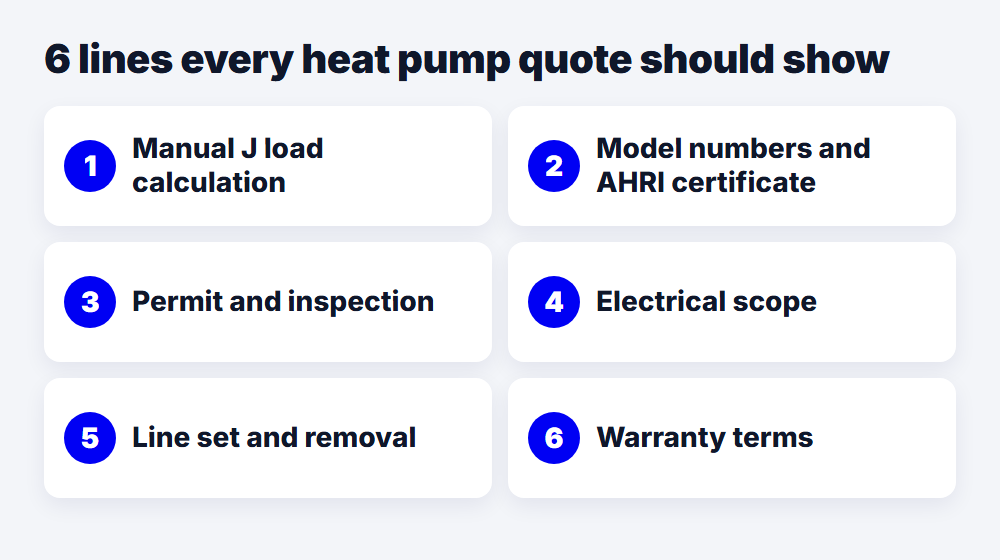
- A Manual J load calculation, not a guess based on the old unit.
- Model numbers for the outdoor and indoor units, plus the Air-Conditioning, Heating, and Refrigeration Institute (AHRI) certificate for the matched set.
- SEER2 and HSPF2 ratings, and a cold-climate listing if you live where winters are hard.
- Permit and inspection on their own line, and HERS testing where it is required.
- Electrical scope in writing: circuit, disconnect and any panel work.
- Line set, pad and condensate drain included, with the old equipment removed.
- Ductwork repairs or changes listed separately, with a reason.
- Warranty terms for parts and for labor, in years.
- No rebate-first pitch: the rebate should not change the scope or the price.
- At least three quotes with the same scope so you can compare line by line.
We found no sourced price for big-box store installs; ask for the same itemized quote there. A fair price is one you can read line by line. If a quote won’t be itemized, that tells you something too.
How We Estimated These Costs
Reviewed by leizha and updated November 8, 2026. National figures come from EnergySage marketplace data (updated March 19, 2026), which averages whole-home quotes and leans toward Massachusetts. Regional examples come from one Philadelphia-area installer’s price book, and the ductless range is HomeGuide’s as cited by Carrier. Labor context uses the BLS Occupational Outlook Handbook and BLS OEWS May 2025 wages. The state table is derived, as the method above explains, from EnergySage’s $15,393 average and BEA’s 2024 RPP, with Census used to pick the states. Reddit items are homeowner reports, not data. Where we found no source, we say so. These are estimates, not quotes.
Heat Pump Installation Cost FAQ
How much does it cost to install a heat pump with existing ductwork?
EnergySage marketplace quotes for ducted systems averaged $14,529 before incentives and $13,527 after. One Philadelphia-area installer’s price book runs from $10,900 to $23,600 depending on size and efficiency. Your price depends on size, electrical work and region, so get itemized quotes.
What is the $5,000 rule for HVAC?
It’s a rule of thumb that circulates among contractors and homeowners; no official body sets it, and it is not a law or a statistic. Multiply the age of your system by the repair cost; if the total is over $5,000, contractors use it as a rough prompt to compare a replacement quote. It is a starting point, not a verdict.
Will installing a heat pump save money?
Often yes, if you replace electric resistance heating. The Department of Energy says heat pumps can reduce electricity use for heating by about 65% compared with electric resistance heating. Savings shrink with cheap gas or high electric rates.
Is there still a federal tax credit for heat pumps in 2026?
No. The 25C credit applied to property placed in service before December 31, 2025, so it is not available for 2026 installs. A 2025 installation can still be claimed on your 2025 return with Form 5695. State and utility rebates may still apply.
Why does a heat pump install cost so much more than the equipment?
The price covers labor, refrigerant handling, electrical work, permits, a labor warranty and overhead. One homeowner reports a $13,000 quote with equipment at about $5,500 and labor at about $6,000. Ask for the quote itemized.
Can I install a heat pump or mini split myself?
Pre-charged DIY units exist, but handling refrigerant requires EPA Section 608 certification, and only certified technicians can buy refrigerant for stationary equipment. DIY can also affect permits, warranty and resale. Homeowners report buying equipment themselves and hiring a certified technician for the refrigerant work.
Do I need a panel upgrade for a heat pump?
Not always. Some homes need only a dedicated circuit, others need a service upgrade. Homeowners report oversizing as a cause of unnecessary upgrades. Ask your contractor to show the load calculation and list any panel work as its own line.

