
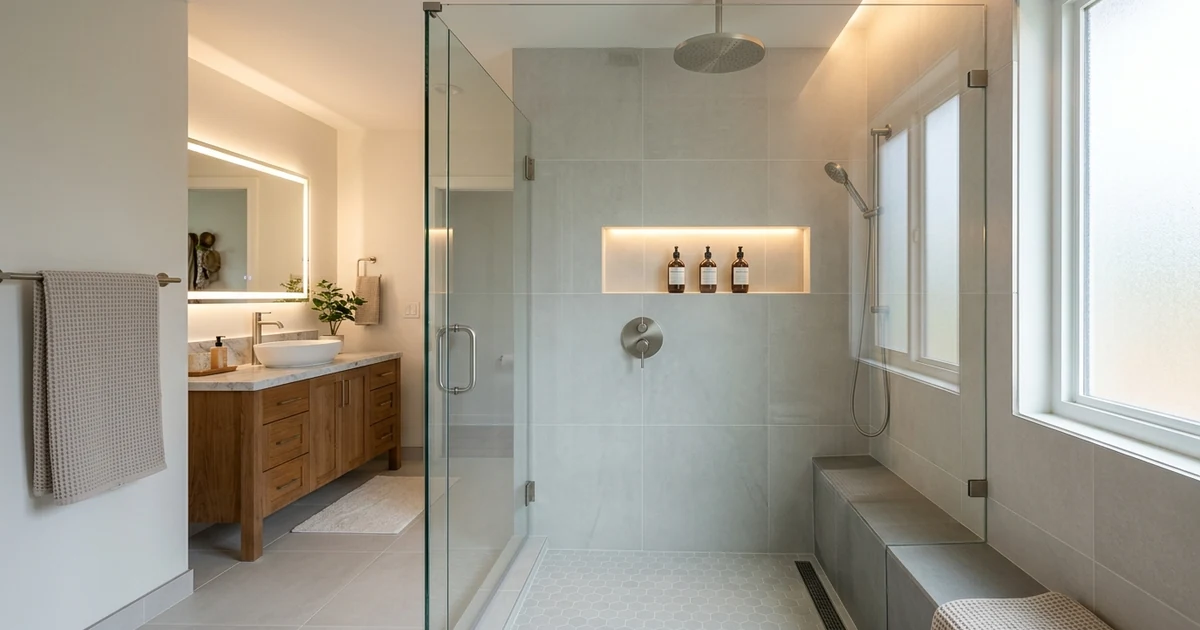
The national average shower replacement cost ranges from $3,200 to $9,800, with most homeowners paying approximately $6,400 for a complete tear-out, updated waterproofing, a modern anti-scald mixing valve, and a mid-range tile or multi-piece acrylic enclosure. On the budget end, swapping an aging alcove unit for a prefabricated fiberglass or acrylic shower kit costs between $1,500 and $4,500 installed. By contrast, constructing a custom ceramic or porcelain tile shower with a frameless tempered glass door runs $4,500 to $11,000, while structural curbless walk-in showers and high-end tub-to-shower conversions range from $5,500 to $15,000 or more.
Unlike cosmetic bathroom updates, replacing a shower requires opening wet-wall cavities, exposing wood framing, verifying subfloor load capacity, and building a vapor-tight waterproof envelope. Whether you are refreshing a compact guest bath or planning a comprehensive bathroom remodel cost budget, understanding how materials, plumbing code upgrades, and waterproofing systems drive contractor labor rates will help you avoid overpriced sales pitches and prevent hidden moisture failures.
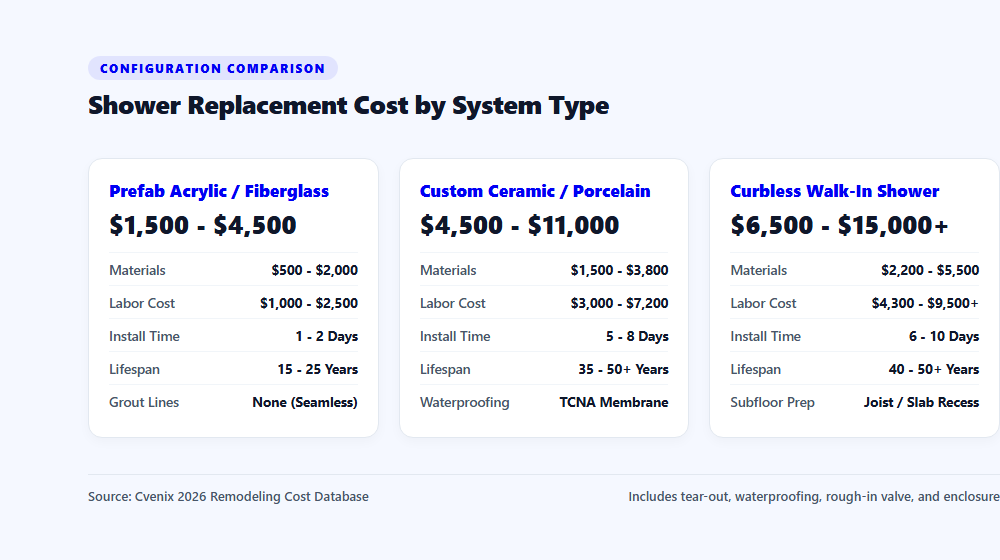
Shower Replacement Cost by Configuration and Type
The architectural layout of your shower enclosure dictates both material quantities and the specialized trade labor needed to complete the project. Replacing a standard three-wall alcove insert in the exact same footprint requires minimal carpentry, whereas converting an alcove bathtub or recessing floor joists for a zero-threshold walk-in shower involves licensed plumbers, structural framing modifications, and multi-day tile setting schedules.
| Shower Replacement Type | Material Cost Range | Professional Labor Cost | Total Installed Cost | Typical Timeline |
|---|---|---|---|---|
| Prefabricated Fiberglass or Acrylic Alcove Kit | $500 – $2,000 | $1,000 – $2,500 | $1,500 – $4,500 | 1 to 2 days |
| Solid-Surface Composite Wall Panel System | $1,600 – $3,800 | $1,900 – $3,700 | $3,500 – $7,500 | 2 to 3 days |
| Custom Ceramic or Porcelain Tile Shower | $1,500 – $3,800 | $3,000 – $7,200 | $4,500 – $11,000 | 5 to 8 days |
| Tub-to-Shower Conversion (Alcove 60×32 in.) | $1,800 – $4,500 | $2,200 – $7,500 | $4,000 – $12,000 | 3 to 7 days |
| Curbless Barrier-Free Walk-In Shower | $2,200 – $5,500 | $4,300 – $9,500+ | $6,500 – $15,000+ | 6 to 10 days |
Prefabricated Fiberglass and Acrylic Alcove Kits ($1,500 to $4,500)
Prefabricated shower stalls come in either single-piece molded shells or multi-piece sectional kits consisting of a pre-sloped receptor pan and three interlocking wall panels. One-piece units eliminate seam joints entirely, offering exceptional leak resistance, but their bulky footprint (typically 36 by 36 inches or 48 by 36 inches) rarely fits through existing 28-inch or 30-inch residential bathroom doorways. Consequently, most remodel projects utilize three-piece or four-piece direct-to-stud acrylic kits that lock together via integrated flange channels or overlap caulked seams.
Solid-Surface Composite Panel Systems ($3,500 to $7,500)
Solid-surface shower walls bridge the gap between budget plastic inserts and labor-intensive custom tile. Manufactured from crushed natural stone, quartz minerals, or alumina trihydrate blended with high-performance polymer resins, these non-porous slabs measure 1/4 inch to 3/8 inch thick and install over moisture-resistant backer board using structural silicone adhesive. Because solid-surface panels feature zero grout lines to scrub or reseal while delivering the visual weight of matte stone, they have become a top choice for low-maintenance primary bathrooms and rental properties.
Custom Ceramic and Porcelain Tile Showers ($4,500 to $11,000)
A custom tiled shower remains the gold standard for architectural flexibility and resale value. Unlike prefab inserts constrained to standard factory dimensions, custom tile adapts to angled ceilings, neo-angle corners, recessed shampoo niches, and built-in corner benches. Labor accounts for 60% to 70% of the total invoice because a certified tile installer must plumb and flatten the wall studs, install a continuous waterproof membrane, pack a sloped mortar bed or set a foam tray, lay tile with lippage-control leveling clips, and apply stain-resistant epoxy or high-performance cement grout.
Curbless Barrier-Free Walk-In Showers ($6,500 to $15,000+)
A curbless (zero-threshold) walk-in shower eliminates the traditional 4-inch to 6-inch step-over curb, allowing bathroom floor tile to flow seamlessly into the shower pan at a 1/4-inch-per-foot drainage pitch. Achieving a flush entry on a wood-framed floor requires sistering and recessing the floor joists beneath the shower footprint so the pre-sloped pan sits below the surrounding subfloor plane. If your bathroom sits on a concrete slab foundation, contractors must either saw-cut and jackhammer a recessed trench into the concrete or raise the entire bathroom floor height by 1.5 to 2 inches to create the required drainage drop.
Shower Replacement Cost by Dimensions and Footprint Size
Beyond the material category, the physical square footage of your shower stall governs how many sheets of backer board, linear feet of waterproof seam tape, and boxes of wall and floor tile your contractor must order. Under International Plumbing Code (IPC) Section 421.4, a residential shower compartment must provide a minimum interior cross-sectional area of 900 square inches (capable of encompassing a 30-inch circle), though the National Kitchen and Bath Association (NKBA) recommends at least 36 by 36 inches for comfortable elbow movement.
- Compact Corner or Neo-Angle Stall (32×32 in. or 36×36 in.): $1,500 to $3,200 for a prefab acrylic kit; $4,200 to $7,500 for custom porcelain tile with a neo-angle pivot glass door. Common in three-quarter guest baths and basement bathrooms.
- Mid-Size Rectangular Alcove Shower (48×36 in.): $2,200 to $4,200 for a multi-piece composite insert; $5,200 to $9,200 for custom tile with a recessed shampoo niche and semi-frameless bypass door.
- Standard Tub-Replacement Alcove (60×30 in. or 60×32 in.): $2,500 to $4,800 for a prefab pan and acrylic surround; $5,800 to $11,500 for custom tile, a 15-inch built-in bench, and 3/8-inch heavy frameless glass panels.
- Luxury Double Walk-In or Wet-Room Enclosure (60×48 in. to 72×60 in.): $8,500 to $18,000+ featuring dual thermostatic rain and handheld valves, a stainless steel linear trench drain, floor-to-ceiling porcelain slabs, and fixed frameless splash panels.
Shower Replacement Cost by Wall and Pan Material
Selecting your shower surface material affects upfront procurement cost, structural subfloor requirements, thermal comfort underfoot, and expected service life. While entry-level fiberglass inserts last 10 to 15 years before gelcoat micro-cracking occurs, porcelain and natural stone assemblies routinely exceed 30 to 50 years when backed by an ANSI A118.10 compliant waterproof membrane.
| Wall and Pan Material | Material Cost per Sq. Ft. | Turnkey Installed Range | Expected Lifespan | Maintenance and Durability Profile |
|---|---|---|---|---|
| Gelcoat Fiberglass Insert | $8 – $18 (kit equivalent) | $1,500 – $3,400 | 10 – 15 years | Lightweight and inexpensive; prone to flexing, scratching, and UV yellowing over time |
| Thermoformed Cast Acrylic | $14 – $32 (kit equivalent) | $2,200 – $4,800 | 18 – 25 years | Color runs through full thickness; resists cracking and retains heat better than fiberglass |
| Glazed Ceramic Tile | $3 – $12 | $4,500 – $8,200 | 25 – 40 years | Best for vertical walls; higher water absorption rate makes small mosaic porcelain better for floors |
| Impervious Porcelain Tile | $6 – $22 | $5,200 – $11,000 | 35 – 50+ years | Water absorption under 0.5%; dense, scratch-proof, and ideal for wet-room floors and steam showers |
| Cultured Marble / Solid Surface | $25 – $65 | $3,500 – $7,500 | 25 – 35 years | Seamless slab appearance with zero grout joints; cleans easily with non-abrasive soap |
| Natural Marble, Slate, or Travertine | $15 – $50+ | $7,000 – $16,000+ | 40 – 60+ years | Luxury veining and texture; porous stone requires annual penetrating sealer and pH-neutral cleaners |
When comparing ceramic and porcelain tile, pay close attention to the Tile Council of North America (TCNA) Dynamic Coefficient of Friction (DCOF) rating for the shower floor. Wet interior walking surfaces must achieve a minimum wet DCOF rating of 0.42 to prevent slip-and-fall injuries. Large-format polished porcelain slabs work well on vertical shower walls, where minimal grout lines simplify cleaning, whereas 2-by-2-inch matte mosaic tiles or textured linear-drain floor panels provide essential traction underfoot.
Component, Waterproofing, and Plumbing Cost Breakdown
Many homeowners are surprised to learn that decorative surface tile or wall panels frequently represent less than 25% of a professional shower replacement invoice. The bulk of your investment goes into behind-the-wall waterproofing chemistry, rough-in plumbing compliance, subfloor framing repairs, and custom architectural glass fabrication.
| System Component or Trade Phase | Typical Cost Range | Technical Specification and Code Standard |
|---|---|---|
| Demolition, Haul-Away, and Subfloor Rot Repair | $400 – $1,500 | Tear-out to bare studs, debris disposal, replacing moisture-damaged 3/4-inch plywood subfloor and sistering wall studs |
| Waterproofing Backer Board and Membrane | $600 – $1,800 | Schluter Kerdi sheet membrane, Johns Manville GoBoard, or Laticrete Hydro Ban liquid membrane per TCNA B415/B422 |
| Shower Pan Construction (Mortar vs. Pre-Sloped) | $500 – $1,600 | Dry-pack deck mud bed with PVC liner and weep-hole clamping ring, or high-density EPS foam tray with integrated bonding flange |
| Thermostatic or Pressure-Balance Mixing Valve | $350 – $1,100 | ASSE 1016 / ASME A112.18.1 compliant anti-scald rough-in brass valve body, cartridge, and Pex-A or copper sweat connections |
| Frameless 3/8-Inch Tempered Glass Door | $900 – $2,600 | ANSI Z97.1 safety-tempered 3/8-inch or 1/2-inch architectural glass with heavy-duty brass hinges and protective hydrophobic coating |
| Recessed Wall Niche and Corner Foot Rest | $250 – $750 | Pre-formed waterproofed storage box (12×24 in.) framed between 16-inch on-center studs with sloped sill for drainage |
| Exhaust Ventilation and GFCI Lighting Upgrade | $300 – $850 | 80 to 110 CFM humidity-sensing bathroom exhaust fan vented to exterior roof or soffit, plus wet-rated IC recessed LED trim |
Waterproofing Membranes: Schluter Kerdi, GoBoard, and Liquid Barriers
The single most critical factor determining whether a custom tile shower lasts 40 years or leaks into your first-floor ceiling within 36 months is the waterproofing system installed behind the tile. Grout and cementitious backer boards (such as Durock or HardieBacker) are water-resistant, meaning they will not disintegrate when wet, but they are entirely porous and allow liquid moisture and water vapor to wick directly into wood framing. If previous leaks have already caused black fungal growth on your drywall or joists, you may also need to factor in mold remediation cost before sealing the new wall cavity.
Modern tile contractors rely on three TCNA-approved waterproofing architectures to create a sealed wet envelope:
- Bonded Sheet Membrane Systems (Schluter Kerdi / Laticrete Hydro Ban Sheet): A pliable polyethylene membrane covered in fleece webbing is embedded into unmodified or manufacturer-specified thin-set mortar over drywall or foam board. Seams and corners are overlapped by 2 inches using waterproof Kerdi-Band strips, creating a completely vapor-tight enclosure suitable for daily showers and residential steam rooms ($750 to $1,800 for materials and labor).
- Waterproof Foam Core Backer Boards (GoBoard, Wedi, Schluter Kerdi-Board): Extruded polystyrene (XPS) or polyisocyanurate panels feature a waterproof core faced with fiberglass mesh or cementitious coating. Installers fasten the lightweight boards directly to wood studs and seal fastener heads and seams with polyurethane sealant or mesh tape ($650 to $1,600 installed).
- Liquid-Applied Elastomeric Membranes (Custom RedGard, Laticrete Hydro Ban, Mapei AquaDefense): Rolled or troweled in two perpendicular coats over cement backer board after alkaline-resistant mesh tape is embedded in the corner joints. Reputable installers verify cured mil thickness with a wet-film gauge to prevent pinhole leaks ($550 to $1,300 installed).
Shower Pan Engineering: Dry-Pack Mortar Bed vs. Pre-Sloped Foam Trays
The shower floor pan bears the highest hydrostatic water load in the bathroom and must maintain an exact 1/4-inch-per-foot slope toward the drain weep holes (per TCNA B415 and B422 standards). Depending on your budget and shower geometry, contractors use one of three pan construction methods:
- Traditional Dry-Pack Deck Mud Bed with PVC Pan Liner ($650 to $1,500): The classic water-in, water-out assembly. A pre-slope of Portland cement and coarse sand is packed over the subfloor, followed by a 40-mil PVC or chlorinated polyethylene (CPE) pan liner clamped into a three-piece cast iron or PVC weep-hole drain, and topped with a 1.5-inch reinforced mortar setting bed. Extremely solid underfoot and adaptable to any odd-shaped stall, though it requires high installer skill to avoid clogging the drain weep holes with mortar.
- High-Density Pre-Sloped EPS Foam Shower Tray ($500 to $1,250): Factory-molded expanded polystyrene trays (such as Schluter Kerdi-Shower-T or Wedi Fundo) come pre-sloped at the exact code pitch with an integrated top-surface waterproof membrane and bonding flange drain. Because water sheds directly off the top surface rather than percolating through a thick cement bed, the shower floor dries rapidly between uses, preventing musty odors and efflorescence.
- Pre-Formed Acrylic, Cast Iron, or Solid-Surface Receptor Base ($450 to $1,400): A one-piece waterproof tray set into a bed of structural mortar or spray-foam bedding for zero flex underfoot. Pairing a heavy cast-acrylic or cultured-stone shower pan with custom tiled walls is a popular hybrid strategy that eliminates floor grout maintenance and cuts total project cost by $800 to $1,500.
Plumbing Valves, Multi-Head Sprays, and Water Heater Sizing
Whenever the wall cavity is open during a shower replacement, plumbers strongly advise replacing the in-wall rough-in mixing valve ($350 to $1,100) rather than reusing a 20-year-old brass valve body. Under International Plumbing Code (IPC) Section 412.3, all replacement shower valves must feature anti-scald protection conforming to ASSE 1016. A standard pressure-balancing valve ($350 to $650 installed) maintains a consistent hot-to-cold water ratio when a toilet is flushed elsewhere in the house. Upgrading to a thermostatic mixing valve with separate volume controls ($650 to $1,350 installed) lets you dial in an exact temperature (such as 104 degrees Fahrenheit) and run multiple outlets simultaneously, such as a ceiling rain head and a handheld wand.
If your walk-in shower design incorporates dual showerheads or high-flow body jets exceeding 5.0 gallons per minute (GPM), a standard 40-gallon storage tank can run cold in less than 10 minutes. In those multi-valve upgrades, homeowners often evaluate water heater replacement cost to pair their new shower with a 75-gallon high-recovery tank or a condensing tankless gas unit.
Shower Doors: Framed vs. Semi-Frameless vs. Heavy Frameless Glass
The enclosure door acts as the visual centerpiece of a finished shower replacement and carries a wide price spread based on glass thickness and hardware engineering:
- Framed Aluminum Sliding or Pivot Doors ($450 to $950 installed): Built from 3/16-inch or 1/4-inch tempered glass encased in extruded aluminum tracks. Budget-friendly and forgiving of slightly out-of-plumb walls, though bottom aluminum channels can trap soap scum and mildew.
- Semi-Frameless Barn-Style Bypass Doors ($750 to $1,450 installed): Uses 1/4-inch or 5/16-inch glass with perimeter wall channels and an overhead stainless steel roller bar, leaving the door edges unframed for a cleaner sightline.
- Custom Heavy Frameless Tempered Glass ($900 to $2,600+ installed): Precision-measured via digital laser templates after tile installation is complete. Fabricated from 3/8-inch or 1/2-inch ANSI Z97.1 tempered glass secured with solid brass wall-mount hinges and structural U-channels. Adding low-iron ultra-clear glass (Starphire) or factory-applied hydrophobic glass protection (ShowerGuard or EnduroShield) adds $200 to $450.
Tub-to-Shower Conversion Cost and Plumbing Code Requirements
Converting a standard 60-by-30-inch or 60-by-32-inch alcove bathtub into a spacious walk-in shower is one of the highest-demand bathroom remodeling projects in North America, costing between $4,000 and $12,000. While the three-wall alcove footprint already exists, a code-compliant tub-to-shower conversion is never a simple surface swap because bathtubs and standalone showers operate under different hydraulic drainage rules.
| Tub-to-Shower Conversion Task | Cost Range | Code Requirement and Structural Purpose |
|---|---|---|
| Cast Iron or Steel Tub Extraction and Disposal | $350 – $950 | Sledgehammer fracturing of 350-lb cast iron tubs or reciprocating saw removal of enameled steel/fiberglass tubs |
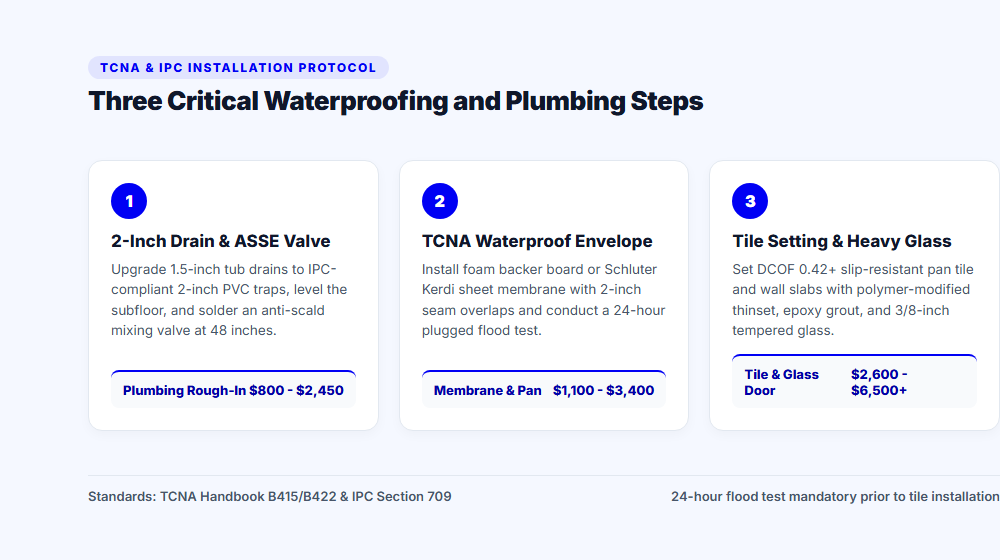
| IPC 2-Inch Shower Drain and P-Trap Upgrade | $450 – $1,350 | Upgrading existing 1.5-inch tub waste pipe and trap to a code-mandated 2-inch PVC/ABS shower drain line |
| Subfloor Trenching or Slab Concrete Cutting | $400 – $1,400 | Relocating the drain from the left/right tub end to the center of the shower pan, including concrete patching on slabs |
| Valve Height Relocation and Spout Capping | $350 – $850 | Raising the mixing valve from tub height (28-32 in.) to standing shower height (45-48 in.) and raising showerhead to 80 in. |
| In-Wall Wood Blocking and ADA Grab Bars | $200 – $550 | Installing 2×8 or 2×10 solid lumber blocking between studs at 33-36 in. AFF to support 250-lb rated stainless steel grab bars |
| Built-In Tiled Bench or Fold-Down Teak Seat | $350 – $1,100 | Constructing a waterproofed 15-inch deep corner/end seat at 17-19 inches height per ADA and NKBA ergonomic standards |
Under International Plumbing Code (IPC) Table 709.1, a bathtub serves as a high-wall reservoir capable of holding standing water while draining slowly through a 1.5-inch waste line and P-trap. A standalone shower pan, however, has a shallow 2-inch to 4-inch threshold (or zero curb in a barrier-free layout) and must evacuate water immediately to prevent overflow onto the bathroom floor. Therefore, most municipal building inspectors require upgrading the branch drain and P-trap to a minimum 2-inch diameter pipe during a tub-to-shower conversion. If your home has a crawlspace or unfinished basement beneath the bathroom, a plumber can swap the P-trap and relocate the drain center in 3 to 4 hours ($450 to $800). On a concrete slab-on-grade foundation, plumbers must saw-cut a trench in the concrete slab to move the drain and upsize the trap, pushing plumbing labor to $900 to $1,600.
Regional and State Shower Replacement Cost Comparison
Geographic location influences your final shower replacement cost by 25% to 45% due to regional differences in licensed plumber hourly rates, tile setter union scales, municipal permit fees, and common foundation types (concrete slab in the Sunbelt versus wood-joist basements in the Northeast and Midwest).
| State / Metro Region | Prefab Kit Installed | Custom Tile Shower Installed | Curbless Walk-In Installed | Licensed Plumber & Tile Hourly Rate |
|---|---|---|---|---|
| California (Los Angeles, Bay Area, San Diego) | $2,400 – $5,800 | $6,800 – $14,500 | $9,500 – $19,500+ | $125 – $195 / hr |
| New York & New England (NYC, Boston, NJ) | $2,200 – $5,500 | $6,500 – $14,000 | $9,000 – $18,500+ | $120 – $185 / hr |
| Texas (Austin, Dallas, Houston, San Antonio) | $1,500 – $3,900 | $4,400 – $9,600 | $6,200 – $13,800 | $85 – $135 / hr |
| Florida (Miami, Orlando, Tampa, Jacksonville) | $1,600 – $4,200 | $4,600 – $10,200 | $6,500 – $14,500 | $85 – $140 / hr |
| Illinois & Upper Midwest (Chicago, Minneapolis, Detroit) | $1,800 – $4,600 | $5,200 – $11,500 | $7,200 – $15,500 | $95 – $155 / hr |
| Georgia, North Carolina & Southeast | $1,500 – $3,800 | $4,200 – $9,400 | $5,800 – $13,200 | $80 – $130 / hr |
| Washington & Pacific Northwest (Seattle, Portland) | $2,100 – $5,200 | $6,000 – $13,200 | $8,500 – $17,500 | $115 – $175 / hr |
| Ohio, Indiana, and Pennsylvania | $1,550 – $4,100 | $4,500 – $9,800 | $6,400 – $14,000 | $85 – $135 / hr |
Independent Tile Contractors vs. One-Day Acrylic Bath Franchises
When gathering bids for a shower replacement, homeowners frequently encounter a startling pricing paradox: nationally advertised “one-day bath remodel” franchises often quote $12,000 to $22,000 for a glued-up thermoformed acrylic wall surround, while a local licensed tile contractor quotes $6,500 to $11,000 for a custom porcelain tile shower with a full Schluter Kerdi waterproof membrane and heavy frameless glass door.
Understanding why these quotes diverge helps you allocate your renovation dollars effectively:
- Marketing and Sales Commission Overhead: National one-day acrylic franchises spend 25% to 35% of gross revenue on television advertising, lead-generation aggregators, and in-home sales representative commissions. Those overhead costs are baked directly into a single lump-sum price accompanied by “today-only” promotional discounts.
- Cover-Up Liners vs. Down-to-Stud Inspection: Some speed-focused installers glue thin acrylic sheets directly over existing tile or damp drywall to finish in 8 hours. Covering old substrates traps residual moisture and conceals rotting bottom plates or leaking copper sweat joints. Always insist on a full tear-out to bare studs so framing and subfloor plywood can be inspected before new backer board goes up.
- Long-Term Home Equity Return: Real estate appraisers and homebuyers distinguish between hollow-sounding plastic wall liners and true ceramic, porcelain, or solid-surface stone assemblies. A custom tile shower installed by a Certified Tile Installer (CTI) typically recoups 65% to 74% of its cost at resale while elevating the perceived quality of the entire home.
Building Permits, Flood Tests, and Inspection Checkpoints
Whether your project requires a municipal building and plumbing permit ($150 to $550) depends on the scope of plumbing alterations. In most jurisdictions, replacing tile or swapping a prefab enclosure in the same footprint without altering waste lines or mixing valves qualifies as minor repair work. However, relocating a drain, converting a 1.5-inch tub trap to a 2-inch shower line, replacing the in-wall mixing valve, or adding a dedicated GFCI electrical circuit requires a permit and two formal inspection checkpoints:
- Rough-In Plumbing and Framing Inspection: Performed after demolition and pipe installation, before backer board closes the walls. The inspector verifies the 2-inch P-trap slope (1/4 inch per foot), proper vent stack tie-in, ASSE 1016 valve height, and nail guard plates protecting pipes passing through wood studs.
- 24-Hour Shower Pan Flood Test (Water Test): Before a single tile is set on the shower floor, the plumber or tile contractor inserts an inflatable rubber test plug into the drain pipe below the weep holes and fills the waterproofed shower pan with water up to 1 inch below the top of the curb for 24 hours. Measuring zero drop in the water level guarantees a 100% leak-free pan membrane and drain flange seal.
Pricing Methodology and Technical Industry Standards
Our 2026 shower replacement cost figures are compiled from national remodeling contractor invoices, RSMeans residential construction cost datasets, and verified homeowner project logs across metropolitan and rural markets. All technical specifications and installation benchmarks align with three governing industry authorities:
- Tile Council of North America (TCNA) Handbook for Ceramic, Glass, and Stone Tile Installation: Reference methods B415, B421C, and B422 governing bonded waterproof membranes (ANSI A118.10), mortar bed receptor slopes, and wet-area DCOF slip-resistance thresholds.
- International Plumbing Code (IPC) & Uniform Plumbing Code (UPC): Reference standards for minimum 2-inch shower waste traps (IPC Table 709.1), shower compartment minimum interior dimensions (900 square inches with a 30-inch minimum circle), and ASSE 1016 anti-scald mixing valves.
- National Kitchen & Bath Association (NKBA) Planning Guidelines: Reference standards for ergonomic shower sizing (36×36 inches recommended minimum), grab bar blocking reinforcement, and barrier-free curbless entry clearances.
Frequently Asked Questions About Shower Replacement Cost
How much does it cost to replace a shower pan without replacing the wall tile?
Replacing only a leaking shower pan costs between $1,500 and $3,800 depending on whether you install an acrylic receptor base or rebuild a custom mortar bed with new floor tile. For a tiled shower, contractors must remove the bottom 8 to 12 inches of wall tile around the perimeter to overlap the new waterproof pan membrane with the existing wall waterproofing, then retile the floor and lower wall border.
Is a Schluter Kerdi system worth the extra cost over traditional cement board and RedGard?
Yes, for most custom tile showers, a bonded sheet membrane or foam board system like Schluter Kerdi, GoBoard, or Wedi adds $250 to $600 in material costs over traditional cement board and liquid RedGard, but frequently saves 1 to 2 days of labor because there is no waiting for multiple liquid coats to cure. More importantly, sheet membranes have a uniform factory-controlled thickness, eliminating the risk of thin spots or pinholes.
Why do one-day acrylic shower companies charge $15,000 or more?
National one-day bath remodelers bundle aggressive lead-generation marketing, showroom overhead, and 15% to 25% sales commissions into their retail pricing. While their custom-bent acrylic or composite panels install quickly in 1 to 2 days, homeowners can often hire an independent licensed contractor to install solid-surface stone panels or custom porcelain tile for $6,000 to $11,000.
Does converting a bathtub to a walk-in shower hurt home resale value?
Converting a tub to a walk-in shower increases home appeal and resale value as long as the house retains at least one full bathtub in another bathroom for families with young children or pets. If you are remodeling the only bathroom in a multi-bedroom house, real estate agents recommend keeping a tub-shower combo; in a primary suite where a secondary hall bath already has a tub, a walk-in tile shower is strongly preferred by buyers.
Can I install a curbless walk-in shower on a second-floor wood subfloor?
Yes, a curbless shower can be installed on a wood-framed second floor as long as a structural carpenter or contractor recesses the subfloor between the joists using reinforced cleat ledgers and sistered framing, or uses a thin-profile pre-sloped pan system verified by the framing span tables. This structural modification typically adds $1,200 to $2,800 to the project compared to a standard curbed shower.
How long does a complete custom tile shower replacement take from demolition to glass installation?
On-site demolition, plumbing rough-in, waterproofing, flood testing, tile setting, and grouting take 5 to 8 working days. However, if you order a custom 3/8-inch frameless tempered glass enclosure, the glass fabricator must laser-measure the opening after the tile is finished, adding 7 to 14 business days for factory tempering and final door installation.

