
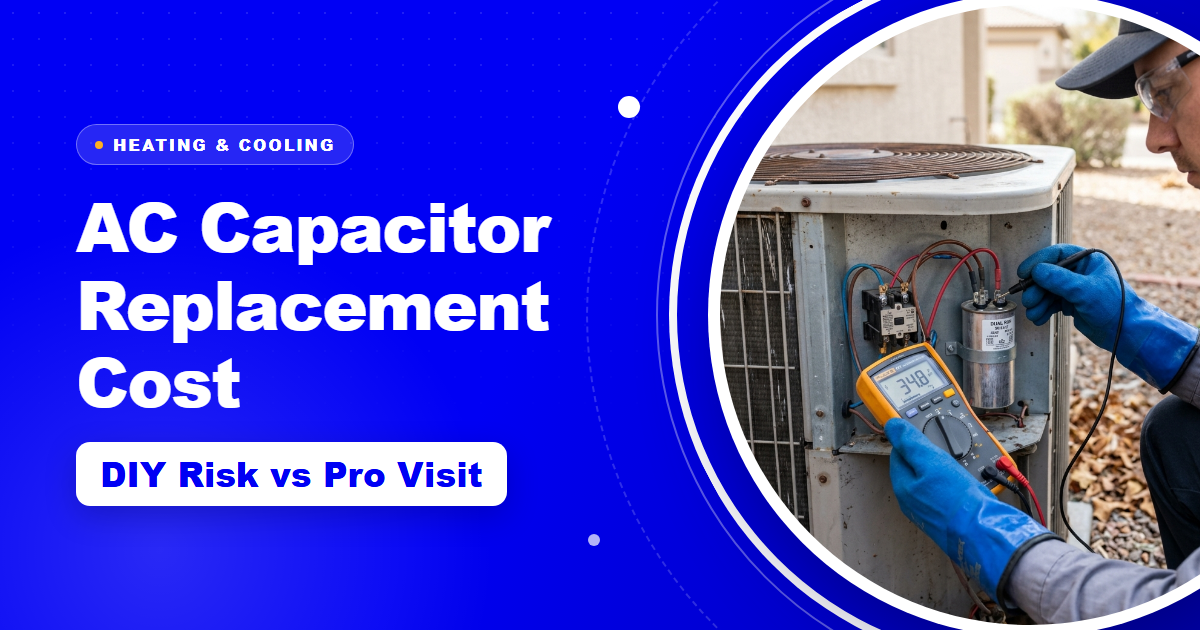
The average ac capacitor replacement cost is $170 to $175, with most professional repairs ranging from $80 to $400 depending on the capacitor type and service timing. If you buy the hardware yourself, a replacement capacitor costs between $8 and $45. That significant price difference leads many homeowners to attempt a DIY swap, but handling a charged capacitor carries severe electrical shock hazards.
Your air conditioner relies on capacitors to supply the electrical surge needed to start and run its compressor and outdoor fan. When one fails on a hot summer afternoon, your cooling system shuts down immediately. This guide breaks down what you can expect to pay for parts and professional labor, explains why service invoices cost what they do, compares regional pricing variations, and details the safety protocols required to avoid personal injury or expensive compressor damage.
How Much Does an AC Capacitor Replacement Cost?
National average and typical price ranges
Across the United States, homeowners typically pay $150 to $250 for a professional AC capacitor replacement during regular business hours. Benchmark industry studies from Bob Vila report an overall national average of $170 with a standard range of $60 to $300. Data compiled by This Old House indicates a median repair cost of $175, with low-end repairs around $80 and complex or after-hours service reaching $400.
Your final invoice depends primarily on accessibility, timing, and whether secondary electrical diagnostics are necessary. A simple daytime swap on an easy-to-reach outdoor condenser costs between $80 and $120. A standard dual-run capacitor replacement with basic voltage verification runs between $150 and $250. If your unit breaks down over a holiday weekend, requires an emergency dispatch, or sits on a steep commercial roof, total costs frequently reach $300 to $400.
Component part cost versus total installed invoice
When homeowners look up AC parts online, they are often surprised to discover that bare capacitors sell for $8 to $45 at retail supply shops. For example, a heavy-duty Titan PRO 40/5 MFD dual-run capacitor costs between $8.70 and $13.00 at wholesale supply houses and roughly $29.99 at consumer retail outlets. Standard single-stage run capacitors sell for $8 to $30, while start capacitors range from $9 to $25.
Comparing the raw component price to a professional invoice can make HVAC companies look overpriced. However, an HVAC repair bill includes much more than the metal cylinder. A legitimate contractor covers fully stocked service vehicles, specialized electrical meters, licensing, insurance, and certified technicians who safely manage high-voltage electricity.
| Capacitor type | Retail part cost | Professional installed cost | Primary function and HVAC application |
|---|---|---|---|
| Dual-run capacitor | $15 – $45 | $105 – $245 | Runs both the compressor and the condenser fan motor in split-system air conditioners. |
| Run capacitor (single stage) | $8 – $30 | $98 – $230 | Sustains continuous running torque for indoor blower motors or dedicated single fans. |
| Start capacitor | $9 – $25 | $99 – $225 | Delivers a high-torque electrical boost to start difficult or heavy-load compressors. |
| Blower motor capacitor | $9 – $12 | $99 – $212 | Powers the indoor furnace or air handler blower motor that circulates air through ducts. |
| Heat pump capacitor | $15 – $25 | $105 – $225 | Heavy-duty dual-run capacitor engineered for year-round heating and cooling operation. |
Cost Breakdown by Capacitor Type
Air conditioners and heat pumps rely on specific capacitor designs to handle different motor starting and running loads. Capacitors act like temporary storage batteries, storing electrical energy and releasing a 300% to 500% surge to kickstart compressor and fan motors. Understanding which capacitor failed helps you predict your repair bill accurately.
Dual-run capacitors
The dual-run capacitor is the most common capacitor in residential split-system central air conditioners. Housed in a round or oval aluminum canister inside the outdoor condenser cabinet, it combines two individual capacitors into a single package. One internal section provides steady running capacitance to the hermetic compressor, while the second section powers the outdoor fan motor.
Replacement dual-run hardware costs between $15 and $45 at retail outlets. When installed by a licensed technician during normal hours, total professional costs range from $105 to $245. Because dual-run capacitors endure heavy electrical loads under intense outdoor heat, they represent the single most common electrical failure point in residential cooling systems.
Run capacitors
Dedicated single-stage run capacitors support a single motor rather than two. They remain in the electrical circuit continuously while the motor operates, maintaining an optimal phase angle and consistent torque. These capacitors are common on older air conditioning split systems, auxiliary condenser fans, and single-stage compressor setups.
Single-stage run capacitor parts cost between $8 and $30. Professional replacement typically costs between $98 and $230, which includes testing the motor amp draw after installation to verify smooth operation.
Start capacitors
Start capacitors provide a powerful, momentary burst of electrical starting torque to break compressor inertia. Unlike run capacitors that stay energized, a start capacitor operates for only a fraction of a second during initial startup. Once the compressor reaches roughly 75% of its operating speed, an internal potential relay disconnects the start capacitor from the active circuit.
Start capacitor components cost between $9 and $25. Professional replacement runs from $99 to $225. If the accompanying potential relay or start relay is also burned out, the technician will need to replace both parts to restore reliable starting.
Blower motor and heat pump capacitors
Indoor air handlers and furnaces contain dedicated blower motor capacitors that power the squirrel-cage fan distributing conditioned air through your ductwork. When an indoor blower capacitor fails, your outdoor compressor may run while no cool air circulates through your home. Blower capacitor parts cost between $9 and $12, and professional replacement costs $99 to $212. If your furnace blower capacitor is aging along with your heating equipment, review our guide on furnace replacement cost to evaluate broader heating maintenance.
Heat pump capacitors perform the same functions as standard central AC dual-run capacitors, but they operate through both summer cooling and winter heating cycles. Because heat pumps run nearly all year, these capacitors undergo twice the thermal expansion and electrical cycling of cooling-only systems. Heat pump capacitor parts cost $15 to $25, and professional replacement runs from $105 to $225.
What Drives the Cost of a Professional Repair?
When you hire an HVAC technician to replace a capacitor, the physical component makes up only 10% to 20% of your total bill. The remainder covers diagnostic labor, travel expenses, insurance, and the overhead required to run a reliable trade business.
Diagnostic dispatch and service call fees
Most HVAC contractors charge a standard diagnostic trip fee of $75 to $150 to dispatch a technician and service vehicle to your home. This fee pays for travel time, fuel, vehicle upkeep, and the initial inspection needed to confirm why your AC stopped running. In many cases, reputable independent contractors apply this service call fee toward the total repair cost if you approve the work on the spot.
Skilled labor rates and technician overhead
Replacing a capacitor may take an experienced technician only 20 to 30 minutes, but you are paying for technical expertise and safety compliance. According to the United States Bureau of Labor Statistics (BLS) under occupation SOC 49-9021 (Heating, Air Conditioning, and Refrigeration Mechanics and Installers), the national median hourly wage for HVAC technicians is $27.55 to $29.33 per hour, with skilled technicians in the 90th percentile earning $40.51 to $45.77 per hour.
To keep certified technicians on the road, contractors must pay for commercial vehicle insurance, worker compensation coverage, EPA certifications, digital testing equipment, and warehouse inventory carrying costs. When overhead and business operating expenses are factored in, the true cost to put a fully equipped service truck in your driveway ranges from $120 to $200 per hour.
Regional labor differences and state cost variations
Where you live directly impacts your final repair bill. Local cost of living, municipal licensing regulations, and regional labor markets create noticeable price differences across the country.
In high-cost metropolitan areas across the Pacific West Coast (California, Washington, Oregon) and the Northeast (New York, Massachusetts, New Jersey), elevated business taxes and technician wages of $34.50 to $44.80 per hour push service call fees to $90 to $175 and total capacitor replacements to $190 to $400.
Conversely, homeowners across the Midwest and Southern states generally pay $120 to $250 for daytime replacements. In lower-cost states such as Alabama, Mississippi, and Arkansas, technician wages average $22.10 to $27.40 per hour, which lowers overall contractor billing rates.
In Sunbelt states like Texas, Florida, and Arizona, high summer humidity and prolonged 100°F heatwaves push air conditioners to their limits. While base labor rates are moderate, seasonal demand spikes during peak summer months, increasing wait times and the likelihood of overtime service rates.
Unit accessibility, brand, and seasonal demand
Standard outdoor condensers installed on a flat concrete pad at ground level allow fast, straightforward access. If your unit is mounted on a steep rooftop, placed in a cramped crawl space, or tucked into a tight attic, labor charges increase to cover safety setup and difficult access.
Timing also plays a major role in pricing. If your air conditioner breaks down in the middle of a July heatwave or over a holiday weekend, you will likely pay an after-hours emergency surcharge of $50 to $150 or more on top of standard daytime rates.
Independent technicians versus private-equity corporate flat rates
One of the largest factors affecting your quote is contractor ownership structure. Over the past decade, private-equity investment firms have purchased hundreds of local HVAC companies nationwide. These corporate chains frequently use computerized flat-rate pricing books designed to maximize revenue per call.
On trade discussion forums such as Reddit r/hvacadvice, independent HVAC professionals routinely report that $180 to $350 is a fair and profitable daytime price for a dual-run capacitor replacement. In contrast, homeowners frequently share quotes from corporate-owned HVAC companies charging $500 to $800 or more for the exact same 15-minute component swap. Asking whether a company is locally owned before scheduling can save you hundreds of dollars.
| Invoice component | Typical cost range | What it covers | Homeowner value and overhead |
|---|---|---|---|
| Diagnostic dispatch or trip fee | $75 – $150 | Service van arrival, preliminary electrical triage, and testing voltage at the disconnect box. | Covers vehicle maintenance, fuel, insurance, and dispatch scheduling. |
| Skilled labor and installation | $60 – $150 | Discharging capacitor, testing microfarads, terminal rewiring, and verifying motor amp draws. | Reflects certified technician trade wages ($27.55 to $45.77/hr) and safety training. |
| Capacitor hardware | $15 – $50 | OEM or heavy-duty universal dual-run capacitor (e.g., Titan PRO 440V). | Wholesale sourcing, warranty backing, and carrying parts on the truck. |
| Total standard invoice | $150 – $350 | Complete daytime diagnostic, replacement, and system cooling test. | Fair daytime rate among independent contractors. |
| Emergency or weekend surcharge | +$50 – $150+ | Premium added for after-hours, weekend, or holiday heatwave emergency service. | Overtime pay for on-call technicians during peak summer cooling seasons. |
| Region and representative states | Typical service call fee | Total capacitor replacement cost | Local HVAC wage baseline (BLS SOC 49-9021) | Key regional cost drivers |
|---|---|---|---|---|
| Pacific West Coast (CA, WA, OR) | $90 – $175 | $190 – $400 | $34.50 – $44.80 per hour | High commercial vehicle operating expenses, rigorous trade licensing standards, elevated metro overhead. |
| Northeast and Mid-Atlantic (NY, MA, NJ, PA) | $85 – $165 | $180 – $375 | $31.80 – $42.10 per hour | High union wage density, congested metro transit delays, older residential electrical panels requiring diagnostic care. |
| Midwest (OH, IL, MI, IN) | $75 – $135 | $150 – $310 | $26.50 – $34.20 per hour | Moderate cost of living, balanced contractor competition, distinct spring tune-up and summer heating/cooling peaks. |
| Sunbelt and Southeast (TX, FL, GA, NC) | $70 – $140 | $140 – $325 | $24.80 – $31.50 per hour | Extreme cooling runtimes stress capacitors; high summer volume leads to overtime premiums during 95°F+ heatwaves. |
| Mountain West (CO, AZ, UT, NV) | $80 – $150 | $160 – $340 | $27.90 – $35.60 per hour | High summer cabinet temperatures in desert climates shorten capacitor lifespans; sprawling service territories. |
| South Central and Rural South (AL, MS, AR, OK) | $60 – $110 | $120 – $250 | $22.10 – $27.40 per hour | Lower baseline labor rates and operational costs; longer travel mileage between rural service dispatches. |
Telltale Signs Your AC Capacitor Is Failing
Capacitors rarely fail without warning. Recognizing the early symptoms of a declining capacitor allows you to replace it before it leaves you without cooling during peak summer heat.
Humming condenser and unspinning fan blades
The most common sign of a failed dual-run capacitor is a distinct electrical humming or buzzing noise coming from the outdoor condenser while the fan blades sit completely motionless. When you turn on your thermostat, the contactor closes, sending electrical voltage to the fan motor. Without the starting phase boost provided by the capacitor, the motor cannot generate enough initial torque to spin.
Technicians often verify this issue with a simple push test. If you gently nudge the top fan blades in their normal rotation direction with a non-conductive wooden stick and the fan immediately starts spinning on its own, the fan run capacitor is bad. The motor can sustain rotation once started, but it cannot start itself from a dead stop.
Hard starting and frequent circuit breaker trips
When a capacitor weakens, the hermetic compressor struggles to overcome internal head pressure. As the compressor motor attempts to start without adequate phase capacitance, it draws excessive electrical current known as locked rotor amps (LRA). This massive current spike trips the circuit breaker in your main electrical panel.
If your AC breaker trips repeatedly, resetting it without diagnosing the problem can melt the compressor internal insulation. Another clear symptom of hard starting is lukewarm air blowing from your indoor vents. The indoor blower fan continues circulating room-temperature air through your ducts, but the outdoor compressor never turns on.
Physical bulging, oil leakage, and top dome swelling
A failing capacitor often shows visible physical deformation. Healthy capacitors feature a completely flat metal top plate where the terminal posts mount. When the internal dielectric insulation breaks down from heat and electrical stress, chemical gas builds up inside the sealed metal canister.
This pressure pushes the top plate upward, making the capacitor look like a swollen soda can. You may also notice an oily residue leaking around the terminal posts or scorched plastic insulation on attached wires. Any capacitor with a rounded, mushroomed top or leaking dielectric fluid is compromised and must be replaced immediately.
Measuring microfarad drop with a digital multimeter
A capacitor can fail electrically while its exterior remains clean and flat. Professional HVAC technicians use a digital multimeter equipped with a capacitance setting (marked in microfarads, µF or MFD) to measure exact performance.
Every capacitor is labeled with a rated capacitance value and an allowable operating tolerance, typically ±5% or ±6%. According to industry standards established by the Air-Conditioning, Heating, and Refrigeration Institute (AHRI), any capacitor that drops more than 10% below its rated value (below 90% of specification) must be replaced. For example, on a 45/5 µF dual-run capacitor, if the compressor terminal reads below 40.5 µF, the capacitor is weak and will cause the compressor to run hot.
DIY Replacement versus Professional Service: Weighing the Risks
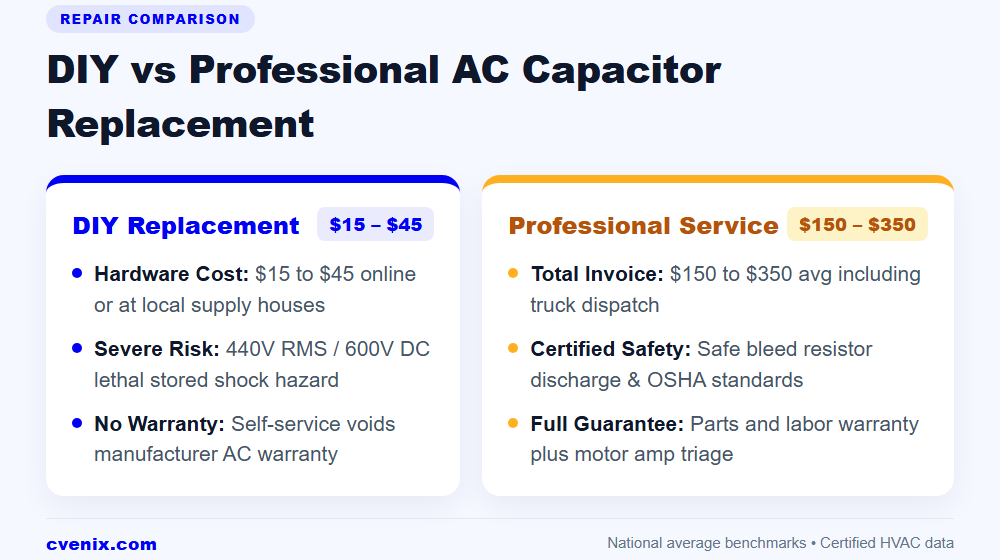
Because a replacement capacitor costs under $30 online, swapping the part yourself is a tempting weekend project. While you do not need an EPA Section 608 certification or municipal electrical permits to change a capacitor, working inside an HVAC electrical cabinet carries serious electrical hazards.
The lethal shock hazard: why pulling the disconnect is not enough
The biggest misconception among DIY homeowners is that pulling the outdoor electrical disconnect handle makes the air conditioner safe to touch. While pulling the disconnect or flipping the breaker cuts incoming 240-volt grid electricity, it does not drain the capacitor.
Residential AC capacitors store high-voltage electricity at 370 to 440 volts RMS alternating current. In active operation, this generates peak direct current charges exceeding 600 volts. Even with the power disconnected, that electrical energy remains trapped inside the capacitor like a loaded spring. Accidentally contacting the live terminals can deliver a violent electrical shock, cause deep burns, or trigger fatal cardiac arrest.
How technicians safely discharge a capacitor
A common YouTube shortcut suggests placing the bare steel shaft of an uninsulated screwdriver across the capacitor terminals to discharge it. Experienced HVAC technicians strongly advise against this practice. Shorting a high-voltage capacitor directly causes a violent electrical arc flash, burns pits into the terminal posts, and can even weld the tool to the metal canister or trigger an explosion.
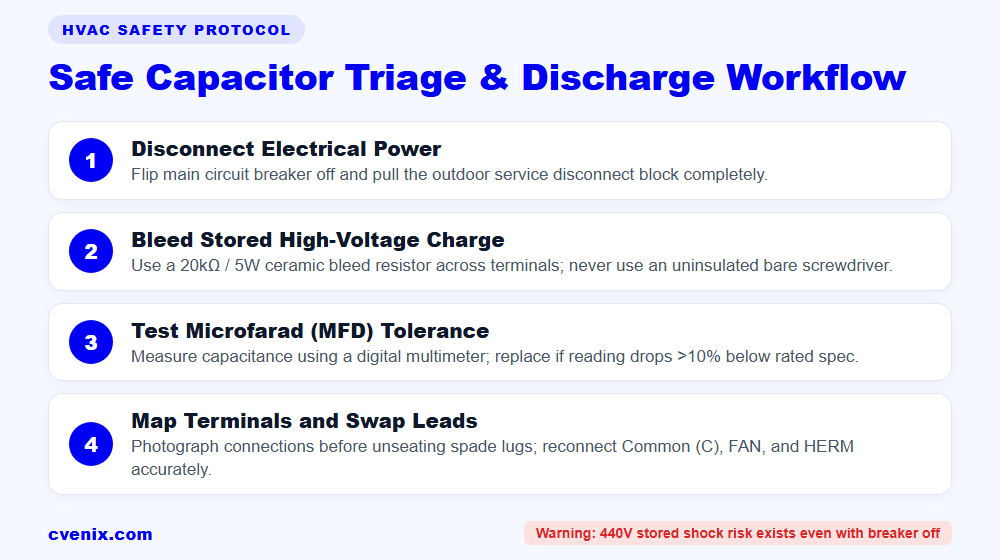
To discharge a capacitor safely, technicians use a specialized discharge pen or an insulated bleed resistor rated at 15,000 to 20,000 ohms and 2 to 5 watts. Connecting the bleed resistor leads across the Common terminal and the Hermetic and Fan terminals safely bleeds off the stored high voltage over a few seconds without sparks or heat spikes. Once discharged, the technician verifies zero voltage with a digital meter before touching any wires.
Terminal mapping: avoiding compressor burnout from miswiring
Dual-run capacitors feature three distinct terminal posts on top, typically identified by raised metal stampings:
- C (Common): Receives incoming electrical power from the heavy-duty contactor switch.
- FAN: Powers the outdoor condenser fan motor.
- HERM (Hermetic): Feeds the high-current compressor motor.
Miswiring these terminals is one of the costliest DIY mistakes. If you accidentally swap the FAN and HERM wires, the fan motor receives excessive capacitance while the compressor motor receives too little. Within minutes of powering the unit on, the compressor can overheat and suffer irreversible winding damage, turning a $25 fix into a $2,000 compressor replacement. Always take a clear, well-lit smartphone photograph of every wire connection before unclipping any spade connectors.
When DIY is viable versus when to call an HVAC pro
Taking a DIY approach makes sense only if you have solid electrical troubleshooting experience, own an insulated bleed tool and a digital multimeter, and take careful photos of the wiring harness before disconnecting anything.
You should always call a licensed professional if your air conditioning system is still covered under an active manufacturer or home warranty. Many equipment warranties explicitly require repairs to be completed by licensed HVAC contractors, and unauthorized DIY work can void remaining coverage on your compressor. You should also call a pro if the old capacitor is badly charred, if breakers continue to trip after a swap, or if you suspect underlying motor damage.
| Evaluation factor | DIY replacement | Professional HVAC service |
|---|---|---|
| Total estimated cost | $15 to $45 (part only) | $150 to $350 (average installed invoice) |
| Safety and shock hazard | High: 440V RMS / 600V DC lethal shock risk | Zero risk: Certified tech follows OSHA and trade safety standards |
| Diagnostic scope | Part swap only; cannot test motor windings | Complete diagnostic: tests amp draws, contactors, and refrigerant |
| Equipment risk | Miswiring FAN and HERM terminals can fry compressor | Protected: Tech guarantees correct terminal mapping |
| Warranty protection | Manufacturer part warranty only (often voids AC warranty) | 30-day to 1-year labor warranty plus full parts warranty |
| Time required | 1 to 3 hours (diagnosing, buying part, discharging) | 30 to 60 minutes on-site |
Related AC Repairs and Additional Costs
A failed capacitor is frequently a symptom of broader electrical or mechanical wear. When an HVAC technician services your air conditioner, they will check related components that may need attention.
Replacing the contactor alongside the capacitor
The contactor is an electromechanical switch that acts as the gateway for 240-volt power entering the condenser. Every time your thermostat calls for cooling, the contactor snaps closed. When a capacitor weakens, excessive current arcs across the contactor points, causing pitting and carbon buildup.
If the contactor contacts become severely pitted, they can stick closed, causing your outdoor unit to run nonstop until it burns out. Replacing a contactor alongside a capacitor is standard preventive maintenance. The contactor part costs $15 to $35, and having a technician install it while the cabinet is already open typically adds $100 to $200.
Condenser fan motor or compressor damage
Sometimes a homeowner replaces a bad capacitor only to find the outdoor fan still will not spin. If the fan motor ran for days with a weak capacitor, the motor windings may have overheated, or the bearings may have seized entirely. Replacing an outdoor condenser fan motor costs between $350 and $650.
In worse scenarios, continuous hard starting can burn out the hermetic compressor. A complete compressor replacement runs between $1,200 and $2,500. When facing a catastrophic compressor failure on an aging unit, it is usually more cost-effective to replace the entire outdoor unit. Review our breakdown on central AC replacement cost to weigh replacement options against expensive major repairs.
Hard start kits for aging compressors
If your air conditioning compressor is more than 8 to 10 years old, it may struggle to start against high refrigerant pressures even with a fresh run capacitor. A hard start kit pairs an additional start capacitor with a solid-state potential relay to deliver a momentary 500% electrical boost during startup.
Installing a hard start kit reduces compressor startup time from roughly 0.5 seconds down to 0.05 seconds, cutting starting heat and extending the compressor working life. The hardware costs $30 to $60, and professional installation runs from $150 to $300.
System age and warranty considerations: repair versus full replacement
HVAC technicians often use the 5,000 rule to help homeowners make repair-versus-replace decisions: multiply the age of your air conditioner in years by the estimated repair cost. If the result exceeds $5,000, investing in a new system is generally wiser than sinking money into repairs.
For an isolated capacitor repair costing $200 on an 8-year-old system (8 x $200 = $1,600), replacing the capacitor is an easy call. However, if your condenser is 14 years old, uses phased-out R-22 refrigerant, and has a weak compressor alongside a blown capacitor, spending $500 or more on electrical repairs may only delay an inevitable whole-system replacement.
Smart Ways to Save on AC Capacitor Replacement
You do not need to risk electrical shock to save money on air conditioning maintenance. Simple preventive steps can cut your repair costs substantially.
Keeping an inexpensive spare dual-run capacitor in the garage
One of the most practical tips shared by professional HVAC technicians on trade forums is the $20 spare capacitor strategy. While your air conditioner is running normally in the spring, take a clear photo of the capacitor specification label inside the service panel. Look for the microfarad rating (such as 40/5 µF or 45/5 µF) and the voltage rating (typically 370V or 440V).
Order an exact OEM or high-grade universal replacement online for $15 to $25 and store it on a garage shelf. If your AC stops cooling on a 95°F Saturday afternoon, you will not have to wait days for parts delivery. Even if you choose to hire an HVAC technician to install it safely, having the exact part on hand ensures your system gets running immediately and avoids emergency weekend part-sourcing markups.
Scheduling routine spring maintenance before summer heatwaves
Capacitors rarely fail without warning signs. Scheduling an annual spring AC tune-up ($75 to $125) allows a technician to test your capacitor with a multimeter before high summer temperatures arrive. Detecting a capacitor that has drifted 8% below spec lets you schedule a relaxed, daytime replacement before it fails during an extreme heatwave.
Vetting contractor estimates and avoiding flat-rate upcharges
If a contractor quotes you $500 to $800 for a standard daytime capacitor replacement, ask for an itemized written estimate that breaks down the service fee, labor, and parts. Unless your condenser requires extensive rewiring, crane access, or after-hours emergency dispatch, a quote above $400 for a single capacitor replacement is unusually high. Getting a second opinion from an independent local contractor can save you hundreds of dollars.
Essential questions to ask your HVAC technician
Before authorizing a capacitor replacement, ask the technician these straightforward questions to verify fair pricing and thorough service:
- What was the exact microfarad reading on my old capacitor compared to its labeled specification?
- Does your service call or diagnostic trip fee apply toward the total repair cost?
- Are you installing an OEM capacitor or a universal aftermarket replacement?
- Did you test the contactor points and motor operating amp draws after installing the new capacitor?
- What specific warranty covers the replacement capacitor and your labor?
Pricing Methodology and Data Sources
To deliver realistic, trustworthy cost information for homeowners, our pricing figures are built on transparent data triangulation from three authoritative sources.
Wage data from the Bureau of Labor Statistics
Our labor cost baselines are grounded in official wage reports from the United States Bureau of Labor Statistics Occupational Employment and Wage Statistics program (SOC 49-9021: Heating, Air Conditioning, and Refrigeration Mechanics and Installers). We analyze national and state-level median, 75th percentile, and 90th percentile hourly wages to reflect accurate skilled labor costs.
We combine these base wage rates with standard contractor overhead factors: commercial fleet upkeep, specialized electrical diagnostics, liability insurance, and continuing trade safety training to determine fair retail billing rates.
Wholesale OEM supply houses and retail hardware tracking
We track pricing across major wholesale HVAC distributors (including SupplyHouse.com, Johnstone Supply, and Ferguson) and consumer retail hardware outlets. Our price ranges reflect genuine OEM and heavy-duty aftermarket components from recognized manufacturers such as Titan PRO, Genteq, and AmRad. We account for customary contractor parts markups that cover inventory storage, warranty fulfillment, and immediate truck availability.
Real-world contractor invoices and community quote verification
We review real residential repair invoices, contractor community discussions, and verified homeowner quotes across professional trade networks and HVAC advice forums. This field data helps us capture true market dynamics, including the distinction between independent contractor rates and corporate flat-rate price books.
Frequently Asked Questions About AC Capacitor Replacement
How much should a pro charge to replace an AC capacitor?
Most homeowners pay between $150 and $300 for a professional daytime capacitor replacement from an independent HVAC technician, with national averages falling around $170 to $175. If a contractor quotes more than $400 for a standard daytime replacement without additional electrical repairs, you should get a second estimate.
Why does an HVAC company charge $200 for a $20 capacitor?
You are paying for more than the metal part. The invoice covers driving a fully stocked commercial service vehicle to your home, performing comprehensive electrical diagnostics, safely discharging high-voltage stored power, verifying motor amp draw, and providing a warranty on parts and labor.
How long does an AC capacitor usually last?
A residential AC capacitor typically lasts between 5 and 10 years. However, its lifespan drops significantly in hot climates where condenser cabinet temperatures exceed 130°F, or when dirty coils force the motor to cycle frequently under heavy electrical loads.
Can a bad capacitor ruin my AC compressor or fan motor?
Yes. When a capacitor drops below its rated microfarad specification, the attached motor draws excessive electrical current trying to reach normal operating speed. Running a compressor or fan with a failing capacitor causes severe overheating that melts internal motor insulation and leads to permanent motor burnout.
Can I replace an AC capacitor myself?
While replacing a capacitor does not require municipal building permits or EPA certification, it carries serious electrical shock hazards. Capacitors store 370 to 440 volts RMS and over 600 peak direct-current volts even after power is turned off. DIY replacement is only safe if you know how to discharge the stored voltage using a bleed resistor and carefully document wire placement before unseating terminals.
How do I know what size capacitor my AC unit needs?
Check the label on your existing capacitor for two key numbers: capacitance in microfarads (µF or MFD, such as 45/5 µF) and voltage rating (typically 370V or 440V). You can safely use a capacitor with a higher voltage rating (such as a 440V unit replacing a 370V model), but the microfarad rating must match equipment specifications within ±5% to ±10%.
Does location affect the cost of AC capacitor replacement?
Yes. In high-cost regions on the West Coast and Northeast, elevated technician wages and business overhead push total replacement costs between $190 and $400. In the Midwest and South, lower baseline wages keep typical daytime repairs between $120 and $250.

