
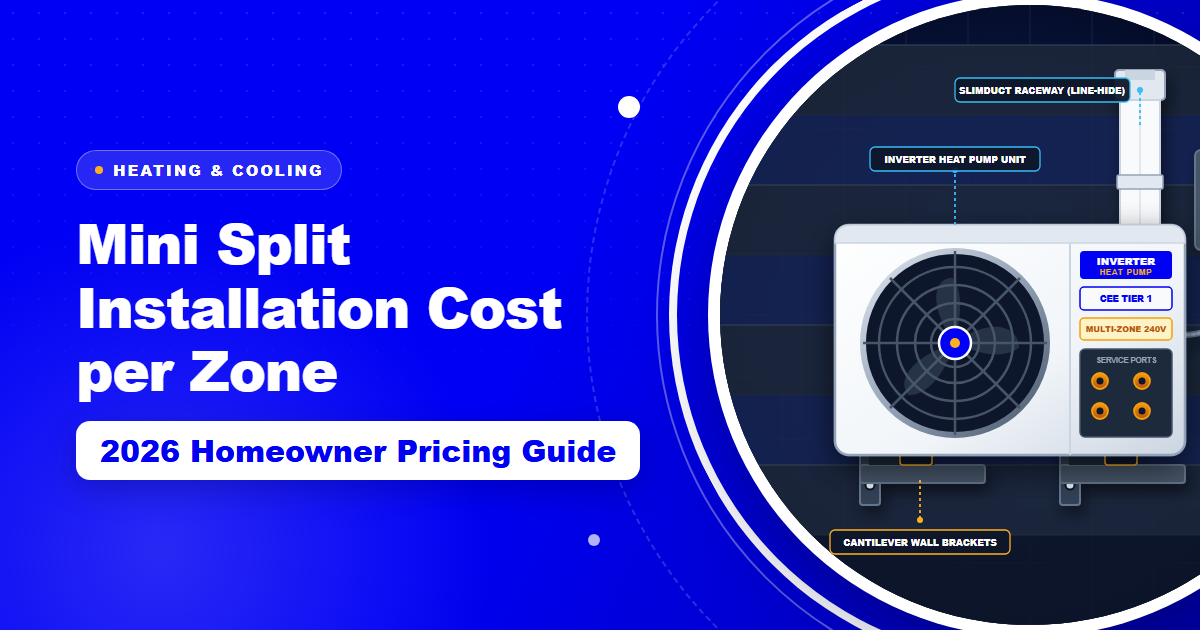
The average mini split installation cost ranges from $2,000 to $14,500, with most homeowners spending about $3,000 for a single-zone system and $11,000 for a whole-home setup. Across all configurations and equipment sizes, total turnkey project costs typically span between $2,000 and $22,000 depending on the number of indoor zones, electrical panel capacity, and installation complexity. A single-room addition costs between $500 and $5,000 installed (averaging $2,750), while multi-zone configurations scale from $4,550 for two zones up to $8,200 for five zones. For larger homes converting entirely to ductless heat pumps, high-efficiency turnkey systems average $19,556 after incentives ($25,393 before incentives).
Ductless mini-split heat pumps provide targeted heating and cooling without requiring expensive ductwork. Because each indoor air handler operates independently, you can adjust temperatures room by room and eliminate energy losses common in traditional central air systems. The overall project cost is driven primarily by how many rooms you condition, whether your electrical service panel requires an upgrade, and whether you select standard equipment or cold-climate hyper-heating models.
| System configuration | Typical equipment capacity | Average turnkey cost | Typical installed range | Federal tax credit potential |
|---|---|---|---|---|
| 1 Zone (single room / garage) | 0.75 to 1.5 tons (9,000 – 18,000 BTU) | $2,750 | $2,000 – $5,000 | 30% up to $2,000 |
| 2 Zones (master suite + living) | 1.5 to 2.5 tons (18,000 – 30,000 BTU) | $4,550 | $3,500 – $8,000 | 30% up to $2,000 |
| 3 Zones (multi-bedroom / floor) | 2.5 to 3.5 tons (30,000 – 42,000 BTU) | $5,450 | $5,000 – $11,000 | 30% up to $2,000 |
| 4 Zones (whole home standard) | 3.0 to 4.0 tons (36,000 – 48,000 BTU) | $6,650 | $7,000 – $15,000 | 30% up to $2,000 |
| 5 Zones (whole home large) | 4.0 to 5.0 tons (48,000 – 60,000 BTU) | $8,200 | $9,000 – $18,000+ | 30% up to $2,000 |
| Whole-home high efficiency (3.9 tons) | 3.9 tons (46,800 BTU average) | $19,556 (net) | $25,393 (gross) | $2,000 maximum credit |
Mini Split Cost per Zone: The 1-to-5 Zone Pricing Matrix
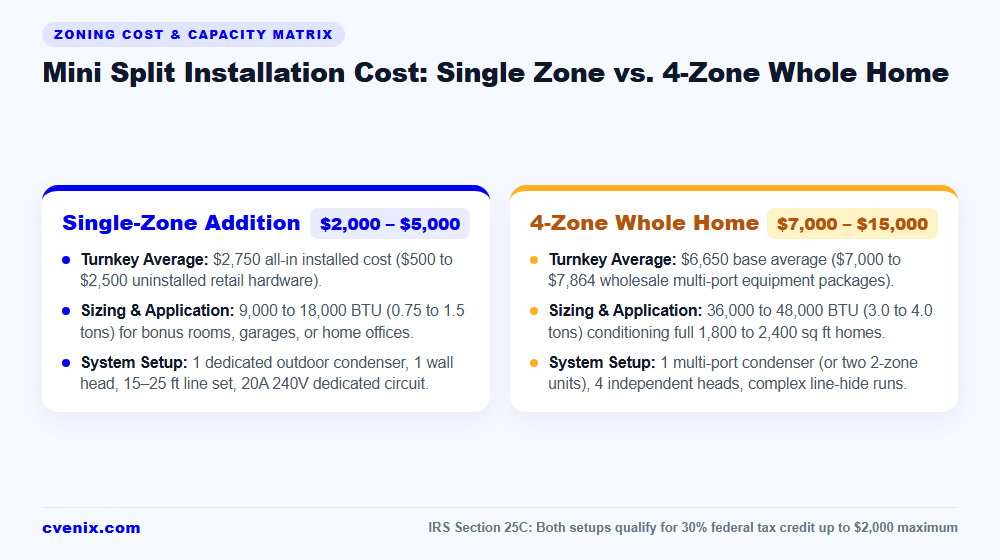
The number of zones is the primary driver of mini split installation cost. Each zone consists of an indoor air handler connected to an outdoor condenser by insulated refrigerant line sets, communication wiring, and a condensate drain line. While single-zone systems use a dedicated outdoor compressor, multi-zone setups connect multiple indoor heads to one large multi-port outdoor condenser or a pair of smaller compressors.
1-zone mini split installation cost ($2,000 to $5,000)
A single-zone mini split connects one indoor air handler to one outdoor condenser. The national average installed cost is $2,750, with turnkey installations typically ranging from $2,000 to $5,000. Entry-level equipment hardware can start around $500 for uninstalled DIY packages, but professional installation with certified electrical connections, vacuum testing, and mounting hardware brings the project into the $2,000 to $3,500 range for standard setups.
Single-zone units are ideal for heating and cooling bonus rooms above garages, home offices, sunrooms, master bedroom suites, and detached workshops. Equipment capacity typically spans 0.75 ton (9,000 BTU) to 1.5 tons (18,000 BTU), providing independent climate control without overloading your central heating and cooling system.
2-zone mini split installation cost ($3,500 to $8,000)
A dual-zone mini split pairs two indoor air handlers with a shared multi-port outdoor condenser. The national average installed cost is $4,550, with complete projects generally falling between $3,500 and $8,000 ($1,400 to $7,700 base project span). This configuration offers substantial savings over buying two separate single-zone systems because both indoor heads share a single outdoor mounting pad, electrical disconnect, and compressor cabinet.
Homeowners commonly use 2-zone systems to condition a primary bedroom suite and a nursery, or an open-concept living room and kitchen. Outdoor condenser capacities typically range from 1.5 to 2.5 tons (18,000 to 30,000 BTU), allowing each room to run at different temperatures or turn off completely when unoccupied.
3-zone mini split installation cost ($5,000 to $11,000)
A 3-zone mini split system heats and cools three distinct areas from a single multi-port outdoor condenser or two paired outdoor units. The national average installed cost is $5,450, with turnkey contractor quotes typically ranging from $5,000 to $11,000 ($1,800 to $9,100 base hardware and labor range). Premium systems designed for sub-zero northern winters sit at the upper end of this spectrum.
This configuration is popular for conditioning three upstairs bedrooms in a two-story home, or an open main floor paired with two secondary rooms. Sizing generally runs from 2.5 to 3.5 tons (30,000 to 42,000 BTU). In spread-out home layouts, contractors often recommend splitting the installation into one dual-zone unit and one single-zone unit to prevent running excessively long refrigerant line sets through interior ceilings.
4-zone mini split installation cost ($7,000 to $15,000)
A 4-zone mini split system provides a comprehensive whole-home heating and cooling solution for homes between 1,800 and 2,400 square feet. The national average installed cost is $6,650, while full turnkey bids from licensed HVAC contractors typically range from $7,000 to $15,000 ($2,600 to $10,700 base range).
Wholesale equipment for a 4-zone package (a 36,000 BTU outdoor condenser plus four 9,000 BTU indoor heads) costs between $7,000 and $7,864 depending on the manufacturer. Mitsubishi equipment lists around $7,767, Durastar at $7,864, LG at $7,157, and Fujitsu at $6,942. The difference between wholesale hardware and turnkey contractor bids covers multi-day labor, refrigerant piping, electrical circuit pulls, decorative line-hide raceways, and warranty coverage.
5-zone mini split installation cost ($9,000 to $18,000+)
A 5-zone mini split system is designed for large multi-room homes (2,400 to 3,000+ square feet) or multi-level properties requiring precise temperature regulation across every bedroom, office, and common living space. The national average installed cost is $8,200, with comprehensive contractor quotes ranging from $9,000 to $18,000 or more ($4,400 to $12,000 base range).
For five indoor zones, equipment options include a large 48,000 to 60,000 BTU 5-port multi-zone outdoor unit or a combination of two smaller compressors (such as one 3-zone unit and one 2-zone unit). Using two separate outdoor condensers often costs about the same in equipment, shortens exterior refrigerant runs, and provides valuable redundancy so half your home remains comfortable if one compressor needs servicing.
Master 1-to-5 zone cost comparison table
To help you budget accurately, the following matrix breaks down average equipment costs, professional labor expectations, and turnkey installation totals across one to five zones.
| Number of zones | Equipment hardware range | Labor cost range | Permits and electrical | Total installed cost range | National average cost | Best home application |
|---|---|---|---|---|---|---|
| 1 Zone | $500 – $2,500 | $1,000 – $2,000 | $300 – $600 | $2,000 – $5,000 | $2,750 | Bonus room, home office, sunroom, garage workshop |
| 2 Zones | $1,400 – $4,200 | $1,600 – $2,800 | $400 – $800 | $3,500 – $8,000 | $4,550 | Master suite and nursery, living room and kitchen |
| 3 Zones | $1,800 – $5,800 | $2,200 – $3,800 | $500 – $1,000 | $5,000 – $11,000 | $5,450 | Three second-floor bedrooms, partial-home retrofit |
| 4 Zones | $2,600 – $7,800 | $3,000 – $5,200 | $600 – $1,500 | $7,000 – $15,000 | $6,650 | Whole-home standard sizing (1,800 – 2,400 sq ft) |
| 5 Zones | $4,400 – $9,500 | $3,800 – $6,500 | $800 – $2,000 | $9,000 – $18,000+ | $8,200 | Large whole-home or multi-level zoned layout |
Mini Split Cost Breakdown: Equipment, Labor, and Permits
Understanding where your money goes helps you evaluate contractor estimates with confidence. A turnkey invoice reflects four core cost components: equipment hardware, professional labor, electrical infrastructure, and local permits.
Equipment hardware costs by brand and component
Equipment hardware represents approximately 30% to 50% of your total project invoice. Equipment prices vary significantly based on brand tier, inverter technology, and cold-climate heating performance:
- Mitsubishi Electric ($1,200 to $8,650): Industry gold standard for inverter reliability, whisper-quiet operation, and low-ambient heating (Hyper-Heat H2i).
- Fujitsu ($1,100 to $8,300): High-efficiency Japanese engineering (Halcyon series) with outstanding heating capacity in freezing temperatures.
- Daikin ($1,000 to $4,000): Global leader in variable-speed compressor technology offering robust mid-tier and high-tier systems.
- Rheem ($1,100 to $8,300): Widely distributed residential units with reliable contractor supply chain support.
- Panasonic ($1,700 to $2,800): Compact, energy-efficient units featuring advanced air purification and filtration technology.
Wholesale catalog pricing reveals that a 4-zone multi-split equipment package (36,000 BTU condenser plus four 9,000 BTU heads) costs $7,767 for Mitsubishi, $7,864 for Durastar, $7,157 for LG, and $6,942 for Fujitsu. Premium brands command higher prices because of their superior variable-speed electronics and extended 10-to-12 year manufacturer warranties.
Indoor air handler form factors and styling costs
Indoor air handlers are available in four distinct form factors to fit your home’s aesthetics and architecture:
- Wall-mounted heads ($400 to $1,000): The most popular and economical option. Mounted high on an exterior or interior wall, they provide excellent airflow and the highest seasonal energy efficiency.
- Ceiling cassettes ($500 to $2,000): Recessed flush between standard ceiling joists with only an architectural grille visible. They require attic clearance or ceiling cavity access and a built-in condensate lift pump.
- Floor-mounted consoles ($1,300 to $4,000): Installed low along the wall near baseboards. They are ideal for rooms with low knee walls, cathedral ceilings, or historic homes replacing cast-iron steam radiators. They deliver excellent winter heating comfort at floor level.
- Ceiling-suspended or concealed duct units ($700 to $2,000): Tucked away in a crawl space, attic, or closet soffit, feeding short duct runs to one or two adjoining rooms for completely hidden climate control.
Labor rates, crew hours, and installation complexity
Labor represents roughly 25% to 35% of the total installation invoice. According to a primary 2026 HVAC homeowner survey of 1,000 respondents, over two-thirds (72%) of homeowners who had a ductless mini-split installed paid $150 per hour or more in labor.
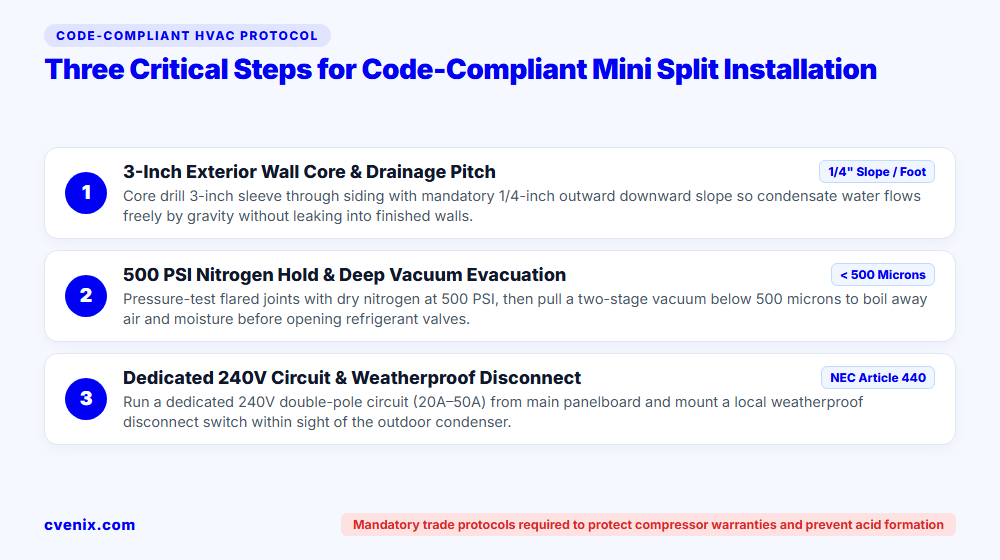
A standard single-zone installation requires 8 to 12 crew hours ($1,200 to $1,800 in labor), while a 4-zone or 5-zone whole-home installation takes a certified 2-person crew two to three full working days (16 to 24 crew hours, costing $2,400 to $4,800 in labor). Certified technicians perform demanding technical tasks: core-drilling exterior wall penetrations with proper pitch, flaring copper lines, running nitrogen holding tests at 500 PSI, and pulling a deep vacuum below 500 microns to remove air and moisture.
Electrical wiring, 240V circuits, and service panel upgrades
Mini-split heat pumps cannot be plugged into a standard 120-volt wall outlet. Every outdoor condenser requires a dedicated 240-volt double-pole electrical circuit (20 to 50 amps depending on tonnage) and an exterior weatherproof disconnect box mounted within sight of the condenser, costing $500 to $1,500 installed by a licensed electrician.
Older homes with 100-amp electrical service often lack the physical breaker capacity to add a large 30-amp to 50-amp heat pump circuit. Upgrading your main electrical panelboard to 200 amps costs between $1,500 and $3,500. Upgrading to a panelboard of not less than 200 amps qualifies for a separate 30% federal tax credit up to $600 under IRS Section 25C.
Municipal permits, refrigerant regulations, and code inspections
Local municipal permits for mechanical and electrical work typically cost $150 to $450. Permitting ensures that exterior electrical disconnects comply with National Electrical Code (NEC Article 440) safety requirements and that structural wall penetrations maintain building envelope integrity.
Under EPA Section 608 regulations, handling and releasing fluorinated refrigerants (R-410A and R-32) requires certified technicians. Skipping permits can void your manufacturer warranty, complicate future home sales, and leave you financially liable if electrical fires occur.
Complete itemized cost breakdown table
The table below itemizes the components of a typical multi-zone mini split installation, showing where your project budget is allocated.
| Cost category | Specific component | Average cost range | Share of total project budget | Pricing notes |
|---|---|---|---|---|
| Outdoor condenser | Variable-speed inverter compressor | $1,000 – $8,650 | 30% – 40% | Driven by tonnage, multi-port capacity, and cold-climate heating rating |
| Indoor air handlers | Wall, cassette, or floor-mounted heads | $400 – $4,000 per head | 20% – 30% | Standard wall units are most economical; floor and cassette heads cost more |
| Refrigerant lines & covers | Insulated copper line sets & line-hide raceways | $200 – $800 | 5% – 10% | Standard line runs include 15 to 25 ft; extra length costs $5 – $10 per linear foot |
| Professional HVAC labor | Certified 2-person installation crew ($150+/hr) | $1,200 – $4,800 | 25% – 35% | Covers 8 to 24 crew hours for wall core drilling, lineset brazing, and vacuum decay |
| Electrical circuit & disconnect | Dedicated 240V circuit & outdoor disconnect switch | $500 – $1,500 | 5% – 10% | Installed by licensed electrician; required by National Electrical Code |
| Service panel upgrade | 200-amp main electrical panelboard replacement | $1,500 – $3,500 | Optional upgrade | Required if older 100A panel lacks breaker slots; qualifies for $600 tax credit |
| Municipal permits & inspection | Local building and mechanical permit fees | $150 – $450 | 2% – 4% | Mandatory for code compliance, safety validation, and manufacturer warranty |
| Mounting & drainage accessories | Condenser wall bracket, pad, condensate pump | $150 – $600 | 2% – 5% | Includes wall brackets ($40 – $100) and cold-climate drain pan heaters ($140 – $560) |
Key Factors That Drive Mini Split Installation Costs
Mini split quotes can vary widely between two similar homes. Several technical and structural factors determine whether your installation falls toward the bottom or the top of the price range.
Sizing and capacity by tonnage and BTUs
System sizing directly impacts equipment pricing. Your contractor should perform an ACCA Manual J heating and cooling load calculation to evaluate your home’s square footage, ceiling heights, window orientation, and insulation levels. Installing the wrong size creates chronic comfort problems.
Typical installed cost ranges based on equipment capacity include:
- 0.75 Ton (9,000 BTU): $3,000 to $4,200 (suitable for small rooms or home offices up to 400 square feet).
- 1.0 Ton (12,000 BTU): $3,500 to $5,000 (ideal for master bedrooms or medium living spaces of 400 to 550 square feet).
- 2.0 Tons (24,000 BTU): $6,000 to $8,000 (designed for large open floor plans or two combined zones of 800 to 1,200 square feet).
- 3.0 Tons (36,000 BTU): $8,000 to $11,000 (powers 3-zone systems covering 1,200 to 1,800 square feet).
- 4.0 Tons (48,000 BTU): $12,000 to $15,000 (whole-home multi-split coverage for 1,800 to 2,400 square feet).
- 5.0 Tons (60,000 BTU): $15,000 to $18,000 (large whole-home applications of 2,400 to 3,000+ square feet).
Avoid the temptation to oversize your indoor heads. An oversized mini-split cools a room too quickly and satisfies the thermostat before extracting moisture from the air. This causes short-cycling and leaves your room feeling cold and clammy.
Brand tier selection and cold-climate inverter performance
Brand selection influences both upfront pricing and winter reliability. Tier 1 Japanese manufacturers (Mitsubishi Electric, Fujitsu, and Daikin) cost 20% to 40% more than budget import brands, but they feature advanced inverter-driven rotary compressors designed to operate in severe climates.
In cold northern regions, selecting a cold-climate heat pump (such as Mitsubishi Hyper-Heat H2i) is essential. These models maintain 100% heating output at outdoor temperatures as low as -5°F without needing supplemental electric resistance heat strips. In contrast, standard budget mini-splits lose up to 50% of their heating capacity when temperatures drop below 15°F, causing indoor comfort to plummet during deep freezes.
Line set run lengths, wall penetrations, and line-hide raceways
Standard manufacturer equipment kits include 15 to 25 feet of copper line set per indoor head. When indoor heads are located on second-story walls or far from the outdoor condenser, technicians must solder extension tubing at $5 to $10 per linear foot and add extra refrigerant.
Routing lines through finished interior walls, attics, or crawl spaces adds $300 to $800 per zone in carpentry labor. On home exteriors, line sets should be encased in durable PVC line-hide raceways (such as Slimduct or SpeediChannel). These raceways protect the foam insulation from UV degradation, prevent rodent chewing, and match your home’s siding.
Single multi-split condenser vs. multiple outdoor units
Many homeowners assume that installing a single large 4-zone or 5-zone condenser is always cheaper and better than installing two smaller outdoor units. However, using two separate condensers (such as two 2-zone units) often costs nearly the same in equipment while providing major functional advantages.
Two independent outdoor compressors shorten refrigerant line runs to opposite sides of your house and minimize exterior line-hide clutter. Even more importantly, dual units provide heating redundancy: if one compressor requires service during a winter cold snap, the second compressor continues heating half your home.
Ductless mini-split vs. central AC and ducted heat pumps
Homeowners frequently weigh ductless systems against ducted central heat pumps. According to EnergySage marketplace data, turnkey whole-home ductless heat pumps average $4,944 per ton, totaling $19,556 installed after incentives ($25,393 before incentives) for a typical 3.9-ton home system.
Ducted central heat pumps average $15,326 installed after incentives, but adding new ductwork to a home without existing ducts costs an additional $2,000 to $10,000. When comparing total heat pump installation cost, ductless mini-splits save thousands of dollars in older homes with radiant or baseboard heat because they bypass duct construction entirely. If your home already has sound, well-insulated ductwork, reviewing your options for central AC replacement cost will help you determine whether replacing your central unit or switching to zoned mini-splits offers better long-term value.
State and Regional Mini Split Installation Costs
Mini split installation costs vary across the country based on local labor rates, heating climate severity, and municipal permitting standards.
How climate zones, heating degree days, and regional labor rates impact pricing
Three geographic factors explain regional quote differences:
- Cold northern climates: States with severe winters (New York, Massachusetts, Illinois) require cold-climate heat pump hardware, outdoor snow stands, and factory drain pan heaters ($140 to $560) to prevent ice accumulation, increasing equipment costs by 15% to 25%.
- High-cost metropolitan markets: Dense urban regions (New York City, Boston, San Francisco) have high prevailing labor rates where certified HVAC technicians bill over $200 per hour, adding $2,500 to $4,500 per zone in labor alone.
- Mild southern climates: Sunbelt states (Texas, Florida) focus primarily on cooling efficiency (SEER2), enabling the use of standard-ambient mini-splits with lower equipment costs and shorter installation times.
State-by-state mini split cost benchmark table
The following table illustrates typical turnkey installation costs across representative states based on local labor indices and climate demands.
| State | Typical 1-zone installed cost | Typical 3-zone installed cost | Typical 5-zone installed cost | Regional labor index | Heating climate factor |
|---|---|---|---|---|---|
| New York | $3,200 – $5,500 | $6,200 – $12,500 | $10,500 – $20,000+ | Very high | Extreme cold (cold-climate unit required) |
| Massachusetts | $3,100 – $5,400 | $6,000 – $12,000 | $10,000 – $19,500 | High | Severe winter heating demand |
| California | $3,000 – $5,200 | $5,800 – $11,500 | $9,500 – $18,500 | Very high | High cooling demand, mild winters |
| Washington | $2,800 – $4,800 | $5,500 – $10,500 | $9,000 – $17,000 | Moderate to high | Moderate heating, high heat pump adoption |
| Illinois | $2,700 – $4,900 | $5,400 – $10,800 | $8,800 – $17,500 | Moderate | Deep freeze winter conditions |
| Ohio | $2,500 – $4,500 | $5,000 – $9,800 | $8,000 – $16,000 | Moderate | Mixed humid summer, freezing winter |
| Florida | $2,400 – $4,200 | $4,800 – $9,200 | $7,800 – $15,000 | Moderate | Extreme cooling, minimal heating |
| Texas | $2,300 – $4,200 | $4,700 – $9,000 | $7,500 – $14,800 | Low to moderate | High cooling, occasional freeze |
| Colorado | $2,900 – $5,000 | $5,600 – $11,200 | $9,200 – $18,000 | Moderate to high | High altitude, sub-zero cold climate |
Federal Tax Credits and Utility Rebates: IRS Section 25C Math
Federal incentives substantially lower the net out-of-pocket cost of installing an energy-efficient ductless mini-split heat pump.
Understanding the 30% Section 25C heat pump tax credit ($2,000 maximum)
Under Section 25C of the Internal Revenue Code (Energy Efficient Home Improvement Credit), homeowners who install qualifying electric air-source heat pumps can claim a nonrefundable tax credit equal to 30% of project costs up to an annual maximum of $2,000.
Because the credit is calculated at 30%, you reach the maximum $2,000 tax credit threshold when your project expenditure reaches $6,667 ($6,667 multiplied by 0.30 equals $2,000.10). Any qualifying multi-zone mini split installation costing $6,667 or more qualifies for the full $2,000 federal deduction against your tax liability. This credit applies to existing primary residences; new home construction does not qualify.
Consortium for Energy Efficiency tier standards and Form 5695 filing
Not all mini-split systems qualify for the federal tax credit. To be eligible, the heat pump model must meet or exceed the highest efficiency tier established by the Consortium for Energy Efficiency (CEE) in effect at the beginning of the installation year. In northern regions, equipment must also satisfy cold-climate heating performance criteria.
To claim the credit, request the Air-Conditioning, Heating, and Refrigeration Institute (AHRI) certificate from your HVAC contractor upon project completion. Your installer must provide the Qualified Manufacturer Identification Number (QMID), which you submit on IRS Form 5695 (Residential Energy Credits) when filing your annual federal tax return.
Electric panel upgrade credit ($600 separate limit)
If your home requires an electrical panel upgrade or a subpanel to handle your new mini-split heat pump, IRS Section 25C provides a separate 30% tax credit up to $600. To qualify, the electrical panelboard must have an amp capacity of not less than 200 amps.
By combining the $2,000 heat pump credit with the $600 panelboard upgrade credit, you can claim up to $2,600 in total federal tax credits for your project. This falls comfortably within the annual $3,200 overall Section 25C cap.
State clean energy rebates and utility incentives
In addition to federal tax credits, many states and electric utilities offer significant upfront rebates for converting to ductless heat pumps. Programs like Mass Save in Massachusetts, NYSERDA in New York, and Tech Clean California offer rebates ranging from $500 to over $3,000 per ton of installed capacity. These utility rebates stack directly on top of federal tax credits, reducing your net system cost even further.
DIY vs. Professional Mini Split Installation
The promise of saving thousands of dollars in labor tempts many handy homeowners to attempt DIY mini-split installations. While pre-charged systems like MrCool have made homeowner installation possible, significant mechanical risks and long-term service realities must be evaluated.
Upfront cost comparison: MrCool DIY kits vs. turnkey professional installation
A 4th Generation MrCool DIY multi-zone kit (18,000 to 48,000 BTU, two to five zones) costs between $1,600 and $4,500 in retail hardware. Comparing this against a turnkey contractor quote of $8,000 to $15,000 suggests an apparent upfront savings of $4,000 to $10,000.
However, DIY installations are rarely completely free of professional labor. You must still hire a licensed electrician to run a dedicated 240-volt circuit and mount an exterior disconnect ($500 to $1,500), purchase local permits ($150 to $400), pour an equipment pad or buy wall brackets ($80 to $150), and install decorative line-hide raceways ($120 to $250). True DIY project expenditures generally range between $2,500 and $6,800.
The engineering trap: excess pre-charged lines and compressor oil traps
MrCool and similar DIY systems use factory pre-charged Quick Connect line sets (sold in fixed lengths of 16, 25, 35, and 50 feet). These lines cannot be cut, shortened, or flared. If you cut a pre-charged line set, you release pressurized refrigerant into the atmosphere, destroy the line set, void the warranty, and face federal Clean Air Act violations.
This creates a common dilemma: what do you do with 15 to 30 feet of leftover copper line? Many homeowners coil the excess lines vertically against the exterior wall. This vertical coiling creates a severe gravitational oil trap. Refrigerant oil circulates with the refrigerant to lubricate the compressor motor; in a vertical coil, oil pools at the bottom of the loops, starving the compressor of lubrication and causing it to seize within one to three years.
Proper practice requires coiling excess pre-charged lines horizontally flat behind the condenser cabinet with gentle curves. If you kink the soft copper tubing while unrolling it, the line set is ruined and must be replaced.
The service orphan reality: why HVAC companies refuse DIY units
The most overlooked risk of DIY installation is the ‘service orphan’ dilemma. Over 95% of licensed HVAC companies maintain strict company policies against servicing, troubleshooting, or recharging homeowner-installed mini-splits.
If a quick-connect fitting develops a refrigerant leak after 14 months or an inverter circuit board fails, professional contractors will refuse to dispatch a technician to work on customer-installed equipment. Homeowners are left completely stranded, forced to troubleshoot electrical error codes alone or replace the entire system at their own expense.
Electrical hazards, refrigerant flaring tools, and vacuum testing
Installing a professional brand like Mitsubishi, Daikin, or Fujitsu requires specialized tools and trade techniques costing $800 to $1,500: an eccentric cone flaring block, a digital torque wrench, a two-stage vacuum pump, a digital micron gauge, and a nitrogen pressure testing regulator.
Licensed technicians pressure-test the copper lines with dry nitrogen at 500 PSI to verify that flare connections are leak-free before pulling a deep vacuum below 500 microns. A deep vacuum eliminates all atmospheric moisture from the system. If moisture remains inside the lines, it reacts with refrigerant and synthetic oil to create hydrofluoric acid, destroying the compressor’s motor windings from the inside out.
Contractor quote shock and how to avoid bloated bids
Many homeowners experience sticker shock when corporate HVAC companies quote $35,000 to $50,000 for a 4-zone installation. These bloated quotes often come from private-equity-backed HVAC consolidators with massive marketing overhead and aggressive sales commissions.
To secure a fair price, solicit quotes from small independent 1-to-3 person HVAC shops and factory-certified Mitsubishi Diamond Contractors. Independent contractors typically offer identical equipment with manufacturer-backed 10-to-12 year warranties at prices 30% to 40% below large regional franchise operations.
Questions to ask a mini split installation contractor
Before signing an installation contract, ask prospective contractors these six vetting questions:
- Did you perform an ACCA Manual J load calculation to size each indoor head and the outdoor condenser accurately?
- Does your turnkey quote include pulling a dedicated 240-volt circuit and exterior disconnect, or must I hire a separate electrician?
- Do you conduct a 500 PSI nitrogen pressure hold test and a vacuum decay test below 500 microns before releasing refrigerant?
- Are protective exterior line-hide raceways included along all outdoor wall penetrations?
- Does this specific equipment model meet the Consortium for Energy Efficiency highest tier for the $2,000 Section 25C federal tax credit?
- Are you an authorized factory dealer providing an extended 10-to-12 year parts and compressor warranty?
Repair vs. Replacement: When Is a Mini Split Worth Fixing?
If you have an existing ductless mini-split experiencing performance issues, knowing whether to repair or replace the system protects your budget.
Signs your mini split needs repair
Minor performance issues and electrical component failures are usually worth repairing when the system is under 10 years old:
- Clogged filters and dirty blower wheel ($100 to $250): Restricts airflow and reduces cooling output. A professional deep coil and blower cleaning restores efficiency.
- Blocked condensate drain line ($150 to $300): Causes water to drip from the indoor head onto walls or flooring. Easily cleared with a nitrogen blow-out.
- Failed run capacitor or control fuse ($150 to $350): Simple electrical repairs that quickly restore outdoor fan and compressor operation.
- Faulty thermistor or room sensor ($200 to $450): Causes temperature inaccuracies or short-cycling; easily replaced by an HVAC technician.
Signs it is time for a full system replacement
Major mechanical failures in older units warrant complete replacement. You should replace your system if you encounter:
- Inverter compressor failure ($1,500 to $3,000): Replacing the compressor motor on an out-of-warranty system rarely makes financial sense compared to buying a new, higher-efficiency unit.
- Severe refrigerant leaks in coils ($1,200 to $2,500): Pinhole leaks in aluminum condenser or evaporator coils are difficult to patch reliably.
- System age over 12 to 15 years: Older systems using phased-out R-410A refrigerant face rising recharge costs.
- The 50% repair rule: If a repair estimate exceeds 50% of the replacement cost of a new mini-split, invest that money into a new system with full warranty coverage.
If your existing mini-split is paired with an aging heating system, consider your options for complete home electrification. Review our guide on furnace replacement cost to decide whether replacing a fossil fuel furnace with an expanded multi-zone heat pump offers superior long-term energy savings.
Lifespan, return on investment, and monthly energy bill savings
A quality, professionally installed ductless mini-split has an expected lifespan of 15 to 20 years when serviced annually. Because mini-split inverters modulate power continuously rather than cycling on and off at full blast, they reduce electrical wear and tear.
Ductless systems deliver immediate returns through lower utility bills. According to the 2026 HVAC homeowner survey of 1,000 respondents, nearly 90% of homeowners who replaced their heating and cooling equipment saved $25 or more on their monthly energy bill. If you are replacing electric baseboard heaters, fuel oil, or inefficient window air conditioners, monthly savings often reach 30% to 50%.
Methodology and Data Sources
Cvenix maintains strict editorial and engineering standards to provide transparent, accurate home improvement cost benchmarks.
Data collection and pricing research framework
The pricing data in this guide synthesizes verified contractor bids, homeowner transactions, and trade pricing models from the following authoritative sources:
- EnergySage Heat Pump Marketplace: Analyzed real homeowner quotes, equipment catalog benchmarks, and per-ton costs across thousands of ductless heat pump installations.
- This Old House 2026 HVAC Consumer Survey: Survey of 1,000 US homeowners who repaired or replaced heating and cooling equipment, establishing verified labor hourly benchmarks and monthly utility savings.
- Wholesale HVAC Catalog Pricing: Real hardware wholesale baselines from Mitsubishi Electric, Fujitsu, Daikin, LG, and Rheem distributor networks.
- RSMeans Construction Cost Data: Standardized regional labor and material cost indexing models for electrical, mechanical, and residential remodeling trades.
- Trade Community Installation Reviews: Real-world quote verification and mechanical troubleshooting analysis from r/heatpumps and r/hvacadvice.
Government programs and technical standards cited
Technical definitions, efficiency ratings, and statutory incentives referenced in this report adhere to official regulatory standards:
- Internal Revenue Service (IRS): Section 25C Energy Efficient Home Improvement Credit statutory rules, Form 5695 instructions, and Qualified Manufacturer Identification Number (QMID) validation.
- Consortium for Energy Efficiency (CEE): Highest Efficiency Tiers for Air-Source Heat Pumps governing federal tax credit eligibility.
- U.S. Department of Energy (DOE): Appendix M1 to Subpart B of 10 CFR Part 430 establishing SEER2 and HSPF2 test procedures.
- Air-Conditioning, Heating, and Refrigeration Institute (AHRI): Directory of Certified Product Performance for heat pump capacity and efficiency verification.
- National Fire Protection Association (NFPA): National Electrical Code (NEC Article 440) for HVAC branch circuits, conductor sizing, and disconnect switches.
Frequently Asked Questions About Mini Split Installation Costs
How much does it cost to install a mini-split per zone?
Installing a mini-split costs between $1,500 and $3,500 per zone on average for multi-zone systems. A dedicated single-zone system typically costs $2,000 to $5,000 installed, with the national average sitting around $2,750. Systems with 2 to 5 zones benefit from shared outdoor compressors, reducing the incremental cost per additional indoor head to $1,200 to $2,500.
How much does a 3-zone mini-split cost to install?
A 3-zone mini-split costs between $5,000 and $11,000 installed, with the national average around $5,450. Pricing depends on total BTU capacity (typically 28,000 to 36,000 BTUs), whether you choose wall or ceiling heads, and the distance of refrigerant lines from the outdoor condenser.
Do mini-splits qualify for the $2,000 federal tax credit?
Yes. Under IRS Section 25C, qualifying electric air-source heat pumps receive a 30% tax credit up to a maximum of $2,000 per year. To qualify, the system must meet or exceed the highest efficiency tier set by the Consortium for Energy Efficiency (CEE). Homeowners reach the full $2,000 credit cap with a project cost of $6,667 or more.
Is it cheaper to install a mini-split yourself?
Upfront equipment for a DIY system (like MrCool) costs $1,600 to $4,500, which is $3,000 to $8,000 less than hiring a contractor. However, you must still pay $500 to $1,500 for a licensed electrician to pull a dedicated 240-volt circuit and disconnect. Furthermore, professional HVAC contractors universally refuse to service or recharge DIY units, leaving you without support if a leak or board failure occurs.
What size electrical breaker and panel do I need for a mini-split?
Most residential mini-splits require a dedicated 240-volt double-pole breaker between 20 amps and 50 amps, depending on condenser tonnage. Homes with older 100-amp service panels may need an upgrade to 200 amps ($1,500 to $3,500), which itself qualifies for a separate 30% IRS Section 25C tax credit up to $600.
Can a ductless mini-split heat and cool a whole house?
Yes. A 3-zone, 4-zone, or 5-zone multi-split heat pump setup can fully heat and cool an entire home. In cold northern climates, ensure you install a cold-climate rated system (such as Mitsubishi Hyper-Heat or Fujitsu Halcyon) that maintains 100% heating capacity down to -5°F without relying on electric resistance heat strips.
Why are contractor quotes for mini-splits so expensive?
While wholesale equipment for a 4-zone system costs $7,000 to $7,800, contractor quotes often range from $12,000 to $18,000+. The difference covers two full days of skilled 2-person labor ($150+ per hour), 240-volt electrical wiring, vacuum decay and pressure testing, municipal permits, company overhead, and a 10-to-12 year warranty on parts and labor.
How much money does a mini-split save on monthly electric bills?
Nearly 90% of homeowners save $25 or more on their monthly electric bill after replacing older equipment with an inverter mini-split. If you are replacing electric baseboard heaters, fuel oil, or window air conditioners, monthly savings can reach 30% to 50% due to high SEER2 and HSPF2 inverter efficiency.
Can you coil excess pre-charged line set on a DIY mini-split?
Yes, but you must coil it horizontally flat behind the outdoor condenser. You should never coil pre-charged lines vertically because gravity causes compressor oil to pool at the bottom of the loops, starving the compressor and leading to premature motor burnout. Never attempt to cut or shorten pre-charged lines.
How long does a mini-split last compared to central AC?
A properly maintained ductless mini-split lasts 15 to 20 years, which is comparable to or slightly longer than traditional central air conditioning systems (12 to 15 years). Routine filter cleaning every 4 to 6 weeks and an annual professional coil cleaning are essential to maximize equipment life.

