

The national average french drain installation cost is $5,000, with most homeowners spending between $1,650 and $12,250 for a full installation. Across all project sizes, total costs typically range from $500 to $18,000. On a per-foot basis, expect to pay $10 to $35 per linear foot for a shallow exterior yard curtain drain, $30 to $90 per linear foot for a deep exterior foundation footing drain, and $40 to $85 per linear foot for an interior basement perimeter drain. Total pricing depends primarily on excavation depth, ground accessibility, pipe durability, and whether your property requires an integrated sump pump.
French drains solve chronic moisture problems by redirecting water through a gravel-filled trench and perforated conduit before hydrostatic pressure damages your foundation or turns your lawn into standing mud. Because labor and machine excavation make up 70% to 85% of contractor invoices, understanding the structural differences between drain styles helps you choose the right fix without paying for unnecessary excavation.
| Drain type | Cost per linear foot | Typical project cost | Trench depth | Best application |
|---|---|---|---|---|
| Shallow yard curtain drain | $10 – $35 | $500 – $8,800 | 12 – 24 inches | Capturing surface runoff and drying waterlogged lawns |
| Deep exterior footing drain | $30 – $90 | $4,500 – $22,500 | 4 – 8 feet | Stopping hydrostatic groundwater pressure against basement walls |
| Interior basement perimeter drain | $40 – $85 | $4,000 – $17,000 | Below floor slab | Collecting basement floor seepage and routing water to a sump basin |
| Crawl space perimeter drain | $20 – $40 | $2,000 – $8,000 | 10 – 18 inches | Eliminating standing puddles and ground dampness under crawl spaces |
French Drain Cost per Linear Foot by Type
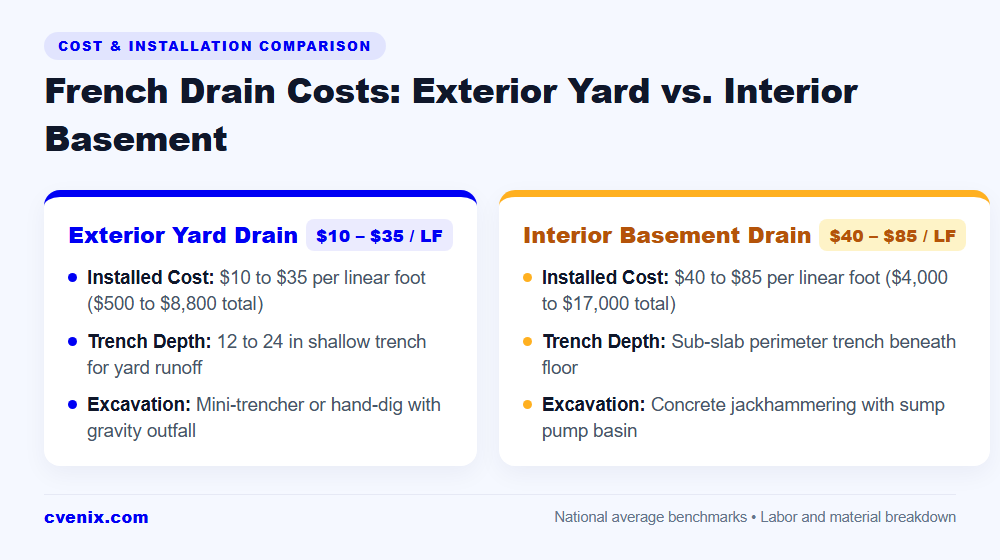
The term French drain covers several distinct drainage designs. While they all rely on perforated pipe surrounded by clean washed aggregate, the depth of excavation and physical location create massive pricing spreads. Digging a shallow 18-inch ditch through an open lawn requires a fraction of the labor needed to break open a concrete basement floor or excavate an 8-foot trench beside an existing foundation wall.
Curtain drain (shallow yard drainage)
A curtain drain is a shallow exterior French drain dug between 12 and 24 inches deep across a yard, lawn, or landscape bed. Professional installation costs $10 to $35 per linear foot, bringing total project costs to $500 to $8,800 depending on length. Contractors dig these trenches along sloped turf or slightly uphill from a home to catch shallow subsurface water and sheet runoff before it saturates the soil.
Because curtain drains sit shallowly in topsoil, contractors can dig them quickly using walk-behind mechanical trenchers or small utility equipment. While ideal for squishy lawns and standing turf puddles, a shallow curtain drain cannot prevent water from leaking through basement walls or rising beneath concrete foundation slabs.
Deep exterior foundation drain (footing weeping tile)
A deep exterior foundation drain, often called weeping tile, is installed 4 to 8 feet below grade directly beside your concrete foundation footing. Professional installation costs $30 to $90 per linear foot, with full residential projects averaging $4,500 to $22,500. This system protects structural integrity by relieving subterranean hydrostatic pressure before moisture pushes through concrete masonry joints.
Excavating down to home footings requires heavy machinery, safety trench shoring, and extensive soil displacement. Crews wash and seal the exterior foundation walls, apply dimpled drainage membrane, place perforated pipe, and backfill with tons of washed gravel. Building codes like International Residential Code (IRC) Section R405.1 require these perimeter drains around all concrete or masonry foundations that retain earth and enclose habitable space below grade. Failing to manage this water pressure can lead to severe structural cracking and tens of thousands of dollars in foundation repair costs.
Interior basement perimeter French drain
An interior basement French drain runs along the inside perimeter of basement foundation walls beneath the finished concrete floor. Professional installation costs $40 to $85 per linear foot, with complete jobs ranging from $4,000 to $17,000. In complex basements with tight utility lines or thick structural slabs, costs can reach $100 per linear foot.
To install an interior drain, a crew uses jackhammers to break a 12-inch to 18-inch trench through the concrete floor slab along exterior walls, costing roughly $15 to $30 per linear foot just for slab breakout and rubble removal. The crew lays perforated pipe over clean crushed stone, installs a wall drainage flange to catch weeping moisture from concrete blocks, repours fresh concrete over the trench, and routes the pipe into a sealed basin. This interior setup requires an active electrical lift station, making the sump pump replacement cost of $500 to $1,800 an essential part of the total waterproofing budget.
Crawl space French drain
A crawl space French drain costs $20 to $40 per linear foot, with total project budgets averaging $2,000 to $8,000. Contractors install these perimeter lines inside dirt or gravel crawl spaces around interior foundation walls to intercept rising water tables and foundation wall seepage.
Crawl space work carries low excavation depth (usually 10 to 18 inches), but tight clearance forces technicians to dig trenches manually with hand tools and transport soil out in buckets. Installing a crawl space French drain is often paired with a heavy 20-mil vapor barrier and dehumidifier system. Leaving high crawl space humidity unaddressed promotes fungal growth and wood rot, eventually triggering steep crawl space mold remediation cost invoices that easily exceed the initial drainage price.
Controlling crawl space groundwater is also a vital step for overall building envelope performance. Pairing perimeter crawl space drainage with sealed encapsulation and whole-home moisture control and insulation stabilizes indoor relative humidity and cuts HVAC cooling loads throughout humid summer months.
French drain type comparison table
| Drain type | Cost per linear foot | Typical project cost | Trench depth | Primary location | Best application |
|---|---|---|---|---|---|
| Shallow yard curtain drain | $10 – $35 | $500 – $8,800 | 12 – 24 in | Open yard or lawn perimeter | Surface ponding and lawn saturation |
| Deep exterior footing drain | $30 – $90 | $4,500 – $22,500 | 4 – 8 ft | Exterior foundation perimeter | Hydrostatic wall pressure and deep water tables |
| Interior basement perimeter drain | $40 – $85 | $4,000 – $17,000 | Under floor slab | Interior basement perimeter | Floor seepage and block wall moisture intrusion |
| Crawl space perimeter drain | $20 – $40 | $2,000 – $8,000 | 10 – 18 in | Interior crawl space perimeter | Chronic crawl space dampness and mud accumulation |
French Drain Cost by Linear Footage
The total linear footage of your drainage run directly determines project costs, pipe requirements, and aggregate weight. Drainage contractors measure properties in linear feet to calculate excavator hours, crushed stone tonnage, and outfall distance.
Project sizing matrix (25 to 200 linear feet)
Project budgets scale based on both footage and location. Shallow yard drains rely primarily on natural gravity slope, while longer basement runs require dedicated mechanical sump basins to eject thousands of gallons during heavy rainstorms.
| Trench length (linear feet) | Exterior yard drain cost | Interior basement drain cost | Typical sump pumps required | Common project scale |
|---|---|---|---|---|
| 25 linear feet | $250 – $900 | $1,000 – $2,100 | 0 (gravity) or 1 pump | Small patio edge or localized lawn low spot |
| 50 linear feet | $500 – $1,800 | $2,000 – $4,300 | 0 (gravity) or 1 pump | Side yard swale or single basement wall run |
| 100 linear feet | $1,000 – $3,500 | $4,000 – $8,500 | 1 pump (interior) | Standard yard curtain or average basement perimeter |
| 150 linear feet | $1,500 – $5,300 | $6,000 – $12,800 | 2 pumps (interior) | Extended yard border or large basement perimeter |
| 200 linear feet | $2,000 – $7,000 | $8,000 – $17,000 | 2 pumps (interior) | Full residential perimeter or wrap-around foundation |
How linear footage impacts labor efficiency
Contractors face fixed mobilization costs on every job, including equipment trailering, crew transportation, and safety setup. For short runs of 25 linear feet or less, many contractors charge a minimum job fee of $500, pushing the effective cost per linear foot toward the top of the price range.
As trench length increases toward 100 or 150 linear feet, equipment efficiency improves because machine operators can dig long continuous trenches without frequent repositioning. However, longer runs introduce slope challenges. Maintaining a proper 1% gravity grade over 150 feet requires the trench to deepen by 1.5 feet between start and finish, which increases dirt volume and gravel backfill requirements near the outfall.
French Drain Cost Breakdown: Materials, Labor, and Permits
A detailed review of contractor estimates reveals that raw materials represent only 15% to 30% of your total expenditure. The remaining 70% to 85% pays for skilled labor, excavation machinery, dirt hauling, and municipal building permits.
Drainage pipe materials and hardware
Drainage pipe selection directly impacts structural longevity and resistance to soil compaction:
- Flexible corrugated perforated polyethylene pipe ($1.00 to $3.00 per foot): Inexpensive and easy to route around landscape curves, but fragile. Corrugated ridges trap fine silt, and thin plastic walls crush under heavy soil backfill or lawn tractor traffic.
- Rigid perforated PVC pipe (SDR 35 or Schedule 40) ($1.20 to $5.00 per foot): The gold standard for residential drainage. Smooth internal walls maximize water flow velocity, resist root penetration, and provide a pipe stiffness rating exceeding 46 pounds per square inch, preventing underground collapse.
- Prefabricated EPS bundled pipe (EZ-Drain) ($7.00 to $10.00 per foot): Combines slotted pipe encased in expanded polystyrene aggregate and geotextile netting. Saves labor by eliminating heavy stone delivery, though not recommended under heavy vehicular traffic.
- Recycled synthetic drainage planks (Hydroblox) ($10.00 to $20.00 per foot): Porous planks made from recycled plastic that absorb and channel water without gravel. Effective in tight spots, though material costs are substantially higher.
Washed aggregate and filter fabric
Drainage aggregate creates void space for water to percolate down into the perforated pipe. Clean, washed #57 crushed limestone or granite costs $35 to $75 per ton bulk delivered, or $4.50 to $7.00 per 50-pound bag at retail home centers. Pea gravel costs $40 to $85 per ton, or $500 to $1,000 for a full residential installation. Never use unwashed gravel or road base; stone dust fines will blind the filter fabric and clog your system within months.
Geotextile filter fabric separates surrounding native soil from the gravel trench. High-grade non-woven needle-punched polypropylene fabric (4-ounce weight with water permittivity above 90 gallons per minute per square foot) costs $40 to $360 for 100 to 200 linear feet ($0.20 to $0.60 per square foot). Avoid woven landscape weed barrier; woven plastic weaves block water passage and rapidly seal shut with fine clay particles.
Labor rates, machine excavation, and project hours
Drainage contractor billing rates range from $45 to $85 per worker-hour, accounting for 70% to 85% of total project costs ($700 to $8,000 for standard 100 to 200 linear foot installations). According to the U.S. Bureau of Labor Statistics (BLS), the median hourly wage for Construction Laborers (SOC 47-2061) is $20.89 (mean $22.68, with the 90th percentile reaching $34.58). For Operating Engineers and Equipment Operators (SOC 47-2073), the median wage is $24.72 (mean $26.85, with the 90th percentile at $41.35).
Contractors bill $45 to $85 per hour to cover base employee wages plus overhead, liability insurance, workers’ compensation, fuel, and equipment depreciation. Professional crews use walk-behind trenchers ($150 to $250 per day rental value) or compact mini-excavators ($250 to $450 per day rental value) to dig quickly, with excavation requirements mirroring broader utility work like trenching and underground pipe excavation projects.
Municipal drainage permits and inspection fees
Permit fees for residential drainage work range from $50 to $300. Most shallow backyard French drains that discharge onto your own property do not require permits. However, permits and municipal inspections are mandatory if your drain cuts into a public street curb, connects to a city storm sewer, or crosses a public utility easement.
Complete itemized cost breakdown table
| Cost category | Specific component | Average cost range | Percentage of total budget | Notes and variables |
|---|---|---|---|---|
| Pipe materials | 4-inch rigid perforated PVC or corrugated pipe | $100 – $500 | 5% – 10% | Rigid SDR 35 PVC provides superior crush resistance |
| Drainage aggregate | #57 washed crushed limestone or granite | $160 – $600 | 5% – 12% | Roughly 4.5 tons required per 100 linear feet |
| Geotextile filter fabric | 4-oz non-woven needle-punched polypropylene | $40 – $360 | 2% – 5% | Wraps gravel and pipe to block fine soil silt |
| Installation and excavation labor | Contractor crew ($45 – $85 per worker-hour) | $700 – $8,000 | 70% – 85% | Covers trenching, grading, pipe setting, and backfill |
| Equipment rental and fuel | Mechanical trencher or mini-excavator | $150 – $450 per day | 5% – 10% | Typically rolled into professional labor quote |
| Municipal permits and inspection | City building or public works department | $50 – $300 | 1% – 3% | Required for curb penetration or storm tie-in |
| Concrete cutting and restoration | Slab breakout and hydraulic cement patching | $15 – $30 per linear foot | Variable (basements only) | Included in interior basement installation estimates |
| Sump pump system integration | Submersible pump, basin, check valve, circuit | $500 – $1,800 | Variable (basements only) | Necessary when gravity discharge is impossible |
Additional Factors That Drive Project Costs
Every residential property presents unique subterranean obstacles. When drainage contractors walk your property, several site-specific conditions influence the final written estimate.
Soil conditions and rock excavation
Soil composition drastically affects digging speed. Sandy loam soil trenches quickly and maintains stable side walls. Dense expansive clay increases labor hours, slows water percolation, and requires a wider gravel envelope. If contractors encounter hardpan caliche or rocky limestone ledge, mechanical rock-breaking hammers or jackhammers add $500 to $2,000 in equipment and labor surcharges.
Accessibility, tree roots, and hand digging
Machine access keeps costs low. If your property features open side yards, contractors can drive mini-excavators straight to the trench line. If narrow gates, air conditioning compressors, retaining walls, or mature tree root networks block machine access, crews must dig the trench by hand. Hand-digging adds $15 to $40 per linear foot in labor costs compared to machine excavation.
Displaced soil management and disposal costs
Trench excavation produces an astonishing volume of loose dirt that cannot go back into the trench once gravel is added. The volume of displaced soil follows this formula:
Trench Volume (cubic yards) = [Length (ft) * Width (ft) * Depth (ft)] / 27
Excavated clay and loam swell by 20% to 30%, weighing approximately 1.25 to 1.4 tons per cubic yard. A standard 100-foot-long, 1-foot-wide, 1.5-foot-deep trench generates 5.55 cubic yards of loose dirt, weighing roughly 7.0 to 7.8 tons. You have three disposal options:
- Redistribute on site ($0 extra): Build decorative landscape berms, level out lawn depressions, or backfill low garden beds.
- Contractor haul-away ($500 to $1,500): The contractor loads spoil into dump trucks and pays commercial tipping fees at local disposal facilities.
- Roll-off dumpster rental ($350 to $600): Rent a 10-yard heavy-debris roll-off container specifically rated for dirt and rock weight limits.
Landscaping repair and concrete restoration
Heavy machinery and open trenches damage existing lawn and hardscapes. Re-grading and laying fresh sod over the trench line costs $1.00 to $3.00 per square foot. If excavation breaks buried sprinkler lines, irrigation repairs cost $150 to $400. Cutting through concrete sidewalks, patios, or driveways requires diamond saw cutting and re-pouring at $8 to $18 per square foot.
State and Regional Cost Variations
Drainage pricing varies across the United States based on climatic rainfall patterns, seasonal frost depth requirements, regional soil geology, and prevailing construction wage rates.
How climate, soil, and frost depth drive regional pricing
In northern climates with deep frost lines, exterior foundation drains must sit below the freeze line (often 4 to 6 feet deep) to prevent frost heave from shearing underground pipes. In the Midwest, dense glacial clay slows percolation, demanding wider gravel envelopes and cleanout ports. On the West Coast and in the Northeast, higher skilled trade wages increase overall labor costs by 20% to 35% above national averages.
State-by-state French drain cost benchmark table
| State or region | Average cost per linear foot (yard) | Average cost per linear foot (basement) | Typical 100-foot project range | Primary local cost driver |
|---|---|---|---|---|
| California (West) | $25 – $45 | $60 – $110 | $3,500 – $11,000 | High trade labor rates, strict municipal runoff permits |
| Texas (South) | $15 – $32 | $45 – $80 | $1,800 – $8,000 | Dense expansive clay soils, shallow winter frost depth |
| Florida (South) | $12 – $28 | $40 – $75 | $1,500 – $7,500 | High water table, sandy easy-digging soil, slab foundations |
| New York (Northeast) | $28 – $50 | $65 – $115 | $4,000 – $12,500 | Deep frost line penetration, rocky glacial till, union wage scales |
| Ohio (Midwest) | $18 – $35 | $45 – $85 | $2,200 – $8,500 | Heavy glacial clay, high basement density, freeze-thaw cycles |
| Illinois (Midwest) | $20 – $38 | $50 – $90 | $2,500 – $9,000 | Urban union wage rates, flat topography, deep basement waterproofing |
| Pennsylvania (Northeast) | $22 – $42 | $55 – $95 | $2,800 – $9,500 | Rocky shale ledge, older stone basement foundations |
| Washington (Pacific Northwest) | $24 – $45 | $55 – $100 | $3,000 – $10,000 | Heavy seasonal rainfall, sloped terrain, strict stormwater codes |
Engineering Standards: Anatomy of a Proper French Drain
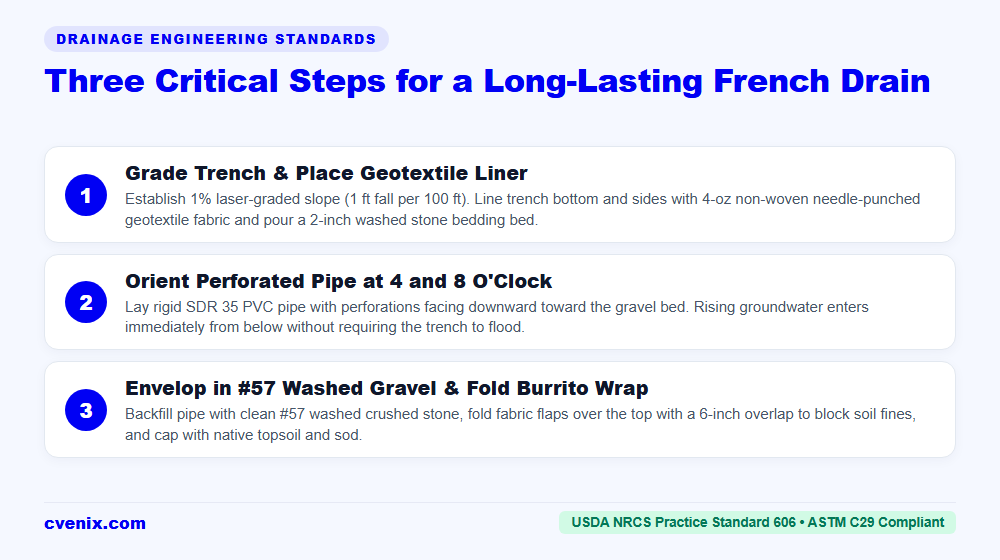
A French drain is not simply a pipe buried in dirt. Long-term performance depends on strict adherence to civil engineering principles. When improperly built, French drains clog with silt within 2 to 5 years, forcing homeowners to dig them up and start over.
The 1% slope rule and gravity fall calculations
French drains are passive gravity conduits. Under USDA Natural Resources Conservation Service (NRCS) Conservation Practice Standard Code 606, subsurface drains require a minimum slope of 1% to ensure continuous water flow and prevent silt sedimentation. A 1% slope equals a 1-foot drop for every 100 linear feet of trench, or approximately 1/8 inch to 1/4 inch of fall per linear foot.
If a trench is dug flat or has undulating dips, water slows down and drops suspended dirt particles. Over time, these fine sediments accumulate in low spots, turning your drainage conduit into a stagnant mud trap. Professional contractors verify trench grade using laser levels or builder transit levels.
Perforated pipe orientation (holes facing down at 4 and 8 o’clock)
The single most widespread DIY mistake is laying perforated pipe with the holes facing upward. Pipe holes must always face DOWNWARD at the 4 o’clock and 8 o’clock positions over a 2-inch bed of washed gravel.
Subsurface water saturates soil from the bottom up as groundwater tables rise. With perforations facing down, rising water enters the bottom of the gravel bed, flows through the holes into the smooth pipe interior, and flushes away immediately. If holes face upward, the entire trench must fill completely with water before entering the pipe, keeping your lawn saturated and encouraging fine surface silt to wash into the holes.
The non-woven geotextile burrito wrap technique
A proper French drain requires total encapsulation of the aggregate bed, known across the drainage trade as the burrito wrap. Follow this step-by-step construction standard:
- Dig the trench: Excavate a trench 10 to 12 inches wide and 18 to 24 inches deep for shallow yard drains, verifying a 1% continuous slope.
- Line with non-woven fabric: Lay 4-ounce non-woven needle-punched geotextile fabric along the bottom and up both sides of the trench, leaving wide excess fabric flaps along the top edges.
- Pour gravel bedding: Spread 2 inches of clean washed #57 crushed limestone or granite stone along the fabric-lined bottom.
- Install rigid perforated pipe: Lay 4-inch rigid SDR 35 PVC pipe directly onto the gravel bed with perforations oriented downward at 4 and 8 o’clock.
- Envelop with drainage stone: Pour washed #57 aggregate around and over the pipe until stone reaches within 4 to 6 inches of the finished surface grade.
- Fold the fabric burrito: Fold the excess side flaps of geotextile fabric across the top of the gravel bed, maintaining a minimum 6-inch overlap along the centerline.
- Backfill and re-turf: Fill the remaining 4 to 6 inches with coarse sand or native topsoil, tamp lightly, and re-lay original sod.
Cleanout access ports and pop-up emitters
To ensure lifelong serviceability, install a 4-inch threaded PVC cleanout riser port at the head of the drainage run ($25 to $50 hardware; $75 to $150 professionally installed). A cleanout provides direct ground-level access for camera inspections and high-pressure hose flushing. At the discharge outfall, install a spring-loaded pop-up emitter ($15 to $35 hardware; $60 to $120 installed) that rises during storms to release water and snaps closed afterward to keep out grass clippings, mulch, and burrowing rodents.
French Drain Discharge and Gravity Outfall Solutions
A French drain collects water, but it does not make water vanish. Every functioning system must terminate at an engineered outfall point. Where and how you discharge collected water represents a major engineering and legal consideration.
Daylighting to a natural downhill slope
Daylighting is the simplest, most reliable outfall method. The underground pipe continues on a downward grade until it exits naturally through an exposed hillside, swale, or retaining wall at least 15 to 20 feet away from your foundation. Install a rip-rap stone splash pad at the pipe opening to prevent high-velocity exit water from scouring your turf.
Dry wells and underground retention chambers
If your property is completely flat with no downhill slope to daylight pipe, an underground dry well provides an effective gravity termination point. Installing a prefabricated dry well system costs $200 to $700 for a modular plastic chamber like the NDS Flo-Well 50-gallon tank, or $50 to $250 for a traditional gravel retention pit. Large commercial concrete dry wells can exceed $3,000 installed.
Dry wells sit underground enveloped in washed stone and geotextile fabric. During severe downpours, storm surge water fills the interior chamber, then slowly seeps out through perforated side panels into surrounding permeable subsoil over 24 to 48 hours.
Sump pump lift stations for flat properties
When gravity slope is impossible and soil percolation is too slow for a dry well, contractors install a mechanical sump pump lift basin ($500 to $1,800). Subsurface French drain lines empty into an exterior sealed basin containing a 1/3-horsepower or 1/2-horsepower cast-iron submersible pump. When the basin fills, the float switch activates, pumping water through a pressurized solid discharge line to a street gutter, roadside ditch, or drainage easement.
Municipal street curb and storm sewer regulations
Discharging water onto neighboring private lots violates civil drainage laws across all US jurisdictions. Discharging to the street curb often requires a municipal right-of-way permit ($50 to $300) and specialized core drilling through concrete curbs. Always check local municipal ordinances before running pipes to public gutters.
Alternative Drainage Systems Compared
French drains excel at lowering groundwater tables and intercepting slow subsurface saturation. However, they are not always the best tool for every drainage challenge. Understanding complementary solutions ensures you do not overspend on the wrong system.
Surface swales and grading berms
A vegetated swale is a wide, shallow sloped ditch covered in turf grass. Creating a swale costs $1,000 to $3,500 depending on yard size and machine grading hours. While French drains handle underground water, swales move massive volumes of visible surface runoff during flash storms without requiring underground pipes or gravel.
Catch basins and channel trench drains
Catch basins ($50 to $200 installed) feature a plastic box with a grated top connected to solid drain pipe. They collect water pooling in low spots on lawns. Channel trench drains ($30 to $90 per linear foot) feature long narrow grates set flush into concrete driveways, garage aprons, and patios to capture sheet water flow across hardscapes.
Gutter downspout extensions vs. French drains
A frequent contractor trap is billing a simple downspout burial ($150 to $350 per downspout) as a French drain. Downspouts must ALWAYS be routed through smooth, solid, unperforated PVC pipe. Never tie roof downspouts directly into a perforated French drain line; high-volume roof runoff will flood out through the pipe holes and soak the very foundation or yard you are trying to dry. Maintaining functional gutters and reviewing your gutter installation cost is your home’s first line of defense before digging yard trenches.
Drainage systems comparison matrix
| Drainage system | Average cost | Best for | How it works | Maintenance required |
|---|---|---|---|---|
| French drain (subsurface perforated) | $10 – $35/LF (yard) or $40 – $85/LF (basement) | Subsurface groundwater and soggy turf | Percolates groundwater through gravel into perforated pipe | Periodic flush via cleanout riser |
| Surface catch basin | $50 – $200 per basin | Localized standing puddles in low lawn spots | Collects surface water through grate into solid pipe | Clear leaves and debris from grate seasonally |
| Channel trench drain | $30 – $90 per linear foot | Driveways, patios, and garage thresholds | Captures sheet flow across concrete surfaces | Remove grate and scoop accumulated sediment |
| Vegetated swale | $1,000 – $3,500 total | Large properties with high surface runoff | Shapes sloped shallow ditch to guide water naturally | Mow grass and inspect for erosion gullies |
| Buried downspout conductor | $150 – $350 per downspout | Directing roof runoff away from foundation walls | Routes gutter water through solid smooth PVC pipe | Keep roof gutters clean of tree debris |
Maintenance, Cleaning, and Lifespan
When engineered correctly, a French drain delivers decades of reliable moisture protection. However, system lifespan and maintenance requirements differ sharply based on the materials installed underground.
How long do French drains last?
A French drain built with rigid perforated PVC (SDR 35 or Schedule 40), washed #57 crushed limestone, and non-woven needle-punched geotextile fabric lasts 30 to 40 years or longer. In contrast, systems built with thin perforated corrugated pipe wrapped only in fabric socks typically fail within 5 to 15 years. Corrugated pipes collapse under ground compaction and trap roots, while lightweight fabric socks rapidly clog with silt and fine clay.
Routine maintenance and inspection checklist
Follow this biannual maintenance routine every spring and autumn:
- Clear discharge pop-up emitters: Remove accumulated grass clippings, mulch, and fallen leaves from around pop-up lids so water discharges freely.
- Inspect cleanout ports: Remove threaded cleanout caps during heavy rains to confirm that water is flowing rapidly through the pipe without backing up.
- Annual garden hose flush: Insert a garden hose with a brass jet nozzle into the upper cleanout port to flush loose silt toward the outfall.
Professional cleaning and unclogging costs
If tree roots or sediment block your line, professional plumbers and drainage specialists charge $150 to $350 for diagnostic video camera pipe scoping. Clearing stubborn blockages via professional hydro-jetting costs $250 to $500. Rigid smooth-wall PVC pipe handles mechanical snaking and high-pressure jetting with zero risk of damage, whereas flexible corrugated pipe can easily tear under hydro-jet nozzles.
DIY vs. Hiring a Professional French Drain Contractor
Installing a French drain yourself offers major paper savings because labor accounts for 70% to 85% of professional bids. However, the physical reality of earthmoving makes it one of the most grueling DIY home projects.
Realistic DIY material and equipment costs
For a standard 100-foot shallow yard curtain drain, DIY material and tool expenses break down as follows:
- 100 linear feet of 4-inch rigid perforated PVC pipe: $150 to $350
- 4.5 tons of bulk-delivered #57 washed crushed gravel: $160 to $340
- Commercial roll of 4-oz non-woven geotextile fabric: $60 to $120
- Cleanout assembly, fittings, and pop-up discharge emitter: $50 to $100
- One-day rental of a walk-behind mechanical trencher: $150 to $250
Your total DIY investment ranges from $600 to $1,200. Comparing that to a professional price of $2,000 to $3,500 yields potential savings of $1,400 to $2,300 on a 100-foot installation.
The physical reality: soil weight and trench labor
Trenching requires moving severe tonnage. Digging a 100-foot trench by hand means excavating over 7 tons of clay dirt with a shovel and moving it in wheelbarrows. Once the trench is dug and lined, you must shovel 4.5 tons of crushed rock into the ditch. Mechanical rental trenchers save time in dry sandy soil, but struggle in sticky wet clay and bounce off buried tree roots or rocks.
When hiring a professional contractor is essential
Tackle a French drain yourself only if you are installing a shallow yard curtain drain (12 to 18 inches deep) across open turf with clear downhill gravity fall. You must hire a licensed professional contractor for:
- Interior basement perimeter systems: Requires industrial jackhammers, slab structural awareness, electrical wiring for sump basins, and concrete restoration.
- Deep foundation footing drains: Digging 4 to 8 feet down beside home footings introduces structural cave-in risks and requires trench boxes, heavy excavators, and compliance with IRC Section R405.1 codes.
- Public street curb penetrations: Cutting municipal curbs or tying into city storm lines requires licensed contractor bonds and municipal permits.
Contractor bidding tips and questions to ask
Collect at least three detailed written bids. Protect yourself by asking these six vetting questions before signing a contract:
- What pipe material do you install? Confirm they use rigid smooth-wall PVC (SDR 35 or Schedule 40) rather than cheap corrugated pipe.
- What aggregate grade will you use? Ensure the contract specifies #57 clean washed stone, not unwashed gravel or road base.
- Do you wrap the entire gravel bed in non-woven geotextile fabric? Verify they use a full burrito wrap rather than wrapping only the pipe.
- Which direction will the perforations face? The only acceptable answer is downward at the 4 and 8 o’clock positions.
- Is soil haul-away and site cleanup included? Clarify whether displaced soil will be removed from your property or left piled on your lawn.
- What written slope verification and warranty do you provide? Confirm they verify a minimum 1% grade using a laser level and provide a multi-year warranty against clogs.
Methodology and Data Sources
Cvenix cost benchmarks and drainage guidelines synthesize national construction labor wage reports, regional contractor bids, municipal public works fee schedules, and retail building material indices. Every figure represents verified pricing data to provide transparent expectations for residential homeowners.
Data collection and pricing research framework
Material costs are tracked through national suppliers (The Home Depot, Lowe’s, regional stone quarries, and NDS Drainage supply distributors). Labor benchmarks incorporate regional contracting invoices, contractor markup structures, and specialized waterproofing bid archives across major US metropolitan zones.
Government wage and engineering standards cited
This guide references established regulatory codes and government labor standards:
- U.S. Bureau of Labor Statistics (BLS): Occupational Employment and Wage Statistics for Construction Laborers (SOC 47-2061) and Operating Engineers (SOC 47-2073).
- International Code Council (ICC): International Residential Code (IRC) Section R405.1 governing mandatory foundation drainage systems.
- USDA Natural Resources Conservation Service (NRCS): Conservation Practice Standard Code 606 (Subsurface Drain) establishing the 1% minimum slope rule and perforation orientation standards.
- ASTM International: ASTM C29 / C29M Standard Test Method for Bulk Density of Aggregate for gravel volume calculations.
Frequently Asked Questions About French Drain Costs
How much does a 100-foot French drain cost?
A 100-foot shallow exterior yard French drain costs $1,000 to $3,500 professionally installed ($10 to $35 per linear foot). A 100-foot interior basement perimeter French drain system costs $4,000 to $8,500 ($40 to $85 per linear foot), which includes concrete slab breakout, aggregate bedding, wall drainage flange, and a submersible sump pump system.
Is a French drain cheaper than a trench drain?
French drains and trench drains cost similar amounts, but solve completely different problems. Shallow yard French drains cost $10 to $35 per linear foot, while grated channel trench drains cost $30 to $90 per linear foot. Trench drains capture high-velocity surface water across impervious surfaces like driveways and patios, while French drains absorb subterranean groundwater saturating lawn soil.
Can I install a French drain myself?
Yes, you can install a shallow exterior yard drain yourself for $600 to $1,200 in materials and tool rentals for a 100-foot run. However, the project demands extreme physical labor: excavating over 7 tons of heavy clay soil and shoveling 4.5 tons of crushed gravel. Deep foundation footing drains and interior basement systems should always be handled by licensed contractors due to structural risks.
How deep should a French drain be?
Shallow yard curtain drains are typically 12 to 24 inches deep and 10 to 12 inches wide to intercept surface water and topsoil saturation. Deep exterior foundation footing drains must be excavated 4 to 8 feet underground, resting level with or slightly below the concrete footing to relieve hydrostatic pressure against basement walls.
Do French drains need an outlet?
Yes. A French drain is strictly a gravity-driven channel, not a water storage tank. It must terminate at a functional outfall point, such as daylighting on a downward slope, emptying into an underground dry well chamber, or draining into a sump pump lift station. Without a clear downhill outlet, water sits stagnant in the gravel trench.
Which way should the holes face on a French drain pipe?
Perforations must always face DOWNWARD at the 4 o’clock and 8 o’clock positions over a 2-inch bed of washed gravel. This allows rising groundwater to enter the pipe from below and flow away immediately. Facing holes up requires the entire gravel bed to saturate before draining, trapping silt and reducing efficiency.
How long does a French drain typically last?
A French drain built with rigid perforated PVC pipe (SDR 35 or Schedule 40), washed #57 crushed limestone, and non-woven needle-punched geotextile fabric lasts 30 to 40 years or longer. Systems built with flexible corrugated pipe wrapped in thin fabric socks typically fail within 5 to 15 years from pipe crushing or silt blinding.
Does homeowners insurance cover French drain installation?
No. Standard homeowners insurance policies (such as HO-3 and HO-5 forms) exclude groundwater seepage, surface runoff, and hydrostatic pressure, classifying them as gradual maintenance issues or flood hazards. Insurance policies do not reimburse French drain installation costs.
What is the difference between a French drain and a curtain drain?
A curtain drain is simply a shallow exterior French drain (12 to 24 inches deep) installed across open turf or slightly uphill from a building to intercept shallow subsurface groundwater before it saturates a lawn, patio, or foundation perimeter.
How long does it take a contractor to install a French drain?
A professional crew can complete a standard 50 to 100 linear foot exterior yard curtain drain in 1 to 2 days. An interior basement perimeter system or deep 6-foot foundation excavation typically requires 2 to 4 full workdays due to concrete demolition or extensive earthmoving.

