
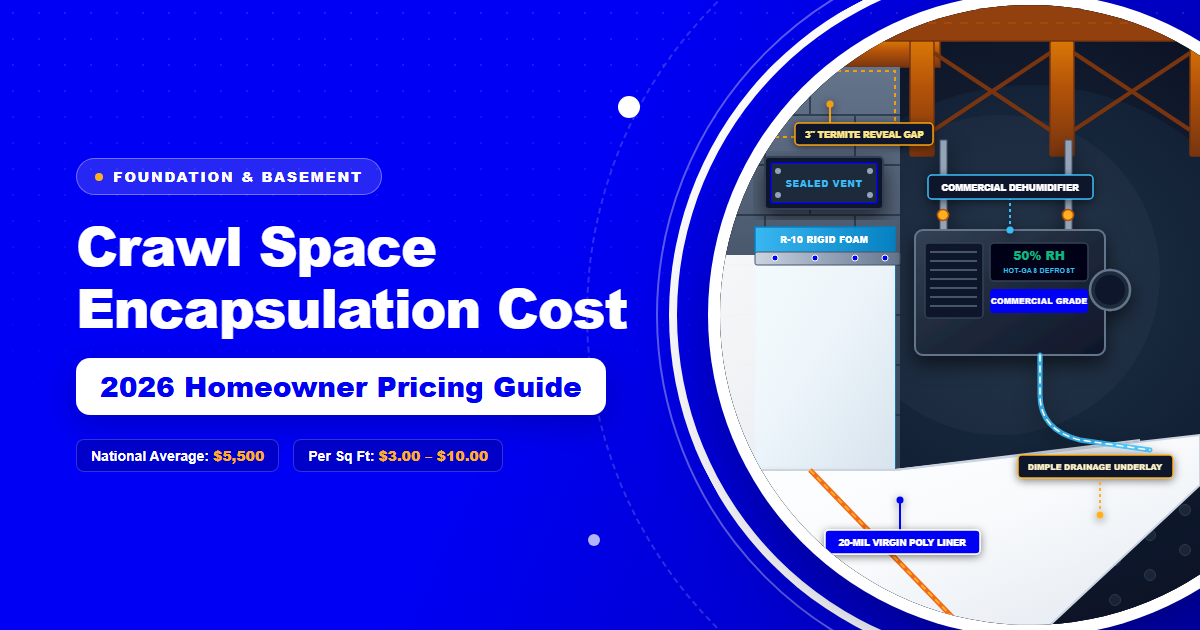
The average crawl space encapsulation cost is $5,500 nationwide, with most homeowners spending between $1,500 and $15,000 depending on crawl space size, moisture levels, and the equipment installed. A basic ground vapor barrier costs $0.50 to $1.50 per square foot installed, while a full sealed encapsulation system with perimeter drainage, wall insulation, and a commercial dehumidifier runs $3 to $10 per square foot. Sealing a damp crawl space protects your wooden subfloor framing from rot and cuts your heating and cooling bills.
Crawl space encapsulation converts a dark, unconditioned dirt space into a clean, dry, semi-conditioned part of your home’s building envelope. While laying thin plastic loosely across the dirt floor helps slow down ground evaporation, a complete encapsulation system seals your perimeter stem walls, plugs exterior vents, and manages liquid groundwater with dedicated drainage equipment. The overview table below outlines what you can expect to pay across typical project tiers.
| Project tier | Typical cost range | Installed cost per sq ft | What is included |
|---|---|---|---|
| Basic ground vapor barrier | $500 – $1,500 | $0.50 – $1.50 | 6-mil polyethylene loosely laid over dirt floor; vents remain open; no wall coverage. |
| Standard crawl space encapsulation | $2,500 – $6,750 | $2.50 – $4.50 | 10-mil to 12-mil reinforced liner on floor and walls; taped seams; sealed foundation vents. |
| Full conditioned encapsulation with drainage | $5,000 – $15,000+ | $3.00 – $10.00+ | 20-mil virgin reinforced liner, wall insulation, interior French drain, sump pump, and commercial dehumidifier. |
Crawl Space Encapsulation Cost per Square Foot and by Home Size
Contractors calculate crawl space pricing using the total square footage of your foundation footprint, vertical stem wall heights, and the physical clearance under your floor joists. Because crawl spaces require specialized labor in tight workspaces, the cost per square foot shifts significantly between basic soil coverings and fully conditioned, sealed envelopes.
Cost per square foot: basic vapor barrier vs. full encapsulation
The material and installation expenses per square foot reflect the durability of the plastic membrane and the complexity of the moisture barrier system:
- Basic 6-mil unreinforced moisture barrier: Costs $0.30 to $0.35 per square foot for materials, or $0.50 to $1.50 per square foot installed. This thin plastic provides temporary moisture reduction on dirt floors but tears easily under routine maintenance traffic.
- Standard 10-mil to 12-mil reinforced vapor barrier: Costs $0.40 to $0.60 per square foot for materials, or $2.50 to $4.50 per square foot installed. Reinforced with internal string scrim, it meets ASTM E1745 Class B/C standards for moderate crawl space access.
- Heavy-duty 20-mil multi-ply reinforced barrier: Costs $0.60 to $0.70 per square foot for materials, or $4.00 to $7.50 or more per square foot installed. This multi-layer virgin polymer meets ASTM E1745 Class A puncture resistance, lasting 25 or more years under heavy storage use.
- Turnkey encapsulation with drainage and dehumidification: Costs $3.00 to $10.00 or more per square foot installed. This full package includes heavy-duty floor and wall membranes, sealed foundation vents, perimeter wall insulation, an interior French drain, and an automatic commercial dehumidifier.
Cost by home square footage: 500 to 2,500 square feet
Foundation size directly drives project costs, but smaller crawl spaces often carry higher per-square-foot rates due to contractor minimum trip fees and the fixed cost of equipment like dehumidifiers. In contrast, larger homes benefit from economies of scale on materials, even though total project labor increases. The table below illustrates realistic installed cost ranges across standard single-family home sizes.
| Crawl space footprint (sq ft) | Basic 6-mil vapor barrier ($0.50 – $1.50/sq ft) | Standard 12-mil encapsulation ($2.50 – $4.50/sq ft) | Full encapsulation with drainage ($3.00 – $10.00/sq ft) | Typical contractor project average |
|---|---|---|---|---|
| 500 sq ft | $250 – $750 | $1,250 – $2,250 | $1,500 – $5,000 | $2,750 |
| 1,000 sq ft | $500 – $1,500 | $2,500 – $4,500 | $3,000 – $10,000 | $4,500 |
| 1,500 sq ft | $750 – $2,250 | $3,750 – $6,750 | $4,500 – $15,000 | $6,250 – $7,750 |
| 2,000 sq ft | $1,000 – $3,000 | $5,000 – $9,000 | $6,000 – $20,000 | $8,500 |
| 2,500 sq ft | $1,250 – $3,750 | $6,250 – $11,250 | $7,500 – $25,000 | $11,000+ |
Itemized Cost Breakdown: Materials, Labor, and Permits
When you review a quote from a foundation specialist or waterproofing contractor, you are paying for three distinct categories: specialized materials, intensive manual labor in confined quarters, and municipal code permits. Understanding how these expenses divide helps you spot fair contractor bids and avoid inflated markups.
Professional labor rates and crew hours
Labor represents 50% to 70% of the total encapsulation budget, typically running between $2,250 and $10,500 for a 1,500-square-foot crawl space. This high labor percentage reflects the extreme physical demands of the job. Technicians spend days working on their knees in 18-inch to 36-inch clearance heights, hauling hundred-pound gravel bags, drilling thousands of masonry anchor holes, and wearing personal protective equipment (PPE) such as half-face respirators with P100 particulate filters.
A typical full encapsulation project requires a crew of two to three skilled technicians working two to four full days. That amounts to 30 to 70 total labor hours billed at $75 to $150 per person-hour. Difficult access points, standing water, or irregular masonry support piers increase the required labor hours.
Itemized materials and equipment costs
Materials account for roughly 30% to 50% of the total cost. Quality materials are engineered to withstand continuous soil moisture, microbial activity, and temperature swings. Essential material line items include:
- Vapor barrier membrane (12-mil to 20-mil virgin poly): $600 to $1,050 for a 1,500 sq ft foundation footprint, priced at $0.40 to $0.70 per square foot for raw rolls.
- Sealing mastic, butyl seam tape, and foundation termination bars: $100 to $250 for airtight, waterproof perimeter bonding.
- Mechanical foundation fasteners: $50 to $100 for non-corrosive masonry pins securing the membrane to concrete stem walls.
- Rigid foam wall insulation (2-inch XPS): $850 to $2,100 ($1.20 to $3.70 per square foot of wall surface) to form a continuous thermal barrier.
- Commercial low-temperature dehumidifier: $800 to $2,000 for a dedicated 70-pint to 100-pint unit equipped with hot-gas bypass defrost.
- Perimeter French drain piping and washed stone: $25 to $70 per linear foot ($2,500 to $7,000 total) for trenches and perforated pipe.
- Submersible sump pump and basin: $1,000 to $2,500 for a commercial-grade cast-iron pump, basin, check valve, and exterior discharge line.
- Airtight vent covers and insulated access door: $400 to $1,300 ($15 to $50 per vent cover, plus $250 to $800 for a weather-stripped exterior door).
Building permits, inspections, and electrical hookups
Municipal building permits for crawl space encapsulation generally run $100 to $250 depending on your local jurisdiction. While laying a basic plastic sheet on dirt does not trigger permits, installing mechanical equipment does. A commercial crawl space dehumidifier draws 6.5 to 10 amps continuously and requires a dedicated 120V 20-amp branch circuit protected by Ground-Fault Circuit-Interrupter (GFCI) receptacles per National Electrical Code (NEC Article 210.8(A)(4)).
Hiring a licensed electrician to run this dedicated circuit adds $150 to $350 in specialized labor, plus $50 to $150 for a municipal electrical permit. Never allow a contractor to power a continuous dehumidifier or sump pump using an extension cord passed through floor vents; this violates NEC Article 400.8 and creates a serious fire hazard.
| Project component | Category | Typical cost range | Percentage of total budget | Notes and code references |
|---|---|---|---|---|
| Polyethylene vapor barrier (12-20 mil) | Materials | $600 – $1,050 | 8% – 12% | ASTM E1745 Class A virgin resin sheeting |
| Foundation wall insulation (2-inch rigid XPS) | Materials | $850 – $2,100 | 10% – 18% | Continuous perimeter stem wall insulation |
| Commercial crawl space dehumidifier | Equipment | $800 – $2,000 | 12% – 20% | Low-temperature hot-gas defrost unit |
| Sump pump and interior French drain | Equipment / Materials | $1,500 – $4,500 | 15% – 30% | Active groundwater capture and discharge |
| Vent covers and airtight access door | Materials | $400 – $1,300 | 4% – 8% | Insulated access well and sealed exterior vents |
| Skilled contractor installation labor | Labor | $2,250 – $7,500 | 50% – 70% | 2-3 technician crew for 2-4 days on site |
| Dedicated 120V 20A GFCI electrical branch | Specialty labor | $150 – $350 | 2% – 4% | Licensed electrician work per NEC 210.8 |
| Municipal building and electrical permits | Administrative | $150 – $400 | 2% – 3% | Local building department fees and inspections |
| Total estimated project | Turnkey contractor install | $6,250 – $15,000+ | 100% | National project average spans $5,500 to $7,750 |
Vapor Barrier vs. Full Encapsulation: Thickness and System Comparison
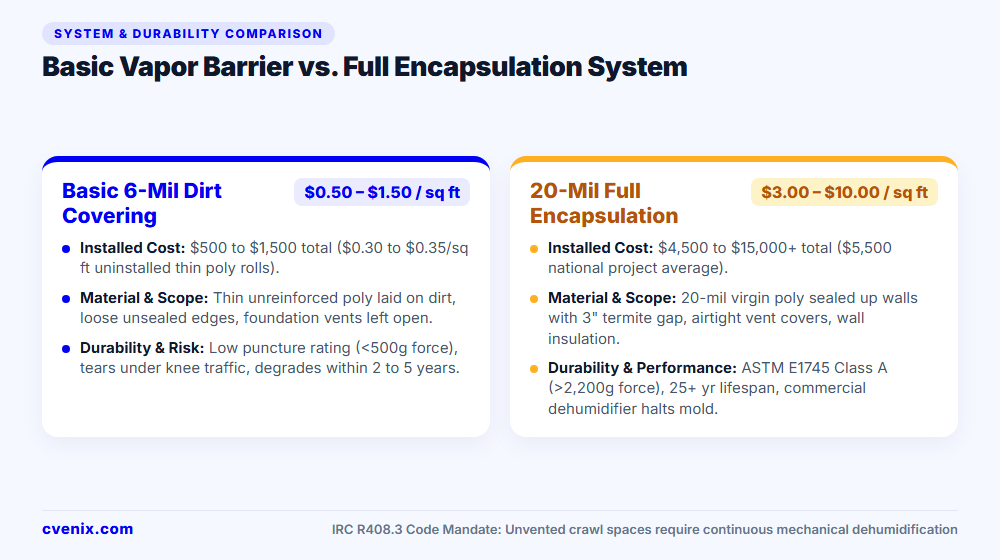
Homeowners often confuse a basic vapor barrier with full encapsulation, but they represent two completely different levels of protection. A basic vapor barrier is a single sheet of plastic laid loosely over damp dirt with edges left open and foundation vents kept unsealed. In contrast, full encapsulation creates an airtight, sealed, conditioned space that isolates your subfloor framing from outdoor humidity, groundwater, and soil gases.
Mil thickness comparison: 6-mil, 10-mil, 12-mil, and 20-mil
The thickness and structural reinforcement of the plastic membrane determine how well your encapsulation holds up over time. Plastic thickness is measured in mils, where one mil equals one-thousandth of an inch (0.001 inches). Here is how the standard options compare:
- 6-mil unreinforced polyethylene: Installed for $0.50 to $1.50 per square foot. Common in hardware stores, this thin sheeting punctures under the pressure of a worker’s knee and offers puncture resistance below 500 grams. It degrades rapidly and lasts only 2 to 5 years.
- 10-mil string-reinforced polyethylene: Installed for $2.50 to $3.50 per square foot. Reinforced with polyester cord scrim, it meets ASTM E1745 Class C standards, offering good durability for crawl spaces that receive minimal foot traffic.
- 12-mil multi-ply reinforced polyethylene: Installed for $3.00 to $4.50 per square foot. A durable mid-tier choice meeting ASTM E1745 Class B standards, lasting 15 to 20 years under routine seasonal maintenance.
- 20-mil multi-ply virgin reinforced polyethylene: Installed for $4.00 to $7.50 or more per square foot. This heavy-duty liner meets ASTM E1745 Class A standards with a puncture resistance exceeding 2,200 grams. It withstands sharp rocks, heavy storage boxes, and crawling workers without tearing, lasting 25 or more years.
| Membrane thickness | Material type | Installed cost per sq ft | Puncture resistance | Expected lifespan | Recommended application |
|---|---|---|---|---|---|
| 6-mil | Basic unreinforced poly | $0.50 – $1.50 | Low (<500 g) | 2 – 5 years | Temporary rental fix or bare-bones dirt covering |
| 10-mil | String-reinforced poly | $2.50 – $3.50 | Moderate (ASTM Class C) | 10 – 15 years | Budget encapsulation, minimal maintenance traffic |
| 12-mil | Multi-ply reinforced poly | $3.00 – $4.50 | High (ASTM Class B) | 15 – 20 years | Standard professional residential encapsulation |
| 20-mil | Multi-ply virgin reinforced poly | $4.00 – $7.50+ | Maximum (ASTM Class A) | 25+ years | Premium encapsulation and active utility storage |
Virgin resin vs. recycled plastic: avoiding the cat-urine odor trap
One of the worst surprises a homeowner can experience after paying thousands for an encapsulation is a pungent, chemical odor smelling like concentrated cat urine or ammonia drifting into living areas. This problem does not come from neighborhood animals; it stems from installing vapor barriers made with post-consumer recycled plastic.
Recycled polyethylene contains chemical impurities, plasticizers, and organic scrap. When pressed against damp crawl space soil in an airtight environment, anaerobic soil bacteria feed on these additives, off-gassing volatile amine compounds. In contrast, liners extruded from 100% virgin polyethylene resin contain no recycled fillers and produce zero off-gassing.
The 48-hour Mason jar test: Protect yourself before buying materials or signing a contractor agreement. Take a handful of damp dirt from your crawl space and a one-square-foot sample of the proposed vapor barrier. Place both inside a clean, airtight glass Mason jar. Keep the sealed jar in a warm room (75°F to 80°F) or direct sunlight for 48 hours. Open the lid and sniff the contents: if you detect an ammonia or chemical smell, reject the material immediately.
What true crawl space encapsulation includes (IRC R408.3)
Laying plastic on the ground is not encapsulation. The International Residential Code (IRC Section R408.3) defines specific engineering criteria for converting an open vented crawl space into an unvented conditioned envelope:
- Continuous Class I vapor retarder: A vapor-impermeable membrane (permeance rating of 0.1 perm or less) covering the entire dirt floor.
- Taped 6-inch overlaps: All membrane seams must overlap by at least 6 inches and be sealed airtight with heavy acrylic or butyl tape.
- Stem wall termination: The liner must extend at least 6 inches up masonry foundation walls and support piers, fastened with termination bars and polyurethane mastic.
- Airtight vent sealing: All exterior foundation air vents must be permanently sealed with insulated covers.
- Conditioned mechanical drying: The space must include active mechanical dehumidification or conditioned supply air from the HVAC system to keep relative humidity below 55%.
Additional System Components and Site Preparation Costs
The wide spread in crawl space encapsulation costs, from $3,000 to over $15,000, is driven primarily by site-specific preparation and supplemental drainage systems. If your crawl space experiences standing groundwater or existing mold colonies, those issues must be resolved before sealing the space.
Commercial crawl space dehumidifiers and continuous drainage
A standard $250 portable room dehumidifier cannot survive in a crawl space. Household units are engineered for warm 70°F rooms; in a cool 55°F to 60°F crawl space, their evaporator coils freeze into solid blocks of ice, causing the compressor to burn out within months. True encapsulation requires a dedicated commercial crawl space dehumidifier costing $800 to $2,000 installed.
Commercial dehumidifiers (such as units from AprilAire, Santa Fe, or AlorAir) feature low-temperature hot-gas bypass defrost systems that melt frost automatically. They remove 70 to 100 or more pints of water per day while drawing modest power. Contractors install them with continuous gravity drain tubes or integrated condensate pumps that discharge water safely outdoors, eliminating the need to empty water buckets manually.
Interior French drains, dimple drainage matting, and sump pumps
A vapor barrier stops water vapor, but it cannot resist standing liquid groundwater. If rainwater seeps into your crawl space during heavy storms, you need an interior water management system beneath the plastic liner.
Contractors dig an interior perimeter trench along the foundation walls, laying perforated PVC pipe surrounded by washed aggregate at $25 to $70 per linear foot ($2,500 to $7,000 total). This French drain channels water toward a sealed basin housing a heavy-duty submersible pump. A professional sump pump replacement cost ranges from $1,000 to $2,500 for a primary pump and basin, with dual-pump battery backup systems adding $800 to $1,500 to keep the system running during storm power outages.
Preventing the waterbed effect: When contractors lay a heavy vapor barrier directly over uneven, muddy ground, pooling groundwater gets trapped underneath, creating a squishy “waterbed effect” where water cannot reach the sump basin. High-performance installations place high-density polyethylene (HDPE) dimpled drainage matting ($0.50 to $1.00 per square foot in materials) directly on the dirt beneath the liner. The raised dimples create a continuous sub-membrane drainage plane that directs seepage smoothly to the perimeter French drain.
Foundation wall insulation: rigid foam boards vs. spray foam
In an unvented crawl space, insulating the perimeter foundation walls brings the space inside your home’s thermal boundary, keeping ductwork and plumbing warm in winter. Homeowners choose between two primary insulation methods:
- Rigid foam boards (EPS or XPS): Installing 2-inch extruded polystyrene boards on stem walls costs $1.20 to $3.70 per square foot. These panels provide an R-10 thermal barrier, do not absorb moisture, and create a neat, flat surface.
- Closed-cell spray polyurethane foam: Applying 2 inches of closed-cell spray foam costs $2.00 to $5.00 per square foot ($850 to $2,100 total). Spray foam expands into mortar voids, air-sealing irregular stone or rubble foundations effectively.
Old insulation removal, mold remediation, and wood rot repairs
Before laying new membranes, workers must remove compromised materials. In vented crawl spaces, fiberglass batts installed between floor joists frequently soak up humidity, sag under their own weight, and fall onto the dirt floor. Removing and disposing of wet, contaminated fiberglass costs $1.00 to $2.00 per square foot ($1,000 to $2,400 for typical crawl spaces).
If trapped moisture has fostered fungal growth on your wooden joists and subflooring, expect a professional mold remediation cost of $15 to $30 per square foot of affected surface, or $1,500 to $4,500 on average. Technicians treat framing with antimicrobial wash or dry-ice blasting before encapsulating. Where wood rot has weakened floor joists, carpenters must sister new lumber alongside damaged framing, which adds $100 to $250 per linear foot.
Critical Building Codes, Safety Hazards, and Pitfalls
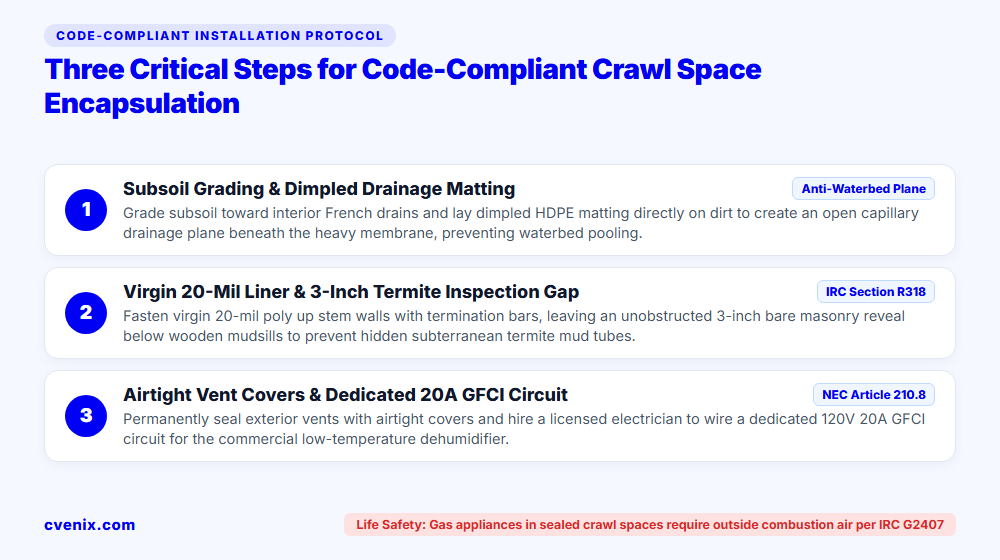
Sealing an open crawl space alters the thermal, moisture, and airflow dynamics under your home. If a contractor cuts corners or ignores residential building codes, you risk costly pest infestations, electrical fires, or life-threatening carbon monoxide poisoning.
Termite inspection gap requirements (IRC Section R318)
Building codes (IRC Section R318.1) strictly require protection against subterranean termites. In areas prone to termite activity, the code mandates an unobstructed 3-inch clear visual termite inspection gap between the top edge of foundation wall insulation or vapor retarders and the bottom of the wooden mudsill plate.
Inexperienced or careless contractors often run vapor barriers or spray closed-cell foam all the way up to the wooden band joist, completely burying the foundation sill. This code violation gives subterranean termites a concealed, moisture-rich highway to build mud shelter tubes directly into your floor framing undetected. Obscuring this inspection reveal will also immediately void your home’s termite warranty bond with pest control companies.
Combustion appliance air starvation and carbon monoxide backdrafting (IRC G2407)
The most critical life-safety danger during crawl space encapsulation involves fuel gas appliances. If your crawl space contains an atmospheric, natural-draft gas furnace, water heater, or boiler, those burners rely on foundation vents for combustion air.
When you seal all exterior foundation vents, you trap those appliances in an airtight enclosure. When the furnace or water heater fires, it starves for oxygen. Under the natural stack effect of the home, warm air rising upstairs creates negative pressure in the crawl space, pulling lethal carbon monoxide (CO) flue gases backward down chimney flues and dispersing them into living spaces.
Under IRC Section G2407.1 and NFPA 54, converting to an unvented crawl space requires installing dedicated outdoor combustion air intake ducts ($250 to $600) or replacing old atmospheric units with direct-vent, sealed-combustion mechanicals before sealing vents. Always install hardwired, interconnected carbon monoxide alarms on every floor.
Radon gas accumulation and sub-membrane depressurization
Radon is an odorless, naturally occurring radioactive soil gas that enters homes through dirt crawl spaces. Sealing foundation vents without active soil ventilation can trap concentrated radon under the vapor barrier, where negative building pressure draws it upstairs through floor penetrations.
Always perform a certified radon test before encapsulating. If radon levels meet or exceed the EPA action limit of 4.0 picocuries per liter (pCi/L), the contractor must install a sub-membrane depressurization (SMD) system. This involves placing perforated suction pipes beneath the liner connected to an exterior inline fan ($800 to $1,500) that exhausts soil gases safely above the roofline. Sealing your crawl space works in tandem with other building envelope improvements, such as balancing your attic insulation cost and directing roof runoff away from the foundation with an updated gutter installation cost.
Crawl Space Encapsulation Cost by Region
Where you live influences total project pricing due to local trade wages, climate severity, and foundation construction styles. In the humid Southeast, crawl spaces require heavy-duty commercial dehumidifiers to fight persistent outdoor humidity. In the cold Northeast, rigid wall insulation with higher R-values drives up material costs.
Regional price variations across the United States
The table below details benchmark pricing for a standard 1,500-square-foot crawl space encapsulation across major United States regions.
| Geographic region | Representative states | Typical cost range (1,500 sq ft) | Regional average | Primary regional cost driver |
|---|---|---|---|---|
| Northeast | NY, PA, MA, NJ, CT | $5,500 – $11,000 | $7,750 | High trade wage rates, deep frost lines, strict wall insulation R-value codes. |
| West | CA, WA, OR, CO, ID | $5,200 – $10,500 | $7,300 | Strict municipal permitting, environmental disposal fees, seismic retrofit requirements. |
| Midwest | OH, IL, IN, MI, WI | $4,800 – $9,500 | $6,600 | Seasonal freeze-thaw groundwater saturation, frequent sump pump and French drain needs. |
| South | NC, SC, GA, FL, TN, VA | $4,500 – $9,000 | $6,250 | High summer relative humidity, widespread demand for high-capacity commercial dehumidifiers. |
DIY vs. Professional Encapsulation: Costs, Risks, and Labor
Because professional labor accounts for more than half of the total price, many handy homeowners consider tackling crawl space encapsulation as a do-it-yourself project. While DIY installation cuts upfront cash expenses, it demands specialized tools, exhausting physical labor, and strict attention to safety codes.
The real costs of DIY crawl space encapsulation
For a 1,500-square-foot crawl space, buying quality raw materials (rolls of 20-mil virgin reinforced poly, butyl seam tape, polyurethane mastic, masonry anchor pins, vent covers, and a commercial crawl space dehumidifier) costs $1,500 to $2,800. Tool rentals and safety gear, including an SDS hammer drill, HEPA vacuum, P100 half-face respirators, Tyvek crawl suits, and heavy-duty knee pads, add $300 to $500.
Unless you are a licensed electrician, you will still need to hire a pro to install the dedicated 120V 20A GFCI circuit for the dehumidifier ($150 to $350). Your total DIY out-of-pocket investment will land between $1,800 and $3,300, providing an apparent savings of $4,000 to $8,000 compared to professional bids ($6,000 to $12,000).
Physical toll, confined space hazards, and common DIY mistakes
Before choosing the DIY route, consider whether you are prepared to spend 30 to 50 hours army-crawling on gravel, mud, and sharp debris in 24 inches of clearance. The workspace is pitch dark, dusty, and confined, with hanging plumbing pipes and active insect nests.
Common DIY mistakes frequently compromise the entire installation:
- Taping over dusty concrete: Butyl and acrylic tape fail to bond if concrete stem walls are coated in masonry dust or efflorescence. Within six months, wall liners peel off and fall to the ground.
- Omitting dimple drainage matting: Laying heavy plastic over wet, uneven clay creates trapped groundwater pools, causing the liner to bubble and squish underfoot.
- Burying the termite inspection gap: Taping plastic directly to wooden sills hides termite mud tubes and violates local building code.
- Using household room dehumidifiers: Standard room units freeze up at 55°F, burning out compressors while leaving crawl space humidity above 70%.
How to evaluate contractor quotes and avoid franchise traps
Homeowner forums on Reddit frequently report shocking quote disparities: one independent contractor quotes $7,000 for full encapsulation, while a national foundation franchise quotes $22,000 to $34,000 for the exact same home. Why such a massive gap?
Large corporate franchises operate high-overhead business models with national television advertising and commissioned sales reps. Salespeople often use two-hour presentations filled with scare tactics, claiming that slight floor bounce indicates immediate structural collapse. They bundle unneeded steel screw jacks, beam replacements, and proprietary liners into the bid, offering bogus “sign today for 15% off” discounts to pressure homeowners before they can get second opinions.
To protect your budget, collect bids from at least three independent, licensed waterproofing contractors. Demand an unbundled, itemized bid that separates standard moisture encapsulation from structural repairs. If a contractor claims your floor joists are failing, do not sign a bundled contract. Check our guide on foundation repair cost and spend $300 to $600 to hire an independent licensed structural engineer for an objective framing assessment before approving any structural carpentry.
Real estate home buyer strategy: If a home inspector uncovers standing water, shredded plastic, or mold during a home purchase, never let the seller hire the repair contractor. Sellers have a strong incentive to hire the cheapest handyman available to lay thin 6-mil plastic over standing mud just to pass reinspection. Instead, negotiate a $5,000 to $10,000 closing credit during escrow so you can hire a vetted professional to complete a permanent encapsulation after closing.
Questions to ask a crawl space encapsulation contractor
Use this six-point vetting checklist when evaluating contractor proposals:
- What exact membrane thickness and brand do you install, and is it extruded from 100% virgin polyethylene meeting ASTM E1745 Class A standards?
- Does your estimate include a dedicated 120V 20A GFCI electrical branch circuit installed by a licensed electrician for the dehumidifier, or must I hire an electrician separately?
- Will your crew leave a visible, unobstructed 3-inch termite inspection gap below the wooden sill plate per IRC Section R318?
- If my crawl space contains gas-fired appliances, how do you verify combustion air intake per IRC Section G2407 before sealing exterior vents?
- Will you install high-density dimpled drainage matting beneath the liner in damp areas to prevent groundwater pooling and the waterbed effect?
- Does your quote unbundle moisture barrier installation from structural framing repairs, and are all required municipal building permits included?
Benefits and Resale Value: Is Crawl Space Encapsulation Worth It?
Spending $5,000 to $12,000 on an unfinished crawl space is a significant investment. However, when evaluated against the destructive long-term effects of chronic subfloor moisture, encapsulation delivers exceptional structural and operational returns.
Energy bill savings and indoor air quality improvements
Sealing exterior crawl space vents and insulating perimeter stem walls stops cold winter air from freezing floorboards and prevents humid summer air from overloading your air conditioner. Encapsulation cuts heating and cooling energy use by 15% to 20% annually.
Encapsulation also improves indoor air quality through the building stack effect. Up to 50% of the air you breathe on your home’s first floor originates in your crawl space, drawn upward through subfloor cracks and duct penetrations. Sealing off damp soil and running an active dehumidifier stops mold spores, dust mites, and musty soil gases from invading your living spaces.
Structural preservation, wood rot prevention, and pest deterrence
Wood-decay fungi and dry rot require wood moisture content above 20% to survive. By maintaining crawl space relative humidity consistently below 55%, encapsulation permanently preserves wooden beams, girders, and subfloors. Spending $5,500 on preventive encapsulation avoids catastrophic structural framing repairs that routinely cost $10,000 to $30,000 or more. Sealing vent grates and installing airtight access doors also keeps out rodents, snakes, and subterranean termites.
Home appraisal value vs. real estate marketability
Encapsulation does not provide a dollar-for-dollar increase on appraisal reports. Real estate appraisers classify crawl space sealing as preventive maintenance and structural preservation, resulting in a $0 direct appraisal adjustment. However, having a clean, dry, warrantied crawl space dramatically boosts real estate marketability. It prevents buyers from demanding steep escrow concessions, ensures clean home inspection reports, and prevents loan underwriting delays.
Long-Term Maintenance and Inspection Checklist
An encapsulated crawl space is a mechanical system that requires routine seasonal checkups to guarantee decades of peak performance. Set a calendar reminder to complete these maintenance tasks once a year:
Annual maintenance tasks for encapsulated crawl spaces
- Commercial dehumidifier filter: Clean or replace the intake air filter every 6 to 12 months. Flush the condensate drain tube with warm water and vinegar to prevent algae clogs, and verify the digital display reads between 45% and 55% relative humidity.
- Sump pump operation: Pour 5 gallons of water into the sump pit to confirm the mechanical float switch triggers the pump automatically. Inspect the exterior discharge pipe to make sure it remains clear of soil, leaves, or ice.
- Membrane and seam inspection: Scan floor seams and perimeter wall terminations to ensure tape and polyurethane mastic remain tightly bonded. Check for punctures if plumbers, cable installers, or HVAC technicians have worked in the crawl space.
- Termite inspection gap scan: Walk the foundation perimeter with a bright flashlight, checking the 3-inch bare masonry reveal below the wooden sill plate for subterranean termite mud shelter tubes.
- Remote wireless monitoring: Place a $25 to $40 Bluetooth or Wi-Fi digital hygrometer inside the crawl space. This allows you to monitor subfloor humidity and temperature directly from your smartphone upstairs, alerting you immediately if the dehumidifier loses power.
Methodology and Data Sources
Cvenix cost benchmarks and technical specifications are developed through rigorous building-science research, national construction cost databases, and real-world contractor pricing audits.
Data collection and cost modeling framework
Pricing models synthesize national construction cost data from RSMeans and the Craftsman Construction Estimator, verified homeowner cost publications (This Old House, Bob Vila, and HomeGuide), manufacturer engineering specifications (Polyguard and Americover), and verified bid breakdowns from thousands of real homeowners across community forums including Reddit r/HomeImprovement, r/DIY, and r/RealEstate. Labor rates reflect regional prevailing trade wages for foundation and waterproofing technicians.
Government building codes and industry standards cited
All technical recommendations and safety protocols cited in this guide adhere to official regulatory codes and testing standards:
- International Code Council (ICC): International Residential Code (IRC 2021 Section R408.3 for unvented crawl space vapor retarder and drying requirements).
- International Code Council (ICC): IRC Section R318.1 for subterranean termite clearance and visual inspection gap mandates.
- International Code Council & NFPA: IRC Section G2407.1 / NFPA 54 for fuel gas combustion air requirements in enclosed mechanical spaces.
- National Fire Protection Association (NFPA): National Electrical Code (NEC Article 210.8(A)(4) and Article 400.8) governing crawl space GFCI branch circuits and wiring safety.
- ASTM International: ASTM E1745 Standard Specification for Plastic Water Vapor Retarders Used in Contact with Soil (Class A, B, and C puncture resistance).
- U.S. Environmental Protection Agency (EPA): Radon Mitigation Standards and 4.0 pCi/L indoor air action guidelines.
Frequently Asked Questions About Crawl Space Encapsulation Cost
Is crawl space encapsulation worth the cost?
Yes, for most damp crawl spaces, encapsulation is worth the investment. While spending $3,000 to $10,000 is a significant upfront expense, it permanently prevents structural wood rot, stops mold growth, lowers heating and cooling bills by 15% to 20%, and prevents expensive buyer credit demands during home sales. Homes with dry, well-drained dirt crawl spaces in arid climates may only require a basic vapor barrier.
How much does it cost to encapsulate a 1,500 sq ft crawl space?
Encapsulating a 1,500-square-foot crawl space typically costs between $4,500 and $15,000, with national project averages falling between $6,250 and $7,750 depending on your region. A basic 6-mil dirt covering costs $750 to $2,250, while a complete system with 20-mil reinforced membrane, wall insulation, and a commercial dehumidifier averages around $7,500.
What is the difference between a vapor barrier and encapsulation?
A vapor barrier is simply a plastic sheet (typically 6-mil to 10-mil) laid loosely across the dirt floor to retard soil moisture. Encapsulation is a complete building envelope system that seals a heavy 12-to-20-mil reinforced membrane across the ground and up foundation walls, permanently seals exterior vents, insulates perimeter walls, and adds active mechanical dehumidification per IRC R408.3.
Can I encapsulate my crawl space myself?
Yes. Performing DIY encapsulation costs roughly $1,500 to $3,300 for raw materials, protective gear, and a commercial dehumidifier, saving $4,000 to $8,000 in contractor labor. However, DIY installation requires 30 to 50 hours of grueling physical labor crawling in tight clearances, and you will still need a licensed electrician to install a dedicated 20-amp GFCI circuit for the dehumidifier.
Does crawl space encapsulation increase home appraisal value?
No. Real estate appraisers classify crawl space encapsulation as structural preservation and preventive maintenance rather than added livable square footage, resulting in a $0 direct appraisal adjustment. However, it significantly improves marketability, prevents buyer escrow credit demands of $5,000 to $10,000, and ensures mortgage inspection approval.
Why does my new crawl space vapor barrier smell like cat urine?
That ammonia or cat-urine smell occurs when contractors install cheap vapor barriers manufactured with post-consumer recycled plastic. Anaerobic soil bacteria break down the plasticizer additives and organic impurities in the recycled resin, off-gassing volatile amine compounds. To prevent this, always specify 100% virgin-resin polyethylene meeting ASTM E1745 standards.
Do I need a commercial dehumidifier, or can I use a household unit?
You must install a dedicated commercial crawl space dehumidifier with low-temperature hot-gas defrost. Household room dehumidifiers are designed for 70°F living areas; inside a 55°F crawl space, their evaporator coils freeze into solid blocks of ice, causing the compressor to burn out within months.
Should crawl space vents be open or sealed?
Modern building science and IRC Section R408.3 confirm that crawl space vents should be sealed airtight in humid and mixed climates. Leaving vents open in summer pulls warm, humid outdoor air across cool subfloor framing, creating severe condensation that rots joists and feeds mold. Sealing vents and running a dehumidifier maintains indoor relative humidity safely below 55%.
Does crawl space encapsulation require a building permit?
Laying a ground moisture barrier alone does not require a permit. However, full encapsulation typically triggers a municipal electrical permit ($50 to $150) because installing a continuous commercial dehumidifier and sump pump requires a dedicated 120V 20A GFCI circuit installed by a licensed electrician.
Why are national franchise crawl space quotes so high?
National basement and crawl space franchises often quote $18,000 to $34,000 for standard crawl spaces because they factor in heavy corporate overhead, national advertising, and high sales commissions. They also routinely bundle unnecessary foundation piering or beam sistering into bids. Solicit quotes from vetted local independent contractors, whose bids typically range from $6,000 to $12,000 for identical materials.

