
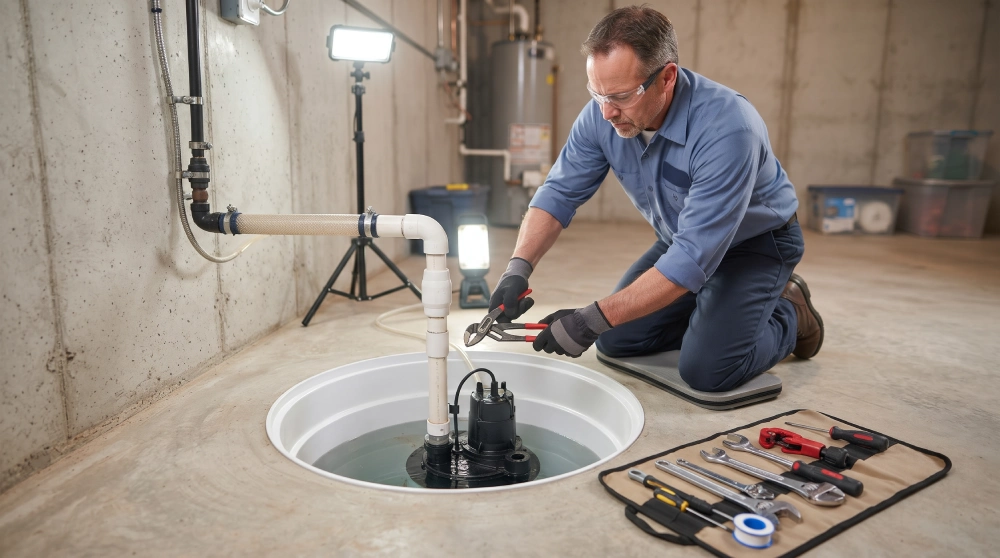
Most homeowners pay between $300 and $750 to replace a sump pump, with a typical cost around $490 for a standard professional swap. If you upgrade to a heavy-duty cast-iron submersible pump paired with an auxiliary battery backup system, total replacement costs generally range from $1,200 to $2,500.
Basements across Pennsylvania often face heavy seasonal groundwater from spring thaws and summer storms. Keeping a reliable basement drainage system active protects your home against costly foundation moisture and flooding. Your final price depends primarily on the pump type, horsepower rating, and whether you add backup redundancy.
Sump Pump Replacement Cost Overview
The total cost to replace a sump pump breaks down into equipment purchases and professional installation labor. The table below outlines expected costs by pump type, power rating, and expected lifespan.
| Pump Type and Rating | Equipment Cost | Total Installed Cost | Flow Rate (at 10 Ft Lift) | Average Lifespan | Data Source Label |
|---|---|---|---|---|---|
| 1/3 HP Pedestal Pump | $80 – $180 | $280 – $520 | 1,800 – 2,400 GPH | 8 – 12 years | Sourced |
| 1/3 HP Submersible (Plastic) | $90 – $160 | $320 – $580 | 2,000 – 2,600 GPH | 3 – 5 years | Sourced |
| 1/2 HP Cast-Iron Submersible | $180 – $340 | $450 – $850 | 3,200 – 4,200 GPH | 10 – 15 years | Sourced |
| 3/4 HP Commercial Submersible | $320 – $550 | $650 – $1,150 | 4,500 – 5,500 GPH | 12 – 15 years | Sourced |
| Primary Pump + DC Battery Backup Combo | $450 – $950 | $1,200 – $2,400 | Dual pump redundancy | 7 – 10 years (battery 3 – 5 years) | Sourced |
| Water-Powered Backup Pump (City Water) | $220 – $450 | $750 – $1,500 | 800 – 1,200 GPH | 15 – 20 years | Sourced |
Key Factors That Affect Sump Pump Replacement Costs
Equipment design and water evacuation capacity drive most price differences. Selecting the right motor size ensures your basement stays dry during high-volume rainfall without burning out the unit prematurely.
Pump design and motor construction
Pedestal pumps feature an upright motor mounted above the sump pit basin. They run louder than submersible units, but their equipment cost remains lower at $80 to $180. Thermoplastic submersible pumps cost $90 to $160 for parts, but their life expectancy is relatively short at 3 to 5 years.
Cast-iron submersible units offer superior heat dissipation and longer service life. A 1/2 horsepower cast-iron pump costs $180 to $340 for equipment and averages 10 to 15 years of operational use. Heavy-duty 3/4 horsepower commercial models cost $320 to $550 for parts and handle up to 5,500 gallons per hour.
Backup systems and power loss protection
Severe weather often causes power outages just when groundwater levels spike. Adding a dual-pump setup with a battery backup system raises equipment costs to between $450 and $950, with total installed costs reaching $1,200 to $2,400. The primary pump runs on household power while the secondary pump kicks in during power failures, though backup batteries require replacement every 3 to 5 years.
If your home connects to a municipal water supply, a water-powered backup pump provides continuous operation without batteries. Equipment costs run $220 to $450, with installation ranging from $750 to $1,500. These units use municipal water pressure to siphon groundwater out of the pit and last 15 to 20 years.
Labor, Materials, and Installation Add-Ons
Replacing an existing pump in a functional pit is straightforward, but extra plumbing or electrical updates will adjust your total invoice.
- Professional labor: Swapping a standard pump in an existing pit takes a plumber or basement technician 1 to 2 hours, accounting for $180 to $400 of the total cost depending on local trade rates.
- Check valve and piping: Replacing worn PVC discharge pipes or installing a quiet inline check valve adds roughly $20 to $50 in hardware materials.
- Old unit removal: Most contractors include the disconnect and disposal of your old pump in their standard service package.
- Electrical additions: If your sump basin lacks a dedicated GFCI outlet nearby, hiring an electrician to run a new line adds to your initial project costs.
Repair or Replace: How to Decide
If your current unit is under 5 years old and stopped working due to a stuck float switch or a clogged intake screen, a simple clearing or component fix makes sense. However, if your pump is over 7 years old, hums without moving water, or continuously trips your electrical breaker, replacing the entire unit is the safer financial choice.
You can review detailed regional pricing breakdowns in our main sump pump replacement cost guide to see how hardware choices impact long-term basement maintenance budgets.
DIY vs. Hiring a Professional
Tackling a direct replacement yourself can save on professional labor fees. If you are replacing an identical unit where the plumbing connections match perfectly, purchasing the replacement unit yourself runs between $120 and $350 for parts.
You should call a licensed plumber or technician when installing complex dual-pump backup systems, connecting water lines for a water-powered backup, or altering existing PVC discharge lines. Professional installation ensures proper float height adjustment, correct check valve orientation, and keeps manufacturer equipment warranties valid.
Frequently Asked Questions
How much does it cost to replace a sump pump in Pennsylvania?
Most standard professional replacements cost between $300 and $750, with the average job coming in around $490. Installing a high-end cast-iron pump with a battery backup system typically ranges from $1,200 to $2,500.
How long does a sump pump usually last?
Plastic submersible pumps last 3 to 5 years, pedestal pumps last 8 to 12 years, and heavy-duty cast-iron submersible pumps last 10 to 15 years under typical operating conditions.
Can I replace a sump pump myself?
Yes, if you are replacing an identical unit with matching discharge pipes. Direct DIY parts costs run between $120 and $350. Hiring a pro is recommended for new backup systems or altered plumbing setups.
Are water-powered backup sump pumps worth it?
Water-powered backups cost $750 to $1,500 installed and work indefinitely during power outages without needing replacement batteries, but they require a municipal water supply to function.

