
The average fence installation cost is $3,059, with most homeowners spending between $1,743 and $4,431 for a typical residential yard enclosure. On a per-foot basis, fence installation cost ranges from $13 to $25 per linear foot for standard residential materials, though overall pricing spans from $12 to $85 per linear foot depending on whether you choose economical chain link or premium composite. For a standard 200-linear-foot suburban backyard, total turnkey installation averages $4,500, with most homeowners paying between $3,000 and $7,000. Key pricing variables include material selection, total perimeter footage, post hole digging depth, gate hardware, and local labor rates.
Evaluating fence pricing on a per-linear-foot basis is the most reliable way to budget your property perimeter. Because labor and site preparation account for 40% to 60% of total contractor invoices, understanding how specific materials balance upfront installation expenses against long-term maintenance helps you avoid unexpected surprises on your final quote.
| Fence material | Cost per linear foot | Typical 200-foot cost | Expected lifespan | Best application |
|---|---|---|---|---|
| Pressure-treated pine | $15 – $30 | $3,000 – $6,000 | 15 – 20 years | Affordable privacy and backyard perimeter fencing |
| Western red cedar | $25 – $45 | $5,000 – $9,000 | 20 – 25 years | Natural rot resistance and rich wood grain aesthetics |
| Vinyl (PVC) | $15 – $40 | $3,000 – $8,000 | 20 – 30+ years | Low-maintenance privacy with zero painting or staining |
| Galvanized chain link | $12 – $25 | $2,400 – $5,000 | 20 – 30 years | Budget-friendly pet containment and boundary demarcation |
| Ornamental aluminum | $15 – $40 | $3,000 – $8,000 | 30 – 50+ years | Rust-proof decorative security and swimming pool barriers |
| Composite (WPC) | $20 – $85 | $4,000 – $17,000 | 25 – 35+ years | Premium acoustic sound dampening and high wind resistance |
Fence Installation Cost per Linear Foot by Material
Your choice of fencing material is the single largest factor determining total project expense, representing 40% to 50% of the initial contractor invoice and 100% of your ongoing maintenance workload. While budget-friendly wire mesh delivers perimeter security at minimal cost, high-end composites and ornamental metals provide multi-decade durability without the ongoing chore of scraping and staining.
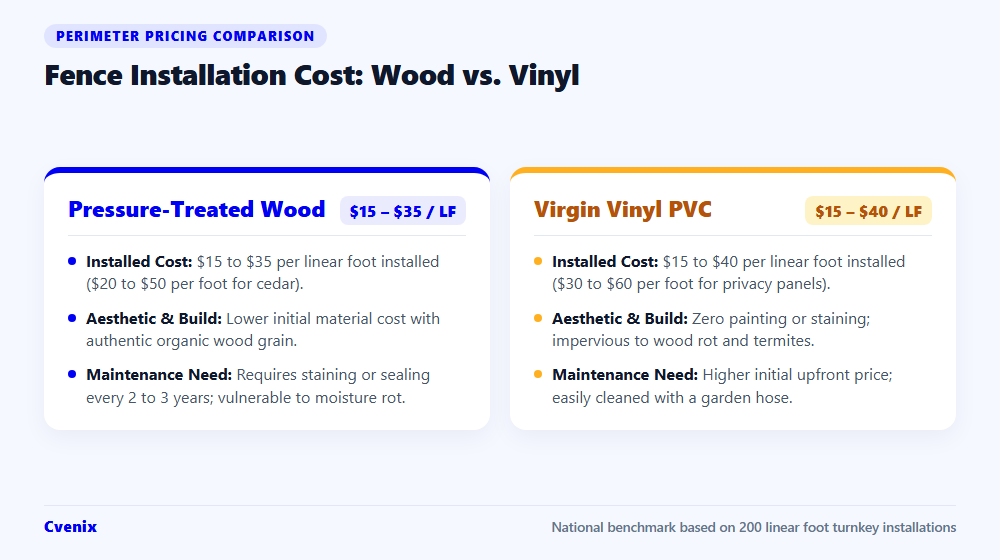
Wood fence installation cost ($15 to $50 per foot)
Wood remains the most popular residential fencing choice in the United States, offering classic warmth and natural beauty. Standard wood fence installation costs $15 to $35 per linear foot installed, with raw materials averaging $5 to $15 per foot and contractor labor adding $10 to $20 per linear foot. Full turnkey installations for 6-foot privacy fences typically range from $20 to $50 per linear foot depending on lumber species, board thickness, and design complexity.
Lumber selection creates noticeable pricing and performance differences across wood fences:
- Pressure-treated pine ($15 to $30 per foot installed): Southern yellow pine chemically infused with preservatives is the most economical privacy option. While highly resistant to insect attack and fungal decay, treated pine holds significant moisture when newly installed, making boards prone to shrinking, twisting, and cupping under intense summer sunlight.
- Western red cedar ($25 to $45 per foot installed): Cedar contains natural organic tannins that resist moisture, rot, and boring insects without harsh chemical additives. It is dimensionally stable, meaning pickets resist warping and maintain tight straight seams, though raw lumber costs run 30% to 50% higher than treated pine.
- Redwood ($35 to $65 per foot installed): Common in western states, redwood provides dense, tight grain structure and rich natural coloring. It offers exceptional natural longevity, though limited regional availability drives material pricing into premium tiers.
To achieve a 15-to-25 year lifespan, all wood fences require proactive maintenance. Homeowners should plan to pressure wash and apply an exterior oil-based stain or water-repellent sealant every 2 to 3 years, which costs $2 to $5 per linear foot when hired out or $50 to $120 in supplies for DIY application.
Vinyl fence installation cost ($15 to $40 per foot)
Vinyl fencing, manufactured from rigid polyvinyl chloride (PVC), offers a clean, contemporary appearance that eliminates regular painting and staining. Professional vinyl fence installation costs $15 to $40 per linear foot installed, with materials running $10 to $30 per foot and labor averaging $5 to $10 per linear foot. Full-height 6-foot solid privacy panels typically cost $30 to $60 per linear foot installed.
While vinyl requires a higher upfront financial commitment than pressure-treated pine, it delivers significant lifecycle value. Vinyl will not rot, splinter, warp, or suffer insect damage, and seasonal cleaning involves little more than a quick spray with a garden hose and mild detergent. However, material quality varies substantially across manufacturers. Professional installers recommend virgin vinyl PVC formulated with impact modifiers and titanium dioxide UV inhibitors. Low-grade recycled vinyl panels lack UV protection, causing them to yellow in intense sun and turn brittle during subzero winter freezes, leaving them vulnerable to cracking from flying lawn debris.
Chain link fence installation cost ($12 to $40 per foot)
Chain link fencing is the most cost-effective and durable solution for securing property perimeters, enclosing pets, and establishing clear boundary lines. Professional chain link installation costs $12.25 to $40 per linear foot installed, with materials ranging from $2.25 to $20 per linear foot and labor adding $6.75 to $15 per foot.
Pricing within the chain link category depends on height, wire gauge, and protective coatings:
- Standard 4-foot galvanized mesh ($12 to $20 per foot installed): The baseline choice for backyard pet containment, utilizing 11.5-gauge or 9-gauge zinc-coated steel wire woven into open diamond patterns.
- 6-foot galvanized mesh ($18 to $28 per foot installed): Taller commercial-style containment offering improved security for perimeter defense and larger dogs.
- Black or green vinyl-coated chain link ($20 to $35 per foot installed): Steel wire core extruded with a thick polyvinyl chloride exterior jacket. The dark vinyl layer protects against corrosion and blends smoothly into surrounding trees and landscape beds.
- Privacy slat inserts ($25 to $40 per foot installed): High-density polyethylene (HDPE) vertical slats threaded through the chain link diamonds, converting an open wire fence into an effective 75% to 90% visual privacy screen.
Aluminum and ornamental metal fence cost ($15 to $40 per foot)
Ornamental aluminum fencing provides the classic, stately look of traditional wrought iron without the heavy weight or persistent rust problems. Professional aluminum fence installation costs $15 to $40 per linear foot installed, with materials averaging $10 to $30 per foot and labor adding $5 to $10 per linear foot. Heavy-duty ornamental panels or commercial pool barrier enclosures range from $25 to $75 per linear foot installed.
Because aluminum does not contain iron, it is naturally rust-proof and corrosion-resistant, making it ideal for coastal environments, rainy climates, and swimming pool enclosures. Factory powder-coated finishes protect the metal from chipping, peeling, and UV fading for decades. For homeowners enclosing an in-ground pool, aluminum fencing easily meets municipal safety codes requiring a minimum 48-inch height, vertical picket spacing under 4 inches, and outward-opening, self-closing gates with child-resistant latches.
Composite fence installation cost ($20 to $85 per foot)
Wood-plastic composite (WPC) fencing represents the premium end of the residential privacy market, manufactured from recycled plastics and reclaimed wood fibers. Professional composite fence installation costs $20 to $85 per linear foot installed, translating to $4,000 to $17,000 for a typical 200-linear-foot suburban backyard. Materials alone average $12 to $55 per linear foot, with specialized installation labor adding $8 to $30 per linear foot.
Composite fencing systems, such as Trex or Fiberon, feature heavy tongue-and-groove boards that slide securely into grooved composite or steel posts. The dense, solid core creates an exceptional acoustic barrier that significantly dampens street traffic noise compared to hollow vinyl or lightweight pine pickets. Composite materials are completely impervious to rot, termites, and splintering, offering a manufacturer lifespan of 25 to 35+ years. Although upfront installation costs are substantial, composite fencing eliminates ongoing staining expenses and board replacements over decades of ownership.
Wrought iron and structural steel fence cost ($30 to $85 per foot)
True wrought iron and heavy welded tubular steel fencing deliver the highest level of physical security and timeless curb appeal, costing $30 to $85 per linear foot installed. Raw materials average $15 to $50 per linear foot, while labor runs $15 to $35 per foot due to the immense weight of the panels and the necessity of deep concrete footings.
Modern steel fences use galvanized tubular steel panels protected with multi-stage powder coatings, whereas historic wrought iron features solid hand-forged bars. While virtually indestructible against impact, iron and steel require vigilance against surface rust. Homeowners in humid or snowy regions should plan to wire-brush, prime, and repaint exposed welds every 3 to 5 years to preserve structural integrity.
Specialty fencing costs: barbed wire, hog wire, electric, and glass ($3 to $40+ per foot)
Beyond standard residential panels, several specialty fencing styles serve distinct agricultural, modern architectural, or containment needs:
- Agricultural barbed wire ($3 to $8 per foot installed): Economical 3-to-5 strand high-tensile wire strung between steel T-posts, primarily used for cattle and large rural acreage perimeters.
- Hog wire with wood framing ($18 to $35 per foot installed): Heavy-gauge galvanized welded wire panels set inside wood top, bottom, and side rails. This design has surged in popularity for modern farmhouse properties, delivering pet containment while preserving open garden sightlines.
- Underground invisible pet fencing ($1,000 to $2,500 total): Buried boundary wire paired with a radio transmitter and pet receiver collar, running roughly $2 to $5 per linear foot installed for yard perimeters.
- Frameless glass pool fencing ($100 to $250+ per foot installed): Half-inch tempered architectural safety glass panels secured with marine-grade stainless steel spigots, offering unobstructed luxury views around swimming pools.
Master material cost per linear foot matrix
The table below provides a comprehensive comparison of materials, labor rates, turnkey 200-foot project totals, expected lifespans, and long-term maintenance needs across all primary fencing options.
| Fence material | Materials cost per foot | Labor cost per foot | Total installed cost per foot | Average 200-foot cost | Expected lifespan | Maintenance requirements |
|---|---|---|---|---|---|---|
| Pressure-treated pine | $5 – $15 | $10 – $20 | $15 – $30 | $3,000 – $6,000 | 15 – 20 years | Power wash and stain or seal every 2 to 3 years |
| Western red cedar | $12 – $25 | $13 – $20 | $25 – $45 | $5,000 – $9,000 | 20 – 25 years | Seal every 3 years to preserve rich natural color |
| Vinyl (PVC) | $10 – $30 | $5 – $10 | $15 – $40 | $3,000 – $8,000 | 20 – 30+ years | Annual garden hose rinse with mild soap |
| Galvanized chain link | $2.25 – $10 | $6.75 – $15 | $12 – $25 | $2,400 – $5,000 | 20 – 30 years | None; clear rust spots with wire brush as needed |
| Black vinyl-coated chain link | $10 – $20 | $15 – $20 | $25 – $40 | $5,000 – $8,000 | 20 – 30+ years | Zero maintenance; inspect ties every 5 years |
| Ornamental aluminum | $10 – $30 | $5 – $10 | $15 – $40 | $3,000 – $8,000 | 30 – 50+ years | Zero maintenance; inspect latch alignment seasonally |
| Composite (WPC) | $12 – $55 | $8 – $30 | $20 – $85 | $4,000 – $17,000 | 25 – 35+ years | Occasional garden hose wash; no staining ever |
| Wrought iron / structural steel | $15 – $50 | $15 – $35 | $30 – $85 | $6,000 – $17,000 | 30 – 50+ years | Wire brush and spot prime rust welds every 3 to 5 years |
| Hog wire with wood framing | $8 – $18 | $10 – $17 | $18 – $35 | $3,600 – $7,000 | 15 – 20 years | Stain wood frame every 3 years; clear bottom debris |
Fence Installation Cost Breakdown: Materials, Labor, and Permits
When a fencing contractor hands you a formal written bid, the bottom-line total reflects far more than just bundles of cedar pickets or rolls of wire mesh. Professional invoices combine raw component supplies, specialized labor, heavy excavation equipment, post setting concrete, municipal permit fees, and optional boundary surveys. Reviewing these line items individually ensures you can evaluate bids accurately and negotiate without sacrificing build quality.
Materials and hardware expenses ($5 to $30 per foot)
Raw building materials generally account for 40% to 50% of the complete installation cost. This expense category includes vertical pickets or manufactured panels, horizontal 2×4 backer rails, vertical structural posts (4×4 or 6×6 lumber, or galvanized steel), post caps, gate latch hardware, and heavy concrete mix. Contractor grade 50-lb to 80-lb bags of fast-setting concrete cost $5 to $9 per bag, with each post footing requiring 1.5 to 2.5 bags plus a bottom cushion of crushed stone.
While purchasing retail fencing packages at big-box home improvement stores costs roughly $22 to $30 per linear foot for standard 6-foot cedar privacy fencing, licensed contractors purchase materials in bulk from commercial lumber yards and wholesale fence distributors at a 15% to 25% discount, helping offset equipment overhead.
Labor rates, crew hours, and installation time ($30 to $80 per hour)
Professional fence installation labor costs between $30 and $80 per hour per worker, which translates to a general rate of $5 to $20 per linear foot depending on terrain and fence type. For a standard residential yard of 150 to 200 linear feet, an experienced 2-to-3 person crew can complete installation within 20 to 35 labor hours, typically spread over 2 to 3 working days to allow concrete footings adequate time to cure before hanging heavy panels and gates.
Skilled labor involves substantial site preparation and physical craftsmanship:
- Staking property boundaries and snapping taut mason string lines to establish a dead-straight perimeter.
- Marking exact post centers at 6-foot or 8-foot intervals.
- Excavating deep post holes with gas-powered hydraulic augers or manual post-hole diggers.
- Plumbing, bracing, and securing structural posts in concrete and aggregate.
- Fastening structural rails, attaching individual pickets with corrosion-resistant screws, and hanging balanced gate frames.
Single post installation and replacement labor ($40 to $150 per post)
Setting new structural posts or replacing damaged posts on an existing fence carries dedicated unit costs. Total installed costs per post range from $50 to $200 for wood, vinyl, or composite, and $50 to $210 for metal posts. The labor charge alone to dig a hole and set a single post in concrete averages $40 to $150 per post.
If a severe windstorm snaps an isolated corner post or ground moisture rots a gate hinge post, hiring a fence technician to replace an individual post requires mobilizing equipment, chipping out the existing concrete footing, resetting a new post, and reattaching fence rails. Most contractors enforce a minimum service fee of $150 to $300 for single-post repair trips.
Municipal fence permits, zoning setbacks, and HOA covenants ($40 to $150)
In most US towns and suburban cities, installing a permanent fence requires a municipal building permit, which typically costs $40 to $150 depending on boundary size and local fee schedules. Building permits are almost universally mandatory for fences taller than 6 feet, fences enclosing swimming pools, or front yard barriers that intersect street sightline visibility triangles.
In addition to city building codes, homeowners must comply with local zoning setbacks and neighborhood Homeowners Association (HOA) covenants. Municipal setbacks frequently require fences to sit 2 to 6 inches inside property lines, preventing encroachment onto public easements or neighboring property. Suburban HOAs often enforce strict architectural review guidelines, dictating acceptable fence heights, banned materials (such as galvanized chain link), and mandatory exterior color stains.
Itemized turnkey fence cost breakdown table
The table below provides a detailed line-item breakdown of a typical turnkey fence installation contract, highlighting where your budget is allocated.
| Cost category | Specific component | Average cost range | Share of total budget | Cost driver details |
|---|---|---|---|---|
| Fence infill materials | Pickets, panels, and 2×4 rails | $8 – $30 per linear foot | 35% – 45% | Wood species, vinyl grade, or composite brand selection |
| Structural vertical posts | 4×4 or 6×6 wood posts, or steel channels | $50 – $210 per post installed | 10% – 15% | Post spacing (6-ft vs 8-ft) and frost depth requirements |
| Footing foundation | Fast-setting concrete and drainage gravel | $10 – $25 per post hole | 5% – 8% | Soil conditions and local frost line excavation depth |
| Installation labor | Site layout, digging, framing, and fastening | $30 – $80 per hour ($5 – $20/LF) | 35% – 45% | Ground slope, tree roots, soil hardness, and crew size |
| Walk-through gates | Pedestrian gate frame, hinges, and latch | $50 – $400 per gate installed | 3% – 6% | Hardware quality, gate width, and anti-sag bracing |
| Demolition and removal | Old fence teardown and debris haul-off | $3.00 – $6.50 per linear foot | 5% – 10% | Disposal dump fees and pulling old concrete footings |
| Municipal permit | City building and zoning inspection fee | $40 – $150 per project | 1% – 2% | Fence height over 6 feet and local municipal rates |
| Property boundary survey | Pin recovery by licensed land surveyor | $400 – $1,000 (optional) | Variable | Establishing legal lot lines to prevent neighbor disputes |
Key Factors That Drive Fence Installation Costs
Every residential property presents unique topographical and structural challenges that alter contractor pricing. Understanding how perimeter length, fence height, yard grading, and subsurface soil affect labor efficiency allows you to anticipate budget adjustments before scheduling on-site estimates.
Fence height and privacy styling (6-foot vs 8-foot privacy panels)
Fence height directly determines material volume and structural post sizing. A standard 6-foot privacy fence costs $25 to $60 per linear foot installed, while an 8-foot privacy fence increases significantly to $50 to $85 per linear foot installed. Moving from a 6-foot to an 8-foot fence nearly doubles the total investment for several critical engineering reasons:
- Longer structural posts: An 8-foot fence requires 11-foot to 12-foot posts, which must be set 36 to 48 inches deep in concrete to anchor the increased leverage.
- Extra horizontal framing: While 6-foot fences utilize two or three horizontal 2×4 backer rails, 8-foot panels require three or four structural rails to prevent pickets from warping.
- Wind sail load: An 8-foot solid privacy fence acts as a massive sail during high-wind storms, demanding larger-diameter concrete footings, heavier post brackets, and formal building department engineering inspections.
Fence length, perimeter layout, and cost per acre (100 to 500 feet and multi-acre lots)
Perimeter length dictates overall project scale. While total expenditure climbs steadily with every additional foot of fencing, longer continuous runs benefit from modest economies of scale because contractor mobilization and equipment transportation costs are spread over more footage. A 200-linear-foot fence represents the typical quarter-acre suburban backyard, averaging $4,500 total ($3,000 to $7,000 range).
| Perimeter length (linear feet) | Galvanized chain link | Pressure-treated pine | Western red cedar | Virgin vinyl privacy | Composite (WPC) |
|---|---|---|---|---|---|
| 100 linear feet | $1,200 – $2,500 | $1,500 – $3,000 | $2,500 – $4,500 | $1,500 – $4,000 | $2,000 – $8,500 |
| 150 linear feet | $1,800 – $3,750 | $2,250 – $4,500 | $3,750 – $6,750 | $2,250 – $6,000 | $3,000 – $12,750 |
| 200 linear feet | $2,400 – $5,000 | $3,000 – $6,000 | $5,000 – $9,000 | $3,000 – $8,000 | $4,000 – $17,000 |
| 300 linear feet | $3,600 – $7,500 | $4,500 – $9,000 | $7,500 – $13,500 | $4,500 – $12,000 | $6,000 – $25,500 |
| 500 linear feet | $6,000 – $12,500 | $7,500 – $15,000 | $12,500 – $22,500 | $7,500 – $20,000 | $10,000 – $42,500 |
For larger parcels, calculating perimeter acreage requires understanding geometric boundary math. Enclosing a square 1/4-acre lot requires approximately 415 linear feet, a 1/2-acre lot requires roughly 590 linear feet, and a full 1-acre square parcel measures about 835 linear feet. Completely enclosing 1 acre with residential wood or vinyl fencing ranges from $12,500 to $45,000+, leading many rural homeowners to choose budget-friendly split-rail or field wire along distant boundaries while reserving privacy fencing for the immediate patio zone.
Yard topography and slope engineering (racked vs stepped installation)
Installing a fence on an uneven or sloped yard requires specialized installation techniques that add $5 to $15 per linear foot in contractor labor. Crews use one of two primary construction methods to handle grade changes:
- Racked fencing: The horizontal rails follow the natural slope of the ground while the pickets remain plumb (perfectly vertical). Racking keeps the bottom gap uniform and close to the turf (under 2 inches), making it the best option for containing small dogs. Racking works smoothly on gentle to moderate slopes up to 10 or 15 degrees.
- Stepped fencing: Fence panels remain completely horizontal, stepping down the hill in staircase fashion between taller posts. While stepped fencing accommodates severe hills, it leaves triangular gaps beneath each panel on the downhill side. Homeowners must install bottom gravel boards or fill dirt to prevent pets from escaping.
Sloped yards often channel storm runoff toward property corners. When heavy rain saturates fence line soil, unchecked pooling weakens concrete footings and accelerates wood decay. Managing perimeter drainage by pairing boundary projects with exterior runoff systems or evaluating your sump pump replacement cost for yard discharge basins protects your fencing investment from water damage.
Soil conditions, caliche rock, and tree root excavation surcharges
Standard contractor labor estimates assume soft loam, sandy soil, or workable topsoil. When digging crews encounter dense compacted clay, limestone caliche rock (common across Texas and the Southwest), granite ledges, or thick tree root systems, manual post hole diggers and standard two-person augers stall out completely.
In tough soils, contractors must bring in heavy mechanical equipment such as skid-steer hydraulic augers, diamond core drills, or pneumatic jackhammers. These difficult digging conditions add equipment surcharges of $10 to $35 per post hole, adding $250 to $875 to a typical 25-post project.
Style profiles: shadowbox, board-on-board, picket, split-rail, and dog-ear
The structural layout of your fence pickets alters material volume and wind resistance:
- Standard dog-ear privacy: Pickets are nailed side-by-side with decorative cut corners. This is the baseline privacy design ($15 to $30 per foot installed). As lumber dries, small 1/8-inch gaps open between pickets.
- Shadowbox (board-on-board alternating): Pickets alternate between the front and back of the horizontal rails. This design uses 15% to 25% more lumber but allows breezes to flow through the fence, reducing wind resistance in storm-prone regions while offering privacy when viewed straight-on.
- True board-on-board ($30 to $55 per foot installed): Vertical pickets overlap by 1 to 1.5 inches. Even when wet lumber shrinks during hot summer months, the overlap guarantees 100% total visual privacy with zero sightline gaps.
- Spaced picket ($15 to $35 per foot installed): Decorative 3-to-4 foot tall front yard fencing with open spaces between pickets, offering traditional suburban charm.
- Split-rail or post-and-rail ($12 to $25 per foot installed): Rustic 2-rail or 3-rail open post design, frequently lined with wire mesh for economical pet containment.
Structural Post Engineering: Frost Lines, Footings, and Rot Prevention
A residential fence is only as durable as the posts that anchor it into the earth. While pickets and decorative panels can be replaced quickly, repairing leaning posts or rotted footings requires dismantling entire sections of the fence line. Applying sound structural engineering standards prevents premature failure from ground rot, fastener corrosion, and winter frost heave.
Frost depth compliance and frost heave mechanics (IRC Section R403.1.4.1)
Under the International Residential Code (IRC Section R403.1.4.1), permanent exterior structural supports and foundation piers must extend below the local frost line, with a minimum footing depth of 12 inches below undisturbed ground surface in frost-free regions. Digging shallow 18-to-24 inch holes in cold northern climates guarantees structural failure through frost heave.
Frost heave occurs when subsoil moisture freezes and expands upward during subzero winter temperatures. Freezing soil grips the rough sides of smooth cylindrical concrete footings like a handle, jacking the post upward 1 to 3 inches each winter. As the ground thaws in spring, loose soil falls beneath the lifted footing, preventing the post from settling back down. Over several freeze-thaw cycles, fence posts tilt outward, rails snap, and gates bind against latches. Just as severe soil movement can drive up your foundation repair cost when home footings shift, shallow fence posts will fail under expanding winter subsoil.
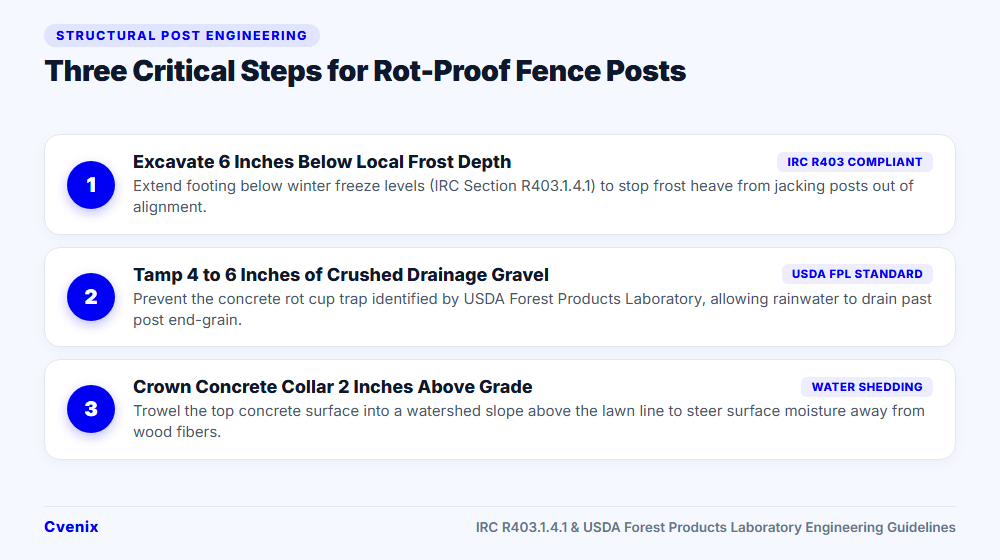
To prevent frost heave, post holes must be excavated at least 6 inches deeper than your local frost line. In southern states, post holes typically measure 24 inches deep; across the Midwest, Northeast, and Great Lakes (such as Minnesota, New York, and Illinois), frost lines reach 36 to 48 inches deep. Experienced contractors use a bell-footing technique, flaring out the bottom of the excavation hole so the concrete footing forms an inverted wedge that locks firmly into deep, unfrozen soil.
The concrete rot cup trap and gravel drainage base requirements (USDA FPL guidelines)
A widespread misconception among homeowners and novice builders is that encasing a wooden post entirely in solid concrete protects the wood. In reality, solid concrete footings poured without bottom drainage create what fence builders call a concrete rot cup, rotting wooden 4×4 posts through at ground level within 5 to 7 years.
According to the USDA Forest Products Laboratory (Wood Handbook, Chapter 14), concrete is a porous material that shrinks slightly as it cures, creating a microscopic gap between the timber and the concrete collar. Rainwater runs down the post into this gap and becomes trapped at the bottom of the concrete plug. Because end-grain wood fibers absorb water like a bundle of drinking straws, trapped moisture saturates the base of the timber, starving it of oxygen and accelerating fungal rot.
To install rot-proof wood posts according to USDA guidelines, follow this three-step standard:
- Excavate 6 inches deeper: Dig the post hole 6 inches deeper than the target post embedment depth.
- Tamp a gravel drainage plug: Pour 4 to 6 inches of coarse crushed rock or drainage gravel at the bottom of the hole and tamp it firm. Rest the bare wood post end-grain directly on the gravel bed so water can drain out into the subsoil.
- Crown the concrete collar: Pour concrete around the sides of the post, stopping 2 inches above the surrounding ground level. Trowel the top surface into a slope away from the wood post, creating a crowned collar that sheds surface rainwater outward.
Post rot is also exacerbated by unchecked roof drainage. If unmanaged rainwater cascades from eaves directly onto perimeter fencing, saturated ground accelerates fungal growth at the soil line. Reviewing your local gutter installation cost to add seamless aluminum gutters and downspout extensions diverts heavy roof runoff away from perimeter fence posts.
Upgrading to concealed steel posts (Master-Halco Postmaster 70 mph wind rating)
Homeowners who desire the authentic look of a cedar privacy fence but want to eliminate the risk of rotting wooden posts can upgrade to engineered in-line steel post systems, such as the Master-Halco Postmaster. Engineered from heavy-gauge galvanized steel, Postmaster posts feature an open hat-channel profile that allows wood 2×4 rails and pickets to mount directly to the metal flange.
Because the steel channel sits entirely concealed behind overlapping wood pickets, the completed installation looks like a traditional all-wood fence from both sides. Postmaster steel posts are engineered to withstand wind loads up to 70 mph when anchored in concrete footings. Because galvanized steel handles soil contact and moisture exposure, structural wood never touches wet earth. Upgrading to steel posts adds roughly $4 to $6 per linear foot over standard pressure-treated wood posts, extending the structural framework lifespan to 30+ years.
Fastener metallurgy and ACQ copper corrosion prevention (AWPA Standard U1 and ASTM A153)
Fastener corrosion is a silent killer of modern wood fences. Under American Wood Protection Association (AWPA) Standard U1 and ASTM A153 Class D specifications, all nails, screws, and structural brackets in direct contact with pressure-treated lumber must be hot-dipped galvanized or manufactured from Grade 304 or 316 stainless steel.
Modern exterior lumber preservatives (such as ACQ, CA-B, and micronized copper azole) contain high concentrations of dissolved copper. When standard steel drywall screws or thin electro-galvanized fasteners contact copper-rich wood in wet outdoor conditions, galvanic chemical reactions corrode the metal fastener shank. Within 2 to 4 years, fastener heads snap off under minor wind pressure, causing pickets to drop from rails. Always verify that your contractor uses hot-dipped galvanized fasteners compliant with ASTM A153 Class D, or Grade 304 stainless steel ring-shank nails.
Gates, Demolition, and Site Preparation Costs
Line items beyond standard perimeter panel runs frequently turn a basic estimate into a complete turnkey project. Adding pedestrian access gates, vehicular entryways, tearing down old dilapidated barriers, and marking buried property lines require dedicated budgeting.
Pedestrian walk-through gates and hardware kits ($50 to $400 installed)
A standard 3-to-4 foot walk-through gate designed for pedestrian yard access costs $40 to $200 for materials, with total installed costs ranging from $50 to $400 depending on style, hardware, and material. Gates represent the highest point of mechanical wear along any fence line, making quality hardware essential.
To prevent gate sag, professional installers use heavy-duty 8-inch commercial tee hinges, self-closing tension springs, and a padlockable gravity latch. Wood privacy gates should always incorporate an internal diagonal anti-sag turnbuckle cable kit or a rigid welded steel frame (such as an Adjust-A-Gate kit). Without diagonal structural bracing, the weight of solid cedar or pine pickets will cause the latch side of the gate to drag across the ground within 12 to 18 months.
Driveway vehicular gates and automated openers ($1,000 to $6,000 installed)
Vehicular driveway gates spanning 10 to 16 feet average $1,000 to $6,000 fully installed for materials and labor. These large systems require heavy structural steel hinge posts (minimum 4×4 or 6×6 steel tubing) set in massive 48-inch deep concrete footings to counter the cantilevered swinging weight.
Adding an automatic electric gate opener increases total costs by $1,000 to $3,000. Homeowners can choose between low-voltage DC solar-powered gate openers ($600 to $1,500 equipment cost) or hardwired 120V AC systems. Hardwired systems require trenching dedicated electrical conduit from the home electrical panel to the driveway perimeter, which adds $1,000 to $2,500 in licensed electrician labor.
Old fence removal, tear-down, and debris haul-off ($3.00 to $6.50 per foot)
If your project involves replacing an existing fence, demolition and haul-off represents a dedicated line item. Removing an old fence costs $3.00 to $6.50 per linear foot on average, including labor to dismantle panels, pull concrete footings from the earth, and pay municipal dump fees. For a standard 150-linear-foot perimeter, removal adds $450 to $975 to your total project bill.
Extracting old concrete footings is the most labor-intensive part of the demolition process. If an installer cuts old wood posts off at ground level and leaves the concrete plugs in the soil, the new fence posts cannot be dug in the same line, forcing the contractor to offset post spacing or shift your property boundary inward. Pulling out 100-lb concrete slugs manually or with skid-steer jacks costs roughly $20 to $40 per concrete footing. When demolition, haul-away, and new installation are bundled together, full fence replacement costs typically range from $30 to $80 per linear foot turnkey.
Property boundary land surveys and pin location ($400 to $1,000)
Hiring a licensed professional land surveyor to mark property boundaries costs $400 to $1,000. A surveyor uses professional transit equipment to locate buried iron survey pins at your property corners and flag exact boundary lines. Investing in a survey before construction begins prevents catastrophic boundary disputes.
Never assume an old fence was built on the exact legal boundary line. Previous owners frequently installed fences 6 to 12 inches inside property lines to avoid neighbor disputes or misjudged boundary markers entirely. If you build a new $8,000 fence that encroaches even 3 inches onto a neighbor’s parcel, they can legally compel you to tear the fence down at your own expense. Many states enforce Good Neighbor Fence laws (such as California Civil Code Section 841), which establish equal responsibility between adjacent property owners for boundary barriers and require a 30-day written notice before construction starts.
Calling 811 utility locators vs private underground line marking
Before excavating post holes, homeowners or contractors must contact the national 811 Call Before You Dig service at least two to three business days in advance. Calling 811 is a free service mandated by law, dispatching utility representatives to spray-paint the location of buried public gas, electric, water, sewer, and telecommunications mains.
However, homeowners must understand a critical limitation: 811 locators only mark public utility mains up to the residential utility meter. They do not locate private secondary lines installed by property owners. Buried electric cables powering detached garages, gas lines feeding pool heaters, invisible dog fence wires, and underground lawn sprinkler pipes will not be marked by 811. Hitting a private electrical conduit with a mechanical auger can cause severe electrical shock or thousands of dollars in emergency repair costs. If your yard has private utility runs, hire a private utility locating company or carefully hand-dig post holes near known utility paths.
State and Regional Fence Installation Costs
Fence installation pricing varies widely across the United States. Labor rates, local frost depths, severe weather risks, and regional lumber distribution channels create substantial price spreads between states. A 200-foot cedar privacy fence that costs $4,800 in rural Ohio can easily exceed $11,000 in suburban New York or coastal California.
Regional labor markets, climate durability, and frost line impacts
Three primary geographic factors drive regional fence pricing differences:
- Frost line excavation depth: In northern states like Minnesota, New York, and Wisconsin, building codes require post holes to extend 42 to 48 inches deep to avoid winter frost heave. Digging these deep holes requires 2x to 3x more concrete and labor per post than in Florida or Texas, where frost depths rarely exceed 12 inches.
- Skilled trade labor rates: Fencing contractors in high-cost metropolitan areas and union markets (Northeast and West Coast) charge $60 to $100+ per hour per worker, compared to $30 to $50 per hour across the rural Midwest and South.
- Climate and environmental engineering: Coastal regions and humid southern states require heavy copper retention lumber, stainless steel fasteners, or corrosion-proof aluminum to combat termites, humidity, and coastal salt fog. In hurricane-prone zones, local codes mandate reinforced post spacing and heavy structural bracing.
State-by-state fence installation cost benchmark table
The table below outlines installed cost ranges per foot for wood, vinyl, and chain link across major states, along with average 200-foot project totals and typical regional frost depths.
| State | Average wood cost per foot | Average vinyl cost per foot | Average chain link cost per foot | Typical 200-foot project cost | Typical frost depth | Regional cost driver |
|---|---|---|---|---|---|---|
| California | $28 – $58 | $35 – $68 | $18 – $35 | $6,500 – $13,500 | 12 inches | High trade labor rates and strict municipal building codes |
| New York | $26 – $55 | $32 – $65 | $16 – $32 | $6,000 – $12,500 | 42 – 48 inches | Deep frost lines requiring heavy excavation and concrete |
| Texas | $18 – $38 | $22 – $48 | $12 – $24 | $4,000 – $8,500 | 12 inches | Dense caliche limestone soil requiring heavy mechanical augers |
| Florida | $20 – $42 | $25 – $52 | $14 – $26 | $4,500 – $9,500 | 12 inches | High wind resistance engineering and high humidity termite risks |
| Illinois | $24 – $50 | $30 – $60 | $15 – $30 | $5,500 – $11,500 | 40 – 42 inches | Severe winter freeze-thaw cycles and metro Chicago labor |
| Ohio | $20 – $44 | $26 – $54 | $13 – $26 | $4,800 – $9,800 | 32 – 36 inches | Moderate labor rates balanced against regional winter frost |
| Washington | $26 – $54 | $32 – $64 | $16 – $32 | $5,800 – $12,000 | 18 – 24 inches | High cedar availability offset by rapid wet-climate fungal rot |
| Colorado | $22 – $48 | $28 – $58 | $14 – $28 | $5,200 – $10,500 | 36 – 44 inches | Rocky mountain soil excavation and deep winter frost lines |
Benefits of Installing a New Residential Fence
Installing a perimeter fence offers immediate functional, security, and financial benefits for single-family homeowners. Beyond establishing clear boundaries, a properly installed barrier enhances your daily outdoor living experience.
Property boundary security and pet containment
A secure perimeter fence creates a safe outdoor play environment for children and pets, allowing dogs to exercise off-leash without running into traffic. A sturdy barrier also deters trespassers, wandering stray animals, and unwanted pedestrian shortcuts across your lawn. For swimming pool owners, fences are a vital safety barrier that prevents accidental drownings while satisfying mandatory home insurance liability clauses.
Visual privacy and blocking neighborhood eyesores
A solid 6-foot privacy fence blocks sightlines from adjacent two-story homes, nearby patios, and busy roadways. Fencing provides a visual screen that conceals unsightly neighboring alleyways, commercial parking lots, or utility boxes. Solid wood and dense composite fences also serve as acoustic sound buffers, dampening neighborhood street noise to create a tranquil backyard sanctuary.
Return on investment, home resale value, and curb appeal
A professionally installed fence delivers a reliable return on investment, typically recouping 50% to 70% of its initial installation cost at resale. In suburban family neighborhoods, fully fenced yards rank among the top search filters for prospective buyers with young children and pets. High-quality ornamental aluminum or finished cedar fencing substantially enhances exterior curb appeal, complementing other key exterior upgrades like modern garage door replacement cost projects to maximize home marketability.
When severe storms or hail damage exterior building envelopes, boundary fences often suffer impact damage alongside residential roofing. Benchmarking your perimeter fence budget alongside whole-home exterior restoration, such as typical roof replacement cost estimates, helps you file organized, consolidated insurance claims following severe weather events.
DIY vs. Professional Fence Installation
Tackling fence installation as a DIY project can save $1,500 to $4,000 in professional labor fees, but it requires significant physical stamina, specialized tools, and precise engineering. Evaluating the true costs of tool rentals, materials handling, and post alignment helps determine whether DIY is practical for your schedule.
Upfront tool and material costs vs professional contractor bids
Purchasing raw lumber, pickets, rails, and concrete mix at big-box home centers runs $22 to $30 per linear foot for standard cedar privacy fencing. While this cuts out the $10 to $20 per linear foot contractor labor charge, DIYers must purchase or rent specialized construction tools:
- Gas-powered post hole auger rental: $80 to $150 per day.
- Portable electric concrete mixer rental: $50 to $75 per day.
- Pneumatic framing nailer and air compressor rental: $40 to $65 per day.
- Post levelers, mason string lines, digging bars, and heavy wheelbarrows: $100 to $200 in purchased equipment.
Physical labor demands, auger rentals, and post alignment risks
The physical demands of building a 200-linear-foot fence are intense. An average residential perimeter requires digging 25 to 30 post holes 36 inches deep, followed by mixing and wheelbarrowing fifty 60-lb bags of concrete (roughly 3,000 pounds of heavy material). Gas augers kick back violently when striking roots or large rocks, creating severe wrist and back strain for inexperienced operators.
In addition, setting posts dead-plumb and perfectly in-line across rolling ground requires precision craftsmanship. If even two or three structural posts are set out of plumb or off-center by an inch, pre-assembled fence panels will not fit, horizontal rails will bind, and gates will fail to latch smoothly.
How to save money on fence installation without cutting corners
If hiring a professional fencing contractor, you can reduce total project expenses without sacrificing durability:
- Split costs with adjacent neighbors: Under Good Neighbor guidelines and state statutes, adjacent property owners who share a common boundary fence often split costs 50/50. Presenting written estimates and agreeing on neutral cedar or vinyl designs cuts your individual expense in half.
- Tackle demolition yourself: Dismantling and hauling away the old fence saves $3.00 to $6.50 per linear foot ($450 to $975 on a 150-foot project). Renting a small utility trailer and clearing the fence line before the contractor arrives eliminates demo labor.
- Schedule during the contractor off-season: Fencing companies experience high demand from spring through mid-summer. Booking your installation in late autumn or winter in moderate climates can secure 10% to 15% discounts on labor.
- Opt for standard 6-foot dog-ear panels: Choosing standard vertical dog-ear pickets over custom horizontal designs or lattice-top panels reduces lumber waste and cuts installation labor by $5 to $12 per linear foot.
- Use hybrid post and picket pairings: Pair rot-resistant pressure-treated pine posts or Postmaster steel posts with premium cedar pickets. This gives you the rich curb appeal of natural cedar where visible, while anchoring the fence with durable, rot-proof vertical supports.
Questions to ask fence contractors before signing a contract
Before executing a binding contract or paying an upfront deposit, ask prospective fence builders these six technical vetting questions:
- How deep do you dig post holes, and do you comply with our local frost line depth code? (Ensure northern holes extend 36 to 48 inches deep rather than a generic 24 inches).
- Do you place a tamped gravel drainage bed at the bottom of each post hole? (Never allow contractors to pour solid concrete directly around wood posts without a 4-to-6 inch gravel drainage base).
- What metallurgy fasteners do you use? (Verify they use hot-dipped galvanized fasteners compliant with ASTM A153 Class D or Grade 304 stainless steel to resist ACQ chemical corrosion).
- Does your estimate include pulling the municipal permit and contacting 811 utility locators? (Contractors should pull permits under their license and file utility locator tickets).
- What specific workmanship and materials warranty do you provide in writing? (Reputable fencing companies offer at least a 1-to-3 year warranty on gate alignment and post stability).
- Are old fence teardown, concrete slug removal, and landfill disposal fees itemized in writing? (Avoid surprise disposal surcharges on final invoices).
Tipping etiquette and who installs residential fencing
Fencing projects are typically performed by dedicated fence installation companies rather than general handymen or landscaping services. Specialized fence crews possess laser layout levels, commercial hydraulic post drivers, heavy skid-steer augers, and established supplier relationships with commercial lumber mills.
Homeowners frequently wonder whether to tip fencing crews upon project completion. Tipping is not customary or expected in the residential construction trades. Providing cold bottled water, electrolyte drinks, and clean access to a restroom is standard homeowner hospitality. However, if an installation crew works through extreme summer heat, handles exceptionally rocky terrain, or completes detailed gate adjustments beyond the contract scope, a cash tip of $20 to $50 per crew member is deeply appreciated.
Methodology and Data Sources
To deliver accurate, transparent cost benchmarking, Cvenix synthesizes contractor bid datasets, national consumer pricing indices, material supply catalog figures, and published building engineering codes.
Pricing research framework and contractor quote synthesis
Our pricing models synthesize comprehensive data from leading trade and home improvement pricing repositories, including Bob Vila cost research, HomeGuide market analysis, and Fixr construction databases. We cross-reference retail lumber and hardware prices from national building supply centers (Home Depot, Lowe’s) with real-world contractor quotes gathered from verified homeowner bid discussions across professional trade communities, including Reddit r/FenceBuilding and r/HomeImprovement. All figures are adjusted for regional labor inflation, material supply cycles, and current residential construction trends.
Building codes and technical engineering standards cited
Structural specifications and durability recommendations throughout this guide conform to official building codes and published engineering literature:
- International Code Council (ICC): 2021 International Residential Code (IRC Section R403.1.4.1), establishing minimum exterior footing depths and frost protection standards.
- USDA Forest Products Laboratory: Wood Handbook: Wood as an Engineering Material (General Technical Report FPL-GTR-190, Chapter 14), defining post drainage mechanisms and fungal rot mitigation standards.
- American Wood Protection Association (AWPA): Standard U1-23 (Use Category UC3B Above Ground / UC4A Ground Contact), governing preservative chemical retentions for exterior timbers.
- American Society for Testing and Materials (ASTM): ASTM A153 Class D specifications for hot-dipped zinc coatings on fasteners in contact with treated wood.
- Master-Halco Postmaster Technical Specifications: In-line galvanized steel structural channel performance criteria under 70 mph wind load conditions.
Frequently Asked Questions About Fence Installation Costs
What is the cheapest fence to install?
Galvanized chain link is the cheapest fence to install, averaging $12 to $25 per linear foot fully installed, with raw materials costing just $2.25 to $10 per linear foot. For a full-privacy enclosure, pressure-treated pine is the most affordable option, costing $15 to $30 per linear foot installed, compared to $25 to $45 for western red cedar and $30 to $60 for vinyl privacy panels.
How much does 200 feet of fence cost?
Installing 200 linear feet of fence costs between $3,000 and $7,000 on average, with the national median sitting at $4,500. A basic 200-foot galvanized chain link fence costs roughly $2,400 to $5,000, while a 6-foot cedar privacy fence or virgin vinyl fence ranges from $5,000 to $9,000 fully installed with posts and gates.
How deep should fence posts be buried?
Fence posts should be buried to a depth equal to one-third to one-half of the fence’s above-ground height, and footings must extend at least 6 inches below your local frost line under IRC Section R403.1.4.1. In warm southern climates, 24-inch holes are standard, whereas northern freeze zones require hole depths of 36 to 48 inches to prevent winter frost heave from jacking the posts upward.
Is it cheaper to install wood or vinyl fencing?
Wood fencing is cheaper upfront, costing $15 to $35 per linear foot installed for treated pine compared to $15 to $40+ per linear foot for vinyl. However, vinyl is often more cost-effective over a 15-to-20 year period because it never requires pressure washing, staining, painting, or board replacements, saving $1,000 to $2,500 in cumulative maintenance expenses.
How much does labor cost to install a fence per foot?
Labor to install a residential fence averages $5 to $20 per linear foot, or $30 to $80 per hour per worker. Professional labor typically accounts for 40% to 60% of the total installation invoice, covering string line layout, post hole digging, concrete footing setting, panel framing, and gate hanging.
How long does a residential fence last?
Lifespan depends heavily on material quality, ground drainage, and routine maintenance. Pressure-treated pine lasts 15 to 20 years; western red cedar lasts 20 to 25 years with regular staining; galvanized chain link lasts 20 to 30 years; virgin vinyl lasts 20 to 30+ years; ornamental aluminum lasts 30 to 50+ years; and composite fencing lasts 25 to 35+ years.
Do you tip fence installers?
Tipping fence installers is not customary or expected in the residential construction trades. Providing cold bottled water, sports drinks, and shaded rest areas is standard hospitality. If a crew performs exceptional work in extreme summer heat or navigates dense rocky terrain, a cash tip of $20 to $50 per crew member is appreciated.
How do I calculate how much fencing I need?
Measure your yard perimeter using a 100-foot measuring tape or a rolling measuring wheel, following the exact route of your planned fence line. Subtract the total width of all planned walk gates (typically 3 to 4 feet each) and driveway gates (10 to 12 feet). Divide the remaining linear footage by 8 to determine the approximate number of posts and pre-assembled 8-foot panels required.
Does installing a fence increase property value?
Yes. A professionally installed privacy or ornamental fence increases overall property value and market appeal, especially for prospective home buyers with young children or pets, typically recouping 50% to 70% of its initial installation cost at resale. Clean boundary fencing also defines property lines and reduces neighborhood disputes.
Do I need a permit to build a fence?
In most US municipalities, yes. Municipal fence permits typically cost $40 to $150. Building permits are almost universally required for residential fences over 6 feet in height, fences enclosing swimming pools, or front yard barriers that intersect roadway visibility triangles.

