
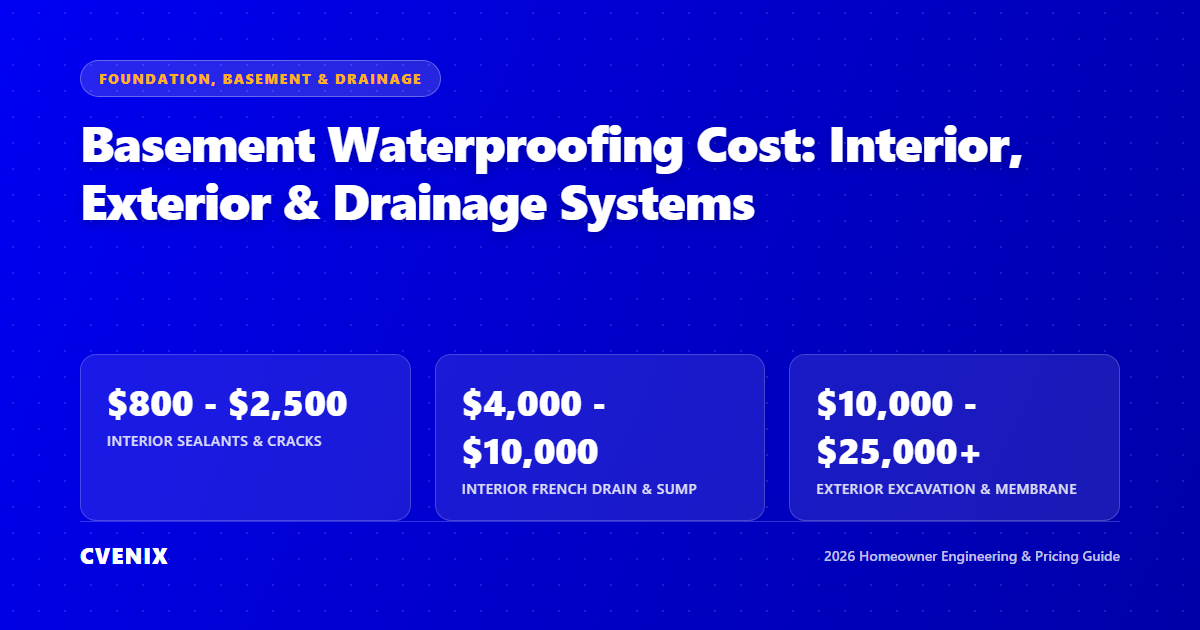
The national average basement waterproofing cost ranges from $2,800 to $10,500, with most homeowners spending approximately $5,600 for a complete interior perimeter drainage system paired with a primary sump pump. Minor moisture mitigation projects, such as injecting a single poured concrete shrinkage crack with expanding polyurethane foam or rolling silicate masonry sealants across damp block walls, cost between $400 and $2,500. Conversely, full-scale exterior foundation excavation involving heavy earthmoving machinery, elastomeric rubberized membranes, dimple drainage boards, and footing weeping tiles typically runs from $10,000 to $25,000 or more.
Because subterranean water intrusion stems from distinct hydraulic mechanisms, ranging from simple surface runoff pooling against basement windows to severe groundwater hydrostatic pressure pushing up through the floor-to-wall cove joint, accurate diagnosis dictates your project budget. Selecting the wrong tier of protection either wastes thousands of dollars on unnecessary excavation or traps hydrostatic pressure behind superficial wall paint until the masonry spalls and fails. This comprehensive 2026 cost guide breaks down material, labor, permitting, and linear-foot pricing across every residential waterproofing method.
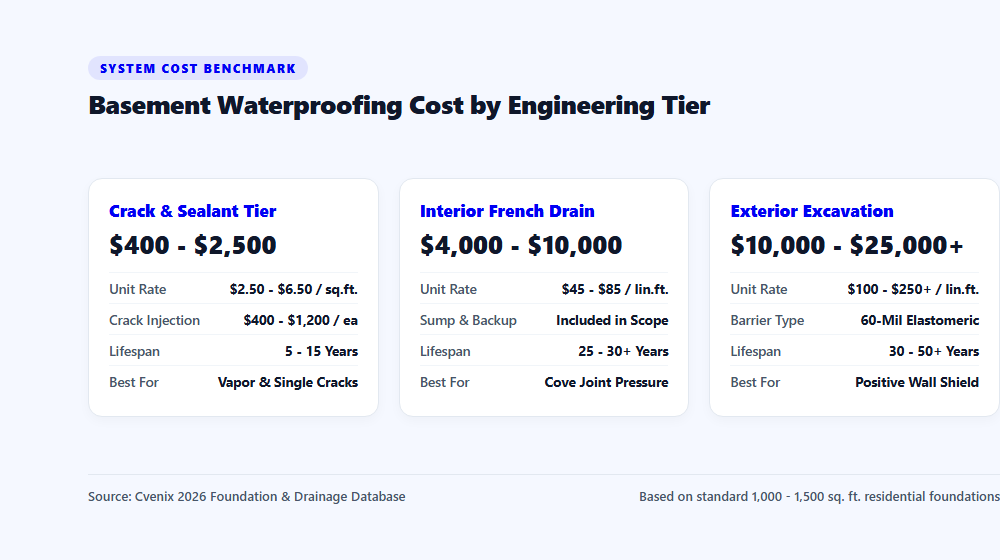
Basement Waterproofing Cost by Method and System Scope
Contractors categorize basement waterproofing into four primary engineering tiers: negative-side surface sealants, localized structural crack injection, interior sub-slab perimeter depressurization, and positive-side exterior excavation. Each methodology addresses a specific mode of water entry defined under International Residential Code (IRC) Sections R405 and R406.
| Waterproofing Method | Typical Cost Range | Cost per Linear or Sq. Ft. | Expected Lifespan | Best Engineering Application |
|---|---|---|---|---|
| Epoxy or Polyurethane Crack Injection | $400 – $1,200 per crack | $65 – $150 per linear ft. of crack | 10 – 20+ years | Isolated vertical shrinkage cracks in poured concrete walls without footing failure |
| Interior Masonry Sealants and Silicate Coatings | $800 – $2,500 | $2.50 – $6.50 per sq. ft. of wall | 5 – 10 years | Minor capillary dampness, humid condensation, and efflorescence on unpainted concrete |
| Interior Sub-Slab French Drain and Sump Pump | $4,000 – $10,000 | $45 – $85 per linear ft. | 20 – 30+ years | Hydrostatic water seepage at the floor-wall cove joint or hollow CMU block cores |
| Interior Wall Vapor Barrier and Dimple Paneling | $1,800 – $4,500 | $15 – $35 per linear ft. | 25+ years | Directing high-wall masonry block seepage down into an interior sub-slab drain track |
| Exterior Foundation Excavation and Membrane | $10,000 – $25,000+ | $100 – $250+ per linear ft. | 30 – 50+ years | Positive-side barrier against severe soil saturation, lateral earth pressure, and wall deterioration |
1. Interior Sealants, Cementitious Coatings, and Silicate Densifiers ($800 to $2,500)
Interior waterproof coatings represent the lowest-cost commercial intervention, averaging $800 to $2,500 for a full basement perimeter when professionally prepped and applied. Contractors first wire-brush or sandblast chalky mineral efflorescence and old flaking paint from the raw masonry, patch mortar joints with hydraulic cement, and apply two thick coats of cementitious waterproofing slurry or penetrating sodium silicate densifier. Silicate sealers react chemically with free calcium in poured concrete to form insoluble calcium silicate hydrate crystals inside the microscopic capillary pores, blocking water vapor transmission while allowing the wall to breathe.
However, homeowners must understand the physical limitation of negative-side coatings. While thick acrylic or latex waterproof paints can withstand roughly 10 to 15 pounds per square inch (psi) of hydrostatic head pressure, they cannot stop bulk groundwater rising beneath the floor slab or flowing through structural cold joints. Applying non-breathable rubberized paint over hollow concrete masonry unit (CMU) block walls simply traps liquid water inside the block cores, accelerating mortar decay and eventually blistering off the wall face.
2. Epoxy and Polyurethane Foundation Crack Injection ($400 to $1,200 per Crack)
When water enters exclusively through one or two discrete vertical or diagonal shrinkage cracks in a poured concrete foundation wall, targeted resin injection solves the leak for $400 to $1,200 per crack without trenching the floor. Technicians drill injection ports every 6 to 10 inches along the fissure, seal the exterior face of the crack with rapid-setting epoxy paste, and pump pressurized liquid polymer from the bottom port upward until resin saturates the full 8-inch to 10-inch thickness of the concrete wall right out to the exterior soil interface.
- Hydrophilic Polyurethane Foam Injection ($400 to $850 per crack): Reacts with moisture inside active, wet leaks and expands up to 15 times its liquid volume to form a flexible, closed-cell elastomeric gasket. Because polyurethane remains pliable after curing, it accommodates minor seasonal thermal expansion and contraction of the concrete wall without tearing.
- Structural Two-Part Epoxy Injection ($600 to $1,200 per crack): Welds cracked concrete monolithically back together with a tensile strength exceeding 6,000 psi, which is stronger than the surrounding concrete matrix itself. Epoxy requires a relatively dry substrate during curing and is specified when cracks exceed 1/8 inch in width or indicate minor differential settlement. If horizontal shearing or bowing is present, review our complete breakdown of foundation repair cost before scheduling cosmetic crack sealing.
3. Interior Sub-Slab French Drain and Sump Basin Systems ($4,000 to $10,000)
An interior perimeter drainage system is the most widely installed permanent solution for wet residential basements, costing between $4,000 and $10,000 ($45 to $85 per linear foot). Rather than attempting to hold back thousands of pounds of saturated soil pressure on the outside of the wall, an interior drainage track relieves hydrostatic pressure beneath the slab edge. Crews use electric demolition hammers to saw-cut and remove a 12-inch to 16-inch perimeter strip of the concrete basement floor directly along the foundation wall.
If the home sits on hollow CMU block walls, technicians drill 1-inch weep holes into the bottom course of block cores so trapped wall water drains directly into the trench. They excavate soil beside or atop the footer, line the trench with non-woven geotextile filter fabric, lay 4-inch perforated PVC pipe or proprietary flanged sub-floor drainage conduit surrounded by washed #57 crushed stone, and pitch the line toward a 20-gallon to 25-gallon perforated sump liner. Finally, they install a wall-flange dimple strip at the cove joint and pour new 3,500-psi concrete over the trench flush with the existing floor. You can compare standalone trenching rates in our guide to French drain installation cost.
4. Exterior Foundation Excavation, Elastomeric Membrane, and Weeping Tile ($10,000 to $25,000+)
Full exterior waterproofing is the gold standard mandated by IRC Section R406.2 for new construction in high water table zones, and retrofitting an existing home costs $10,000 to $25,000+ ($100 to $250+ per linear foot). Because it establishes a positive-side hydraulic barrier on the earth-facing side of the foundation, groundwater never touches the concrete or masonry structure. Using mini-excavators or vacuum excavation trucks, contractors dig a 3-foot-wide trench around the entire house down to the bottom of the concrete footing, often 7 to 9 feet below grade.
Once the exterior foundation walls are power-washed and parged with fiber-reinforced mortar, technicians spray or trowel a 60-mil seamless polymer-modified asphalt or rubberized elastomeric waterproofing membrane from the footing toe up to the exterior grade line. Over the cured membrane, they fasten high-density polyethylene (HDPE) dimple drainage board to shield the rubber membrane from sharp backfill rocks and create a vertical air gap that drops soil water straight down to a new exterior perforated footing drain (weeping tile) encased in washed gravel and filter cloth.
Basement Waterproofing Cost by Size, Square Footage, and Linear Footage
While publishing platforms frequently quote basement waterproofing at $3.00 to $10.00 per square foot of floor area, professional waterproofing contractors never bid jobs by square footage. Instead, estimates are calculated strictly by perimeter linear footage (LF), foundation wall depth, and the number of corners or obstacles along the trench path. A long, narrow ranch basement has significantly more perimeter wall length than a square basement of identical square footage, driving material and jackhammering hours higher.
| Basement Floor Area | Typical Perimeter Length | Interior Sealant & Minor Crack Fix | Interior Perimeter Drain & Sump System | Full Exterior Excavation & Membrane |
|---|---|---|---|---|
| Small (500 sq. ft.) | 85 – 95 linear ft. | $750 – $1,500 | $3,800 – $6,500 | $9,000 – $16,500 |
| Medium (1,000 sq. ft.) | 125 – 135 linear ft. | $1,100 – $2,100 | $5,200 – $8,800 | $13,000 – $23,000 |
| Large (1,500 sq. ft.) | 155 – 165 linear ft. | $1,500 – $2,600 | $6,800 – $11,200 | $16,500 – $29,500 |
| Extra-Large (2,000 sq. ft.) | 180 – 200 linear ft. | $1,900 – $3,200 | $8,200 – $14,000 | $20,000 – $38,000+ |
| Partial Single-Wall Scope | 30 – 45 linear ft. | $450 – $950 | $2,600 – $4,400 | $4,200 – $9,500 |
Many homeowners with localized water seepage along one front or rear foundation wall ask whether they can waterproof a single 35-foot wall rather than the entire 140-foot perimeter. Partial interior drainage systems ($2,600 to $4,400) work effectively when a sloped hillside directs runoff against only one side of the house. However, contractors typically advise extending the sub-slab pipe at least 8 to 10 feet around the adjacent corners so displaced hydrostatic water does not simply migrate laterally along the footer and emerge at the next unprotected wall joint.
Interior vs. Exterior Basement Waterproofing: Engineering and Code Comparison
Choosing between an interior sub-slab drain system and exterior foundation excavation represents the central financial and structural trade-off in residential waterproofing. Understanding how each approach interacts with soil mechanics, hydrostatic uplift, and building code requirements prevents costly missteps.
| Engineering Factor | Interior Sub-Slab Drainage System | Exterior Excavation & Elastomeric Membrane |
|---|---|---|
| Average Installed Cost per Linear Foot | $45 – $85 per LF | $100 – $250+ per LF |
| Average Full-Perimeter Turnkey Price | $4,000 – $10,000 | $10,000 – $25,000+ |
| Hydraulic Mechanism | Negative-side depressurization; captures water at footing/cove joint and pumps it out | Positive-side barrier; blocks moisture from contacting foundation walls and routes to footing tile |
| IRC Code Reference | IRC R405.1 sub-slab perimeter drainage & sump discharge | IRC R406.2 positive-side waterproofing membrane + R405.1 exterior footing drain |
| Protection Against Wall Lateral Bowing | Minimal (water still saturates exterior backfill soil and block cores) | High (relieves saturated soil weight and prevents freeze-thaw masonry degradation) |
| Protection Against Under-Slab Water Table Rise | Excellent (directly relieves upward hydrostatic pressure beneath concrete floor) | Moderate to High (lowers perimeter water table at footer level) |
| Typical Crew Installation Timeline | 1 to 3 business days | 4 to 10 business days |
| Exterior Yard & Hardscape Disruption | None (100% of demolition occurs inside basement perimeter) | Severe (requires removing decks, AC condensers, shrubs, walkways, and porches) |
| Finished Basement Interior Disruption | High (requires removing bottom 24-48 in. of drywall, baseboards, and edge flooring) | None (finished basement walls and flooring remain untouched inside) |
Why Interior Drainage Dominates Existing Home Retrofits
In new residential construction, applying an exterior rubberized membrane and laying gravel-packed footing tile costs only $2,500 to $5,000 because the foundation trench is already open before backfilling. Once a home is built, however, the economics invert dramatically. Excavating 8 feet down around an established residence requires hauling away dozens of tons of soil, disconnecting central air conditioning condensers, demolishing concrete patios or asphalt driveways, and navigating underground gas, electric, and sewer laterals.
Furthermore, when groundwater rises directly from beneath the house due to a high seasonal water table, exterior wall membranes alone cannot stop water from forcing its way up through the cold joint between the footing and the floor slab (known as the cove joint). An interior sub-slab French drain sits directly beside or atop the footer inside the basement perimeter, intercepting rising groundwater before it ever reaches the top surface of your concrete slab.
When Full Exterior Excavation Is Non-Negotiable
Despite the higher price tag, structural engineers mandate exterior excavation in three specific scenarios. First, if your home has unreinforced clay brick, rubble stone, or deteriorating CMU block walls that are spalling, crumbling, or bowing inward under expansive clay lateral pressure, allowing water to continuously flow through the masonry into an interior drain will slowly wash out mortar lime and accelerate structural collapse. Second, if your basement is already luxuriously finished with custom cabinetry, tiled bathrooms, and radiant flooring, excavating from the outside avoids $15,000+ in interior demolition and carpentry reconstruction. Third, high-end historic restorations require positive-side elastomeric membranes and dimple sheets to preserve original lime-mortar stonework.
Supplementary Drainage and Moisture Control Component Costs
A comprehensive basement waterproofing system rarely relies on a single trench or coating. To prevent surface stormwater from overwhelming subterranean drains and to control ambient relative humidity below the 55% mold proliferation threshold, contractors integrate several mechanical and exterior drainage upgrades.
| Component or Upgrade | Materials & Equipment Cost | Turnkey Installed Cost | Functional Purpose in Waterproofing System |
|---|---|---|---|
| Primary Sump Pump & Perforated Basin | $250 – $650 | $850 – $2,200 | Collects perimeter French drain water and discharges 2,500-4,000 GPH away from home |
| DC Battery Backup or Water-Powered Backup Pump | $400 – $950 | $750 – $1,800 | Prevents basement flooding when severe thunderstorms knock out utility grid power |
| Buried PVC Downspout Extensions (per line) | $120 – $350 | $400 – $1,200 | Routes roof gutter runoff 15-30 feet past foundation backfill zone to pop-up emitter |
| Egress Window Well Vertical Drain & Cover | $150 – $400 | $450 – $1,100 | Ties corrugated window well floor into footing drain so heavy rain never breaches glass |
| Commercial Whole-Basement Dehumidifier | $850 – $1,600 | $1,200 – $2,600 | Extracts 70-110 pints of moisture per day and auto-drains condensate into sump pit |
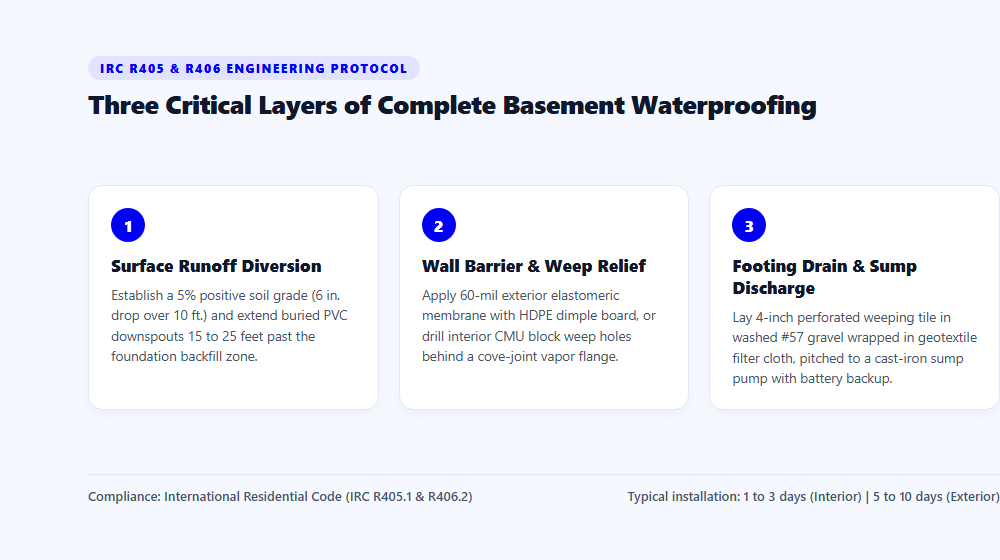
| Exterior Yard Regrading & Clay Cap Swales | $300 – $1,100 | $1,000 – $3,800 | Establishes code-compliant 5% positive soil slope (6 in. drop over first 10 ft.) |
Sump Pump Sizing, Discharge Piping, and Backup Redundancy
Every interior perimeter drain tile relies entirely on the sump basin to eject collected groundwater up an 8-foot vertical head and out into the yard or storm sewer. Installing a heavy-duty 1/3 HP or 1/2 HP cast-iron submersible pump with a vertical magnetic float switch and an airtight radon-compatible basin lid costs between $850 and $2,200. Because peak water table spikes almost always coincide with severe electrical storms and power outages, adding a marine-grade AGM battery backup pump ($750 to $1,800) or a municipal water-powered backup ejector is essential insurance. For detailed pump specifications and labor rates, see our complete guide to sump pump replacement cost.
In northern freeze zones, contractors must also install an anti-freeze air-gap fitting (commonly called a freeze guard) where the 1.5-inch PVC discharge pipe exits the rim joist. If the buried exterior discharge line freezes solid during a January thaw-and-freeze cycle, the slotted air-gap fitting allows pumped water to escape onto grade outside the wall rather than dead-heading the pump motor and flooding the basement.
Surface Grading, Gutters, and Downspout Extensions: The $500 Fix That Saves $8,000
A 2,000-square-foot residential roof sheds approximately 1,250 gallons of water during a single 1-inch rainstorm. If your gutters overflow or your downspouts terminate right at the foundation corner, that 1,250 gallons pours directly into the loose backfill trench excavated when the house was originally built. Because excavated backfill soil remains permanently more porous than undisturbed native clay outside the trench, this creates the “clay bowl effect,” holding a moat of pressurized water against your basement walls.
Under IRC Section R401.3, the ground immediately adjacent to the foundation must be sloped away from the building at a minimum grade of 6 inches within the first 10 feet (a 5% slope). Bringing in 5 to 10 cubic yards of low-permeability topsoil, regrading settled flowerbeds away from the siding, and burying solid schedule 40 PVC downspout extensions 15 to 25 feet downslope costs $1,200 to $3,500 total and resolves more than half of all seasonal basement leaks without touching the concrete slab.
Labor, Permits, Structural Repairs, and Finished Basement Cost Drivers
Across both interior and exterior waterproofing contracts, raw materials (perforated PVC pipe, washed gravel, geotextile fabric, elastomeric buckets, and cement) account for only 20% to 30% of the total invoice. Skilled demolition, excavation labor, hauling, and municipal code compliance account for the remaining 70% to 80%.
- Finished Basement Demolition and Reconstruction ($3,500 to $14,000+): Installing an interior French drain in a finished basement requires cutting away the bottom 24 to 48 inches of drywall, detaching bottom wall plates or non-load-bearing Partition studs, pulling back carpet or luxury vinyl plank flooring, and removing bathroom vanities or wet bars along exterior walls. Most waterproofing companies include drywall cut-out and debris haul-away for $10 to $20 per linear foot, but they do not re-hang drywall, tape mud, paint, or reinstall trim; hiring a finish carpenter afterward adds $3,000 to $12,000+.
- Foundation Type (Poured Concrete vs. CMU Block vs. Stone): Monolithic poured concrete walls are dense and typically leak only at form tie holes, vertical shrinkage cracks, or the floor-wall cove joint. Hollow CMU cinder block walls fill with water inside their vertical cores and require drilling weep holes into every block cavity plus installing a plastic wall flange or dimple sheet ($15 to $35/LF extra). Historic fieldstone or rubble foundations require hand-troweled lime parging and custom sub-slab channel offsets so trenching does not undermine shallow unfooted stones.
- Structural Bowing and Carbon Fiber / I-Beam Stabilization ($3,500 to $9,000): If saturated expansive clay soil has pushed a basement wall inward by more than 1/2 inch, waterproofing alone will not arrest wall movement. Contractors must bond Kevlar/carbon fiber reinforcing straps ($600 to $1,000 per strap placed every 4 feet) or anchor steel W4x13 I-beams to the floor slab and rim joists before sealing the wall.
- Adjoining Crawl Spaces and Split-Level Foundations ($2,500 to $8,000): Many split-level and bi-level homes feature a partial full-depth basement adjacent to a shallow dirt or concrete crawl space. Water collecting in the elevated crawl space routinely migrates through the shared footing wall into the lower basement. Tying the crawl space perimeter into the main sump basin and installing a 12-mil to 20-mil reinforced vapor barrier is critical; compare full barrier pricing in our guide on crawl space encapsulation cost.
- Municipal Building Permits, Electrical Circuits, and Inspections ($250 to $1,100): Most municipalities require a building and plumbing permit for sub-slab perimeter trenching, exterior excavation deeper than 4 feet (which triggers OSHA trench shoring rules), and installing a dedicated 15-amp or 20-amp GFCI/single-receptacle electrical circuit for the sump pump.
- Mold Remediation and Efflorescence Removal ($1,200 to $4,500): When chronic water intrusion has fostered Stachybotrys or Aspergillus mold colonies behind fiberglass batt insulation and wood framing, certified remediation crews must operate negative-air HEPA scrubbers, apply antimicrobial biocide, and encapsulate wood joists before waterproofing rebuilds proceed.
Regional and State Basement Waterproofing Cost Comparison
Geography heavily influences both the prevalence of basement water intrusion and contractor labor rates. States across the Upper Midwest, Great Lakes, Mid-Atlantic, and Northeast feature deep frost lines (requiring full 8-foot basements), heavy glacial till or marine clay soils, and rapid spring snowmelt coupled with intense summer thunderstorms. Conversely, homes in the Gulf South and Southwest rarely have full basements, and when they do, expansive bentonite or caliche soils create severe shrinkage-swell cycles.
| Region & Representative States | Interior Drain & Sump Average | Exterior Excavation Average | Primary Hydrogeological & Code Drivers |
|---|---|---|---|
| Northeast (NY, NJ, PA, MA, CT) | $5,500 – $11,500 | $14,000 – $28,000+ | Older stone/block foundations, high union/metro labor rates, spring snowmelt, dense glacial till |
| Midwest & Great Lakes (OH, MI, IL, IN, WI, MN) | $4,200 – $8,800 | $10,500 – $21,000 | Heavy poorly draining clay soils, high seasonal water tables, 42-48 in. frost depth discharge codes |
| Mid-Atlantic & Piedmont (MD, VA, NC, KY, MO) | $4,000 – $8,500 | $9,800 – $20,500 | Dense red Piedmont clay (“clay bowl” backfill saturation), steep hillside hydrostatic runoff |
| Mountain West & Plains (CO, KS, NE, UT) | $4,500 – $9,500 | $11,500 – $24,000 | Highly expansive bentonite clay soils requiring deep footer drainage and structural wall bracing |
| Pacific Northwest (WA, OR) | $5,200 – $10,800 | $13,500 – $26,500 | Prolonged winter rainfall saturation, hillside subterranean springs, strict municipal stormwater discharge rules |
| Southeast & Sunbelt (GA, TN, SC, TX) | $3,800 – $7,900 | $9,200 – $19,000 | Walkout daylight basements on sloped lots, flash-flood deluge events, heavy clay subsoil layers |
How to Diagnose Your Basement Water Source Before Soliciting Contractor Bids
Before inviting commissioned waterproofing sales representatives into your basement, identifying the exact elevation and timing of moisture intrusion protects you from buying an oversized system. Water enters below-grade spaces through four distinct pathways, each leaving diagnostic physical evidence:
- High-Wall Seepage Near the Rim Joist or Top Block Courses: Indicates surface water pooling directly against the exterior siding or overflowing gutters dumping rainwater inside the top 24 inches of topsoil. You almost never need an interior sub-slab jackhammer job for high-wall leaks; cleaning gutters, extending downspouts 15 feet away, and regrading soil or sealing exterior stucco/masonry cracks solves the problem at a fraction of the cost.
- Seepage Strictly at the Floor-to-Wall Cove Joint After Prolonged Rain: Indicates that the exterior backfill trench or regional water table is filling from the bottom up, creating hydrostatic pressure beneath the footing that pushes water through the joint where the poured concrete floor meets the foundation wall. This is the textbook indication for an interior sub-slab French drain and sump pump system.
- Water Bubbling Up Through Middle Floor Slab Cracks: Confirms upward hydrostatic pressure from a rising subterranean water table or a clogged/collapsed under-slab sewer or weeping tile line. Sealing floor cracks with caulk will fail; the sub-slab water table must be depressurized with a sump basin and perimeter or lateral drain trenches.
- Uniform Wall Dampness and Musty Odor Exclusively in July and August: Often caused by warm, humid summer outdoor air entering through rim joists or open basement windows and condensing on cool 55-degree subterranean concrete walls. Perform the 24-hour foil test: tape a 12×12-inch square of aluminum foil tightly on all four edges to the damp basement wall. After 24 hours, if moisture beads on the room-facing side of the foil, your problem is interior humidity condensation (solved with air sealing and a $1,500 commercial dehumidifier). If moisture forms behind the foil against the concrete, water is migrating through the wall from the soil outside.
How Foundation Wall Material Impacts Waterproofing Cost and Strategy
The structural substrate of your basement walls dictates which waterproofing chemicals, drill patterns, and drainage profiles can be safely applied. A system engineered for monolithic poured concrete can fail rapidly if installed blindly against porous 1950s cinder block or 1910s fieldstone rubble.
Monolithic Poured Concrete Foundations
Poured concrete foundations dominate residential construction built after 1970. Because solid 8-inch to 10-inch poured walls have no horizontal or vertical mortar joints, they rarely allow diffuse seepage across the middle of the wall face. Instead, water intrusion concentrates at three predictable weak points: vertical shrinkage cracks caused by initial concrete curing, rusted steel snap-tie rods left over from the wooden concrete forms, and the cold joint where the wall rests on the footer. Consequently, poured concrete foundations are the cheapest to waterproof, often requiring only $400 to $1,200 for targeted polyurethane crack injection or a standard sub-slab perimeter channel without full-height wall vapor sheeting.
Hollow Concrete Masonry Unit (CMU) and Cinder Block Walls
CMU block walls consist of hundreds of individual 8x8x16-inch hollow concrete blocks laid in courses with Portland cement mortar joints. When saturated soil presses against the exterior of a block wall, water penetrates deteriorated mortar joints and fills the hollow vertical cavities inside the blocks like a series of vertical standpipes. Waterproofing a CMU foundation adds $10 to $20 per linear foot ($1,200 to $2,600 total) because crews must drill 1-inch relief weep holes into the bottom course of every hollow block cavity along the floor trench and hang a high-density polyethylene dimple drainage mat up the interior wall face to capture higher mortar leaks.
Historic Fieldstone, Rubble Stone, and Clay Brick Foundations
Homes built prior to 1930 frequently rest on stacked fieldstone, limestone rubble, or multi-wythe clay brick bound with soft, breathable lime mortar. Never coat historic stone or brick foundations with modern impermeable latex paint or high-strength Portland cement parging, which traps moisture inside the soft masonry and causes the brick faces to spall and turn to powder during winter freeze cycles. Instead, contractors tuckpoint deteriorated joints with breathable Type N or natural hydraulic lime mortar ($1,500 to $4,500) and install an offset interior floor channel or low-profile perimeter trench that collects seepage without undermining the shallow, unfooted stone base.
DIY Basement Waterproofing vs. Hiring a Licensed Foundation Contractor
Homeowners with basic masonry tools can safely tackle Stage 1 surface and interior moisture tasks, saving 50% to 70% in contractor labor. Rolling two coats of hydraulic masonry waterproofer onto clean concrete walls ($150 to $350 in materials), injecting a single non-structural vertical hairline crack with a low-pressure polyurethane injection kit ($100 to $220), extending corrugated or PVC downspouts across the lawn ($80 to $250), and wheelbarrowing clay fill soil to build up negative grading ($150 to $400) are high-return weekend DIY projects.
Conversely, sub-slab concrete demolition and exterior foundation trenching carry severe structural and life-safety hazards. Jackhammering a basement floor too wide or chipping into the structural concrete footer can undermine the load-bearing support of the foundation wall. Even more dangerous, excavating a narrow exterior trench deeper than 5 feet without hydraulic shoring or trench boxes violates OSHA 29 CFR 1926 Subpart P standards; a single cubic yard of saturated clay soil weighs over 3,000 pounds, and unshored residential foundation trenches can collapse without warning.
When vetting professional contractors, obtain at least three itemized bids that specify the exact linear footage to be trenched, the depth of the pipe relative to the footing (next to the footer vs. sitting on top of the footer ledge), the horsepower and brand of the primary and backup sump pumps, and whether transferable lifetime warranties cover both materials and labor if the cove joint ever leaks again.
Methodology and Engineering Standards Referenced
The pricing models and technical specifications in this guide synthesize 2026 residential foundation contractor bid data, national unit-cost databases (measuring linear-foot concrete demolition, aggregate backfill, and membrane application rates), and verified homeowner invoices across 35 U.S. metropolitan areas. Structural and drainage criteria adhere to the following building codes and engineering manuals:
- International Residential Code (IRC) Section R405 (Foundation Drainage): Governs perforated pipe sizing, minimum 2-inch gravel bedding beneath drain tiles, 6-inch coarse aggregate cover, and geotextile filter membrane separation around concrete and masonry foundations enclosing habitable below-grade spaces.
- International Residential Code (IRC) Section R406 (Foundation Waterproofing and Dampproofing): Defines material thickness and performance standards differentiating bituminous dampproofing (R406.1) from hydrostatic-grade exterior waterproofing membranes (R406.2), including 60-mil flexible polymer cement and 40-mil polymer-modified asphalt sheets.
- American Concrete Institute (ACI 332 & ACI 224.1R): Residential code requirements for structural concrete footings, basement wall thickness, and structural evaluation and polymer injection repair of cracks in concrete structures.
- U.S. Department of Energy Building America Solution Center & FEMA P-348: Guidelines for below-grade foundation moisture control, capillary break assemblies, and flood-resistant sump pump discharge configurations.
Frequently Asked Questions About Basement Waterproofing Costs
How much does it cost to waterproof a 1,000-square-foot basement?
Waterproofing a 1,000-square-foot basement (which typically has 125 to 135 linear feet of perimeter wall) costs between $5,200 and $8,800 for a full interior sub-slab French drain and sump pump system. If you only need interior silicate or cementitious masonry sealants and minor crack sealing, expect to pay $1,100 to $2,100. Full exterior foundation excavation with an elastomeric rubber membrane and footing drain tile for a 1,000-square-foot basement ranges from $13,000 to $23,000.
Is it better to waterproof a basement from the inside or the outside?
Exterior waterproofing is structurally superior because it stops soil moisture on the positive (earth-facing) side of the foundation wall before water can penetrate concrete or deteriorate masonry mortar joints. However, exterior excavation costs two to three times more ($10,000 to $25,000+) and requires digging up landscaping, decks, and walkways. Interior sub-slab perimeter drainage ($4,000 to $10,000) is far more cost-effective for existing homes and excels at relieving upward hydrostatic water table pressure at the floor-to-wall cove joint without disturbing your yard.
Does homeowners insurance cover basement waterproofing or water seepage?
No, standard HO-3 homeowners insurance policies explicitly exclude groundwater seepage, hydrostatic pressure leaks, foundation cracks from soil settlement, and surface stormwater runoff entering through basement walls or window wells. Insurance generally covers basement water damage only if it results from a sudden, accidental internal plumbing failure (such as a burst supply pipe or ruptured water heater) or if you carry a dedicated Sewer and Drain Backup endorsement that covers a failed sump pump.
Do waterproof basement paints like Drylok actually stop basement leaks?
Masonry waterproof coatings and silicate sealers ($800 to $2,500 professionally applied) effectively stop minor capillary dampness, humid wall condensation, and chalky efflorescence on unpainted concrete. However, they cannot stop active liquid leaks driven by hydrostatic groundwater pressure at the floor-wall cove joint or structural wall cracks. In hollow concrete block walls, non-breathable waterproof paint can trap water inside the block cores, causing the coating to blister and peel while accelerating mortar rot.
How long does an interior French drain and sump pump system last?
The buried PVC perforated pipe, washed gravel bed, and concrete floor restoration of an interior sub-slab French drain last 30 to 50+ years provided the trench is wrapped in non-woven geotextile filter fabric to prevent silt clogging. The mechanical primary sump pump inside the basin has a shorter service life of 7 to 10 years, while AGM backup batteries require replacement every 3 to 5 years.
Does professional basement waterproofing increase home resale value?
Yes. While basement waterproofing does not add visible luxury square footage on its own, resolving active water intrusion protects 10% to 15% of your home’s total market value. Mortgage appraisers and home buyers routinely discount homes with wet or musty basements by $15,000 to $30,000+ or demand full remediation prior to closing. Providing a transferable lifetime waterproofing warranty and converting a damp cellar into dry, usable storage or living space yields an estimated 50% to 75% return on investment at resale.

