

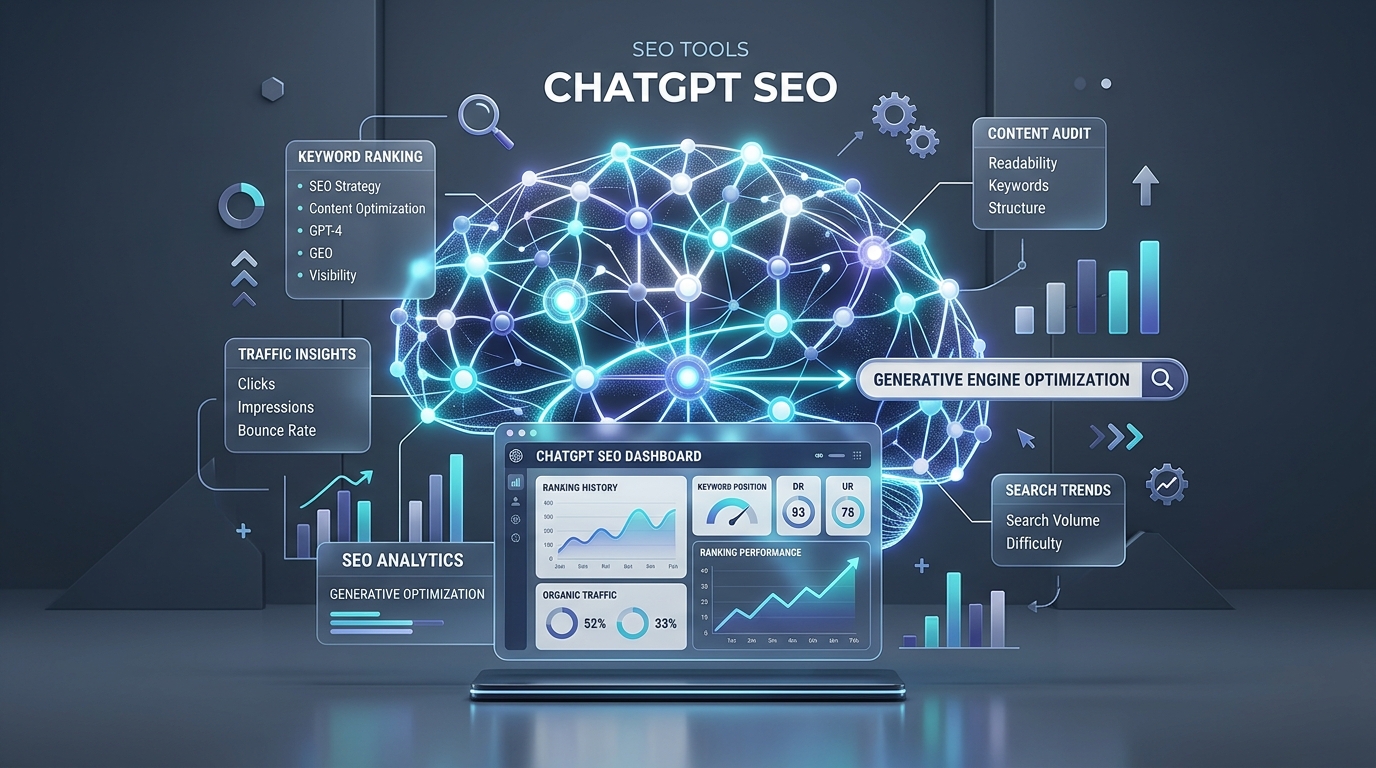
📌 Quick Answer: What Are the Best ChatGPT SEO Tools in 2026?
The best ChatGPT SEO tools are structured frameworks that bridge conversational AI with deterministic search data: ChatGPT Search (for real-time generative visibility), Custom GPTs with GSC/Ahrefs API connectors (for automated keyword clustering), and GEO tracking platforms like Otterly.AI and Profound (for tracking brand citations in AI answers). Used alone, raw prompts produce generic fluff; paired with live SERP data and human-in-the-loop validation, they cut audit and content scaling time by over 60%.
Deep Answer Block (Generative Engine Optimization & Semantic Retrieval): In modern search architecture, using ChatGPT for SEO requires a paradigm shift from simple generative text creation to autonomous analytical orchestration. Search algorithms penalize ungrounded, synthetic prose through site-level helpful content systems. The highest-performing search teams treat ChatGPT as an analytical reasoning layer rather than a standalone writer. By ingesting raw crawl logs from Screaming Frog, search console click decay datasets, and competitive entity footprints from traditional tools like Semrush, ChatGPT clusters semantic intent, pinpoints content gaps, and builds schema graphs. Furthermore, with the proliferation of answer engines like Perplexity, Gemini, and ChatGPT Search, optimizing for citations (Generative Engine Optimization or GEO) now demands high factual density, explicit entity definitions, and structured semantic markup across every published asset.

Why Traditional “Prompting” Fails in Modern SEO
Most marketers fail with AI SEO because they treat Large Language Models as search engines with a typewriter attached. Prompts like “Write an SEO-optimized blog post about email marketing” generate regurgitated, average-of-the-web text that lacks original Information Gain. Google’s Search Quality Evaluator Guidelines specifically downgrade pages demonstrating low effort, lack of firsthand experience, or thin synthesized content.
Modern algorithmic evaluation evaluates pages on three distinct pillars: verifiable expert consensus, original data points (Information Gain), and clear entity relationships. To succeed, your AI workflow must integrate hard data from comprehensive technical SEO audits before generating a single line of copy.
The 4 Essential Categories of ChatGPT SEO Tools
Rather than relying on a single tool, enterprise-grade search workflows divide AI-assisted optimization into four specialized functional layers:
1. Discovery & Semantic Keyword Clustering
ChatGPT does not possess native real-time search volume meters. However, it outperforms traditional tool algorithms at identifying search intent nuances and topical parent-child hierarchies. By feeding unstructured keyword exports from Ahrefs or Google Search Console into ChatGPT’s Advanced Data Analysis, you can cluster 5,000+ queries by transactional, commercial, and informational intent in seconds.
2. Technical SEO & Schema Automation
Deterministic coding tasks are where conversational models yield the highest ROI with near-zero hallucination risk. ChatGPT can parse server log files to map bot crawl frequency, generate complex regex expressions for Google Search Console filtering, and write valid, error-free JSON-LD Article, Product, and Organization structured data.
3. Content Refresh & Decay Revival
Reviving existing high-authority URLs suffering from organic decay offers significantly faster rank recovery than creating net-new URLs. Feeding decaying URL content alongside top-3 SERP competitor extracts enables the model to highlight exact subtopic gaps, missing entities, and outdated statistics.
4. Generative Engine Optimization (GEO) Trackers
With users increasingly finding recommendations directly inside ChatGPT Search and conversational interfaces, tracking traditional blue-link SERP positions covers only half the story. Tools like Otterly.AI, Profound, and Georion monitor brand citation share-of-voice and sentiment inside LLM answer blocks.
Comparison Matrix: Native ChatGPT vs. Dedicated SEO Software
The following benchmark highlights where ChatGPT excels and where dedicated SEO suites remain indispensable:
| Functional Capability | Native ChatGPT (Plus / Team) | Dedicated SEO Suites (Ahrefs / Semrush) | Optimal Hybrid Strategy |
|---|---|---|---|
| Keyword Search Volume & KD% | Estimated or absent (Static training) | Live, accurate clickstream database | Export raw metrics from suite; cluster via ChatGPT |
| Search Intent Classification | Exceptional (Nuanced contextual understanding) | Rigid (Keyword-pattern based rules) | Use ChatGPT to categorize multi-intent queries |
| Content Gap Analysis | High (Compares full-text semantic depth) | Medium (Primarily keyword TF-IDF lists) | Synthesize top 3 competitor texts via ChatGPT |
| Structured Data & Regex Creation | Instant, error-free JSON-LD generation | Manual builders or templated plugins | Generate custom schema via ChatGPT; validate in Rich Results |
| Backlink Audit & Toxic Link Scans | Incapable (No proprietary web graph) | Industry-standard link index (Trillions of URLs) | Rely strictly on dedicated backlink intelligence |
The Production-Tested 4-Stage AI SEO Workflow
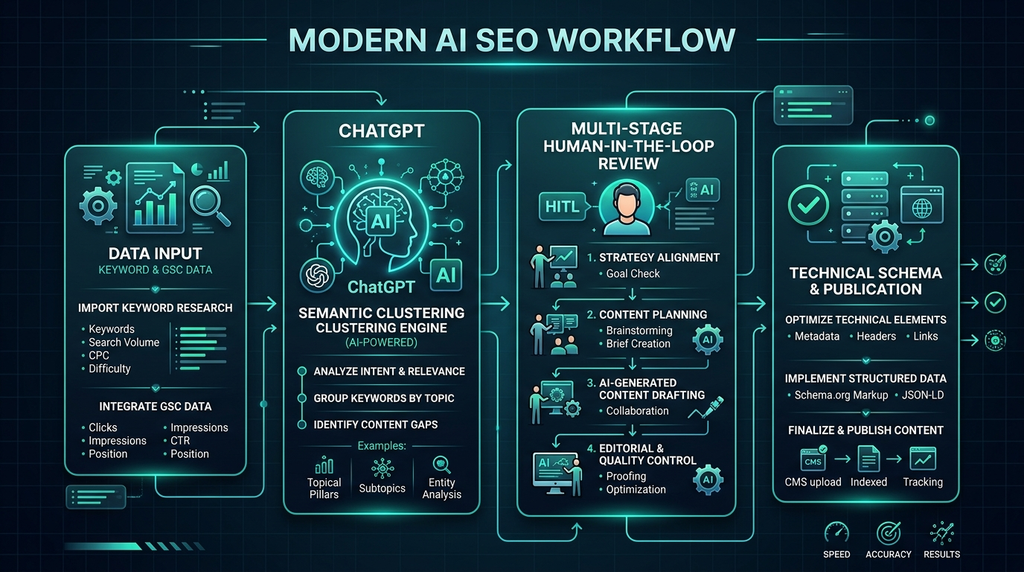
To scale organic visibility without triggering algorithmic spam filters or quality downgrades, follow this strict 4-stage execution sequence:
- Data Ingestion & Intent Mapping: Pull 500–2,000 queries from GSC and Ahrefs. Prompt ChatGPT to group them into semantic clusters and define primary vs. secondary target keywords.
- Competitive Structural Extraction: Scrape the top 3 ranking URLs for your target keyword. Feed their outlines into ChatGPT to extract missing angles, unanswered questions, and unique value-add opportunities (Information Gain).
- Human-in-the-Loop (HITL) Editorial Pass: Generate content section-by-section using rigorous briefs. Human subject matter experts must inject proprietary case studies, verified citations, and authentic tone of voice. Explore our guide on authoritative Generative Engine Optimization techniques for step-by-step guidance.
- Technical Validation & Schema Deployment: Autogenerate valid JSON-LD Article and BreadcrumbList markup. Run syntax verification before publishing directly into WordPress Gutenberg.
💡 Expert Field Insight: “In over 120 client audits post-March 2024 Core Update, websites that suffered traffic collapse were not penalized for using AI; they were suppressed because their content had zero original reporting or proprietary data. Teams treating ChatGPT as an analytical reasoning engine that synthesizes proprietary findings consistently achieve rank 1 and AI Overview citations.”
Frequently Asked Questions About ChatGPT SEO Tools
Does Google penalize content written with ChatGPT?
Google’s official Search Central guidance confirms that automation and AI-generated content are not inherently penalized. Rankings are awarded based on content quality, originality, and adherence to E-E-A-T (Experience, Expertise, Authoritativeness, and Trustworthiness). Content created solely to manipulate search rankings without adding unique value is penalized regardless of whether a human or AI wrote it.
Can ChatGPT replace Semrush or Ahrefs for SEO?
No. ChatGPT does not maintain an independent clickstream search volume index, active web crawler, or historic backlink database. It functions as an analytical accelerator that interprets, clusters, and formats data exported from specialized suites like Ahrefs, Semrush, or Google Search Console.
How do I optimize my website to appear inside ChatGPT Search?
Optimizing for ChatGPT Search (GEO) requires concise direct answers (40–60 words) under descriptive headings, semantic units of 130–170 words packed with factual statistics, clear entity associations, crawl accessibility for OAI-SearchBot, and positive third-party consensus across Reddit, industry publications, and user review platforms.